EPA to hold full-day meeting on PFAS in Bucks County


The agency will spend nearly 12
hours presenting information and listening to residents.

Kyle Bagenstose reports for the Bucks County Courier Times:

The Environmental Protection Agency released an agenda Thursday for its July 25 “community engagement” session in Horsham.
The agency announced the event last month, in which it will hear community concerns regarding local drinking water contaminated with perfluorinated chemicals, also known as PFAS. The agenda details a nearly 12-hour schedule for the event.
According to the EPA, the event will run as follows:

  • 9:30 a.m.: Registration

  • 10 a.m.: Welcome and PFAS National Leadership Summit Recap

  • 10:30 a.m.: EPA PFAS Research and Federal Panel on PFAS Activity in Pennsylvania

  • 11:30 a.m.: Lunch (not provided)

  • 12:15 p.m.: State panel on PFAS activity in the Mid-Atlantic

  • 1 p.m.: Local panel on PFAS activity in Pennsylvania

  • 2 p.m.: Community presentation

  • 2:30 p.m.: Wrap up of the working session

  • 2:45 p.m.: Break

  • 3:30-9 p.m.: Listening session

Read the full story

Like this? Click to receive free updates

EPA to hold full-day meeting on PFAS in Bucks County Read More »

Reporter compares NJ, D.C. approaches to plastic-bag fees

Michael Sol Warren reports for NJ.com


All eyes are on Gov. Phil Murphy.

Sitting on the Governor’s desk is a bill that would impose a statewide five-cent fee on single-use plastic and paper bags.

Supporters of the bill say that the fee will encourage consumers to use reusable bags and cut back on litter.

Opponents, however, believe that a fee will do little to stop the trashing of New Jersey, instead only serving as the latest environmental fund for legislators to raid in their yearly quest to balance the budget.


New Jersey would be the first state to have a statewide fee on single-use bags, but there is a precedent. Washington, D.C. has had a district-wide fee in place since 2010. Here’s what the Garden State can learn from the nation’s capital.


Reporter compares NJ, D.C. approaches to plastic-bag fees Read More »

Stung by snow critiques, JCP&L plans big grid upgrade

Utility, criticized by the governor for poor performance during winter storms, says it needs a rate increase to carry out thousands of improvements. Advocates fear consumers will pay more

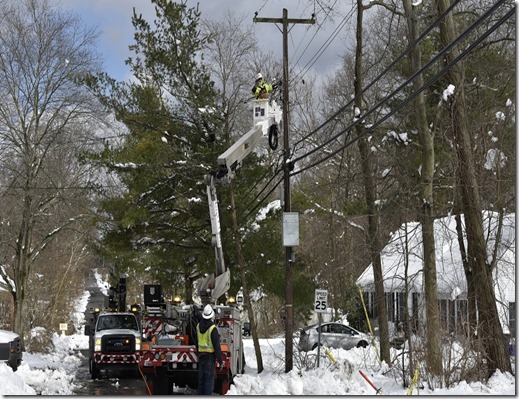
JCP&L crew doing snow repairs
JCP&L crew working to restore power after a winter snow storm
Tom Johnson reports for NJ Spotlight:

Jersey Central Power & Light is asking state regulators to approve a four-year, $400 million spending plan to upgrade its electric grid to buttress its reliability.

The request, filed with the New Jersey Board of Public Utilities last Friday, focuses on curbing the types of widespread outages that have plagued electric companies in New Jersey during extreme storm events in recent years.
JCP&L, the state’s second-largest utility, is the latest utility to seek approval for a rate increase to fund huge investments in modernizing an aging grid, a priority of New Jersey and policymakers across the nation.
In June, Public Service Electric & Gas filed a $2.5 billion, five-year investment program with the BPU to upgrade its electric and gas distribution systems. Atlantic City Electric, too, is seeking to spend $340 million over four years to modernize its power grid. At the same time, both PSE&G and ACE each has other separate rate cases pending before the agency.
These various rate cases are a concern to consumer advocates who fear that customers face spikes in their bills, particularly given recent laws signed by the governor that will ramp up the state’s reliance on clean energy as well as possibly asking ratepayers to subsidize nuclear power.

Read the full story 


Like this? Click to receive free updates

Stung by snow critiques, JCP&L plans big grid upgrade Read More »

Catch limits the sticking point in controversial fishing bill

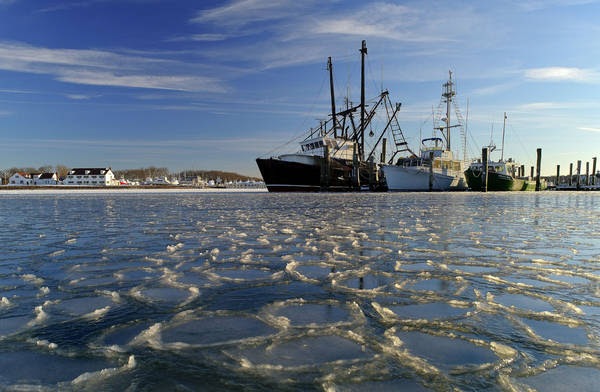
Surrounded by ice, commercial fishing boats are docked in their slips in Lake Montauk in Montauk, N.Y. earlier this year. (AP Photo/Julie Jacobson)

Surrounded by ice, commercial fishing boats are docked in their slips in Lake Montauk in Montauk, N.Y. earlier this year. (AP Photo/Julie Jacobson)
Recreational fishermen are applauding and environmental are decrying a proposed overhaul to a 1976 fishing law credited with regrowing fish populations off the nation’s coasts.

Dino Grandoni reports for the Washington Post:

Largely along a party-line vote, the House greenlit the measure seeking to amend what is known as the Magnuson-Stevens Act late last week.  Under the current law, regional councils delineate seasons and set catch limits for fishermen — all so fish stocks can be sustained from year to year.

The House bill seeks to cede more control to these local groups in developing recovery plans when populations dip too low. 

Rep. Don Young (R-Alaska), who sponsored both this recent bill and the original 1976 law, said the update ensures “a proper balance between the biological needs of fish stocks and the economic needs of fishermen.”

For example, when a species is deemed “overfished,” current law requires the regional councils to develop a plan to rebuild the population that often involves placing new short-term and, at times, financially painful catch limits on fishermen. The law requires the plans to try to resuscitate the fishery as quickly as possible — in 10 years or fewer.

Critics of the current system say that time requirement is too unyielding. Instead, the House bill gives councils, which are part of the Commerce Department’s National Marine Fisheries Service, the discretion to base the time frame on “the biology of the stock of fish.”

But many conservation groups and House Democrats said Young’s bill would gut the very fisheries law he helped author four decades ago which they say has proven successful at stymieing the once rampant overfishing of some fish populations.

“The bottom line with this Magnuson reauthorization is this: The law is working as intended,” Rep. Jared Huffman (D-Calif.), the top Democrat on the House Natural Resources subcommittee on oceans, said on the floor. “Reauthorization is important but it shouldn’t come at the expense of the law’s core provisions that have made it so successful.”

The Magnuson-Stevens Act was amended and reauthorized in 1996 and then again 10 years later, each time largely with bipartisan support. “What’s atypical is how partisan this has become,” said Meredith Moore, director of the fish conservation program at the Ocean Conservancy.

Speaking on the House floor, Young acknowledged how bitterly divided the chamber was over re-upping a relatively low-profile fisheries law.

“I know some of my colleagues will say I didn’t do enough to ensure the act retains a strong bipartisan nature,” Young said.

The longest-serving member of the House then recalled that his original bill passed committee in the 1970s with scant Democratic support.

In addition to dividing Democrats and Republicans, the legislation also reveals a divide between commercial and recreational fishermen.

The bill was commended by some regional seafood industry groups, who in a letter organized by the National Coalition for Fishing Communities last month lauded the bill for creating “flexibility without compromising conservation.” The bill is backed by many boating and sportsmen groups, too.

But business support is not universal. Some representatives of commercial fishers, including the Seafood Harvesters of America, oppose the legislation for holding hobbyist anglers to looser standards when compared to professional fishermen.

“Very simply,” said Christopher Brown, the organization’s president, “it erodes what has been working.”

As with so many pieces of legislation passed by the GOP-dominated House, the bill will have a tough time becoming law in its current form. Fifteen House Republicans voted against the measure. Republicans, who hold the Senate by a narrow 51-to-49 majority, have even fewer votes to spare there in the upper chamber.


Catch limits the sticking point in controversial fishing bill Read More »

Trump Tower, Trump Vodka, and now–Trump Asbestos?

As US officials decide against banning the product, producer Uralasbest puts Trump ‘seal of approval’ on pallets

donald trump

 Donald Trump’s Environmental Protection Agency recently decided not to ban new asbestos products
outright. Photograph: Isopix/Rex/Shutterstock

Oliver Milman reports from New York for The Guardian:
Donald Trump’s environmental policies may have caused controversy in the US but the president’s stance has managed to get him a literal stamp of approval from a Russian mining company.
Uralasbest, one of the world’s largest producers and sellers of asbestos, has taken to adorning pallets of its product with a seal of Trump’s face, along with the words “Approved by Donald Trump, 45th president of the United States”.
The move follows the US Environmental Protection Agency’s recent decision not to ban new asbestos products outright. The EPA said it would evaluate new uses of asbestos but environmental groups have criticized the agency for not going further by barring them on public health grounds.
In a Facebook post, Uralasbest published pictures of its Trump-adorned chrysotile asbestos, writing: “Donald is on our side!” The post thanks Trump for supporting Scott Pruitt, the recently departed head of the EPA, “who declared that his agency would no longer deal with matters related to side effects potentially caused by asbestos”. It adds that Trump called asbestos “100% safe after application”.
Uralasbest, which is located in the mining city of Asbest in the Ural Mountains, is reported to have close ties to Russian president Vladimir Putin, who Trump will meet for talks in Helsinki next week.
Asbest was once known as the “dying city” due to its high rate of lung cancer and other asbestos-related health problems.
“Vladimir Putin and Russia’s asbestos industry stand to prosper mightily as a result of the Trump administration’s failure to ban asbestos in the US,” said Ken Cook, president of the Environmental Working Group.
“Helping Putin and Russian oligarchs amass fortunes by selling a product that kills thousands each year should never be the role of a US president or the EPA, but this is the Trump administration.”
Asbestos was once widely used in the US for insulation and roofing but is now classed by the federal government as a “known carcinogen” due to evidence that, when disturbed, asbestos fibers can become lodged in the lungs and cause mesothelioma, as well as cancers of the lung, larynx and ovary. According to the Centers for Disease Control and Prevention, around 2,500 Americans die from mesothelioma every year.
Trump, however, has previously voiced his support for asbestos, calling it “100% safe, once applied”, in his 1997 book The Art of the Comeback. In the same tome, Trump wrote: “I believe that the movement against asbestos was led by the mob, because it was often mob-related companies that would do the asbestos removal.”

Trump Tower, Trump Vodka, and now–Trump Asbestos? Read More »

PA Turnpike and Interstate 95 Are About to Be Connected

Car and sign courtesy of iStockphoto; Eisenhower courtesy of James Burke/The LIFE Picture Collection
/Getty Images. Illustration by Gluekit


After nearly 50 years, it’s the dawn of a new era for two of Pennsylvania’s busiest roads — and the end of a very
different one.

Don Steinberg reports for Philadelphia Magazine:

On June 29, 1956, President Dwight D. Eisenhower signed a bill allocating $25 billion in federal funds to build 41,000 miles of highways across America. Ike was in the hospital for stomach pain when he launched what we now call the Interstate Highway System.


Sinclair Weeks, Secretary of Commerce at the time, called it “the greatest public works program in the history of the world.” Author Phil Patton wrote in 1986 that the plan, which Congress approved with bipartisan support, was “the last program of the New Deal and the first space program.” Dan McNichol, who wrote a history of the interstate system and was a White House transportation adviser to George H.W. Bush, told me, “It is probably the single greatest physical model of American democracy.”

This fall, the original vision of Eisenhower’s grand interstate highway system will officially be finished, near a massage parlor and a cannabis dispensary in Bristol.

One day recently, standing atop one of the twin gigantic elevated arcs that will finally make I-95 continuous from Florida to Maine, on virgin concrete roadway not yet open to the public, Patrick Kelly took in the vista. Kelly is a project manager at Jacobs Engineering, the design management firm for the massive undertaking. It was his first time actually walking on the new highway connection.

“This has been 90 percent of my job for 13 years,” he said. “I’ve done 40 other projects, and you’re driving with your kids and you say, ‘Dad designed this road.’ But this is just — what a beast.”

Nearby, Mike Phillips, the project manager from the Pennsylvania Turnpike Commission, who tends to thousands of daily details on the job, seemed concerned that the new noise-reduction walls along the roadway and the concrete supports under it, called piers, were presenting an irresistible canvas to local graffiti taggers.

“We have a guy down here, his tag name is Super Fresh Outlaw,” Phillips explained, with a mix of exasperation and admiration. “I’m trying to find him through social media. I don’t even want to arrest him. I want to give him a job, so he stops painting our stuff.”

There are a lot of reasons why this $420 million highway project is a milestone — some of them practical, some historic, and some, if we can wax poetic, kind of symbolic. For starters, two of the Commonwealth’s busiest highways, the Pennsylvania Turnpike and Interstate 95, will be directly connected for the first time ever, after close to 50 years of crossing without touching.

The new connection also remedies another 50-year-old whoops. It makes I-95 unbroken — and, more importantly for this region, directly connects Philadelphia to New York. This hasn’t been the case before. For decades, I-95 has had a miles-long gap in central Jersey, bewildering motorists.

Your mileage may vary, but the new link could improve your commuting, your sightseeing, your interstate commerce. Amazon’s 600,000-square-foot warehouse, just over the river in Florence Township, New Jersey, will be easily accessible from 95. An economic impact study released in 2000 (this project has been cooking for a while) suggested that by improving connections to regional markets, cutting travel costs, and enhancing “office-market” attractiveness, Bucks County could get a $400 million boost in business sales and 3,000 new jobs by 2025. That’s not even factoring in the potential for graft, kickbacks and patronage.

Meanwhile, as the interstate-building era at least technically ends (by virtue of how long it’s taken, finishing off I-95 is the last eligible project to use federal Interstate Completion Funds), it’s an opportunity to pull over for a moment and contemplate this road we’ve been on.

PA Turnpike and Interstate 95 Are About to Be Connected Read More »