Federal report on climate change has grim warnings for NE

Bass River
Atlantic white cedars dying near the banks of the Bass River in New Jersey show wetland encroachment on forested areas. Credit: Ted Blanco/Climate Central.

There’s no sugarcoating the conclusions of this major document. It underlines threats to health and well-being in the Northeast

Tom Johnson reports for NJ Spotlight:

Heat waves, coastal flooding, warmer oceans, and rising sea levels threaten the Northeast region’s environmental and economic systems, jeopardizing the health and safety of its residents, according to the latest climate report by the federal government.
The grim report of more than 1,600 pages, concludes those events are already happening and likely will intensify in the future. The Fourth National Climate Assessment, produced by 13 federal agencies, was released this past Friday and for the first time detailed how climate change will affect specific regions around the country.


Its release, a couple of months after other recent studies on global warming, occurs at a time when states like New Jersey are moving aggressively to deal with climate change at the same time as the Trump administration is rolling back initiatives to reduce emissions from power plants and vehicles that contribute to global warming.
“This report makes it clear that climate change is not some problem in the distant future,’’ said Brenda Ekwurzel, director of climate science at the Union of Concerned Scientists and one of the authors of the report.
“It’s happening right now in every part of the country. When people see wildfires, hurricanes and heat waves they’re experiencing unlike anything they’ve seen before, there’s a reason for that, and it’s called climate change,’’ she said.
Look out: weather, air, water


For the Northeast, including New
Jersey, changing climate threatens the health and well-being of people through
more extreme weather, warmer temperatures and degradation of air and water
quality, the report said.

“These environmental changes are expected to lead to health-related impacts and costs, including additional deaths, emergency room visits and hospitalizations, and a lower quality of life,’’ according to the assessment. The effects likely will particularly impact the most disadvantaged populations in the Northeast.
The more densely populated and developed urban areas already tend to have higher temperatures than surrounding regions due to the urban heat-island effect. Projected increases in temperatures in the Northeast may result in approximately 650 additional premature deaths per year from extreme heat, the report said.
Climate change also threatens to reverse gains made in recent decades in air quality, particularly for ground-level ozone, or smog, according to the assessment. New Jersey has reduced ozone levels dramatically in recent years but has yet to achieve the national health quality standard for the pollutant, which increases respiratory ailments for the young and elderly.
Air quality also could suffer from more frequent and severe wildfires due to climate change. That is of particular concern in the Pinelands in southern New Jersey, a 1.1 million acre preserve considered one of the most combustible forests in the country.
Economic impacts at the coast
Warmer ocean temperatures and sea-level rise also could adversely affect the region’s coastal and oceanic economies — impacting recreation, fishing, and tourism by changes in marine ecosystems and the ability of coastal communities to adapt as climate risks increase, the report said. Some fish species already are moving northward because of higher ocean temperatures.
Rising sea levels and storm surge could result in up to $30 billion in property losses for coastal New Jersey and Delaware by 2100, according to some projections in the report. Many coastal communities will be transformed by the end of the century — even under the lowest scenarios of climate-change risk.

Federal report on climate change has grim warnings for NE Read More »
NJ enviros say ‘let’s wait and see’ on EPA truck emissions

David Matthau reports for New Jersey 101.5:

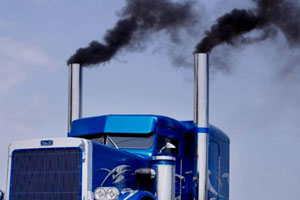
The U.S. Environmental Protection Agency has announced plans to decrease the amount of allowable nitrogen oxide pollution emissions that come from the engines of diesel and heavy-duty truck engines.

However, they haven’t indicated what the new allowable level will be.

Doug O’Malley, the director of Environment New Jersey, is expressing cautious optimism about the plan.

“The EPA has not updated these rules in more than 17 years. Our diesel trucks are still one of the largest sources of air pollution, especially in our cities. This is the pollutant that comes out of our cars, and certainly our trucks, that leads to smog,” he said.

“Obviously there’s a lot of trucks from out of state on the Turnpike, so we need to ensure that we have a strong-as-possible standard.”

O’Malley pointed out that up until now the Trump administration weakened environmental protections, not strengthened them.

“We want to see the ‘beef’ of this regulation; we want to make sure it’s for real, and we definitely want to make sure that states, whether they be New Jersey or California, can go above and beyond this federal standard,” he said.

He said states like New Jersey should be allowed to tighten diesel pollution emission because it is a major cause of air pollution that causes asthma and lung disease.

“Right now in New Jersey, especially in the summer months, we have way too many days that are unhealthy to breathe the air because of ozone,” he said.

Last summer, Environment New Jersey released a report showing New Jersey has more than 90 days a year when elevated pollution levels make breathing unhealthy.

The EPA isn’t expected to announce what kind of new emission standard it is proposing until the beginning of 2020.


NJ enviros say ‘let’s wait and see’ on EPA truck emissions Read More »

Pennsylvania planning to crank up its solar energy efforts

solar energy - NY Times photoTim Sylvia reports for pc magazine:Pennsylvania’s Department of Environmental Protection has announced a new RPS initiative aimed at increasing the state’s amount of deployed solar and job creation.The plan, dubbed “Pennsylvania’s Solar Future” is a strong starting point for a state that currently generates less than 1 percent of its electricity from solar resources.The plan itself is not one coherent guideline, but rather an aggregate of 15 recommended strategies. These strategies vary in the means by which solar would be developed, but disappointingly more than half of the strategies eye increasing development in either utility-scale or distributed systems, rather than both.The plan itself is not one coherent guideline, but rather an aggregate of 15 recommended strategies. These strategies vary in the means by which solar would be developed, but disappointingly more than half of the strategies eye increasing development in either utility-scale or distributed systems, rather than both.While the bright side remains that the plan may choose to use a strategy that utilizes both distributed and utility-scale solar, strategies that use both make up less than half of the total strategies contained in the plan. This type of potential one-or-the-other development is eerily similar to what has happened in Arizona, where utilities are more than happy to develop solar through massive projects, yet kick, scream and fight against the expansion of distributed solar in their service areas.Read the full storyLike this? Click to receive free updates

Pennsylvania planning to crank up its solar energy efforts Read More »

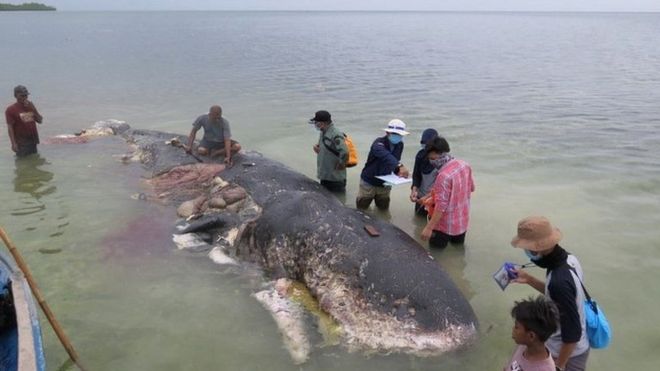
Dead sperm whale in Indonesia ingested 115 plastic cups

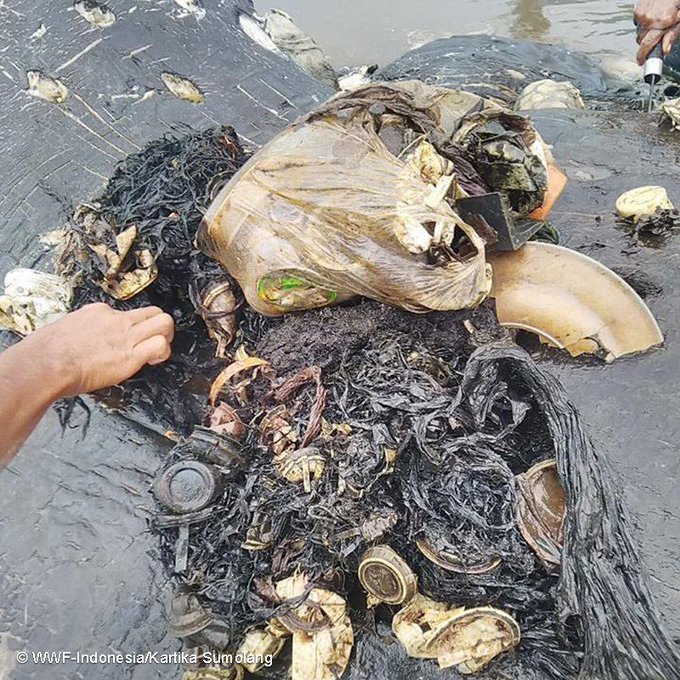
A stranded whale with plastic in its belly is seen in Wakatobi, south-east Sulawesi, Indonesia,19 November 2018 in this picture obtained from social mediaImage copyrightImage captionItems found inside the whale included drinking cups, plastic bottles, plastic bags and flip-flops

A dead sperm whale that washed ashore in a national park in Indonesia had nearly 6kg (13 lbs) of plastic waste in its stomach,
park officials say.
BBC News reports:
Items found included 115 drinking cups, four plastic bottles, 25 plastic bags and two flip-flops.
The carcass of the 9.5m (31ft) mammal was found in waters near Kapota Island in the Wakatobi National Park late on Monday.
The discovery has caused consternation among environmentalists.
“Although we have not been able to deduce the cause of death, the facts that we see are truly awful,” Dwi Suprapti, a marine species conservation co-ordinator at WWF Indonesia, was quoted as saying by the Associated Press.
It was not possible to say whether the plastic had caused the whale’s death because of its advanced state of decay, she added.
In a tweet, WWF Indonesia gave the breakdown of what was found inside the animal:
“Hard plastic (19 pieces, 140g), plastic bottles (4 pieces, 150g), plastic bags (25 pieces, 260g), flip-flops (2 pieces, 270g), pieces of string (3.26kg) & plastic cups (115 pieces, 750g).”

Dead sperm whale in Indonesia ingested 115 plastic cups Read More »

Philly doctors join national NRA debate over gun safety

The American College of Physicians in Philadelphia says caring for patients with gunshot wounds puts those in the medical profession on the front lines of dealing with gun violence. That's contrary to the National Rifle Association's position.  (dolgachov/BigStock)

The American College of Physicians in Philadelphia says caring for patients with gunshot wounds puts those in the medical profession on the front lines of dealing with gun violence. That’s contrary to the National Rifle Association’s position. (dolgachov/BigStock)

Nina Feldman reports for WHYY News:
As the director of orthopedic trauma at Penn Medicine, Dr. Samir Mehta treats a lot of gunshot victims. He doesn’t always see them in a crisis setting, like an ER doctor would, but he’s dealing with the long-term impacts. One of his patients, who was shot trying to break up a dispute over traffic, suffered a spinal cord injury and paralysis. He will likely enter hospice care soon.
Along with thousands of doctors across the country, Mehta said caring for patients like these puts those in the medical profession on the front lines of dealing with gun violence.
To assert that position, doctors have taken to social media recently in response to a tweet from the National Rifle Association that demanded doctors stop speaking out about gun control and “stay in their lane.”
Thousands of doctors reacted to the tweet, describing their experiences treating patients with gunshot injuries, and maintaining that the topic is, in fact, very much in their lane. Now, the Philadelphia-based American College of Physicians has issued a statement affirming the role of doctors in treating gun violence as a public health crisis.
Mehta says that, if his patient’s injury had been caused by say, bacteria, the public would demand that doctors know how such an illness could have been prevented.
“We could have given him an antibiotic, or we could’ve prevented disease, or we could’ve given a vaccination,” Mehta hypothesized. “But when we say that about guns, then it’s a different conversation.”

A dearth of research

The debate between doctors and the NRA unfolded online in the interim between the shooting at the Tree of Life Synagogue in Pittsburgh and the subsequent shooting at the Thousand Oaks bar. The timing inevitably  politicized the debate and framed it as a Second Amendment issue, but Mehta and the American College of Physicians both say that their principal concern is supporting research that will lead to evidence-based practices for doctors to help prevent gunshot injury.
“We’re not anti-gun, we’re anti gun injury,” said Dr. Christine Laine, an internist at Thomas Jefferson University Hospital and the co-author of the ACP editorial.

Read the full story

Like this? Click to receive free updates

Philly doctors join national NRA debate over gun safety Read More »

NYDEC awards $2.24 M in Urban Forestry Grants

Funding Supports Tree Plantings and Projects to Protect Air Quality, Water Quality, and Natural Resources

New York State Department of Environmental Conservation (DEC) Commissioner Basil Seggos today announced $2.24 million in grants for urban forestry projects to protect air quality, water quality and natural resources across the state. 
The grants are part of DEC’s Urban and Community Forestry Program, which helps communities develop and implement comprehensive tree planting, management, maintenance, and education to create healthy forests while enhancing the quality of life for residents.
“Continued investments in New York’s urban forestry programs promote clean air, clean water, energy savings, and habitat creation,” said Commissioner Seggos.“Thanks to Governor Cuomo, funding for these grants was made available through the State’s Environmental Protection Fund, providing crucial assistance for communities to manage their forests, particularly trees lost to the invasive emerald ash borer.”
The 54 projects to receive funding were selected from a total of 115 applications, ranked by cost-effectiveness, lasting benefits, use of partnerships, and support from local stakeholders. The urban forestry grants complement DEC’s ongoing initiatives to address invasive species, climate change, environmental degradation, environmental justice, and urban sprawl. Over the last seven years, New York State has funded more than $9.2 million in grants to support projects with a total value of more than $16 million.

NYDEC awards $2.24 M in Urban Forestry Grants Read More »