Here’s some good news for all you lighthouse fans


Chris Franklin reports for NJ.com

The second oldest lighthouse in the state — dangerously exposed to elements along the Delaware Bay —  received some help by way of a nonprofit organization. And it was just in time for National Lighthouse Day.

The
New Jersey Conservation Foundation recently sold 8.8 acres of land to the state’s Department of Environmental Protection to provide additional access and protection for the lighthouse, which is more than 150 years old.

The land will become part of the Heislerville Wildlife Management Area, which is where the lighthouse is located, adjacent to the Delaware Bay in Maurice River. The sale price was a “bargain” price of $8,668, according to the foundation.

“East Point Lighthouse is a valuable cultural resource, and we are grateful to the New Jersey Conservation Foundation for partnering with the NJDEP as we explore long-term solutions that will protect the structure,” NJDEP Assistant Commissioner for Natural and Historic Resources Ray Bukowski said in a statement.

The lighthouse, built in 1849, 
has survived a fire, but weather-related issues from a number of storms in recent years have caused a significant amount of erosion. State, county, township and lighthouse officials are looking at ways to protect the lighthouse from damage and to keep the lighthouse open for years to come.

Here’s some good news for all you lighthouse fans Read More »

Will third roll pay off for wind energy off Atlantic City?

Turned down twice for being too costly, small clean-energy project is proposed once again for three miles off Jersey Shore

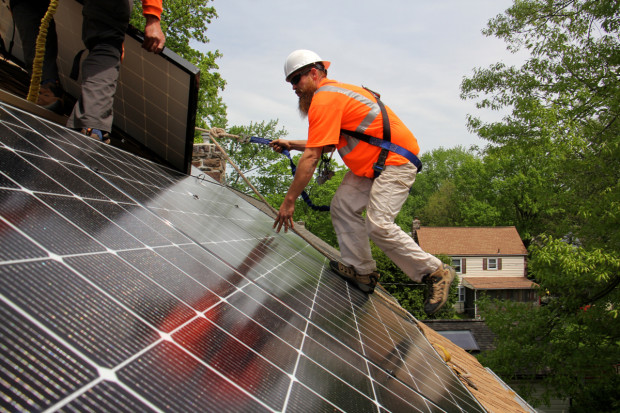
Wind power worker

Tom Johnson reports
for NJ Spotlight:


Once again, the state is being asked to approve a small offshore-wind pilot project a few miles from Atlantic City.
In an application submitted last week, the New Jersey Board of Public Utilities is being asked to authorize a 25-megawatt demonstration project about three miles offshore of the resort town, a version of the project the state agency rejected as too costly on two previous occasions.
The latest proposal, submitted by EDF Renewables North America and Fishermen’s Energy, is vying to become the first offshore-wind farm in New Jersey, a project that would provide insight to the state as it moves to develop the nation’s largest offshore-wind industry.
The Murphy administration has committed to building 3,500 megawatts of offshore-wind capacity, the most aggressive goal of any state, and the proposal, dubbed the Nautilus Offshore Wind Project, could give a jump start to those efforts.
The application shows substantial net benefits to the state at low cost to New Jersey electric consumers — who will bear the costs — according to a press release issued by the developers, EDF Renewables North America and Fishermen’s Energy.

Cost of ‘a small cup of coffee’ for ratepayers

But Doug Copeland, regional development manager for EDF, declined to say what the project will cost overall nor its specific impact on ratepayers. “We are estimating it will cost a small cup of coffee,’’ he said.
Under legislation Gov. Phil Murphy signed into law earlier this spring, the BPU has 90 days to review the project. If it’s approved within that time, the developer will qualify for a more lucrative investment tax credit of 18 percent, according to Copeland. Offshore-wind developers hoping to build farther offshore hope to qualify for a 12 percent investment tax credit if they win approval next year.
The pilot proposal has long been pushed by lawmakers and some environmentalists as a demonstration of the benefits to the state of local investment, job opportunities, and offshore-wind development.
But with other large new offshore-wind projects vying to build off the coast, some clean-energy advocates argue a pilot is no longer necessary given the offshore-wind farms long operating off the coasts of Europe and elsewhere, as well as the first project in the U.S. near Block Island.

Will third roll pay off for wind energy off Atlantic City? Read More »

Which NJ counties have preserved the most farmland?

Bill Gallo reports for NJ.com:

There’s one sure-fire way to slow development in New Jersey — saving the land we have left.

A few counties in New Jersey figured that out early on and have made a mission out of preserving farmland. Between July 1,
2017 and June 30, 2018, our state saw more than 5,800 acres of farmland saved from future development.

According to the New Jersey State Agriculture Development Committee, the state’s total of preserved farmland had risen to 232,500 acres by June 30, 2018. 

Through its program, the state buys the development rights for the farmland from the owner.

Five counties saw no additional acres go into the preservation program in the last fiscal year. Those counties were Passaic, Bergen, Camden, Ocean,
and Atlantic.

Which NJ counties have preserved the most farmland? Read More »

Will FERC ruling strangle New Jersey’s clean-energy plans?

A ruling by Federal Energy Regulatory Commission that state subsidies of nuclear and renewable energy are ‘unjust and unreasonable’ could unravel a range of NJ energy initiatives

Tom Johnson reports for NJ Spotlight:

With two new laws this spring promoting nuclear and clean energy the Murphy administration moved aggressively to combat climate change, but a decision by a federal agency may end up thwarting those policies.

The action by the Federal Energy Regulatory Commission this past June could have huge implications for how much customers pay for electricity to power their homes and businesses, and undermine state policies aimed at reducing greenhouse gas emissions.
In New Jersey, the state Board of Public Utilities last week asked FERC to reconsider the decision, a step also requested by the operator of the nation’s largest power grid, some of the biggest energy companies in the nation, as well as a coalition of the most prominent environmental organizations.
The long-running dispute revolves around what power suppliers are paid for providing extra capacity in reserve to supply electricity to the grid when energy demand peaks. State policies that provide incentives to nuclear plants and renewable energy are depressing those prices, according to some suppliers. The result has led to the early retirement of both coal and nuclear power plants.

‘Unjust and unreasonable’

In its decision, FERC ruled that a current tariff that sets prices for power suppliers within the PJM Interconnection — which serves the nation’s largest electricity market with 65 million people — is “unjust and unreasonable.’’ In essence, the agency sided with Calpine, the owner of a fleet of natural-gas plants, which argued that state subsidies to nuclear and renewables artificially drive down prices.
For New Jersey, the order by FERC could unravel long-standing legislative initiatives to promote cleaner sources of energy like solar power, as well as the state’s proposed subsidies to keep nuclear power a part of its energy mix by having ratepayers subsidize plants it deems uneconomic.

Read the full story

Like this? Click to receive free updates

Will FERC ruling strangle New Jersey’s clean-energy plans? Read More »

Renewable energy in Minnesota receives a battery boost

Mike Hughlett reports for the Star Tribune:

Renewable energy in Minnesota is about to take a potentially big step forward.

Connexus Energy is building two electricity “storage” systems — solar-panel arrays connected to big batteries. Each battery can store up to two hours of power, allowing Connexus to inject renewable energy into the grid on command.
“It’s a big endeavor, especially since it is new and first of its kind,” said Greg Ridderbusch, CEO of Ramsey-based Connexus, the state’s largest cooperatively owned electricity provider. “It’s not research and development. This is a commercial project.”
The $31 million undertaking marks the first commercial-battery deployment in Minnesota and the largest by an electric co-op in the country. Falling battery prices have made “solar-plus-storage” a viable alternative for Connexus.
The improving economics of storage, combined with regulatory mandates in some states, has prompted a surge in battery projects nationwide. Minneapolis-based Xcel Energy has plans for one of the country’s largest energy-storage initiatives in Colorado.
Xcel’s battery efforts in Minnesota have been limited, though it may unveil bigger plans next year.
Batteries address gaps in power

The improving economics of storage, combined with regulatory mandates in some states, has prompted a surge in battery projects nationwide. Minneapolis-based Xcel Energy has plans for one of the country’s largest energy-storage initiatives in Colorado.

“The holy grail for renewable energy is to have storage you can dispatch at any time,” said Ellen Anderson, executive director of the University of Minnesota’s Energy Transmission Lab.
Ramsey-based Connexus — which serves 130,000 customers in portions of seven counties, particularly Anoka and Sherburne — began looking at energy storage in 2016. At first, batteries didn’t pencil out.
But Connexus devised a plan that would work, saving the co-op around $4 million in annual power-supply costs.
“This is a cost-efficient project for them,” Anderson said. “They will save customers money because they will reduce peak demand.”

Read the full story

Renewable energy in Minnesota receives a battery boost Read More »

CBS Sunday Morning report: Drowning in a sea of plastic

Piece by piece, an environmental threat is piling up, and we’re ALL to blame. Worse yet, even those of us trying to bring an end to the problem may not be doing as much good as we think. David Pogue reports our Cover Story:

In the 1950s, a new material burst onto the scene that would change the world forever. Cheap, durable, sanitary, strong, and light.
And today, there are literally thousands of raw categories of plastic, according to Fred Betke, founder of Delta Pacific Products, which makes plastic parts for medical instruments.
The technical name is polypropylene, and all almost everything plastic starts out as pellets. They’re available in every color under the sun. 
Delta Pacific’s clients specify the exact design of the parts they want. Hot plastic gets injected into heavy steel molds.

plastic-pellets-to-molded-plastic-parts-620.jpg

From pellets to molded plastic parts.
  CBS NEWS
After 65 years of making plastic, we’ve pretty much mastered the art. What we haven’t yet figured out is what to do with plastic once we’re done with it.
“It lasts a really long time,” said Roland Geyer, professor of environmental science at UC Santa Barbara. “It doesn’t biodegrade. So, it just sits there.”
Geyer has studied how much plastic we throw away. “We have statistics reaching all the way back to the dawn of plastic mass production, 1950. And if we add it all together, it’s 8.3 billion metric tons. So, if we take that and spread it out evenly over California, the entire state of California would be covered. And that would be an ugly sight.”

plastic-landfill-620.jpg

  CBS NEWS
About 70 percent of our discarded plastic winds up in open dumps or landfills.
“So, a plastic bag probably used once between the cash register and the car, and then how long will it be here in the landfill?” asked Pogue.
“It will be with us for hundreds of years,” Geyer said.

plastic-non-biodegradable-refuse-at-landfill-roland-geyer-david-pogue-620.jpg

Environmental science professor Roland Geyer and correspondent David Pogue at a landfill, with a piece of plastic that isn’t biodegrading any time soon.
  CBS NEWS
But some plastic winds up in an even worse place: The ocean. “Every single year, somewhere between 5 and 12 million metric tons of plastic waste enters the ocean,” Geyer said. “Plastic in the ocean has a tendency to break down into other smaller pieces. And these tiny pieces then get taken up even lower down in the food chain. So, we know that it ends up on our dinner plates.”
“Wait a minute – there’s plastic in my food?” asked Pogue.
“There is plastic in your food. Plastic in your sea salt. And there is plastic coming out of your tap.”
In fact, at this rate, the World Economic Forum predicts that by 2050, our oceans will contain more plastic than fish.

floating-trash-island-off-honduras-b-620.jpg

A floating island of plastic waste off the coast of Honduras. Because plastics do not biodegrade, much of our waste that is not recycled ends up in landfills or the ocean.
  CBS NEWS
But wait a minute: Don’t most people recycle plastic? Not exactly. Geyer says that as of 2017, the world recycles only about 9 percent of all our plastic.
Even if you’re good about using your recycling bin, your plastic may never actually get recycled. Its first stop is a material recovery facility, where metal, glass, paper and plastic get sorted. 

plastic-sorting-plastic-trash-at-recycling-center-620.jpg

Sorting plastic at GDB International in New Brunswick, N.J.
  CBS NEWS

We sort everything,” said Sunil Bagaria, the co-founder of GDB International, a corporate recycling facility in New Jersey. His staff sorts the plastic by type and then wraps it into huge bales.  “We will sort hangers. We will sort plastic film. We will sort soda bottles, pill bottles, and make individual bales of each plastic.

“Then it is going to another factory, which is then washing it, grinding, pelletizing it. Then from there it will go to another company which will make another product or maybe blowing another bottle.”
It’s easy and economical to recycle clean, pure plastic. But well over half of the plastic we throw in our bins is contaminated by food, paper labels, or other materials.
For 30 years, we’ve had an easy solution for disposing of that dirty plastic: Send it to China. “China was buying 50% of all graded plastic scrap in the world,” Bagaria said. “Now, that continued for, say, 20, 30 years.  And then there was I think a movie made by somebody, ‘Plastic China.'”
The 2017 documentary “Plastic China” illustrated the brutal truth about the contaminated plastic that developed nations were selling to China. It showed a desperately poor Chinese family eking out a living by hand-sorting these mountains of plastic trash.
“So the Chinese government, the Communist Party is waking up and saying, ‘Why are we doing this?'” Bagaria said.
“There’s some national pride – ‘We don’t wanna be the world’s dumping grounds’?” asked Pogue.
“Yes, there is national pride.”
So, the Chinese government announced a new policy. Staring on January 1 of this year, China stopped accepting other countries’ plastic unless it is impossibly pure. “If you are sending any scrap it should not have more than 0.5% of foreign matter,” Bagaria said.
“So it’s gotta be 99.5% pure?” said Pogue.
“Pure plastic. And that was obviously unattainable.”

plastic-piles-of-plastic-waste-gdb-international-sunil-bagaria-david-pogue-620.jpg

David Pogue with GDB International’s Sunil Bagaria.
  CBS NEWS


In his plant, Bagaria showed Pogue why. A lot of plastic come to recyclers like Bagaria all mixed together, impossible to separate cost effectively.
So, what happens now to the plastic we used to ship to China? Nothing. It’s just piling up.

CBS Sunday Morning report: Drowning in a sea of plastic Read More »