NY says Exxon’s sitting on key records subpoenaed in climate fraud investigation

New York’s new attorney general isn’t letting up on the oil giant. Investigators want to know if it misled investors and the public about climate change.

Credit: Spencer Platt/Getty Images

The attorney general’s office wants to see internal estimates of how future limits on global warming pollution would affect Exxon’s sales. The oil giant hasn’t complied. Credit: Spencer Platt/Getty Images
ExxonMobil has yet to turn over key financial records subpoenaed by state investigators over a year ago in a climate fraud inquiry, New York’s attorney general told a judge in new court filings.
New York Attorney General Barbara Underwood asked Judge Barry Ostrager to order the oil giant to obey the state’s subpoenas, saying that company employees had told investigators that the records are readily accessible.
At issue are records that document the company’s estimates of how future limits on global warming pollution would affect its sales of oil and gas.
Known as “proxy costs,” these estimates are thought to be laid out in the cash flow spreadsheets that Underwood’s office is seeking. They could be crucial to understanding whether the assets that underlie Exxon’s value as a company might be stranded if fossil fuels have to be left in the ground to stave off climate change.

Exxon has steadfastly insisted in public documents and statements, including its filings with the U.S. Securities and Exchange Commission, that none of its oil and gas reserves will become stranded. The Exxon investigation in New York and a similar investigation underway in Massachusetts seek to determine if the company misled investors and the public about risks related to climate change.
“Exxon has repeatedly assured investors that it is taking active steps to protect the company’s value from the risk that climate change regulation poses to its business,” the attorney general says in the 30-page motion filed in the Supreme Court of New York in Manhattan.

Two Sets of Numbers?

State investigators suspect that the company used one set of numbers in describing risks to investors but used a secret set internally to calculate the impact of greenhouse gas regulations. The internal estimates are the ones the investigators want to see.
The evidence lies in records related to 26 of Exxon’s largest projects, the investigators say.
“Cash flow spreadsheets likely provide the most direct evidence of what proxy costs, if any, Exxon used, as well as the financial impact of any failure to abide by the company’s public representations,” the motion, some of which was redacted, states.
Exxon has said that searching through hundreds of thousands of documents for the spreadsheets is too much of a burden to find what investigators are seeking. But the attorney general’s office says that argument has been undermined by the testimony of Exxon’s employees, who have said the company has the spreadsheets stored in an organized and readily accessible manner.

Exxon Says It’s Taking Steps on Climate Risk

Underwood, who inherited the investigation after the abrupt resignation of former Attorney General Eric Schneiderman, asserts that the basis for the state’s investigation has only grown stronger because the company continues to maintain it is taking steps to protect the company’s value from climate change risks.
Exxon claims that it safeguards the company’s assets, and consequently its investors, by considering a proxy cost for greenhouse gas emissions in the company’s long-term projections that form the foundation of it internal planning.
The investigators say they doubt that the same information was presented to investors as required by law.
“The evidence obtained in the course of the OAG’s investigation provides substantial reason to believe Exxon’s representations were false and misleading,” according to the motion.
The attorney general’s office issued its first subpoena in 2015, three months after InsideClimate News published an investigative series of stories disclosing Exxon’s early understanding of the link between burning fossil fuels and global warming in the late 1970s.  The Los Angeles Times later published similar stories.
New York investigators later subpoenaed Exxon records held by company auditor PricewaterhouseCoopers, seeking internal records the company may have provided its accountants.
Exxon has faced a series of legal setbacks in the last few months. The company was rebuffed in New York federal court in its attempt to block investigations by both the New York Attorney General’s office and the Massachusetts Attorney General’s office. The company also failed to halt the Massachusetts investigation in that state’s highest court.
ABOUT THE AUTHOR

NY says Exxon’s sitting on key records subpoenaed in climate fraud investigation Read More »

5-cent plastic grocery bag bill adds to NJ budget debate


If Murphy signs on, law could reduce clutter in landfills and landscapes, but it won’t deliver money to lead-abatement programs — as originally intended

Plastic bags

Credit: Creative Commons

Tom Johnson reports for NJ Spotlight:


By the slimmest of margins, lawmakers yesterday voted to impose a nickel fee on plastic and paper bags, a strategy intended to reduce the use of single-use carryout bags.
The bill (A-3267) aims to tackle the mounting problem of coping with the millions of bags that end up in garbage dumps and waterways and littering roads and landscape across the state.
The legislation, approved without debate in both houses, now heads to the governor, where the debate over the measure is sure to intensify. Backers say the fee will encourage consumers and stores to switch to reusable bags.
“More stores have made the change and now provide more environmentally friendly bags for customers,’’ said Assemblywoman Valerie Vainieri Huttle, the bill’s sponsor. “This bill encourages more stores to get on board and move away from using the bags that are harmful to the environment.’’
Some environmental groups oppose the bill, preferring to ban plastic bags outright. They also are against a provision that would pre-empt individual towns from adopting bans on single-use plastic bags as some communities are doing.
But the New Jersey Food Council backed the bill, arguing a patchwork of assorted bans and fees on bags would create confusion and increase costs to consumers and retail stores.
Under the bill, the money raised by the fee is targeted to go to lead abatement programs, a recurring problem in New Jersey, where 3,500 children were found to have elevated lead levels in their blood.
Whether that money — projected at about $23 million just from plastic bags — ever is spent on lead abatement programs is another question. The money was meant to remove and replace lead-based fixtures, plumbing, and pipes in schools and communities, as well as stripping lead paint from schools, apartments, and houses.
In the fiscal 2019 state budget approved by the Democratic-controlled Legislature yesterday, there is language in the spending plan that would instead divert the money to the general fund. The budget supersedes other bills enacted by lawmakers.


Read the full story

Like this? Click to receive free updates

5-cent plastic grocery bag bill adds to NJ budget debate Read More »

Local stormwater utility bill approved in NJ Senate

                                                                                                                                 Credit: Project Every Drop

By Frank Brill
EnviroPolitics Editor

Legislation authorizing New Jersey municipalities, counties and certain authorities to establish stormwater utilities cleared the Senate yesterday on a 25-15 vote.

The bill is sponsored by Democrat Senators Bob Smith, Richard Codey, Linda Greenstein and Republican Christopher Bateman. 

“New Jersey faces extensive problems due to inadequate stormwater infrastructure and management. Rainwater runoff that flows into sewer systems and waterways contains bacteria and potentially hazardous chemicals, which can pollute our drinking water,” said Smith (D-Middlesex / Somerset).

“With New Jersey as densely populated as it is, we need the proper infrastructure in place to handle contaminated stormwater in order to avoid our drinking water from becoming tainted. If we have this infrastructure in place, the health and well-being of New Jerseyans will improve.”

The bill, S1073, would authorize municipalities, counties, and authorities to establish a stormwater utility for the purposes of acquiring, constructing, improving, maintaining, and operating stormwater management systems.

It also would allow governing bodies of municipalities and counties to enter into shared services agreements to provide for the construction, improvement, maintenance, or operation of stormwater management systems.

Any county, municipality, or authority that establishes a stormwater utility would be authorized to charge and collect  fees and other charges to recover the stormwater utility’s costs. The fees would be charged to the owner or occupant of any property where stormwater runoff originates.

Business organizations fear higher costs

The legislation is opposed by business organizations representing owners of large properties, like shopping centers and chemical plants,that could face significant new costs.

The New Jersey Business and Industry Association lobbyist Chrissy Buteas testified at an earlier committee hearing that  “many facilities are already required to obtain costly stormwater permits from the New Jersey Department of Environmental Protection. Under these permits, companies are required to pay application fees and oversight fees that run in the thousands of dollars. These facilities are required to mitigate impacts to stormwater as a requirement under the permits.

“Under this bill, companies would be assessed a fee by a separate county or municipal authority, even if they already have a stormwater permit and are taking steps to accomplish the goal of the bill.”

The fees would pay for the initial establishment of a stormwater utility and ongoing related administrative expenses, capital expenditures, including planning, design, engineering, acquisition, construction, and improvement of a stormwater management system, and operation and maintenance expenditures of a stormwater management system.

The bill sponsors sat that many municipalities lack the proper infrastructure to handle contaminated stormwater and this has led to health issues across the state.

The legislation has won widespread support from environmental organizations. 
    

Local stormwater utility bill approved in NJ Senate Read More »

NY Offshore Wind – Fisheries Stakeholder Meetings


Notice from the NY Department
of Environmental Conservation

Comment Period Meetings for New York Bight Call Areas

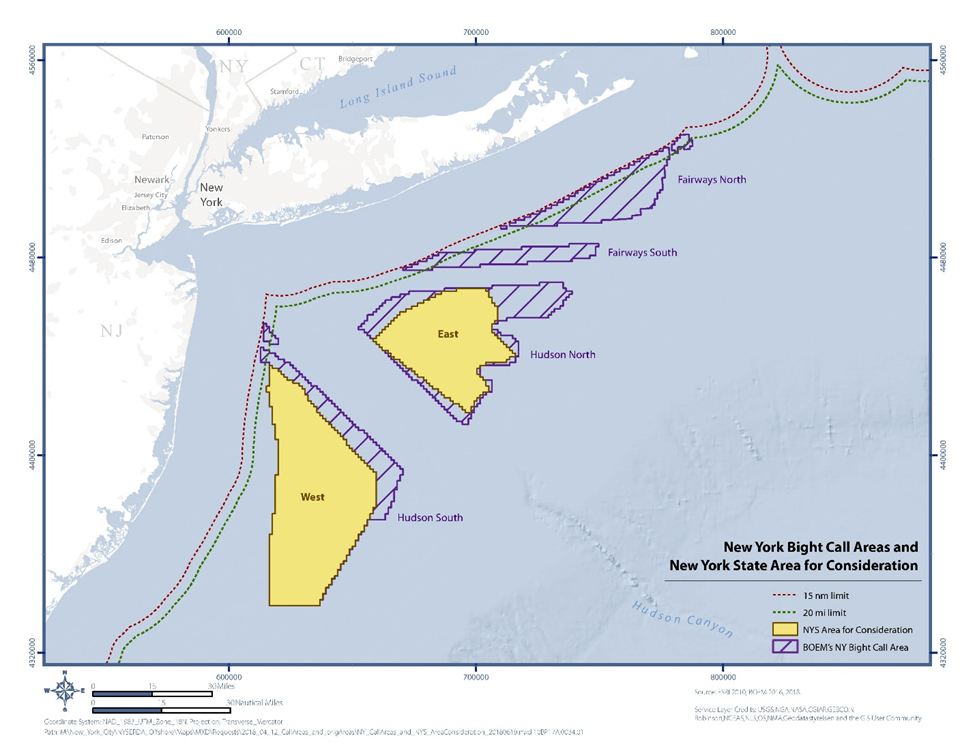
On May 22, 2018, the federal Bureau of Ocean Energy Management (BOEM) extended the public comment period for offshore wind energy development within the New York Bight region to July 30, 2018. BOEM is requesting comments on potential lease areas for offshore wind energy development identified on the map below as “BOEM NY Bight Call Areas.”

In collaboration with the State of New York (Department of Environmental Conservation and New York State Energy Research and Development Authority), BOEM is convening two public comment sessions to help ensure that BOEM is aware of the questions or concerns of New York’s fishing community and other stakeholders. BOEM will present information regarding the NY Bight Call for Information and Area Identification process and characterization of NY Bight fisheries.

These sessions will occur:
July 11, 2018
4 p.m. – 8 p.m.
Montauk Community Playhouse, ADC Room
240 Edgemere Street, Montauk, New York, 11954

July 12, 2018
4 p.m. – 8 p.m.
Shinnecock Commercial Fishing Dock Office
333 Beach Road (aka Dune Road), Hampton Bays, NY 11946
*Located at the Shinnecock Commercial Fishing Dock on the Hampton Bays side of the Shinnecock Inlet
BOEM NY Bight Call AreasIf you are unable to attend a meeting, or if you prefer to submit written comments to BOEM electronically, comments may be submitted by July 30, 2018. To submit comments online or get information on how to mail in comments, please visit www.regulations.gov, and in the search bar, enter ‘BOEM-2018-0004.’

The accompanied map indicates “NYS Areas for Consideration” for offshore wind energy leasing identified by the State of New York through the development of the New York State Offshore Wind Master Plan.
For more information about the BOEM process and submitting comments visit, BOEM’s New York Activities website.

Like this? Click to receive free updates

NY Offshore Wind – Fisheries Stakeholder Meetings Read More »

NJ Senate enviro & energy bill's for June 21

The following bills are scheduled for votes in the New Jersey Senate on Thursday, June 21.

S1073 – Authorizes municipalities, counties, and certain authorities to establish stormwater utilities.
S1074 – Provides for protection of public’s rights under public trust doctrine.
S2129 – Authorizes electric and gas public utility assistance grants funded from societal benefits charge revenue for qualified households.
S2167 – Dedicates $500,000 annually in revenues from vessel registration and renewal fees to NJ Greenwood Lake Fund.
S2307 – Creates Garden State Growth Zone at Atlantic City International Airport and surrounding area.
S2645 – Makes various changes to New Jersey Infrastructure Bank’s enabling act.
S2646 – Appropriates funds to DEP for environmental infrastructure projects for FY2019.
S2647 – Authorizes NJ Infrastructure Bank to expend certain sums to make loans for environmental infrastructure projects for FY2019.
S2662 – Limits liability for persons who deliver heating oil to unregulated tanks for discharges from that tank under certain circumstances.
S2728 – Appropriates $15,294,000 from constitutionally dedicated CBT revenues to DEP for State acquisition of lands for recreation and conservation purposes, including Blue Acres projects.
S2729 – Appropriates $9.703 million from constitutionally dedicated CBT revenues for recreation and conservation purposes to DEP for State capital and park development projects.
SCR122 – Approves FY 2019 Financial Plan of NJ Infrastructure Bank.
S879 – Amends definition of “existing major hazardous waste facility” in “Major Hazardous Waste Facilities Siting Act.”

NJ Senate enviro & energy bill's for June 21 Read More »

Did you take the bribe? I sure did, admits Jersey pol

NEWARKBloomfield First Ward Councilman Elias Chalet pleaded guilty Tuesday to a second-degree bribery charge, admitting he solicited and accepted $15,000 from a resident trying to sell his property to the township.


Former Bloomfield, NJ
First Ward Councilman Elias Chalet. (File photo)

Asked by defense attorney Peter W. Till whether he accepted the payments, Chalet, standing before the court in a dark suit, responded: “I sure did.”
Chalet, a Democrat, was arrested in November 2015 by investigators with the state Attorney General’s Office, which later obtained an indictment against him on charges of official misconduct, bribery, evidence tampering and hindering apprehension.
Chalet, who previously faced a recall attempt, was ordered to give up his council post and faces a lifetime ban on public employment. Speaking to reporters outside court, Till said Chalet’s forfeiture of the council seat was in effect as of the plea.

Did you take the bribe? I sure did, admits Jersey pol Read More »