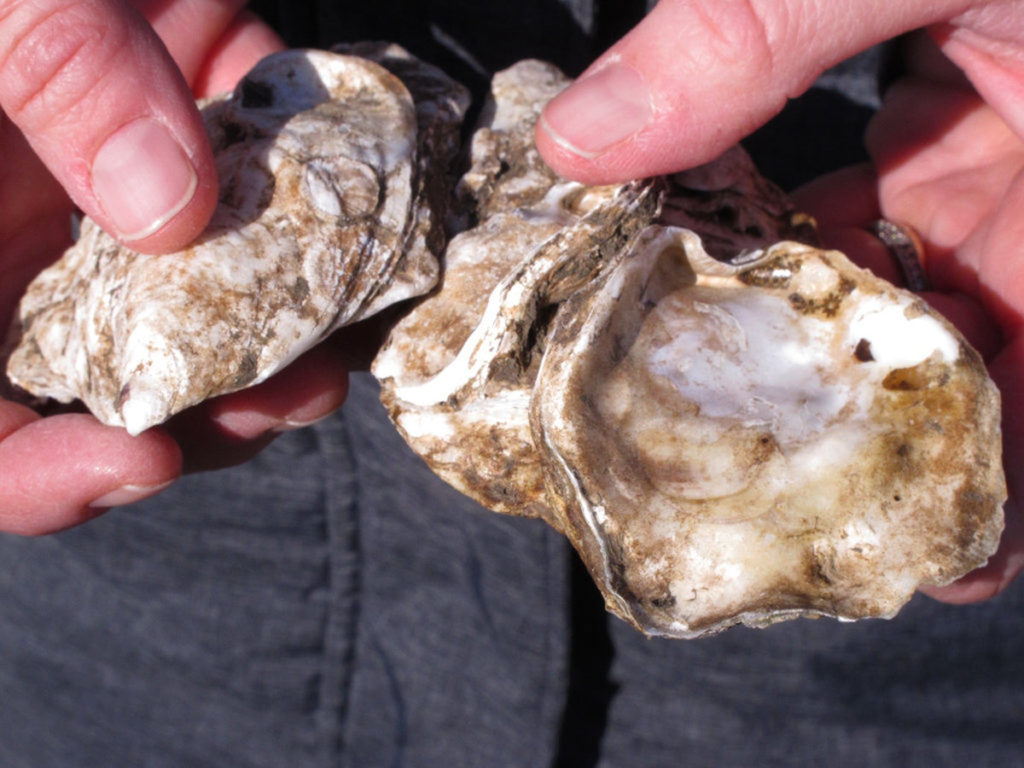
Military turns to oyster reefs to protect against storms

Wayne Parry reports
for The Associated Press

MIDDLETOWN, N.J. — Earle Naval Weapons Station, where the Navy loads some of
America’s most sophisticated weapons onto warships, suffered $50 million worth
of damage in Superstorm Sandy. Now the naval pier is fortifying itself with
some decidedly low-tech protection:
oysters.
The facility has
allowed an environmental group to plant nearly a mile of oyster reefs about a
quarter-mile off its shoreline to serve as a natural buffer to storm-driven
wave damage.

Other
military bases are enlisting the help of oysters, too. In June, environmental
groups and airmen
established
a reef in the waters of Elgin Air Force Base Reservation in Florida, and more
are planned nearby. 
Oysters also help protect Naval Station in Norfolk in Virginia.

Three oyster reefs protect the USS Laffey museum in South Carolina. And military installations in Alabama and North Carolina have dispatched their enlisted personnel to help build oyster reefs in off-base coastal sites.
They are among hundreds of places around the U.S. and the world where oyster reefs are being planted primarily as storm-protection measures. And a bill just introduced in Congress would give coastal communities $100 million over the next five years to create “living shorelines” that include oyster reefs.

“Having a hardened structure like that oyster reef will absorb some of that wave energy,” said Earle spokesman Bill Addison. “All the pipes and cables that are on the pier now, all of that was washed away and had to be rebuilt. And there was a lot of flooding that came into the base. Will this protect us against all of that? No, but it will do a significant amount of good to protect the base and the complex and our surrounding communities.”

The NY/NJ Baykeeper group has been experimenting with oysters at the Navy pier since 2011, originally as a way to see if the shellfish, through their natural filtering ability, might help improve water quality in the murky Raritan Bay. (They did somewhat.)

In summer 2016, the group planted the oyster reef primarily as a storm protection measure — a trend that has taken hold around the world within the past decade or so, according to Bryan DeAngelis, a program coordinator for The Nature Conservancy in Rhode Island. Every coastal state in America is using oyster reefs as either a combination storm-protection or a water improvement project, or both.

In addition to cleaning the water, the oyster reefs help blunt the force of incoming waves.

“They are nice speed bumps,” said Meredith Comi, an official with the Baykeeper group.

Environmentalists say “living shorelines” including oyster colonies are far preferable to, and cheaper than, armoring the coast with steel seas walls or wooden bulkheads that invariably accelerate erosion of the sand in front of such man-made structures.

“Waves are affected by the roughness of the bottom,” said Boze Hancock, a marine restoration scientist with The Nature Conservancy who has studied and participated in oyster projects around the world. “Picture a wave trying to roll over a huge sponge, compared to one rolling over an asphalt parking lot. The ‘sponge,’ or rough, uneven oyster reef, sucks the energy out of the wave as it rolls toward the shore.”

U.S. Rep. Frank Pallone Jr., a New Jersey Democrat, recently introduced The Living Shorelines Act, which would make coastal communities eligible for $100 million over five years in federal grants for oyster reefs and wetlands plants. Its prospects remain uncertain in the Republican-controlled Congress.

In most spots, the oysters are designed not to be harvested and eaten. But in other places, including New Jersey, the oysters have been planted in polluted waterways where shellfish harvesting is prohibited, leading to concerns about poachers stealing them and sickening customers.

Such a dispute forced Baykeeper to rip out an oyster reef it planted a few miles from the Navy pier and relocate the shellfish to waters near the pier that are patrolled by gun-toting boats.

Like this? Use form in upper right to receive free updates
See popular posts from the last 30 days in right column —
>> 

Military turns to oyster reefs to protect against storms Read More »

Asbury Park replacing its boardwalk in 2018 and 2019

 Austin Bogues reports for the Asbury Park Press:

ASBURY PARK – The boardwalk is getting a face lift.

The city
is soliciting bids for a $400,000 project to replace wooden planks along the boardwalk in 2018 and 2019. 


City Manager Michael Capabianco said the city replaces boardwalk planks each year and that the planks are expected to last between 3 and 7 years, depending on weather and traffic.

He said the work would take place during the day and is not expected to cause major closures on the boardwalk, which sees hundreds of thousands of visitors per year. 


Proposals for the contract are due Thursday at 10:30 a.m. to the city manager’s office. 


The wooden planks aren’t the only thing getting renovated at the boardwalk in the coming months.

In a separate project, Asbury Park Boardwalk developer Madison Marquette is launching new designs for the Fourth Avenue Pavilion and Fifth Avenue Pavilions, which you can see in the video above this story. 


Read the full story 


Like this? Use form in upper right to receive free updates

See popular posts from the last 30 days in right column —
>>

Asbury Park replacing its boardwalk in 2018 and 2019 Read More »

Trump’s offshore oil rush a disaster for oceans. climate

David  L. VALENTINE, UNIVERSITY OF CALIFORNIA, SANTA BARBARA  Deepwater Horizon surface oil burning, June 2010


Richard Steiner writes in the Huffington Post:

At a time when science says that to stabilize global climate two-thirds of all fossil fuel reserves must stay in the ground, Trump is instead pushing a huge increase in fossil fuel production, onshore and offshore.
Expanded drilling, weakened agency oversight, relaxed safety regulations, and oil companies now with more available cash from tax cuts is a “perfect storm” for increased risk of climate disasters and oil spills.
Nowhere is President Trump’s historic assault on our natural environment
more worrisome than his reckless push for increased offshore oil and gas
drilling.
If this dangerous offshore plan moves ahead, we can expect decades of
more catastrophic oil spills, hurricanes, floods, droughts, and wildfires.
In addition to the oil and gas already in production offshore, the U.S.
offshore seabed may hold another 90 billion barrels of oil and 400 trillion
cubic feet of natural gas, or more. Burning this amount of fossil fuel would
add over 50 billion tons of CO2 to the global atmosphere, a “carbon bomb”
comparable to the Alberta tar sands. And much of this CO2 would be
reabsorbed into seawater, increasing ocean acidification.

Read the full story


Like this? Use form in upper right to receive free updates
See popular posts from the last 30 days in right column —
>>

Trump’s offshore oil rush a disaster for oceans. climate Read More »

Beijing tops China’s ‘green development’ index, but the public doesn’t see it that way

BEIJING (Reuters) – China published its first “green development” index on Tuesday, listing regional governments which promote environmentally friendly development, with Beijing coming out top, though it came second-to-last in a survey of public satisfaction.


The heavily polluted capital was first in the ranking of 31 provinces and regions for 2016, which was published by the National Bureau of Statistics, followed by Fujian and Zhejiang provinces, while Tibet and Xinjiang were the lowest ranked regions.

Hebei province, which surrounds Beijing and is home to several cities with some of the worst air pollution in the world, was ranked 20th.


Like this? Use form in upper right to receive free updates
See popular posts from the last 30 days in right column —
>>

Beijing tops China’s ‘green development’ index, but the public doesn’t see it that way Read More »

Superfund sites are in danger of climate-change flooding, putting millions of Americans at risk


An investigation by the Associated Press found that 327 of the most polluted sites in the country are vulnerable to flooding and sea-level rise spurred by climate change.

The 2 million people who live within a mile of these sites face a serious health threat if floodwaters carry hazardous materials into their homes or contaminate drinking water.
Like this? Use form in upper right to receive free updates
See popular posts from the last 30 days in right column —
>>

Superfund sites are in danger of climate-change flooding, putting millions of Americans at risk Read More »