Watch out, Gov. Murphy, you’re about to get kneecapped

Star-Ledger Columnist Tom Moran writes:


After a killer career in the private sector, Gov. Phil Murphy is about to get an education in the frustrations of governing.


He’s had a good run, so far. In four months, he’s checked off several big items from the liberal wish list. Equal pay for women. Automatic voter registration. Funding for Planned Parenthood. A return to sanity on climate change. And a robust fight against President Trump on everything, from sanctuary cities and guns, to taxes and water pollution


“We will reclaim the progressive soul of this state,” Murphy said in March.


I sat with the governor for an hour on Monday and came away with two main thoughts.


One is that he’s a likeable guy, sincere and smart — a bit nerdy, perhaps, but bursting with genuine passion to build a more just economy, one strong enough to bring everyone aboard. I root for him to succeed.


But I’m not betting on it. Which brings us to my second thought: I have a sinking feeling that we’ve already seen the best of the Murphy Era. This could get ugly fast.


Because all signs say the Legislature is going to murder his budget next month by refusing to raise the sales tax, leaving him a whopping $581 million short. Legislative leaders say that in public, and they emphasize it in private. And Murphy has built no reservoir of good will to fall back on.


They don’t like him. They don’t fear him. And they are convinced he’s mistaken about the state’s progressive soul — at least when it comes to raising taxes.


Read the full column


Like this? Click to receive free updates

Watch out, Gov. Murphy, you’re about to get kneecapped Read More »

New Jersey, Meet your 3 new state lawmakers

NJ State House
Democrats Linda Carter, Lisa Swain, and Chris Tully were sworn in at the Statehouse in Trenton on Thursday as the newest members of the state Assembly, the lower house of the New Jersey Legislature.
Carter, a Union County freeholder, replaces the late Jerry Green, who died at age 79 last month.
Swain, the former mayor of Fair Lawn, and Tully, the former council president in Bergenfield, will be district mates.
They replace Joseph Lagana, who moved up to the state Senate last month when state Sen. Robert Gordon resigned to join the state Board of Public Utilities, and Tim Eustace, who resigned last month to take a job outside of state government.

New Jersey, Meet your 3 new state lawmakers Read More »

Places in the U.S. Where Disaster Strikes Again and Again

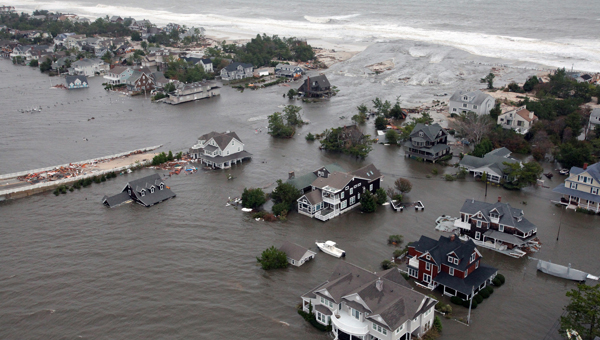
Flooding at the New Jersey Shore after Hurricane Sandy

Sahil Chinoy reports for The New York Times:


In the last 16 years, parts of Louisiana have been struck by six hurricanes. Areas near San Diego were devastated by three particularly vicious wildfire seasons. And a town in eastern Kentucky has been pummeled by at least nine storms severe enough to warrant federal assistance.

These places are part of a small fraction of the United States that has sustained most of the damage from major natural disasters, forming a pattern of destruction concentrated in particular areas.

About 90 percent of the total losses across the United States occurred in ZIP codes that contain less than 20 percent of the population, according to an analysis of data from the Small Business Administration.

The federal government, through disaster relief programs and flood insurance, subsidizes the cost of rebuilding in areas hit repeatedly by storms, floods and fires. Critics say that encourages too much development in those regions, wasting tens of billions of dollars in tax money and endangering lives.

Christina DeConcini, the director of government affairs at the World Resources Institute, said that federal programs do not adequately emphasize adapting to the risks posed by climate change. She said that instead of just being responsive, the government should stress building for resilience against disasters.

Some residents continue living in disaster-stricken areas because they cannot afford to leave. Others rebuff appeals to resettle, citing deep family ties or a sense of fatalism. Rather than move the town, “it’s easier to throw your hands up and say, ‘Forget it,’” said Linda Lowe, the president of a historical society in flood-prone Olive Hill, Ky.

“Abandoning a location and moving a city makes sense from a scientific, risk point of view, but the fact is that to get to a place culturally and psychologically where that conversation can be tolerated is a difficult thing to imagine,” said Dr. Irwin Redlener, the director of the National Center for Disaster Preparedness at Columbia University. “It’s not all that rational — but I guess a lot of these things are not really rational.”


Places in the U.S. Where Disaster Strikes Again and Again Read More »

Two new bills change the energy map for New Jersey


Governor puts signature to bill calling for half of the state’s electricity to come from renewable sources by 2030

Murphy signs energy bills May 23 2018Tom Johnson reports for NJ Spotlight:
Gov. Phil Murphy yesterday signed bills to dramatically overhaul New Jersey’s energy policies while ensuring nuclear power will remain a significant part of its energy mix — albeit with a hefty new subsidy from consumers.
In a ceremony at a solar farm in Monmouth Junction, the governor’s action marked a step toward achieving his ambitious clean-energy agenda, by requiring at least half of the state’s electricity to come from renewable energy by 2030. The plan also mandates utilities ramp up programs to reduce energy use.
“Today is a big leap forward,’’ Murphy told legislators, cabinet officials, and representatives of key environmental groups who gathered at the solar farm, which is still under construction. The governor also signed an executive order, directing the development of a new Energy Master Plan to have the state achieve 100 percent clean energy by 2050.
Whether the state can deliver on that agenda and at what cost to ratepayers will likely generate as much debate and argument over the next few years as occurred during the bruising fight to get the bills through the Legislature in the past six months.
No issue was more controversial than the measure (S-2313) to direct up to $300 million a year in ratepayer subsidies to keep three nuclear power plants from closing in South Jersey. Public Service Enterprise Group threatened to shutter them, arguing they are no longer economically competitive.


In the money — or not?

Critics, including many business groups, consumer advocates, and environmental groups, countered that PSEG never demonstrated the plants are losing money. By handing out such a huge subsidy, opponents feared it would hinder efforts to reach the aggressive renewable energy targets set by Murphy.
“What we have here in New Jersey is the company admitting they are profitable —they are just not profitable enough,’’ said Ev Liebman, director of advocacy for AARP of New Jersey. If implemented, the bill could cost residents about $41 a year, and large companies, tens of thousand of dollars annually, according to opponents.

Two new bills change the energy map for New Jersey Read More »

$74M American Cyanamid cleanup to remove toxic sludge


Bob Makin reports for My Central Jersey:


A new $74 million cleanup proposal makes the American Cyanamid Superfund site in Bridgewater, NJ more of a federal priority, said U.S. Environmental Protection Agency (EPA) Regional Administrator Pete Lopez at a press conference on May 23.


The plan includes the removal and treatment of 55,000 cubic yards of acid tars and such cancer-causing chemicals as benzene from the floodplains of the Raritan River, Lopez said in the parking lot of TD Bank Ball Park, a remediated part of the Superfund site. A chemical and drug manufacturing plant for nearly 100 years, the 435-acre property now is on both the National Priorities List and the EPA Administrator Scott Pruitt’s list of Superfund sites targeted for immediate and intense attention, Lopez said.


The EPA will conduct a public meeting on June 12 to explain the cleanup proposal and other options considered and to take public comments. An informal public information session will be start at 6 p.m. and the public meeting will begin at 7 p.m. at the township municipal building, 100 Commons Way. Comments will be accepted until June 28.


Lopez also announced that construction of a permanent water treatment facility at 20 Polhemus Lane will be completed by year’s end.


Read the full story


Like this? Click to receive free updates

$74M American Cyanamid cleanup to remove toxic sludge Read More »

Pets and animal bills before NJ Senate committee May 31


The Senate Economic Growth Committee will meet on Thursday, May 31, 2018 at 10:30 AM in Committee Room 1, 1st Floor, State House Annex, Trenton, NJ.


The following bills will be considered:

S381 (Madden / Beach) – Prohibits persons violating animal cruelty law from owning, keeping, or harboring animals; requires DHSS establish and maintain website list of such persons.

S1093 (Cruz-Perez) – “Nosey’s Law”; prohibits use of wild or exotic animals in traveling animal acts.

S1209 (Singleton) – Prohibits surgical declawing of cats and other animals.

S1230 (Singleton / Sweeney) – Establishes an animal abuser registry.

S1429 / A1053 (Van Drew / Houghtaling / Taliaferro / Andrzejczak) – Revises and expands laws on trespass and vandalism on agricultural and horticultural lands.

S1860 (Cruz-Perez) – Provides immunity from civil and criminal liability for rescue of animal from motor vehicle under inhumane conditions.

S1923 (Singleton / Gopal) – Revises criteria for determining whether dog is vicious or potentially dangerous.

S1953 (Oroho / Cruz-Perez) – Directs Dept. of Agriculture to authorize and advise food hubs.

SJR72 (Singer / Weinberg) – Designates second Monday of May each year as “New Jersey Economic Development Day.”


(The public may address comments and questions to Patrick Brennan or Andrew Ward, Committee Aides, or make bill status and scheduling inquiries to Kimberly Johnson, Committee Secretary, at 609-847-3840, fax 609-292-0561, or e-mail: OLSAideSEG@njleg.org. Written and electronic comments, questions and testimony submitted to the committee by the public, as well as recordings and transcripts, if any, of oral testimony, are government records and will be available to the public upon request.)


Like this? Click to receive free updates

Pets and animal bills before NJ Senate committee May 31 Read More »