Yet another giant Iceberg breaks free of Antarctica


USA Today reports:


A massive iceberg broke off Antarctica on Saturday, the latest piece of ice to leave the continent.

The U.S. National Ice Center measured the iceberg at 71.5 square miles, about three times the size of Manhattan. Previous media reports had the iceberg at over 100 square miles.

The iceberg is now in the Amundsen Sea but will eventually drift into Pine Island Bay, notes the Ice Center. The iceberg shows signs of fracturing, meaning smaller pieces of ice may break off. The Ice Center said it’s not expected to cause any shipping hazards.

Chris Shuman of NASA’s Goddard Space Flight Center said the break is part of a natural process, but the frequency of the breaks is concerning. Forces such as wind, tides, currents and even collisions with other icebergs can create rifts in the ice. Warm water moving underneath the glaciers causes the ice to thin and perhaps accelerates the rifts.

“The fact that the calving events have gotten a little more frequent is not a good sign,” Shuman said. He adds there is no sign the trend is reversing.

The continuation, he said, means further ice losses to Antarctica and possible rising sea levels as a result.

The glacier, reports the Washington Postis a part of West Antarctica that already loses 45 billion tons of ice annually, contributing to sea level rises. Pine Island Glacier, Gizmodo reports, is the “fastest-melting glacier in Antarctica.”

The break comes two months after a 2,200 square-mile piece of ice detached from Antarctica in July. At nearly the size of Delaware, the iceberg was one of the largest ever recorded. In 2014, a 255-square-mile iceberg also calved from Antarctica.

Yet another giant Iceberg breaks free of Antarctica Read More »

Bipartisan bill could enable U.S. offshore wind to take off

Recently introduced legislation would create a 30% investment tax credit for the first 3 GW of offshore wind projects deployed in the U.S.

Justin Gerdes reports for GreenTechMedia:

When the U.S. was ready to ramp up its solar industry, developers benefited from investments made in Germany, Spain and elsewhere in Europe that had funded gigawatt-scale annual deployments and pushed down costs. The same could happen with offshore wind.


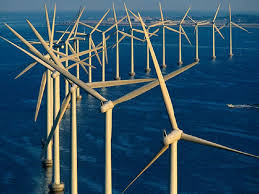
By the end of 2016, 14.4 gigawatts of offshore wind capacity had been installed globally, with nearly 90 percent of the total deployed in European waters. Prices for projects coming on-line from 2020 have fallen to $50 per megawatt-hour in Denmark, the Netherlands and Germany. The United States, meanwhile, has so far managed to bring on-line just one modest commercial project, the 30-megawatt Block Island Wind Farm off of Rhode Island.
A bill introduced this summer by a bipartisan group of senators aims to help the U.S. catch up with Europe. On August 1, 2017, Senators Tom Carper (D-Del.) and Susan Collins (R-Maine) introduced the Incentivizing Offshore Wind Power Act with 10 co-sponsors.
In a clever twist, the legislation trades a calendar deadline — typical for federal clean energy tax incentives — for a deployment target. The bill would create a 30 percent Investment Tax Credit (ITC) redeemable for the first 3 gigawatts of offshore wind projects placed into service in both coastal waters and inland navigable waters like the Great Lakes.
“Offshore wind energy has the potential to power every home, school and business from Florida to Maine with clean, renewable energy,” said Carper, in a statement. “I’m proud to partner with Senator Collins to provide this growing industry the certainty it needs to draw private sector investments in new offshore wind facilities across the country.”

Why the deployment target instead of deadline year? In short, project developers need more time to get more steel in the water. To take advantage of the existing federal tax incentive — developers can opt for either an ITC or a Production Tax Credit (PTC) — projects must commence construction before December 31, 2019.


Developer interest in the sector is strong. The Bureau of Ocean Energy Management has conducted seven competitive lease sales for wind energy development in federal waters since July 2013. In December 2016, a 33-round bidding war ended with a $42.5 million winning bid by Statoil Wind U.S. LLC to develop 79,350 acres off the shore of New York. But it is unlikely many of the offshore projects in the pipeline will be able to claim the federal ITC/PTC before the 2019 expiration.

Sens. Carper and Collins cite the long development time required to build offshore wind as part of the justification for the legislation. “The ideal offshore winds are often found in federal waters — requiring federal permits and other logistical complications that can add years to the construction timeline,” they said in a statement.

Read the entire story

Like this? Use form in upper right to receive free updates
See popular posts from the last 30 days in right column — >>


Bipartisan bill could enable U.S. offshore wind to take off Read More »

This is Trump’s chance to tank the solar industry


Rebecca Leber reports for Grist:

If President Trump were honest about which industries are the biggest job-creation powerhouses, it wouldn’t be the sluggish coal industry. It’s solar. More than twice the size of the wind industry and roughly five times bigger than the coal industry, solar accounted for one in every 50 jobs created in 2016, according to an annual census by the Solar Foundation.


But Trump will soon have the chance to cut off U.S. solar from the cheap foreign panels that have led to the industry’s booming success the past few years.


The U.S. International Trade Commission on
Friday decided 4-0 that foreign imports of solar panels and cells have damaged
the business of two domestic solar manufactures, Suniva and SolarWorld.
Now that the ITC has found injury, it will
likely suggest a price floor or tariffs. The decision on whether to regulate
these imports will ultimately fall to Trump, and evidence suggests he’s likely
to do it.
“I would place the odds of the president
agreeing to some type of remedy at 90 percent,” an anonymous Trump administration
official
told the news site Axios. Suniva has already proposed a
price floor of 78 cents per watt and a tariff that would more than
double the
current panel costs.
Solar Energy Industries Association President
Abigail Ross Hopper’s statement Friday warned that such a proposal could hobble
the industry.


Like this? Use form in upper right to receive free updates
See popular posts from the last 30 days in right column —
>>

This is Trump’s chance to tank the solar industry Read More »

Rutgers team wins $1 million ‘Nobel Prize for students’

Avalon R. Zoppo writes for Philly.com:

For recent Rutgers graduate Hasan Usmani, the sight of the vast Karachi slum was a shock, despite his family connections and previous visits to Pakistan.

The 8,000-acre Orangi Town, home to 2.5 million people, many of them refugees from Afghanistan and Bangladesh, is barely livable, the 23-year-old said. Lacking adequate sewer lines, its streets are awash in wastewater when it rains. One resident told Usmani her children shower only once a week so the family can afford food.

“I was surprised to see people living in these conditions and surviving,” Usmani said.

He and three other fellow business school students at Rutgers University in New Brunswick — Hanaa Lakhani, Gia Farooqi, and Moneed Mian — had gone there in May with a project in mind to help the slum residents: solar-powered rickshaws. It was a concept that had won a regional competition earlier. When they got to Pakistan, an even better idea emerged: a ride-share program to better connect impoverished residents of the shantytown to rickshaws, an Uber of sorts.

This month, their pilot program, Roshni Rides, snagged first place and $1 million in start-up capital in the prestigious Hult Prize competition, founded by Swedish businessman Bertil Hult and funded by his family. The award has been dubbed the Nobel Prize for students.
Among the runners-up? A team from Harvard.


Read the full story

Like this? Use form in upper right to receive free updates
See popular posts from the last 30 days in right column —
>>

Rutgers team wins $1 million ‘Nobel Prize for students’ Read More »

Mystery group picking Breitbart apart, tweet by tweet


Paul Farhi reports for The Washington Post:

Hardly anyone paid attention last November when a strangely named Twitter account, Sleeping Giants, sent its first tweet into the digisphere. “Are you aware that you’re advertising on Breitbart, the alt-right’s biggest champion, today?” read the tweet, aimed at a consumer lending outfit called Social Finance. “Are you supporting them publicly?”

Within 30 minutes, Social Finance replied, tweeting that it would stop running ads on Breitbart.

It was, it turns out, the start of an odd, and oddly effective, social media campaign against Breitbart.com, the influential conservative news site headed by Stephen Bannon, President Trump’s former campaign chairman and ex-White House chief strategist.

Sleeping Giants is a mysterious group that has no address, no organizational structure and no officers. At least none that are publicly known. All of its leaders are anonymous, and much of what it claims is difficult to independently verify. A spokesman for the group wouldn’t identify himself in interviews for this story.

But the group does have a singular purpose, pursued as relentlessly as Ahab chasing a whale: It aims to drive advertisers away from Breitbart. “We’re trying to defund bigotry,” the spokesman says.


Like this? Use form in upper right to receive free updates
See popular posts from the last 30 days in right column —
>>

Mystery group picking Breitbart apart, tweet by tweet Read More »

Longtime business owners see an upside to gentrification

A&A Bake & Double Shop on Nostrand AvenueJeremy Smerd, editor of Crain’s, writes:In the four-plus years I’ve lived in Bedford-Stuyvesant, Brooklyn, Noel Brown has gone from fearing gentrification to embracing it. That’s because his business is booming. Not only have his old customers not left, but he has also gained new ones. Like me.I used to pass Brown’s Bake Double Shop daily on my way to the Nostrand Avenue A station. Invariably a line would snake out of the 300-square-foot spot onto the sidewalk as customers waited to pay a couple of bucks for doubles—Trinidadian street food that consists of two fried flatbreads filled with curried chickpeas.I have since moved to another part of the neighborhood. Soon Brown will be moving too. In the coming weeks he’ll open a 3,000-square-foot restaurant on Fulton Street that will serve lunch and dinner—in addition to his signature doubles. His staff of eight will grow considerably. “I was skeptical,” said Brown, whose small shop has been open for 17 years. “The original people were moving out, and new people were moving in. But my business exceeds the limit I was thinking about by 15%.”The story of Bed-Stuy is Brown’s writ large. Since he opened his shop, the number of businesses in the neighborhood has grown by 73%, to 1,910, as violent crime fell by 44%, according to a report published last week by state Comptroller Thomas DiNapoli. Employment is at a record high, having increased by 45%, to around 17,000 jobs since the end of the Great Recession.
Read the full story

Longtime business owners see an upside to gentrification Read More »