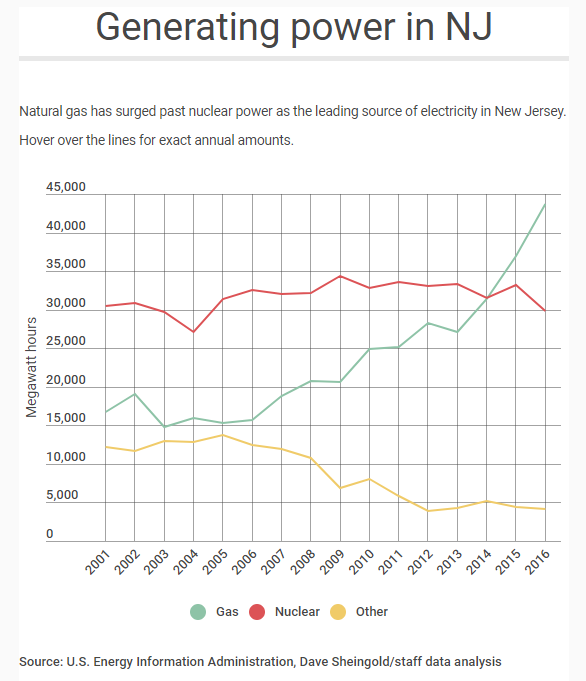
Is the future fading to black for nuclear power in NJ?


Salem and Hope Creek nuclear generating stations in Salem County, NJ. Photo:Gary Emeigh,,The News Journal 

Herb Jackson is Washington Correspondent for The Record:

New Jersey’s biggest utility is telling state officials it may close two nuclear plants in Salem County if the flood of cheap natural gas accessed by fracking shale deposits makes them unprofitable.

Closing the Hope Creek and Salem reactors run by Public Service Enterprise Group, combined with the scheduled closure of Exelon’s Oyster Creek plant in Ocean County, would leave New Jersey nuke-free.

But that would force PSEG to scramble for other ways to generate about half the electricity the state uses, and those alternatives all come with consequences of their own for the utility and for customers.


PSEG chief executive Ralph Izzo said shifting to gas alone would be more expensive because of added capital costs and price increases caused by increased demand. It also would increase carbon dioxide emissions by the equivalent of 3 million more cars, and make New Jersey more vulnerable to supply disruptions, especially during extended winter cold snaps, he said.

“You would have 97 percent of the state’s power coming from natural gas,” Izzo said during a recent Washington, D.C. visit to receive an award from a trade group for the company building solar arrays on landfills.

“We believe gas is abundant, we believe it’s going to be low-cost for a long time to come, but we also know at some time in the future you’re going to have a polar vortex, you’re going to have a disruption in a pipeline,” Izzo said.

The company has “begun a conversation” with state officials about creating a “zero-emission credit” in the electricity market that rewards nuclear plants for not creating air pollution. Izzo argued that power sources such as wind and solar already get federal tax credits that compensate for their higher costs.

Read the full story here


Related news story:
NJ CANT hopes lawmakers won’t subsidize PSEG nuclear

Like this? Use form in upper right to receive free updates


Is the future fading to black for nuclear power in NJ? Read More »
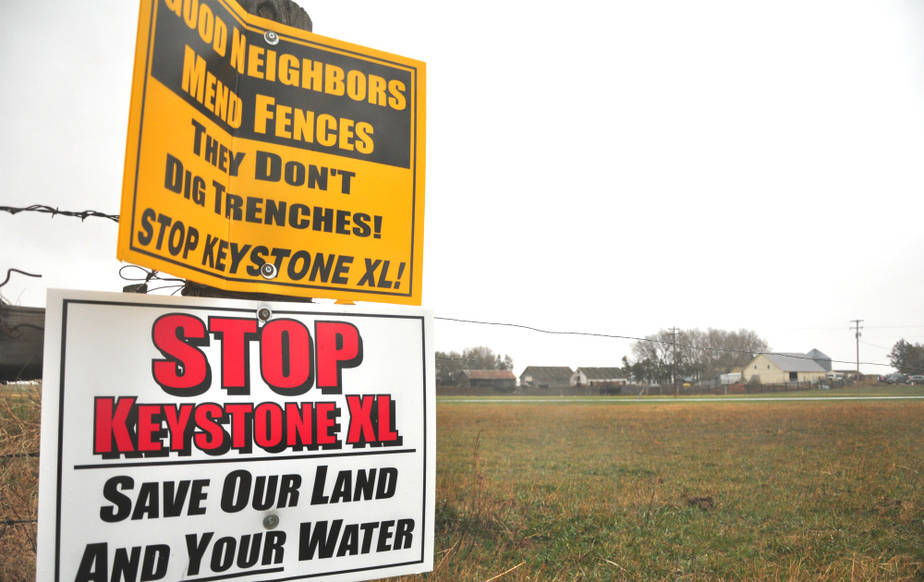
Will the controversial Keystone XL pipeline be completed?

        Nebraska landowners are pushing back against TransCanada’s construction
       Photo credit: Guillaume Meyer/AFP/Getty Images
Phil McKenna reports for Inside Climate News:

It will be close to three years, at least, before oil could possibly be moving through the controversial Keystone XL pipeline—if the pipeline is completed at all. Company officials now concede that after battling protests and regulatory hurdles for nearly a decade, market forces could scuttle the project.
Canadian pipeline giant TransCanada first proposed the 1,700-mile project in 2008 to ship tar sands oil from Alberta to the Gulf Coast. The half-built project was halted by President Obama in 2015 only to be revived through an executive order signed by President Trump soon after he took office. The company has spent $3 billion on the project, mostly for pipe but also for land rights and other costs of lobbying for its proposal. 
During the prolonged dispute, the price of oil fell from more than $130 a barrel to roughly $45 a barrel today, undercutting the prospects for production growth in the Canadian tar sands, which were used to justify the Keystone XL project at its outset.
Along with changing market conditions, the emergence of competing pipelines scattered TransCanada’s customer base. Now it’s uncertain whether the company can sign enough new commitments from Alberta’s beleaguered oil patch to move forward.
The company recently embarked on an “open season” for Keystone XL, inviting commitments from companies to ship tar sands crude (or, alternatively, lighter oil from the U.S. Bakken fields, in North Dakota and Montana).
At the same time, regulators in Nebraska are weighing the concerns of landowners, environmental organizations and indigenous groups who oppose the pipeline. The state’s Public Service Commission will hold a week-long hearing starting Aug. 7 on whether or not to approve the pipeline’s proposed route through Nebraska.
How much opponents will be allowed to tell the commission, however, was signficantly limited this week by a retired judge who is overseeing that hearing.


Read the full story here


Like this? Use form in upper right to receive free updates

Will the controversial Keystone XL pipeline be completed? Read More »

Lisa Jackson explains Apple’s sustainable forests

Theodore Kaye/WWF-China
Aerial view of eucalyptus forests in Guangxi Province, China. In partnership with WWF, Apple transitioned 320,000 acres of forest in China into sustainable management certified by the Forest Stewardship Council.
Joel Makower is executive editor of GreenBiz Group: 
When it comes to environmentally responsible packaging, Apple is not feeling boxed in.
The tech giant has just announced the latest expansion of its sustainable forestry strategy, aimed at protecting or creating enough responsibly managed forests to offset its packaging footprint. Late last week, it said that the Forest Stewardship Council had certified 320,000 acres of working forest that the company supports in China, enough to cover all its product packaging.
In 2015, the company committed to protect responsibly managed working forests and announced a five-year partnership with World Wildlife Fund (WWF) to transition up to 1 million acres of forest, across southern provinces of China, into responsible management by 2020.
Two-thirds of the newly certified forest is owned and managed by Maoyuan Forestry, a private company in Central China’s Hunan province. The rest is owned and managed by state-owned Qinlian Forestry Company in Southwest China’s Guangxi Zhuang region. The land includes semi-natural forests and forest plantations.
“We found that the Chinese were willing to be wonderful partners, both on the private- and public-sector side because they have a real appreciation for the forest resource,” Lisa Jackson, VP of Environment, Policy and Social Initiatives, told me. 
“We’re finding that China is very fertile soil to grow green programs.”
Given the growing interest in sustainable forestry by companies seeking to reduce their supply-chain impacts, I asked Jackson to reflect on what Apple learned working in China. 
“One of the learning lessons is to work with folks on the ground with real experience in China,” she said. “WWF is that, but part of the reason WWF is so respected in China is that they are local. They are hiring local Chinese foresters and experts and water managers. They work with landowners, and again, one of the entities is even a state government entity.
“And they’re showing that you can have economic growth, and you can harvest this land and still make money, which is very important still in a developing economy like China. Parts of China are still very much in a development situation. And so you can make money, but you can also preserve the natural environment and all the biodiversity that goes along with it.”
Like this? Use form in upper right to receive free updates
See popular posts from the last 30 days in right column — >>

Lisa Jackson explains Apple’s sustainable forests Read More »

$80M containerboard plant to create 120 New Jersey jobs

Anjalee Khemlani reports for NJBIZ:
Canadian recycled product company Cascades Inc., announced an $80 million investment for a new containerboard packaging plant in Piscataway on Thursday.
The 400,000-square-foot plan will create 120 jobs, and begin operation in the second quarter of 2018, according to the company in a statement.
 
“The Piscataway conversion plant will have state-of-the-art technology and will be among the fastest in the industry. It will offer increased flexibility and allow us to provide more efficient and innovative products to meet our customers’ needs, said Charles Malo, president and chief operating officer of Cascades Containerboard Packaging. 

“Located close to the major urban centers along the eastern seaboard of the United States, the site was also chosen because it has room for subsequent development. This important investment strengthens our position and continues our growth.”
 
Cascades produces green packaging products and tissue paper, and the new plant’s total annual production capacity will be 2.4 billion square feet.
 
“The investment announced today, which is already included in our capital expenditure budget, is part of the deployment of our strategic plan that aims specifically to modernize our assets and increase the integration rate between our primary production and conversion activities. It is also part of our continuing process to reorganize and consolidate our containerboard and packaging activities in the northeastern United States, said CEO and President Mario Plourde.

“This investment will help us better serve our customers and boost our production capacity, thus increasing our market positioning.”

Like this? Use form in upper right to receive free updates
See popular posts from the last 30 days in right column — >>

$80M containerboard plant to create 120 New Jersey jobs Read More »

Can Congress help get wind energy whirling off NJ coast?

Bipartisan legislation that would extend tax credits for investments in the renewable energy could give
state’s efforts at offshore wind a lift

wind turbine

Tom Johnson reports
for NJ Spotlight:
In a push to spur development of an offshore wind industry, bipartisan legislation to extend tax credits for investments in the renewable energy in coastal and other waters across the United States is now before Congress.
If enacted, the legislation could be significant for New Jersey, because its efforts to develop offshore wind farms have stalled, allowing other states on the Eastern Seaboard to take the lead.
It was seven years ago later this month that Gov. Chris Christie signed with fanfare a bill aimed at promoting the sector, but his administration cooled on the policy, never implementing a key aspect of the law. Now offshore wind developers say it could be 2023 before wind turbines are producing electricity off the coast.
The legislation, introduced by Sen. Tom Carver a Democrat from Delaware and Sen. Susan Collins, a Republican from Maine, would extend an investment tax credit that is only available to projects that start construction before December 31, 2019.
Under the bill, a 30 percent tax credit on the investment in offshore wind would be provided to the first 3,000 megawatts that come into service, a provision likely to benefit the two developers seeking to build wind farms off the Jersey coast.
“Investing in clean, renewable energy sources like wind is both good for the economy and our environment,’’ said Sen. Bob Menendez (D-NJ), a sponsor of the bill. “New Jersey, with its vast Atlantic shoreline, is well-positioned to benefit from this legislation.’’


Read the full story here


Like this? Use form in upper right to receive free updates
See popular posts from the last 30 days in right column — >>

Can Congress help get wind energy whirling off NJ coast? Read More »

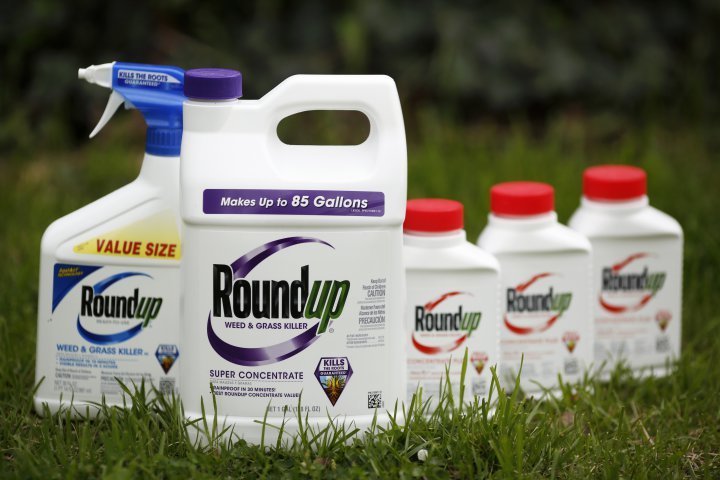
Monsanto emails raise new questions about Roundup


Danny Hakim reports for The New York Times:


Documents released Tuesday in a lawsuit against Monsanto raised new questions about the company’s efforts to influence the news media and scientific research and revealed internal debate over the safety of its highest-profile product, the weed killer Roundup.

The active ingredient in Roundup, glyphosate, is the most common weed killer in the world and is used by farmers on row crops and by home gardeners. While Roundup’s relative safety has been upheld by most regulators, a case in federal court in San Francisco continues to raise questions about the company’s practices and the product itself.

The documents underscore the lengths to which the agrochemical company goes to protect its image. Documents show that Henry I. Miller, an academic and a vocal proponent of genetically modified crops, asked Monsanto to draft an article for him that largely mirrored one that appeared under his name on Forbes’s website in 2015. Mr. Miller could not be reached for comment.

A similar issue appeared in academic research. An academic involved in writing research funded by Monsanto, John Acquavella, a former Monsanto employee, appeared to express discomfort with the process, writing in a 2015 email to a Monsanto executive, “I can’t be part of deceptive authorship on a presentation or publication.” He also said of the way the company was trying to present the authorship: “We call that ghost writing and it is unethical.”

A Monsanto official said the comments were the result of “a complete misunderstanding” that had been “worked out,” while Mr. Acquavella said in an email on Tuesday that “there was no ghostwriting” and that his comments had been related to an early draft and a question over authorship that was resolved.


Like this? Use form in upper right to receive free updates
See popular posts from the last 30 days in right column — >>

Monsanto emails raise new questions about Roundup Read More »