NJ Transit customers: Pop two aspirins and watch this

NJ Transit commuters, frazzled by breakdowns and delays, are looking for a light at the end of the tunnel. But there’s no new tunnel there.


David Cruz of NJTV News interviews Martin Robins, the former deputy executive director of NJ Transit.


Bottom line
: It’s going to get worse before it gets better. Maybe much worse. But NJ’s reinvigorated Transportation Trust Fund will help. Eventually.


Like this? Use form in upper right to receive free updates
See popular posts from the last 30 days in right column —
>>

NJ Transit customers: Pop two aspirins and watch this Read More »

Political opposition to natural gas compressor in NJ

Rendering of Transco compressor station proposed by the Williams Companies


Yesterday, we posted a link to a NJTV News story about New Jersey residents who are trying to get the ear of the the Federal Energy Regulatory Commission (FERC) to express their opposition to a natural gas compressor facility proposed by the Williams Companies to be located near the border of Franklin Township and South Brunswick Township.

This time, one part of a gas pipeline is getting the heat

Today, we received notice that State Senator Kip Bateman also opposes the project. In addition, his media release (below) contains links to news stories reporting that both freeholder boards in Somerset and Middlesex counties have filed as intervenors with FERC.

—————————————————————————


Senator Christopher “Kip” Bateman (R-Middlesex, Mercer, Hunterdon, Somerset) voiced his opposition to a portion of the Williams Transco Northeast Supply Enhancement project that would put a massive natural gas compressor in central New Jersey, joining the Middlesex and Somerset county freeholder boards who 
came out against the proposed project this week.

http://www.senatenj.com/uploads/stop-fracking-pipelines-520.jpg

“The people of Middlesex and Somerset counties don’t want this project,” Senator Bateman said. “It could have a negative effect on property values, and it could be invasive on our communities. Residents are worried it might even be dangerous.”

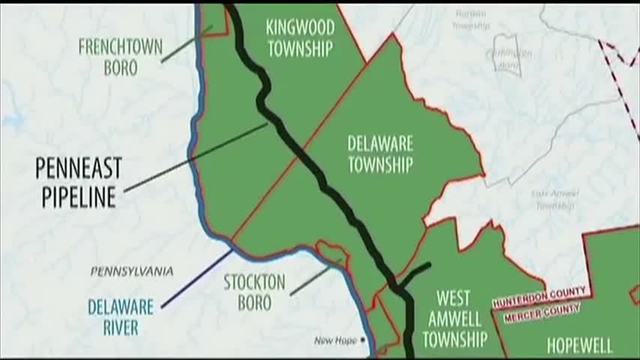
The project would transport natural gas from Pennsylvania to the New York City area through an underground pipeline that cuts through Hunterdon, Somerset and Middlesex counties to the Raritan Bay. It includes plans for a 32,000 horsepower gas compressor near the border of Franklin Township and South Brunswick.

This week, the Middlesex County Board of Chosen Freeholders announced they filed as intervenors
 with the Federal Energy Regulatory Commission (FERC), the federal agency that would ultimately approve the project. According to a report by the South Brunswick Patch, that allows the county to access any filings and documents related to the project. Somerset County’s freeholder board later announced their intention to file a similar motion with FERC.

“Improving our energy infrastructure is crucial to our state’s economic future,” Senator Bateman said. “However, if our residents have serious concerns about this project, we owe it to them to do whatever we can to find a solution that takes the health and safety of our communities into consideration first.”

Like this? Use form in upper right to receive free updates
See popular posts from the last 30 days in right column —
>>

Political opposition to natural gas compressor in NJ Read More »

Pa. court rules on ‘continuous trigger’ for enviro insurance

In an update to clients, K&L Gates attorneys John M. Sylvester and John M. Hagan write:

John M. Sylvester

In a
significant decision for Pennsylvania insurance law, the Pennsylvania
Commonwealth Court has ruled that a “continuous trigger” of coverage applies to
long-term, latent environmental property damage claims. 


John M. Hagan
Specifically, in Pennsylvania Manufacturers’ Association
Insurance Co. v. Johnson Matthey Inc.
, a unanimous panel of the
court rejected an attempt by the insurer, Pennsylvania Manufacturers’
Association Insurance Company (“PMA”), to apply a “first manifestation” trigger
of coverage for the environmental coverage claim of the policyholder, Johnson
Matthey Inc. (“Johnson Matthey”), under “occurrence-based” policies that PMA
issued to Johnson Matthey in the 1960’s and 1970’s.

Rather, the Court observed that the record of the case presented a long latency
of continuing, undetected property damage taking place during the PMA policy
periods, which supported a continuous trigger throughout that latency period,
such as that adopted by the Pennsylvania Supreme Court for asbestos bodily
injury claims in its seminal decision, J.H.
France Refractories Co. v. Allstate Insurance Co.

The Commonwealth Court rejected PMA’s argument that a recent Pennsylvania
Supreme Court decision, Pennsylvania
National Mutual Casualty Insurance Co. v. St. John
, which had
applied a “first manifestation” trigger to a non-environmental property damage
coverage claim, should be followed in this case.


To read the full alert, click here.

Like this? Use form in upper right to receive free updates
See popular posts from the last 30 days in right column —
>>

Pa. court rules on ‘continuous trigger’ for enviro insurance Read More »

NJ lawmakers may seek to block DEP’s septics rule


Department wants to open preserve to greater development, claiming water quality would not be adversely affected


Tom Johnson reports for NJ Spotlight
:


The state Department of Environmental Protection may be heading toward another confrontation with the Legislature — this time over a rule it is reviewing that would open up parts of the Highlands to more growth.
The regulation, proposed last year by the agency, would allow more septic systems in sensitive parts of the Highlands, a step critics argue would threaten the drinking water supplies of millions of residents.
Under a resolution to be considered by the Senate Environment and Energy Committee on Monday, the DEP could be blocked from adopting the rule because lawmakers contend it violates the legislative intent of a 13-year-old law to preserve and protect hundreds of thousands of acres in the Highlands, a region in central and north Jersey of woodlands, lakes, and rolling hills.
The rarely used legislative tool allows the legislative branch to overturn actions by the executive branch the former believes are inconsistent with laws that have been adopted. It has been used more often during the Christie administration in disputes over environmental policies, but not successfully, falling short of reversing rule changes, other than winning a procedural victory.
The proposed rule would increase the density of development in the preservation area of the Highlands by allowing more septic tanks per acre, a red flag to environmentalists because they are a primary source of nitrate pollution.

Read the full story


Like this? Use form in upper right to receive free updates
See popular posts from the last 30 days in right column —
>>

NJ lawmakers may seek to block DEP’s septics rule Read More »

This time, one part of a gas pipeline is getting the heat

Residents in Franklin Township, South Brunswick and surrounding communities in Somerset County, New Jersey are racing against the clock to have their objections to a proposed natural gas compressor station heard by federal regulators.


Operators of the Williams Companies, who want to install the facility, already supervise 500 miles of Transco pipelines running under the state without problems, according to a spokesman. He says the compressor station, proposed to be built on a 52-acre wooded quarry site, would not be seen nor heard by neighbors.


David Cruz reports the story above for NJTV News.

Like this? Use form in upper right to receive free updates
See popular posts from the last 30 days in right column —
>>


This time, one part of a gas pipeline is getting the heat Read More »

Op -Ed: Our infrastructure is shot; What’s the solution?


New Jersey’s infrastructure — and the nation’s — are in need of a massive infusion of capital

richard f. keevey

Richard F. Keevey
Published today in NJ Spotlight:

The status of the nation’s infrastructure may be characterized as anywhere from discouraging to alarming. Every four years the American Society of Civil Engineers (ASCE) issues a report on the status of infrastructure for the nation and for each state. Their latest report was for 2017.
The Society grades 16 categories, including dams, solid waste, drinking water, and transportation.
It is not a pleasant read; in fact, it is pretty depressing. You’d think we are living in a third-world country. The society minces no words and gives an overall grade of D+. New Jersey also received a D+.
New Jersey’s grades range from a high of B- for solid waste to D- for transit. National grades followed the New Jersey pattern — so, we are all pretty bad.

Read the full essay here

Like this? Use form in upper right to receive free updates
See popular posts from the last 30 days in right column — >>

Op -Ed: Our infrastructure is shot; What’s the solution? Read More »