NJ enviro groups urge lawmakers to strike budget language diverting large chunk of Exxon settlement
The following is a news release (and letter to New Jersey legislators) from 11 state environmental organizations:
Trenton, NJ – Dangerous language is again included in Governor Christie’s FY 2017-2018 Budget, currently in front of the New Jersey Legislature, that would divert millions of dollars from environmental restoration protections and communities impacted by pollution.
Within the Christie Administration’s budget proposal, and the budget currently under consideration by the Legislature, no matter how much money the State wins in damages from corporate polluters to restore natural resources, the amount going to restore impacted communities is capped at $50 million. The State of New Jersey can then direct the remaining money to the General Fund to use for unrelated costs.
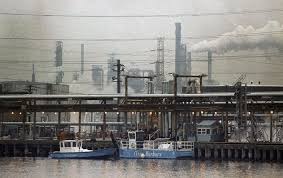
“To put this into perspective, Exxon Mobil is required to pay $225 million for damages to the environment in Northern New Jersey. Only $50 million of this sum will be dedicated to investing back into impacted communities with parks, waterfront access and habitat restoration,” said Debbie Mans, Baykeeper & Executive Director, NY/NJ Baykeeper. “These communities have lived too long with pollution and deserve justice.”
Several environmental and community organizations are urging the Legislative leadership to strike the language completely from the budget bill, rather than amend the existing language. The groups include: New Jersey League of Conservation Voters, NY/NJ Baykeeper, Ironbound Community Corporation, New Jersey Audubon, Trust for Public Land, American Littoral Society, ANJEC, Food & Water Watch, New Jersey Conservation Foundation, New Jersey Highlands Council, and NJ Environmental Lobby. (See attached letter.)
“It’s Groundhog Day. If this same compromise language is inserted we know the Governor will use his line item veto power, just as he did the last two years. In order to truly protect the funds and ensure they go to protect our most vulnerable communities and restore natural resources impacted by polluters, the language must be struck completely from the budget,” said Kelly Mooij, Vice President of Government Relations, New Jersey Audubon.
“It’s outrageous to see the Legislature once again complicit in the Governor’s attempt to rob Natural Resource Damage polluter money from communities throughout New Jersey ravaged by pollution, particularly communities of color which are disproportionately impacted,” exclaimed Ed Potosnak,.
“The Legislature just can’t keep their hands out of the cookie jar, and if this dangerous language remains in the 2018 budget families and business will be shortchanged once again and will never see there environment resorted,” Potosnak added.
“This money belongs in the communities and natural areas that have been harmed” said Tim Dillingham, Executive Director, American Littoral Society. “This budget raid adds insult to injury. These funds should remain dedicated to their intended use.”
Both houses of the New Jersey Legislature passed legislation, by over 70%, asking voters to constitutionally dedicate Natural Resource Damages to environmental restoration and enhancement and pursuing claims against polluters. If the question is passed it would end the Governor and Legislature’s ability to divert these funds, putting the lockbox in place mid-December this year. Until it is passed funds could be siphoned off to the General Fund. Voters will be asked the question on Tuesday, November 6th Ballot throughout New Jersey.
***********************************************
TO: Senate President Sweeney, Majority Leader Loretta Weinberg, Republican Leader Tom Kean Jr., Deputy Republican Leader Diane Allen, Chairman Paul Sarlo, Speaker Vincent Prieto, Majority Leader Louis Greenwald, Chairman Gary Schaer
We the undersigned write to urge the absolute rejection of any language capping the amount of settlement funds collected for Natural Resources Damages (NRD) or other environmental settlements that can be deposited into the Hazardous Discharge Site Cleanup Fund.
Dangerous language is again included in Governor Christie’s FY 2018 Budget on page D-130 aiming to divert funds away from restoration.i This provision could redirect hundreds of millions of dollars from future environmental settlements into the General Fund instead of restoring the environment. The specific provision of concern states that the first $50,000,000 in natural resource, cost recoveries and other associated damages recovered by the State shall be deposited into the Hazardous Discharge Site Cleanup Fund and are appropriated for: direct and indirect costs of remediation, restoration, and clean up; costs for consulting, expert, and legal services incurred in pursuing claims for damages; and grants to local governments and nonprofit organizations to further implement restoration activities of the Office of Natural Resource Restoration (within NJDEP). Recoveries in excess of the amounts appropriated pursuant to this paragraph shall be deposited in the General Fund as general State revenue.
The intention of NRD statute is for polluters, in addition to paying for cleanup from pollution, to compensate communities for the loss of the use of the natural resource and to restore those communities impacted by toxic dumping and chemical spills. If this cap provision is once again allowed to remain, nearly all restoration funds would be raided to support the general fund, leaving little money remaining to do important restoration work in and around the polluted site for which the settlement was awarded.
This provision in the FY18 budget directs money away from the restoration of natural resources and compensation, as intended by the original lawsuits and the laws they are being brought under, leaving communities that have been living with this pollution for decades empty handed.
This same language was in Governor Christie’s FY16 and FY17 budgets. Although, the Legislature amended it to require that one-half of any amount over $50 million would also be deposited in the Hazardous Discharge Site Cleanup Fund for FY2016, Governor Christie vetoed this amendment and the language was left unaltered in FY2017.
This language has already had an impact on communities. In September 2014, the Attorney General’s Office announced a $190 million settlement for pollution on the lower Passaic River. Only $50 million of that settlement will be used for natural resource restoration projects in and around Newark, Harrison, Bayonne and Jersey City.ii Projects that could provide open spaces, restored habitats and public access in our underserved communities. The remaining $140 million went into the General Fund.
The potential for more diversions will increasingly disaffect communities already strained with polluted water, diminished air quality, and toxic lands. Making a bad deal even worse, the $225 million ExxonMobil environmental settlement currently sitting in escrow will be subject to the same provision if allowed to remain in the proposed budget leaving families and business in Linden and Bayonne, as well as towns across the state where Exxon has pending environmental settlements, unable to fully restore their lost resources.
As a final point, the legislature has already overwhelmingly approved a ballot question for November that asks voters to constitutionally dedicate NRD funds to environmental purposes and the associated legal and administrative costs. By putting the question on the ballot, the legislature has determined diverting these funds is a big enough problem, that voters should have the opportunity to constitutionally protect NRD monies. By leaving the Governor’s language in the budget, the legislature is giving the administration one last chance to improperly divert funds away from communities before they are able to have their voices heard on this matter.
The language, in its totality, must be removed in order to prevent another executive maneuver by the Governor to divert restoration funds away from the damaged communities. Thank you for your attention to this important matter.
Sincerely,
Ed Potosnak, Executive Director
i Except as otherwise provided in this act and notwithstanding the provisions of any other law or regulation to the contrary, the first $50,000,000 in natural resource, cost recoveries and other associated damages recovered by the State, along with such additional amounts as may be determined by the Director of the Division of Budget and Accounting, in consultation with the Attorney General, to be necessary to pay for the costs of legal services related to such recoveries, shall be deposited into the Hazardous Discharge Site Cleanup Fund established pursuant to section 1 of P.L.1985, c.247 (C.58:10-23.34), and are appropriated for: direct and indirect costs of remediation, restoration, and clean up; costs for consulting, expert, and legal services incurred in pursuing claims for damages; and grants to local governments and nonprofit organizations to further implement restoration activities of the Office of Natural Resource Restoration. Recoveries in excess of the amounts appropriated pursuant to this paragraph, consistent with the terms and conditions of applicable settlement agreements or court rulings, shall be deposited in the General Fund as general State revenue.
Like this? Use form in upper right to receive free updates
See popular posts from the last 30 days in right column — >>