Degnan: When New York Gov. Andrew Cuomo engaged in shameful personal attacks Gov. Christie Christie put a stop to it.. (Aristide Economopoulos | NJ Advance Media, for NJ.com)
In an Op-ed today in the Star-Ledger, Port Authority chairman John Degnan writes:
Last week’s adoption by the Port Authority of New York and New Jersey of a $32 billion 10-year capital plan was an historic event that could never have happened without the support of Gov. Chris Christie.
The record amount of capital spending furthers recommendations of the 2014 Special Panel on the Future of the Port Authority and returns the agency to its core mission of transportation infrastructure with the most ambitious set of regional investments it has ever adopted.
Credit for the plan’s adoption can rightly be shared among many people. As a witness and participant in the lengthy and challenging process, it needs to be acknowledged that Christie was pivotal and instrumental in its final adoption. Some contend he has been “disengaged” from the Port Authority over the past few years. In reality and to the contrary, the governor has been an effective and persistent advocate for important components of the plan behind the scenes, without public fanfare, and I believe he is entitled to credit for that.
In the face of determined and vocal opposition by New York Gov. Andrew Cuomo to the inclusion of adequate funding for the replacement of an aging and obsolete bus terminal, Christie drove a bargain to include $3.5 billion in the capital plan for that project, an amount that virtually guarantees its completion.
When Cuomo tried to renege on that commitment, Christie was adamant about its inclusion. When Cuomo engaged in shameful personal attacks – including a call for my removal from bus terminal matters — in an effort to assert his own control over the process, Christie put a stop to it.
In the end, a chairman of the Port Authority rarely wins a battle with a powerful governor like Cuomo unless he or she has the firm and resolved support of the other governor, in this case Christie.
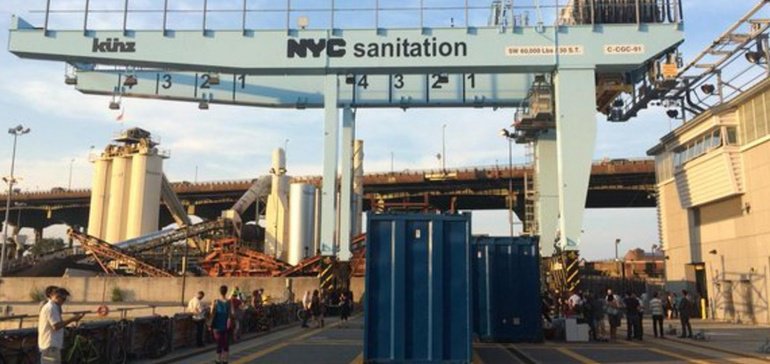
Cole Rosengren reports in Waste Dive: Waste Management has been selected by New York’s Department of Sanitation (DSNY) for a new $3.3 billion contract, ensuring that landfills will continue to play a large role in the city’s long-term waste strategy as it works toward a goal of “zero waste” by 2030. The 20-year deal involves shipping containerized waste via barges from two DSNY marine transfer stations (MTS) in Brooklyn — Hamilton Avenue and Southwest Brooklyn — to rail connection for long-distance export. Waste Management already has contracts with DSNY at three local rail transfer stations and this new contract will put them in charge of shipping a large majority of New York’s residential waste out of the city. This is part of an ongoing overhaul of DSNY’s infrastructure that will decrease the use of private transfer stations while significantly increasing export costs.
Rather than soliciting new bids, DSNY decided to review submissions from the original 2014 request for proposals. At the time Waste Dive confirmed that Waste Management and Covanta — both current export vendors – were among these bidders. It is unclear whether any other companies were considered. Republic Services was also an existing export vendor, but did not confirm whether it submitted a bid for this contract.
In October, multiple sources told Waste Dive that Waste Management was the leading contender due to cost considerations. DSNY subsequently confirmed that it was negotiating with one vendor, but declined to disclose further details. Later that month, DSNY posted a notice in New York’s official city record stating that a hearing would be held in November to discuss a proposed contract with Waste Management. The contract was for “transport and disposal of containerized waste” from the two Brooklyn marine transfer stations. The 20-year deal, with the option of two five-year renewals, was not to exceed $3.3 billion.
Like this? Use form in upper right to receive free updates See popular posts from the last 30 days in right column — >>
As of publication, this contract has not officially been registered with the city comptroller’s office and DSNY has not responded to a request for comment.
Based on a transcript of Waste Management’s quarterly earnings call on Feb. 16, Waste Management CEO Jim Fish cited New York among recent contract “wins” that would require capital expenditures in 2017. Later in the call, Fish went on to say that the Brooklyn MTS contract would start in July and spending had already begun on the necessary containers and other equipment required to operate the two stations. As described in the call, waste will be going to the company’s High Acres Landfill in western New York and Atlantic Waste Disposal landfill in Virginia.
According to Fish, once both marine transfer stations are operational Waste Management will be handling an estimated 1.8 million tons of material for DSNY. This includes the company’s rail export contracts at Harlem River Yards in the Bronx, Varick Street in Brooklyn and Review Avenue in Queens. DSNY currently collects more than 3 million tons of refuse from residents each year.
As envisioned in the city’s 2006 Solid Waste Management Plan, this MTS network was meant to reduce the use of private transfer stations in overburdened neighborhoods and improve operational efficiency. More than 10 years later, only the North Shore MTS in Queens is fully operational. Covanta has the contract for that facility as well as the highly contentious East 91st Street MTS in Manhattan, which is still under construction. The Hamilton Avenue MTS has been essentially finished for years and open to occasional public tours since at least 2015. Construction of the Southwest Brooklyn MTS has been beset with legal challenges andongoing pushback from local officials.
Joseph Vas, a former state assemblyman and Perth Amboy mayor who was convicted on corruption charges, was scheduled to be released from federal prison on Saturday. (Ed Murray | NJ Advance Media for NJ.com)
Vas, who has been serving a sentence at the Federal Correctional at Danbury, Conn., will complete that term and then be turned over to New Jersey corrections officials to complete a state prison term.
“He will be returned to New Jersey,” said Pat Lombardi, spokesman for the New Jersey Department of Corrections.
He said Vas must finish a state prison sentence that could keep him behind bars until June.
There has been little talk recently of the former mayor in Perth Amboy, said former city Councilman Ken Balut, but some have anticipated Vas’ release from a federal facility. “There been a whisper in the air that he’s getting out,” Balut said. “People had posted it. They’re passing it around,” he said of people mentioning Vas on social media. However, Balut said, he and others are aware that Vas still must serve a state sentence.
In October 2010, a jury in U.S. District Court in Newark found Vas guilty of five of nine corruption charges relating to his quest for campaign funds in his bid for a seat in Congress.
The jury found that Vas, while mayor of Perth Amboy in 2006, bought a 12-unit apartment building for $660,000, then quickly flipped it for $950,000, closing the deal with a promise to give the buyer $360,000 in city redevelopment funds. The former mayor funneled $80,000 from the sale to his congressional campaign.
A month after his federal conviction, in November 2010, Vas pleaded guilty to state corruption charges after a Superior Court judge rejected a dramatic and desperate last-minute request for an adjournment.
The following April Vas was sentenced to eight years in state prison, and required to serve at least five years before he was eligible for parole. The state sentence ran concurrent with the federal term.
He pleaded guilty in state court two counts of official misconduct and single counts of theft and money laundering to receive illegal campaign contributions.
Vas was accused of billing the city of Perth Amboy for $5,000 worth of clothing, sneakers and other personal items, and of conspiring to rig a lottery that gave city employee Anthony Jones the chance to buy a house built through a federal program for first-time home buyers.
Melvin Ramos, Vas’s aide, was a co-defendant in the federal and state cases. Ramos was also convicted in federal court and pleaded guilty to state corruption charges. However, he received shorter sentences. He completed a state prison sentence in 2013 and a federal term in 2014, according to public records.
Balut said Ramos has since returned to Perth Amboy.
Like this? Use form in upper right to receive free updates See popular posts from the last 30 days in right column —
>>
A board member at the bistate agency joins some transit watchdogs saying few riders will use LaGuardia AirTrain or PATH extension
Daniel Geiger reports for Crain’s
The Port Authority of New York and New Jersey’s passage of its largest ever capital plan on Thursday didn’t come without reservations from at least one of its board members.
During a public board meeting at the bistate agency’s lower Manhattan headquarters, Ken Lipper, a Port Authority commissioner appointed by Governor Andrew Cuomo, repeated his opposition to part of the $32 billion plan.
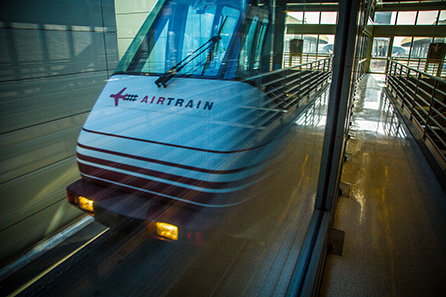
At issue was over $3 billion of spending reserved for an extension of the PATH to the AirTrain system serving Newark Airport, as well as a new AirTrain from Willets Point to LaGuardia Airport.
Lipper, who aired pointed criticism for the projects during a board meeting in December, reasserted his concerns that the two rail links would serve only a small group of riders, would be money losers for the Port and potentially damage its credit rating and fiscal health.
“It will strain the Port Authority,” said Lipper, who in his remarks suggested the two projects together will actually cost $4 billion. “I believe $4 billion could be spent where there’s greater demand for our services and where there’s ridership.”
The Port Authority has not yet conducted definitive ridership studies for the rail links that could confirm or refute Lipper’s criticism, even though both projects have been discussed for years.
“What hasn’t been done—and it should have been done—is an analysis of the ridership and data that would provide a better analytical base for spending the money,” the Port Authority’s New Jersey appointed chairman John Degnan told Crain‘s.
But Degnan said the board, including Lipper, ultimately voted unanimously in support for the capital plan because it allows projects to be further reevaluated before they actually break ground and require the agency to spend money.
“There will be several points over the next few years where the board will be called on to advance these projects further and the next time they’ll be revisited there will be more ridership data available and more cost updates and more certainty around the projected costs,” Degnan said. “That’s why all of us were comfortable, including Ken, voting for the capital plan.”
Some 600 opponents of a proposed South Jersey Gas pipeline through preserved areas of the New Jersey Pinelands voiced their outrage today at a 9-5 decision by the Pinelands Commission to permit the pipeline installation. The project has been fought in and out of court for years by environmentalists, three former governors, and the commission’s two previous directors. NJTV‘s Brenda Flanagan has the story above.
Wayne Parry AP photo
Wayne Parry covered the story for The Associated Press: New Jersey environmental regulators on Friday approved a hotly contested plan to run a natural gas pipeline through a federally protected forest preserve amid raucous protests that included drums, tambourines and choruses of “This Land Is Your Land.”
The 15-member New Jersey Pinelands Commission voted to approve a plan by South Jersey Gas to run the pipeline through the federally protected Pinelands preserve, where development is drastically restricted. The protesters’ loud ruckus drowned out the members, even as they voted nine in favor and five against, with one abstention.
It was the most emotionally charged jobs-vs-environment clash in recent New Jersey history, and was closely watched by environmental and energy groups around the nation, particularly with a new presidential administration seen as more supportive of the energy industry.
“As a priest, I will pray for you when you stand before the throne of God and you are asked to give an accounting of your stewardship of this special ecological area,” said Rev. David Stump, a Catholic priest from Jersey City. “May God have mercy on your souls.”
“Your legacy is disgraceful!” added Jeff Tittel, director of the New Jersey Sierra Club.
The company said the vote “recognizes the energy reliability challenges facing southern New Jersey and the balanced solution this project offers. The careful construction of this pipeline will address the energy demands of 142,000 customers in Cape May and Atlantic counties, protect and create jobs, and provide a meaningful opportunity to significantly reduce air emissions.”
The B.L. England power plant, where the pipeline would end, currently burns coal and oil to generate electricity.
“The use of natural gas and state-of-the-art emissions control technology, together, can turn the facility into a cleaner and more efficient generator of electricity for the people of south Jersey,” RC Cape May Holdings, the plant’s owners, said in a statement after the vote.
Protesters repeatedly disrupted the meeting, chanting “No! No! No!” for nearly 10 minutes when the commission was about to vote. They burst into song in protest whenever a commissioner voted in favor of the plan.
After the plan was approved, they chanted, “Shame on you!” and “See you in court!” Pipeline supporters including construction workers, though greatly outnumbered, chanted “USA! USA!”
Tittel said his and other environmental groups plan to challenge the approval in court on numerous procedural and factual grounds, hoping to delay it long enough for New Jersey’s next governor to appoint Pinelands commissioners that will reverse the decision. Republican Gov. Chris Christie’s successor will be elected in November.
Like this? Use form in upper right to receive free updates See popular posts from the last 30 days in right column — >>
The 22-mile pipeline plan was narrowly defeated in 2014. But since then, Christie has replaced several Pinelands commissioners with supporters of the pipeline.
Carleton Montgomery, executive director of the Pinelands Preservation Alliance, called the vote “a symptom of what’s going on nationally” regarding pipeline projects.
South Jersey Gas plans to run the pipeline mostly under or alongside existing roads. The company says it already operates over 1,400 miles of gas mains and 133 miles of elevated pressure lines within the Pinelands without harming the environment.
After the proposal was defeated in 2014, the executive director of the Pinelands Commission unilaterally decided that it met the agency’s criteria and was therefore approved. Environmentalists sued, and a court ordered the commission to take a new vote.
Read more here: http://www.mercedsunstar.com/news/business/article134687414.html#storylink=cpy
Environmental groups fear the pipeline will harm the fragile Pinelands and set a bad precedent for future development. They say it will cause a loss of habitat and increase runoff and erosion in an area that is home to an aquifer that is estimated to hold 17 trillion gallons of some of the nation’s purest water.
South Jersey Gas maintains that in addition to providing a cleaner fuel source to the power plant, the new pipeline would provide a second transmission vehicle for natural gas to customers in the two southern New Jersey counties. Currently, only one pipeline takes gas to nearly 29,000 homes and businesses, which could be left out in the cold without a second way of getting gas to their homes if the existing pipeline fails.
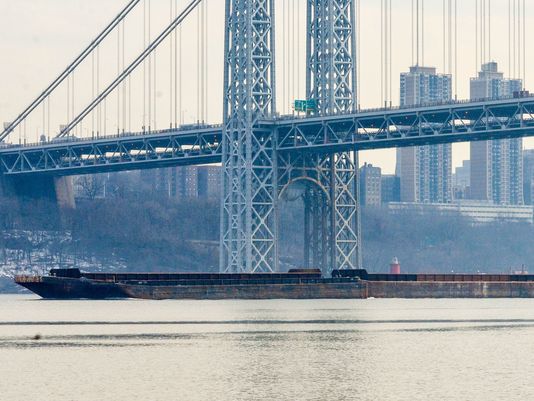
Just north of the George Washington Bridge near the preserved banks of Palisades Interstate Park lies a 715-acre section of the Hudson River that could soon become a virtual parking lot for the scores of oil barges that travel the waterway.
The U.S. Coast Guard is evaluating a proposal that would allow up to 16 barges to drop anchor in the middle of the river between Alpine and Yonkers, N.Y., to accommodate an expected increase in the amount of oil hauled to and from Albany N.Y.
It is the largest and southernmost of seven proposed anchorages on the Hudson, and has galvanized local officials, residents and environmental groups in New York. They say the plan is an environmental threat that will “re-industrialize” the river, make it unsightly and increase the risk of an oil spill. Supporters say it will make the river safer by having more places to anchor with increased traffic.
The issue, however, has gone largely unnoticed in New Jersey even though more people live along the state’s 26 miles of waterfront than ever before. Of the 10,212 comments sent to the Coast Guard about the project, few came from New Jersey.
“It’s the forgotten river for so many here, but this proposal will affect New Jersey, no question,” said Gil Hawkins, president of the Hudson River Fishermen’s Association, who lives in Leonia. “When you go to the Palisades and look down and see these giant oil barges instead of small boats or eagles hunting fish, maybe then people will realize how important this issue is.”
Over the past five years, the Hudson River has become a major transportation route for crude oil, with millions of gallons transported from upstate New York to refineries, including Bayway in Linden. The crude originates from the oil boom in North Dakota and is shipped by rail to Albany, where New York officials have allowed the amount handled at the city’s port to triple to 2.8 billion gallons annually.
While it is a boon for domestic oil production, it has raised concerns about the risk of a spill on the recovering waterway, though oil barges are required to have double hulls and there have been no major spills on the river. A tanker carrying crude ran aground near Albany in December 2012 and ruptured its outer hull but did not spill any of its 12 million gallons of oil.