Connecticut looks to wrap up plastic bag, film recycling

Cole Rosengren reports for WasteDive:


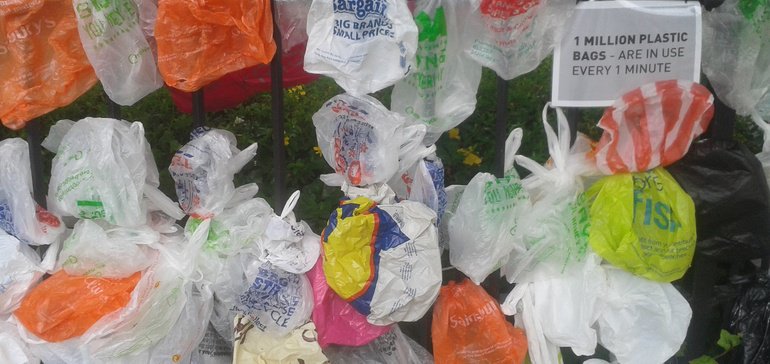
Connecticut officials, in partnership with the American Chemistry Council’s Flexible Film Recycling Group (FFRG)launched a new collection campaign this week to improve plastic film recycling rates. Residents are encouraged to recycle a range of products such as shopping bags and plastic wrap at 175 participating stores within the state.
About half of Connecticut residents don’t know about drop-off options for plastic recycling and many don’t know the full list of accepted materials, according to a recent survey. According to the American Chemistry Council, more than 18,000 stores now offer drop-off options for plastic film recycling nationwide.
Like this? Use form in upper right to receive free updates
See popular posts from the last 30 days in right column —
>>

Connecticut looks to wrap up plastic bag, film recycling Read More »

26-year-old New Yorker getting rich from scavenging cans

Aaron Elstein reports for Crain’s New York:

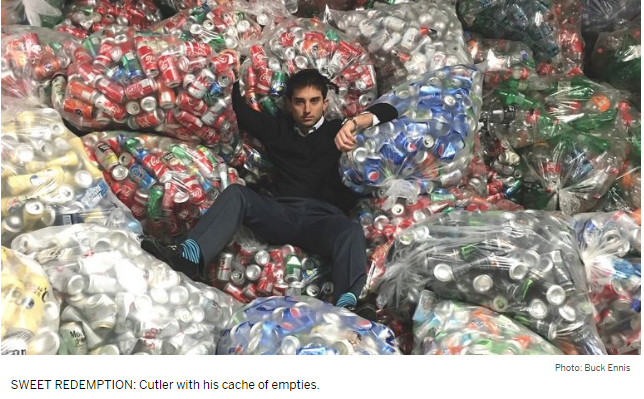
Conrad Cutler drives a Porsche Macan, which seems fitting considering the 26-year-old entrepreneur has made his money one can—and bottle—at a time.
Less than five years out of college, Cutler runs Galvanize Group, a four-year-old business that generates almost $10 million in annual revenue from collecting recyclable cans and bottles around the city and returning them to the distributors, who pay the 5-cent deposit plus a state-mandated 3.5-cent handling fee for each one.

In the winter about 1 million empty containers of Coke, Poland Spring and other beverages consumed in the city are sorted weekly by about 35 full-time employees at his Mount Vernon warehouse. Volume doubles during the warmer months, when New Yorkers tend to consume more cold drinks, so he keeps his shop open 24 hours in the summer.

“My friends make fun of me, saying I go through people’s garbage for a living,” said Cutler, whose company processes about 110 mil
llion empty bottles and cans every year.

“One part of the 
government encourages redeeming recyclables; another part discourages it. And we’re caught in the middle.”

Cutler’s pals may mock him, but to city officials, his bustling business is no laughing matter. In their eyes he and the collectors who supply him are undermining the municipal recycling program by seizing the most valuable items before the city can pick them up and resell them as a commodity. Metal, glass and plastic collected by sanitation department crews are routed to a private company called Sims Municipal Recycling, which has a multiyear agreement with the city to process recyclables at a Brooklyn facility.
In a trade publication in 2012, Robert Lange, a former head of the city’s Bureau of Waste Prevention, Reuse and Recycling, labeled outfits like Cutler’s a “sophisticated mob of scavenger collectives that systemically removes valuable recyclables…and leaves the worthless and costly-to-collect rest for the Department of Sanitation.”
A less harsh critic, Wayne DeFeo, an industry expert and founder of consulting firm DeFeo Associates, said Cutler operates in an “ethical gray zone.”
The controversy rests on how Cutler goes about gathering his millions of bottles and cans. Some come from large retail outlets, such as CVS stores. Most, however, are sourced via a network of 100 subcontractors who have relationships with apartment supers and property managers and give Cutler’s crews first dibs on recyclables before they’re hauled to the curb. (It’s illegal to rummage through recyclables once they’re curbside, but it’s impossible for Cutler to police that.)

Photo:
DIGGING FOR ALUMINUM: Cutler gets cans and bottles from a network of 100 subcontractors. It’s illegal to grab recyclables from the curb, though Cutler can’t police his whole supply chain.

Bars and restaurants are less important sources, as those establishments seldom generate more than a few hundred empties per day. The largest volume comes from office buildings.
“A big tower will have thousands of people working in it and consuming two or three bottled beverages every day,” said Cutler, adding that a dedicated collector can bank up to $200 a day, which translates to 4,000 bottles or cans daily.
Plus, Cutler said, his firm helps make the city cleaner by picking up recyclables that might otherwise litter the streets. Such litter remains common even though the state has imposed a refundable nickel deposit on every bottle and can of soda or beer since 1982. (Plastic noncarbonated beverage bottles were added to the mix eight years ago.)

Read the full story here 


Like this? Use form in upper right to receive free updates
See popular posts from the last 30 days in right column — >>

 

26-year-old New Yorker getting rich from scavenging cans Read More »

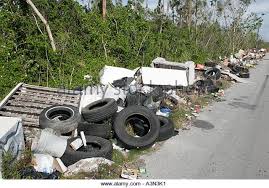
State finds 9 illegal dump sites, writes 200 tickets on LI, NY

Emily C. Dooley reports for Newsday:

New York State environmental conservation officers and police fanned out around Long Island, the Hudson Valley and New York City last week, finding nine illegal dumping sites and issuing nearly 200 tickets for unlawful disposal, operating without a permit and other violations, Gov. Andrew M. Cuomo’s office announced Monday night.

More than half the tickets were issued on Long Island as part of roadside checkpoints near exits 62 and 66 on the Long Island Expressway. Trucks were followed in three cases and one possible dumping site will be investigated, although authorities would not say where because the case is ongoing. 


The nine illegal dumping sites were found in the Hudson Valley.The crackdown took place Feb. 15 and Feb. 16 and involved more than 100 environmental conservation officers, state police, local police agencies and the state Department of Transportation.

Department of Environmental Conservation Commissioner Basil Seggos said last week’s action was one of several that would happen in the coming months.

“We will continue to do all that we can to keep toxic waste and debris from being dumped in our communities,” Cuomo said in a news release announcing the crackdown.

Read the full story here


Like this? Use form in upper right to receive free updates
See popular posts from the last 30 days in right column —
>>
State finds 9 illegal dump sites, writes 200 tickets on LI, NY Read More »

Tom Moran remembers NJ political veteran Jamie Fox, 62

Jamie Fox, who served both parties in New Jersey state government, dead at 62

** Updated to add a related news story below**
 
Tom Moran, the Star-Ledger’s political columnist and editorial writer, begins his eulogy for Jamie Fox like this:


Let me start by confessing that I am hopelessly biased on this one. But I am not the only one, not by a long shot.
Jamie Fox just died. He was 62. He was a friend of mine, and throw-back of the sort that seems to be passing from this earth, marching to extinction in the path of the dinosaurs.
After a lifetime in politics, fighting one tough campaign after another, serving in the cabinet of two governors, he somehow won the unreserved affection and respect of people on both sides of the aisle.
He was a Democrat, and not a gentle one. But when the bell rang, he put his weapons down and looked for the human beings behind the opponent’s armor.
Put it this way: He was friendly with Gov. Chris Christie, who appointed Fox to his cabinet. And yet, one of his closest friends was Sen. Loretta Weinberg (D-Teaneck), the governor’s arch-enemy.

“I guess that sums it up,” Weinberg says. “Everybody liked Jamie, and it stretched to both extremes in New Jersey politics.” 

Read the full piece here (it’s worth it)


Related news story:

Jamie Fox, longtime N.J. political operative, dies

Like this? Use form in upper right to receive free updatesSee popular posts from the last 30 days in right column — >>

Tom Moran remembers NJ political veteran Jamie Fox, 62 Read More »

From butcher to recycler to award winner: Pat McGaheran

How does one go from 10 years as a butcher store owner to a successful career in paper recycling?


Pat McGaheran says the secret is communication and taking good care of your customer.


Pat also has been contributing both skills for many years as a board member of the Association of New Jersey Recyclers.

ANJR recognized  his contributions this year by presenting him with its highest honor– the REX Award for recycling excellence.

Meet Pat McGaheran

Disclosure: ANJR is a client of our sister business, Brill Public Affairs

Like this? Use form in upper right to receive free updates
See popular posts from the last 30 days in right column —
>>
From butcher to recycler to award winner: Pat McGaheran Read More »

In Philly, opting for home deconstruction over demolition

Greg Trainor, founder of Philadelphia Community Corps

Caitlin McCabe writes for the Philadelphia Inquirer:


Cities from Seattle and Portland to Baltimore have been experimenting with deconstruction as an alternative to demolition. With more than 245,000 residential structures and nearly 50,000 commercial structures demolished nationwide each year, generating by some estimates about 136 million tons of waste, preservationists have touted deconstruction as a system that could transform development practices — and cities.

Skeptics, however, have pegged deconstruction as an inefficient and initially expensive system — one, they say, that cannot expeditiously tackle urban blight.

The idea behind it is simple: When a home falls victim to blight, a developer, property owner, even a city planner can hire a team of deconstructionists to dismantle it. Rather than eliminating the house in a quick job with a demolition truck, the team instead strips it down, salvaging doors, bathtubs, and bricks along the way. By using manual labor, advocates say, deconstruction can boost local employment.


It’s an approach that (Greg) Trainor’s deconstruction company, Philadelphia Community Corps, is banking on. In 2010, it was estimated, 40,000 parcels here — both properties and tracts of land — were vacant. Recent estimates from the city’s Department of Licenses & Inspections put the number of vacant structures alone at about 15,000


Like this? Use form in upper right to receive free updates
See popular posts from the last 30 days in right column —
>>

In Philly, opting for home deconstruction over demolition Read More »