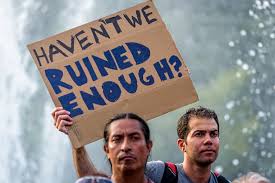
On immigration: A tale of two states, NJ and NY

Unlike state and local officials in the Empire State, Gov. Christie is supporting the president’s travel ban and formally ending the state refugee-resettlement program

liberty


Matt Katz reports for NYC/News:


In front of the Statue of Liberty sits New York, where local and state government are at the forefront of fighting President Donald Trump’s efforts to restrict immigration of refugees and would-be political asylees.  [Editor’s note: asylees]
Behind her back sits New Jersey, where Gov. Chris Christie is taking the opposite approach, supporting the president’s travel ban and formally ending the state refugee-resettlement program.
Here’s a rundown of the difference between the two states when it comes to the hot-button national issue of the moment:
New York: Attorney General Eric Schneiderman has become something of the face of the opposition against Trump in a variety of areas, including immigration. He joined a lawsuit against Trump’s now heavily litigated executive order temporarily banning certain refugees, calling it discriminatory and a new low in American foreign policy. He also sent legal help to refugees stuck at John F. Kennedy International Airport.

New Jersey: Attorney General Chris Porrino is a friend and appointee of Christie’s, and he has stayed mostly quiet about the situation even as attorneys general in the states across the northeast — New York, Pennsylvania, Delaware, Connecticut, and Massachusetts — joined a lawsuit against Trump’s travel ban now winding its way through the courts. Christie, a staunch ally of Trump’s who has said he was offered jobs in the Trump administration, agrees with the president’s travel ban. He has only criticized the rollout, which he blamed on Trump’s staffers.

New York: Immigration advocates say services for immigrants in New York have long been superior to those offered in New Jersey, from health coverage to language assistance to legal aid. And last month, New York Gov. Andrew Cuomo launched a hotline to assist immigrants affected by Trump’s executive order.

New Jersey: As a presidential candidate in November 2015, Christie announced that New Jersey would no longer settle refugees from Syria, even 5-year-old orphans. By this past October, the state had fully “divested” from its refugee program, according to a spokeswoman. Refugees are still coming to New Jersey — including a Syrian family moving to Union City this week — but they are being resettled by a nonprofit agency, the International Rescue Committee. That means, for example, that refugees in New Jersey now go to the International Rescue Committee to collect allotted federal cash assistance, instead of state government. And a phone number that New Jersey once operated for refugees is no longer in service — an operator this week referred WNYC to the International Rescue Committee.

New York: The state maintains a robust website for its Bureau of Refugee and Immigrant Assistance to help refugees with  “economic and social self-sufficiency.” The site includes an educational curriculum to help teenage refugees find employment.
New Jersey: A spokeswoman for the state Department of Human Services confirmed this week that all information helping refugees is being removed from its web site. While the landing page still exists; information for refugees on getting help with child care, homelessness, and welfare has been purged.
New York: In the wake of Trump’s election to the presidency Cuomo ordered the New York State Police to create a special unit to investigate the growing number of hate crimes.New Jersey: The state already has a Bias Crime Unit — and efforts were announced to step up patrols of mosques after the Quebec mosque shooting last month — but a calendar of significant dates in which bias crimes may occur hasn’t been updated in five years.
New York: If Trump cuts funding to so-called sanctuary cities like New York that are refusing to cooperate with federal immigration law enforcement officers, Mayor de Blasio said he’d go to court immediately to fight the president. He’d likely be backed up by Schneiderman and Cuomo.

New Jersey: Christie said he will be a “willing partner” with Trump on his efforts to crack down on sanctuary cities. That could have severe financial ramifications in many urban communities like Jersey City, whose mayor has signed his own executive order, declaring it a sanctuary city.

Like this? Use form in upper right to receive free updates
See popular posts from the last 30 days in right column — >>
 

On immigration: A tale of two states, NJ and NY Read More »

Your NFL birds have winged away but here’s good news


Down in the dumps because your favorite flock of Falcons, Ravens, Seahawks or Eagles won’t return to the field until next August? Take heart. The majestic Snowy Owl has returned to fields, dunes and maybe even some buildings in New Jersey.


The Snowy Owl is a favorite of ours and we can’t seem to learn enough about this beautiful creature. NJTV News anchor Mary Alice Williams helps out with an information-packed chat above with NJ Audubon Society bird expert, Scott Barnes


Like this? Use form in upper right to receive free updates
See popular posts from the last 30 days in right column — >>


Your NFL birds have winged away but here’s good news Read More »

Environmental bills set for votes Thursday in NJ Assembly

NewsWorks photo

ALERT: CANCELLED DUE TO EXPECTED SNOW STORM

The following environmental bills are among more than 50 pieces of legislation scheduled for a floor vote Thursday (February 9) in the New Jersey Assembly:


A-963  Wolfe, D.W. (R-10); McGuckin, G.P. (R-10)
Requires DOT, NJTA, and SJTA to use only native
vegetation for landscaping, land management, reforestation, or habitat
restoration.  
Related Bill: S-227
      
A-1649  Schaer, G.S. (D-36); Spencer, L.G. (D-29) 
Requires local governments and authorities to obtain
financing cost estimate from NJ Environmental Infrastructure Trust for certain
projects.  
Related Bill: S-853
      
A-4395  Schaer, G.S. (D-36)
Requires continuing identification and remediation of
waste tire sites.
      
S-227  Holzapfel, J.W. (R-10); Allen, D.B. (R-7)
Requires DOT, NJTA, and SJTA to use only native
vegetation for landscaping, land management, reforestation, or habitat
restoration.  
Related Bill: A-963

     
Like this? Use form in upper right to receive free updates
See popular posts from the last 30 days in right column — >>

Environmental bills set for votes Thursday in NJ Assembly Read More »

Bill to punish sanctuary cities passes Pa Senate

Emily Previti reports for WITF:

The Municipal Sanctuary and Federal Enforcement, or SAFE, Act would restrict state funding for communities where law enforcement agencies don’t cooperate with Immigration and Customs Enforcement.

The bill would require municipalities to prove they’re complying with the law when submitting applications for certain state grants, loans and economic development and other programs.
More than $1.3 billion could be affected, according to estimates from legislation sponsors.

Compliance, under this proposal, means law enforcement agencies communicate with ICE about people in custody, and hold anyone with a detainer. A detainer is a written request from ICE that a local jail or other law enforcement agency detain an individual for an additional 48 hours beyond local law enforcement custody, in order to provide ICE agents extra time to decide whether to take the individual into federal custody.

State Sen. Guy Reschenthaler, R-Washington, is the prime sponsor of the bill. He responded to supporters of sanctuary cities who say promising not to turn over individuals to ICE helps undocumented immigrants feel that they can trust police, and so they will be more likely to report crimes.

“This only pertains to undocumented immigrants who are in police custody pursuant to a lawful arrest,” Reschenthaler says. “Victims, witnesses and individuals reporting crimes — they’re not affected.”
Reschenthaler cites horrific crimes committed by people living in the United States illegally after being released from police custody.
Majority leader Jake Corman, R-Centre, described a common courtesy of sorts: cooperation with ICE as with any other law enforcement agency.

“If someone was arrested on drug charges and the [district attorney] had a flag on this person, we would probably cooperate, and say, ‘Hey, you know, we got this guy or a woman.’ And … they would know [we have them] and I think that’s all we’re asking here,” Corman said.

But opponents say the measure presents a lot of risks: police profiling, trampling on residents’ rights to due process, and taxpayer liability for improper detentions.

“If the opportunity to save a life is there, then this body should take it very seriously,” said state Sen. Larry Farnese, D-Philadelphia. “But if that is the course that we are going to take, … before today, there have been many bills that if they were enacted, not one, but hundreds of lives would most likely have been saved.”

Farnese went on to provide the example of stricter gun regulations that are proposed and “never even get the chance to be debated.”

The measure passed out of the Senate Tuesday after more than an hour of debate,  with a 37-12 vote, almost exactly along party lines (Lisa Boscola, D-Lehigh/Northampton, and John Yudichak, D-Luzerne, were the sole Democratic supporters).

It now goes to the House.


Asked about veto potential, Gov. Tom Wolf’s spokesman J.J. Abbot said via email:

We have concerns about this bill, including whether states may legally require that municipalities assist with the enforcement of federal law, as the federal government must enforce its own immigration policy. We also have concerns about the impact on citizens and families from the loss of federal and state funding if municipalities or counties don’t comply.


Like this? Use form in upper right to receive free updates
See popular posts from the last 30 days in right column — >>


Bill to punish sanctuary cities passes Pa Senate Read More »

Second wind farm off Rhode Island moving closer to reality

        Alex Kuffner reports for
The Providence Journal:
A second wind farm proposed in waters off Rhode Island cleared a major hurdle in January when the public utility on Long Island approved a long-term contract to buy power from developer Deepwater Wind.
The board of trustees of the Long Island Power Authority unanimously approved a 20-year agreement to purchase energy from the 90-megawatt South Fork Wind Farm, which would be triple the size of the demonstration project off Block Island that Providence-based Deepwater completed last fall.
Deepwater Wind is among three companies seeking to develop large-scale wind turbine farms in leased federal waters about 15 miles south of Martha’s Vineyard. The company announced a downtown New Bedford office last September.
The company’s Massachusetts vice president is Matthew Morrissey, a former economic development director for New Bedford and the first director of the city’s Wind Energy Center, formed in 2013.
The five-turbine Block Island Wind Farm is the first offshore wind farm in the United States.
A proposed $740-million array of up to 15 turbines that would be built for LIPA in Rhode Island Sound is poised now to be the second, with a projected completion date of 2022.
The deal comes at an uncertain time for offshore wind. Although President Donald Trump has pledged support for an all-of-the-above energy strategy, he has also disparaged the aesthetics of wind turbines and there is concern about the future of a federal investment tax credit that is important to the industry.
Deepwater CEO Jeffrey Grybowski said he is confident that the project will qualify for the tax credit and move forward.
Like this? Use form in upper right to receive free updates
See popular posts from the last 30 days in right column — >>

Second wind farm off Rhode Island moving closer to reality Read More »

Great White Father Trump ready to grab more tribal land


The deputy secretary of the Army will grant the final permit needed for completion of the Dakota Access Pipeline, the Army declared in a court filing Tuesday, clearing the final bureaucratic hurdle standing in the way of the massive infrastructure project.
The Army’s intention to grant a 30-year easement under Lake Oahe, which came in a court filing over an ongoing federal environmental review of the controversial project, was immediately hailed by congressional Republicans and decried by members of the Standing Rock Sioux tribe and other opponents of the pipeline. In documents filed with the U.S. District Court for the District of Columbia, Army officials indicated that they were terminating a plan to prepare an environmental-impact statement on how the pipeline would affect land and water along its 1,170-mile route.
The move, coming two weeks after President Trump instructed the Army Corps of Engineers to conduct an expedited review of the easement, underscores the new administration’s intent to spur infrastructure development and support the fossil fuel industry. Both during the presidential campaign and since taking office, Trump has spoken of the need to accelerate domestic energy production and the construction of pipelines that can bring oil and gas to market.
While couched in dry language–the letter from Deputy Secretary of the Army Paul D. Cramer to Rep. Raúl M. Grijalva (D-Ariz.) detailed the 7.37 acres the pipeline would traverse on federal property–the easement marks a major blow to activists who had come from across the country last year to gather on the Great Plains and mark the land as the site where a tribe and its allies would defy the federal government. Those opponents argued the project–which crosses four states and would carry crude oil from the rich shale oil basins of western North Dakota to the pipeline networks and refineries in the Midwest–could damage the environment and disturb ancient burial grounds.
Construction cannot begin until the actual easement is granted, which Cramer wrote will be given to the project’s sponsor Energy Transfer Partners no later than Wednesday afternoon. The 1,100-mile stretch running underneath Lake Oahe is one of the final parts to be built, and it will take between 60 and 80 days from the start of construction before the pipeline will become operational.
In the meantime confrontations between activists and law enforcement, who have already clashed on the proposed site of the project, could flare up once again. While the Standing Rock Sioux tribe has urged its supporters to go home due to worsening weather conditions, a few hundred protesters have remained. Last week, authorities arrested 74 activists who had decamped from the tribal reservation to land owned by Energy Transfer Partners.
Like this? Use form in upper right to receive free updates
See popular posts from the last 30 days in right column — >>

Great White Father Trump ready to grab more tribal land Read More »