In the birthplace of U.S. oil, Methane leaking everywhere

A mail box sits on an abandoned well pipe near blooming peonies, logs snag on metal casings rising out of a creek, children swing next to rusted pump jacks.
Jennifer Oldham reports for Bloomberg:
In Pennsylvania, birthplace of the U.S. oil industry, century-old abandoned oil wells have long been part of the landscape. Nobody gave much thought to it when many were left unplugged or filled haphazardly with dirt, lumber and cannon balls that slipped or rotted away.

A home in Pennsylvania with an old pumpjack and tank in front yard.


Photographer: Chris Goodney/Bloomberg

But the holes — hundreds of thousands of them pockmark the state — are the focus of growing alarm, especially those in close proximity to new wells fracked in the Marcellus shale formation, the nation’s largest natural-gas field. They leak methane, which contaminates water, adds to global warming and occasionally explodes; four people have been killed in the past dozen years.
“We had so much methane in our water, the inspector told us not to smoke a cigar or light a candle in the bath,” said Joe Thomas, a machinist who lives with his wife, Cheryl, on a 40-acre farm with at least 60 abandoned wells. Patches of emerald-hued oil leech to the surface, transforming the ground into a soupy mess.
Hundreds like the Thomases live over lost wells.
Like this? Use form in
upper right to receive free updates

See
popular posts from the last 30 days in right column — >>

Reviewing Rules

Now the state’s attorney general is reviewing rules requiring drillers to document wells within 1,000 feet of a new fracking site. This puts Pennsylvania among states such as California, Texas, Ohio, Wyoming and Colorado confronting the environmentally catastrophic legacy of booms as fracking and home development expand over former drilling sites.

Oil and other pollutants from an abandoned oil well on the property of Joe and Cheryl Thomas.


Photographer: Chris Goodney/Bloomberg

As the number of fracked wells increases, so does the chance they might interact with lost wells. Pennsylvania regulators have documented several instances of fracking too close to an abandoned hole, causing methane to leak into homes, the air or water.
At least 3.5 million wells have been drilled in America since operators plumbed the first hole in the small Pennsylvania town of Titusville back in 1859.  It was oil pumped from this rugged landscape, near the state’s western border with Ohio, that John D. Rockefeller started refining a few years later in a venture that would evolve into the Standard Oil Trust.

Years of Work

Today, about a quarter of the 3.5 million wells across America are active, leaving an inventory of 2.6 million that are no longer in use. The locations of some inactive wells are documented, but little is known of the whereabouts of wells drilled before permitting regulations were enacted 60 years ago. Only 10 percent of abandoned wells are recorded in state databases — meaning there are years of work ahead to locate and plug them. Seth Pelepko of Pennsylvania’s Department of Environmental Protection says the agency has plugged only 3,000 such sites in 30 years.

Barr points out an abandoned oil well in the Allegheny National Forest.


Photographer: Chris Goodney/Bloomberg

Regulators are ramping up detection efforts, including testing the use of drones equipped with magnetometers. For the moment, however, they rely on a low-tech solution of “citizen scientists” who hunt for leaking wells near watersheds and recreation areas in the Allegheny National Forest.

Click here to read the full story

Like this? Use form in
upper right to receive free updates

See
popular posts from the last 30 days in right column — >>


In the birthplace of U.S. oil, Methane leaking everywhere Read More »

How Navy bases contaminated drinking water in Pa. towns

Hope Grosse and brother Chris Martindell (Michael Bryant photo)


When the planes
burned, the kids would come out.


Hope Grosse and her siblings would run down their Warminster street and
rubberneck amid shrieking sirens. They would watch Navy firefighters shoot a
dense white foam from hoses, smothering the flames that leapt up from the
fenced-off lot.

When the blackened
plane was cool, the children would climb the fence and jump into the burned-out
cockpit, pretending to be pilots, Grosse recounted.


The plane, and the
field where the Navy conducted drills, was also a playground for the Kirk Road
kids back in the 1970s and ’80s. They did not know then that the firefighting foam could be toxic, or that it would seep into their drinking water.

Now Grosse wonders,
like at least hundreds of others in Bucks and Montgomery Counties: Have we been
poisoned?

For decades, Navy
personnel used the firefighting foam at hundreds of bases. Now they know that
it contained chemicals linked to cancers, and that those chemicals flowed
through the groundwater, into wells, and out of the faucets 
of thousands of
residents in Southeastern Pennsylvania.
Two former
bases just north of Philadelphia have become the first Navy sites linked to
drinking water tainted by these chemicals. As the Department of Defense
investigates others across the country, what happens here could help shape the
response nationwide.

Since 2014, nearly half of public drinking wells and scores of
private wells in Horsham, Warminster, and Warrington have been shut down
because of contamination. Some homeowners may have to use bottled water for up
to a year; others have switched to bottled by choice.

Public awareness and alarm spiked last month when federal
regulators issued new and stricter water quality standards that called into
question drinking water that had previously been deemed safe.

Like this? Use form in
upper right to receive free updates

See popular posts from the last 30 days in
right column — >>

How Navy bases contaminated drinking water in Pa. towns Read More »

Rift grows between Pa. Gov. Wolf and environmentalists

Marie Cusick reports for StateImpact:
As Pennsylvania’s July 1 budget deadline looms, Governor Tom Wolf is finding common ground with the Republican-led legislature on bills affecting climate change policy and regulations for the oil and gas industry.
But it’s leading to a growing rift between his administration and environmentalists.
“He’s caving on the environment”
“The environment has historically been the low man on the totem pole in budget negotiations,”says Rep. Greg Vitali (D- Delaware).  ”It’s frequently been traded off by the Democrats to get other things.”
Last week Vitali called a press conference to blast Wolf for what he views as a failure to prioritize the environment. Vitali is particularly upset the governor is on board with a Republican-led effort to kill tougher regulations for the conventional oil and gas industry.
“I don’t know why he’s caving on the environment, but he clearly is caving,” Vitali says.

The conventional industry drills shallower wells and get far less attention than the deeper, newer operations in the Marcellus Shale. But the number of producing conventional wells stands at more than 74,000 statewide and dwarfs the number of Marcellus wells. In 2014 the conventional industry was cited for 1,449 environmental violations.

Joanne Kilgour heads the state chapter of the Sierra Club and points out the proposed Chapter 78 regulations were almost complete. They’ve been in the works for five years, as part of a process that began under Wolf’s predecessor, Republican Governor Tom Corbett. In April the regulations were approved by a state commission, which found they were in the public interest.
“It would be unacceptable and offensive for any lawmaker to agree to a compromise that would abrogate any portion of this rulemaking,” says Kilgour.
Likewise, Rep. Steve McCarter (D-Montgomery County) opposes efforts to torpedo them at the eleventh hour.
“Those regulations were long in the making,” he says. “Yet in the span of less than hour the House Environmental Resources and Energy Committee voted to set them aside.”
Bureaucrats “run wild”
Republicans see things differently. Rep. John Maher (R-Allegheny) chairs the committee and says the measure is an effort to rein in bureaucrats who have “run wild” at the state Department of Environmental Protection and overstepped their authority. The rules for the conventional industry are too similar to those designed for the Marcellus Shale drillers, he says. So, they need to go.
“The governor’s on board with this bill as it stands right now,” Maher told the House Tuesday. “This is one of those happy moments when we actually see the legislature and the governor sitting down and sorting things out.”
Like this? Use form in upper right to receive free updates
See popular posts from the last 30 days in right column — >>

Rift grows between Pa. Gov. Wolf and environmentalists Read More »

NY State lawmakers out to shred NY City bag fee

Environmentalists who lobbied for months to get New York City Council to adopt a fee on single-use plastic and paper grocery bags may see their victory snatched away by state lawmakers in Albany.

Marcus Solis reports for ABC 7


Nearly a month after the New York City Council voted to approve a tax on plastic and paper shopping bags, the New York State Senate passed a bill on Tuesday that prevents cities all across the state from doing just that.

The legislation, sponsored by Brooklyn Democratic Senator Simcha Felder, would block the 5-cent tax that was scheduled to go into effect on October 1 in New York City. Fines wouldn’t start until April 1, 2017.


Wednesday afternoon, Liz spent $120 on groceries that she’ll try and make last for two weeks.

But under a new city law, every bag in her cart, and most bundles are double bagged, would have cost her an extra five cents.

“My pocket it will affect because I’m constantly shopping,” Liz said.

The City Council passed the law last month. The goal is to cut down on single use plastic bags, which are rarely recycled and end up as trash in landfills.

The Bronx borough president acknowledges the environmental concerns, but calls the fee: a tax.

“We believe that we have to protect the environment, but we can’t do that on the backs of the poor,” said Ruben Diaz, Bronx Borough President.


Nick Powell sees this as another case of Albany overreach

The law was supposed to go into effect in October. The state senate has passed its own bill that would prevent municipalities from imposing such fees because of the economic impact.

The city has agreed to work with the assembly to change the law, rather than have it blocked altogether.

“It’s good it’s being delayed. It’s terrible that they are going to charge us for bags, it should be free,” said Ben Reyes, a Bronx resident.

The Bronx borough president says he would like to see incentives or a public awareness campaign to cut down use.

“Where we educate folks, we’ll teach them to change that behavior, but we protect the environment and we do so in a way that people are not going to have an added strain in their pockets,” Diaz said.

For now the law is scheduled to go into effect in February. As for Liz, she seems resigned to the fact that some change is coming.

“It is what it is either way,” Liz said.

The bill has been sent to the Assembly and will be voted on next week before it is sent to Governor Andrew Cuomo to sign into law.

Like this? Use form in upper right to receive free updates
See popular posts from the last 30 days in right column — >>


NY State lawmakers out to shred NY City bag fee Read More »

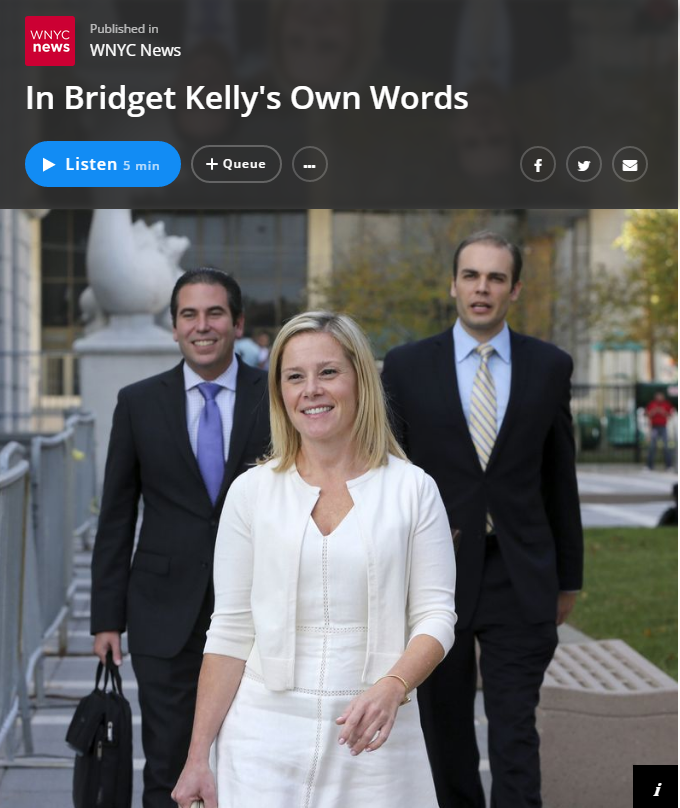
Judge won’t let ex-Christie aides out of GWB trial

Bridget Anne Kelly and Bill Baroni lose attempt to have ‘bridgegate’ case charges dismissed 

A federal judge has rejected arguments made by two former allies of Governor Christie seeking dismissal of charges related to their alleged roles in the politically-motivated closure of access lanes to the George Washington Bridge.

An in-depth look at the scandal over the lane closures at the George Washington Bridge and related aftershocks. Click here to launch.

Paul Berger reports in The Record:

Christie’s former deputy chief of staff, Bridget Anne Kelly, and his former top executive appointee at the Port Authority, Bill Baroni, were indicted last year on charges of conspiracy, fraud and civil rights violations related to the bridge lane closures.

The pair were accused of creating massive traffic jams in Fort Lee over four mornings in September 2013 to punish the town’s mayor for not endorsing the Governor’s re-election.


Their attorneys claimed that prosecutors twisted and stretched federal laws to build a high-profile case. They said that the pair could not have known that their actions would ever be construed as illegal.

In a ruling published Tuesday, U.S. District Judge Susan D. Wigenton dismissed the defendants’ claims.

“If true, the facts do not allege a mistake or a misunderstanding of policies or rules,” Wigenton wrote, “but rather an intentional desire to subvert existing policies and/or practices in order to achieve an improper end.”

Wigenton also dismissed claims made by Baroni’s attorney that Baroni’s testimony before a state legislative committee was improperly used by prosecutors.

“Because Baroni was not under oath when he appeared before the Committee, his testimony is not immunized,” Wigenton wrote.

The trial is due to begin in Newark on Sept. 12.

Judge won’t let ex-Christie aides out of GWB trial Read More »

Enviros rally in Harrisburg today for clean energy

The following story was provided by Public News Service 


Hundreds traveled to Harrisburg today to rally for clean energy and climate action. 

Calling themselves Clean Power PA, the broad coalition of environmental advocates, health professionals, business interests and concerned citizens came from across the Commonwealth.

Adam Garber, field director for PennEnvironment, says members of the General Assembly are out of step with their constituents.

“While they’re attacking everything from the Clean Power Plan to new protections from fracking, citizens are coming to demand their legislators do something positive to reduce the climate pollution that’s driving extreme weather and asthma attacks in our communities,” says Garber.

Legislators have introduced bills they claim will save jobs and protect the energy industry from excessive federal and state rules. But according to Garber, those bills would undermine critical environmental programs.

In particular, he’s concerned about Senate Bill 1195.

“Which would hamper the state’s ability to come up with a strong Clean Power Plan to move us towards clean energy and an energy-efficient economy while slashing climate pollution,” says Garber.

The federal Clean Power Plan, requiring states to meet goals for reducing carbon emission from power plants, has been put on hold by the U.S. Supreme Court as it is being challenged by several states.

Garber notes the Supreme Court has ruled several times that the Environmental Protection Agency has the authority to regulate carbon emissions from a variety of sources.

“And we would be better off as a society if polluters recognize that reality and helped come up with a plan that moved us towards a clean energy future, rather than trying to delay any action,” says Garber.

The advocates are also urging the General Assembly to reject bills that would loosen gas and oil drilling standards, or allow legislators to block implementation of environmental standards.


Like this? Use form in upper right to receive free updates
See popular posts from the last 30 days in right column — >>

Enviros rally in Harrisburg today for clean energy Read More »