Court: Demolition of Doris Duke mansion can resume

In this Sunday, Sept. 20, 2015 file photo, a portion of the sprawling main mansion of the Duke Farms estate that tobacco heiress Doris Duke once called home is seen in Hillsborough, NJ.
 

Demolition work will now be allowed to resume at a historic New Jersey mansion once owned by tobacco heiress and socialite
Doris Duke.

Associated Press reporter Bruce Shipkowski writes:

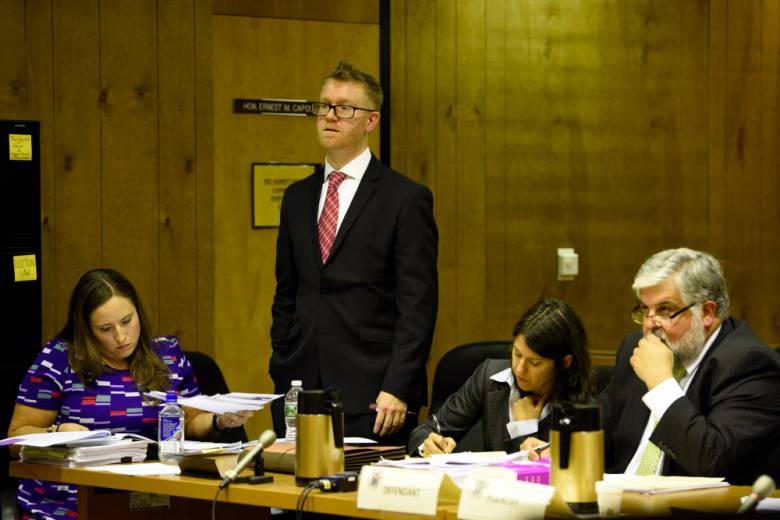
A state appellate court on Friday removed an emergency stay that was issued March 6 at the request of a community group that’s been fighting for months to stop the work. The panel said the group failed to show “a reasonable probability of ultimate success” with their case against The Duke Farms Foundation.


It wasn’t clear Saturday when the demolition work would resume. A large portion of the Hillsborough Township mansion had been torn down the day before the emergency stay was issued earlier this month.


“We are grateful that the courts agreed with us,” Michael Catania, the foundation’s executive director, said Saturday. “We are hoping to get started again (on the demolition) in the near future, but we haven’t set a schedule yet.”

The 67,000-square-foot mansion has been empty since Duke’s death in 1993. Foundation officials say it is in disrepair and would take at least $10 million to fix.

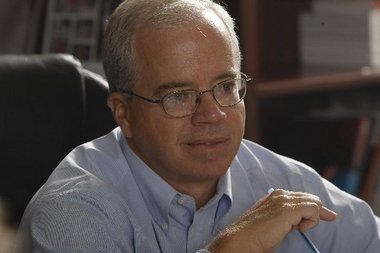
David Brook, a lawyer and a leader of the community group Demolition of Residence is Senseless, or DORIS, said the group has the option to take its case for an emergent motion to the New Jersey Supreme Court. However, he said that was not likely to happen.

“This is a sad day for us, for Hillsborough, for everyone involved,” in this matter, Brook said Saturday.


Court: Demolition of Doris Duke mansion can resume Read More »

Marcellus gas royalties bill back in the spotlight in Pa.

                                                                                                                 MariE CUSICK/ STATEIMPACT PA
“The Guaranteed Minimum Royalty Act of 1979 was enacted to avoid some of these predatory practices,” says Bradford County businessman and royalty owner Dave DeCristo. “Obviously people were getting ripped off.”
Royalty advocates were back in Harrisburg Tuesday urging lawmakers to pass legislation to prevent drillers from cheating landowners out of money.
Marie Cusick of State Impact reports:
“The legislature should clearly define ‘royalty’ to prevent the theft of our resources through creative accounting,” says Jackie Root, who heads the state chapter of the National Association of Royalty Owners.
Shortly after the Marcellus boom took off, people began complaining some drillers were shortchanging them. Most of the complaints have focused on Chesapeake Energy, which has been sued over the issue around the country. The issue is complicated, and it often revolves around who pays for post-production costs, which the expenses of moving gas from the well to the market and include things like compression, dehydration, and pipeline transport.
In 2013 Rep. Garth Everett (R- Lycoming) introduced a bill to attempt to address the problem. Although the measure was approved by a House committee, it never made it to the floor for a vote. He later blamed the House GOP leadership for blocking it.
Last summer Everett revived the effort. The new bill has 37 co-sponsors from both parties. On Tuesday the House Environmental Resources and Energy committee held an informational hearing and heard testimony from landowners who say they’ve been cheated, as well as representatives from the Game Commission and Department of Conservation and Natural Resources, which have also had trouble get paid properly.

 
Was this of interest to you? 


Marcellus gas royalties bill back in the spotlight in Pa. Read More »

At legislative showdown, NJDEP pulls controversial rules

Moving closer to completing a two-year process to invalidate rules proposed by the New Jersey Department of Environmental Protection, the state Legislature hit the pause button
on Monday, March 7, when the DEP announced at a hearing that it would withdraw its controversial changes and make significant modifications to them.

Ray Cantor, chief assistant to DEP Commissioner Bob Martin, told the Senate Environment and Energy Committee in Trenton “You never get something right
the first time you do it.’’


Cantor said that the department continues to work its way through thousands of pages of public comments submitted on its proposed floodwater and storm hazard rules and expects to reissue a revised set sometime in May.

Listen here to Cantor’s summary of the DEP process and areas where they anticipate changes to be made.

After hearing the department’s commitment to redo the rules, as well as testimony, pro and con, from business and environmental advocates, Chairman Bob Smith said the committee would hold off on voting on the resolution (SCR-66) until the panel has a chance to review DEP’s revised proposal.

Following the hearing, EnviroPolitics, interviewed three of the participants.

Senator Bob Smith, Chairman, NJ Senate Environment and Energy Committee


Dennis Toft, environmental attorney, Chiesa Shahinian & Giantomasi


Jeff Tittel, New Jersey Sierra Club


Related news story:

State DEP withdraws rule changes, avoids clash with lawmakers


At legislative showdown, NJDEP pulls controversial rules Read More »

Feds claim ‘lies and deceit’ on part of NJ Bridgegate pair

Kelly and Baroni.jpg - Amy Newmak and Kevin R. Wexker Record photographers
Bridget Anne Kelly, Bill Baroni- Amy Newman & Kevin R. Wexler photos

Two former top aides to Governor Christie knew they were engaged in wrongdoing when they closed access lanes to the George Washington Bridge to punish a political rival because they lied about it, federal prosecutors said in court papers filed Friday night.

Abbott Koloff reports in The Record today:


An in-depth look at the scandal over the lane closures at the George Washington Bridge and related aftershocks. Click here to launch.
Former Port Authority Deputy Executive Director Bill Baroni and Bridget Anne Kelly, the former deputy chief of staff to the governor, created a massive traffic jam to punish Fort Lee Democratic Mayor Mark Sokolich and engaged in “lies and deceit” by creating a cover story that the lane reductions were part of a traffic study, the prosecutors said.
The filing by U.S. Attorney Paul Fishman and his office was in response to the defendants’ motion to dismiss federal charges against them, which include the alleged misuse of Port Authority resources.
The defendants argued that the charges should be thrown out because, among other things, they are based on vague federal laws that have been twisted to fit the facts of the case. They also said that they did not have “fair warning” that a federal statute applied to their actions, according to court papers.
Baroni and Kelly were indicted on multiple counts related to the lane closures last year while another former top Port Authority executive, David Wildstein, pleaded guilty to his part in the alleged scheme. Authorities say they orchestrated the closure of two of three access lanes to the bridge for four days beginning on Sept. 9, 2013 with the intention of punishing Sokolich for not endorsing Christie’s bid for reelection as governor.
 
Christie has not been implicated by federal prosecutors and has denied any knowledge of the alleged scheme until long afterward.
 
Prosecutors said in Friday’s filing that the attempt by Baroni and Kelly to conceal the true purpose of their actions “negates their contention that they lacked fair warning that their conduct was wrong.” They said the use of a “sham” story about a traffic study to explain the closures was a “lie” that demonstrated “conscious wrongdoing.”
 

Recent blog posts:

Feds claim ‘lies and deceit’ on part of NJ Bridgegate pair Read More »

No rail strike in NJ; massive commuting mess averted

Did you hear that collective sigh of relief resounding across northern New Jersey?

Yes, the threatened rail strike that would have resulted in car-choked traffic lanes on New Jersey to New York bridges and tunnels is no longer a worry for thousands of commuters.

 NJ Transit officials and its rail unions have reached a tentative agreement on their long-simmering contract dispute, a day before a planned strike that threatened to paralyze the region.  

Steve Burkert, spokesman for the transit workers union coalition, announces that an agreement has been made averting a possible strike by 11 rail unions working for NJ Transit. Friday March 11, 2016. Newark, NJ, USA (Aristide Economopoulos | NJ Advance Media for NJ.com)


Larry Higgs reports for NJ.com:

No immediate details on the settlement were announced Friday night, or when union members might vote on the proposed accord, but for now commuters can breathe a deep sigh of relief. Gov. Chris Christie added there would be no immediate fare hike.
Union spokesman Stephen Burkert first announced the settlement Friday night.
“Thankfully for the commuters of NJ Transit, the crisis is averted,” Burkert said. “We’re going home to our families.”
Speaking at press conference immediately afterward, Christie also would not get into details of the proposed settlement until union officials had a chance to review its points with membership.
“That’s the appropriate thing to do,” he told reporters.
Christie, who had been in Newark most of the day, said he had been confident there would be a settlement and called “all the hysteria” of the recent days “ginned up”  by the media.
“These things,” he said, “always come down to the end.”
A strike would have affected 105,000 daily riders to New York who would have had limited options to get to work Monday, and would have cost businesses millions. The last NJ Transit strike was in March 1983. It lasted 34 days.


Recent blog posts:

No rail strike in NJ; massive commuting mess averted Read More »

Three hour hearing on drilling cases before PA’s top court

Natural gas drilling rig - Lindsay Lazarski-WHYY
The Pennsylvania Supreme Court wrestled on Wednesday in Philadelphia with how to scrutinize government actions that affect publicly owned natural resources and citizens’ environmental and property rights in two cases with roots in shale gas drilling but with potential repercussions for other forms of development.
Laura Legere of the Pittsburgh Post-Gazette writes today:
During a dynamic morning session that lasted nearly three hours, the justices peppered attorneys on all sides with questions both sweeping and practical — such as whether the environmental rights described in the state constitution are fundamental rights and whether lawmakers have singled out the gas industry for special treatment.
One case, Pennsylvania Environmental Defense Foundation v. Commonwealth, concerns the state’s decision to lease publicly owned forestlands for gas development and use the money to balance budgets.
The other, Robinson Township v. Commonwealth, challenges several provisions in the state’s updated oil and gas law, including the validity of the state’s centralized method of reviewing municipal gas drilling ordinances and limitations on sharing information about gas development fluids that might affect drinking water or public health.
Six of the court’s seven justices heard oral arguments in the cases, including three who were presiding over their first days of arguments since being elected to the high court last year. Justice Michael Eakin, who was suspended in December, did not participate.
The justices seemed inclined to go back to the text of the state’s environmental rights amendment — Article 1, Section 27 of the constitution — to discern what should be expected of the government as the steward of Pennsylvania’s public natural resources. They did not give any clear sign of how they would define those standards.
In a surprising move, one of the Commonwealth’s attorneys Sean Concannon encouraged the court to do away with the current three-part harms and benefits balancing test that has for decades been the shorthand method for judging whether government actions comply with the state’s environmental rights amendment.
But he urged the court to adopt a reasonable replacement that will not stifle economic development or infringe on property rights.


Was this of interest to you? 


Three hour hearing on drilling cases before PA’s top court Read More »