NJBPU boss grilled by budget panel over diverted funds
Mroz argues that money siphoned from clean-energy fund has not affected NJ’s efforts to reduce power consumption, greenhouse-gas emissions
Tom Johnson reports for NJ Spotlight today:
Even though more than $1 billion has been diverted from a clean-energy fund, a top Christie administration official yesterday defended the state’s efforts to reduce energy use and cut emissions contributing to global warming.
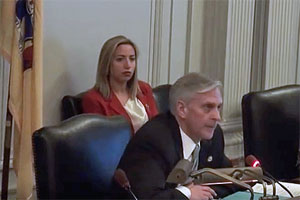 In an appearance before the Senate Budget and Appropriations Committee, Board of Public Utilities President Richard Mroz faced questions over the $1.3 billion — including $121 million next year — taken from utility customers to balance state budgets during the Christie administration.
The diversion of the funds has been repeatedly criticized by clean-energy advocates who believe it is adversely affecting the state’s efforts to switch to less-polluting methods of generating electricity like solar systems and invest in ways to reduce energy consumption.
Some lawmakers also fault the practice, initiated by the Corzine administration, but the Legislature has gone along with the governors and approved the diversions in every budget since the 2008 fiscal year.
In next year’s budget plan, the governor proposes to use $114.5 million from the fund to pay for energy costs at state buildings and for NJ Transit. Another $3.7 million from the clean-energy fund would go to the state Department of Environmental Protection’s office of green energy and to pay for administrative costs at the BPU’s office of clean energy.
Mroz noted that the money being diverted in next year’s proposed spending plan is virtually identical to what lawmakers approved in the current state budget. The fund is supported by a surcharge on utility customer’s bills, which amounted to at most to $56.67 annually for the average electrical user and $89.10 for the average gas user, according to an analysis by the Office of Legislative Services.
The cost is much higher for the typical industrial customer because the surcharge is based on how energy is used.
In an appearance before the Senate Budget and Appropriations Committee, Board of Public Utilities President Richard Mroz faced questions over the $1.3 billion — including $121 million next year — taken from utility customers to balance state budgets during the Christie administration.
The diversion of the funds has been repeatedly criticized by clean-energy advocates who believe it is adversely affecting the state’s efforts to switch to less-polluting methods of generating electricity like solar systems and invest in ways to reduce energy consumption.
Some lawmakers also fault the practice, initiated by the Corzine administration, but the Legislature has gone along with the governors and approved the diversions in every budget since the 2008 fiscal year.
In next year’s budget plan, the governor proposes to use $114.5 million from the fund to pay for energy costs at state buildings and for NJ Transit. Another $3.7 million from the clean-energy fund would go to the state Department of Environmental Protection’s office of green energy and to pay for administrative costs at the BPU’s office of clean energy.
Mroz noted that the money being diverted in next year’s proposed spending plan is virtually identical to what lawmakers approved in the current state budget. The fund is supported by a surcharge on utility customer’s bills, which amounted to at most to $56.67 annually for the average electrical user and $89.10 for the average gas user, according to an analysis by the Office of Legislative Services.
The cost is much higher for the typical industrial customer because the surcharge is based on how energy is used.
Like this? Use form in upper right to receive free updates
See popular posts from the last 30 days in right column — >>
See popular posts from the last 30 days in right column — >>
Sen. Linda Greenstein (D-Mercer) questioned whether the continued diversions are impeding efforts to cut energy use, noting New Jersey has dropped in an often-cited ranking by an energy-efficiency association from being rated in the top 10 nationally to 23rd.
“New Jersey has and continues to have a robust energy-efficiency program that is meeting our needs and reducing emissions,’’ Mroz told the committee, when asked about the diversions. Over the past 15 years, the state has invested more than $2..4 billion in energy efficiency, Mroz said.
Mroz also said New Jersey does not need an energy-efficiency portfolio standard, a policy adopted by other states to require a specified reduction in energy use. “We don’t feel that setting that goal is necessary,’’ he said.
Next year, the BPU is planning to allocate $344 million for its clean-energy program, but typically does not spend all of the money it has set aside, a practice that has made the fund more inviting to be tapped when the state is facing a budget crisis.
 As for the state’s prospects for developing offshore wind farms, Mroz was less optimistic. The state’s Energy Master Plan recommends 1,100 megawatts of offshore wind be developed by 2020, a target impossible to achieve at this point. Critics blame the BPU for failing to write crucial regulations to help finance the projects with ratepayer subsidies.
Mroz acknowledged two developers have leased acreage offshore to build wind turbines, but was noncommittal about moving forward quickly. “It depends on what is presented by the developers and what the costs are,’’ he said. Studies to answer those questions and others could take a year or more.
Like this? Use form in upper right to receive free updates
See popular posts from the last 30 days in right column — >>
NJBPU boss grilled by budget panel over diverted funds Read More »