
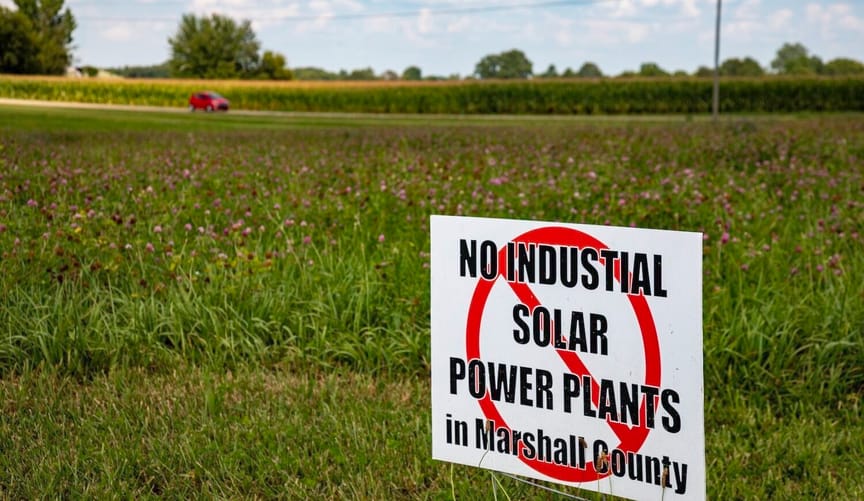
In Rutland, Indiana, a sign along a rural road opposes a solar power installation. (Jim West/UCG/Universal Images Group via Getty Images)
By Kari Lydersen, Canary Media, July 23, 2026
When the largest solar farm in Indiana came online in early 2025, nearby residents in rural Jasper County were not exactly excited.
“It will mess up their fields,” said long-time resident Gena Carlson, referring to solar panels on farmers’ land. Carlson’s concerns, which were echoed by other locals, highlight the growing on-the-ground opposition to Indiana’s remarkable boom in solar construction.
Last year, Indiana ranked third among states for the most new solar projects brought online. Only Texas and California — the nation’s clean energy leaders — built more. It’s a new position for Indiana, which ranked 15th for solar additions in 2023 and 10th in 2024. The Solar Energy Industries Association expects Indiana to maintain its momentum, projecting it will have the fourth-highest solar growth over the next five years.
“That’s a pretty notable fact since we don’t have the incentives and policy support for solar that a lot of other solar leaders do,” said Ben Inskeep, program director at the Citizens Action Coalition, the state’s primary consumer watchdog group.
The growth is due in part to the state’s data center boom, with solar developers taking advantage of Indiana’s level land, robust transmission networks, and relatively sunny weather to build clean power that meets tech companies’ sustainability goals. The utility NIPSCO, owner of the Jasper County solar farm, adopted ambitious clean energy goals in 2018 and brought more than a gigawatt of solar online in Indiana last year.
But as solar capacity has increased, so too has local opposition — and clean energy advocates say developers and officials must find common ground with communities in order to keep the solar buildout going.
Like Carlson and her neighbors in Jasper County, residents across the state are protesting that solar will eat up farmland, affect property values, or change the bucolic character of counties in America’s heartland. These claims are not unique to the Hoosier State — similar pushback is spreading around the country as solar grows, even if the tech uses only a sliver of farmland nationwide.