Tennessee developer thinks it’s cracked the code for mixing solar panels and cattle. Scaling the model could make it easier to build clean energy in rural America.
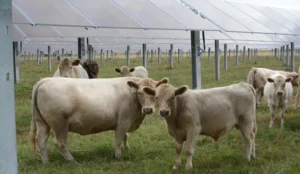
Ccattle underneath solar panels. (Julian Spector/Canary Media)
By Julian Spector, Canary Media, 9 November 2026
CHRISTIANA, Tenn. — As sunlight fell between the gaps in flinty November clouds, I found myself impressed by the quietness of the lawn mowers in a Middle Tennessee solar field. Instead of the obnoxious roar of diesel engines, they just produced an occasional moo.
Six months ago, Tennessee’s largest solar developer, Silicon Ranch, channeled its nomenclature and brought cattle to this 3.25-megawatt solar project. The 15-member herd rotates among 15 paddocks marked out by simple electrical wire, munching Bermuda grass that grows in the shade of the panels, which sit on higher-than-usual steel piles. The cows seem amenable to the situation, judging by how plump they’ve become in that short time.
This is the first commercially viable utility-scale project combining solar and cattle farming in the U.S., according to Silicon Ranch (an earlier 2-MW project from AES sought to prove the concept in Massachusetts’ community solar market). If the model takes off, it could boost revenues for farmers while producing more clean, cheap electricity in regions that don’t have a lot of wide-open, unused spaces to develop. And it might remedy a major obstacle to ongoing solar growth.
The U.S. builds more solar installations than any other form of power plant these days. But the industry’s upstart success story is colliding with a bulwark of local opposition from communities that don’t like the idea of this relatively new technology taking over their landscapes. One way around that conflict is to use the same land for solar power and agriculture.
The solar industry already has adopted sheep grazing as a mainstream approach to cutting grass at project sites, while supporting a secondary market for domestic meat. Researchers have also found that grasses and some crops grow better in the shade of photovoltaic panels than in an open field. But the burgeoning “agrivoltaics” sector has almost entirely excluded one of the major pillars of American agriculture — cattle ranching — for the simple reason that rambunctious bovines could easily wreck the carefully calibrated solar panels.
____________________________________________________
Daily energy and environment updates. Free 30-day subscription