Rutgers and its partners aim to transform flood-prone properties into functional natural landscapes

Brooke Maslo stands with her dog in the middle of a field, trees in the background. She holds onto a chin-height grey pole, one of many in the field.
Rutgers ecologist Brooke Maslo stands in the floodplain forest she designed in Woodbridge, NJ

 A $4.2 million award to Rutgers University will help transform former home sites along the Woodbridge River into wetlands and woodlands designed to reduce flooding in surrounding neighborhoods.

The National Fish and Wildlife Foundation, a private conservation grant maker, has approved the funding for restoration in Avenel and Sewaren, two sections of Woodbridge Township, N.J., where properties have been acquired through New Jersey’s voluntary Blue Acres buyout program.

Led by Rutgers ecologist and RCEI affiliate Brooke Maslo, the project will create places to collect and temporarily hold stormwater, improve drainage and restore habitat for birds and other wildlife. The project is expected to start early next year. The work applies years of research and planning to a landscape where some homes have been removed and others remain, their owners having elected against accepting a buyout.

“Climate resilience requires us to rethink how we manage our landscapes,” said Maslo, an associate professor in the Department of Ecology, Evolution and Natural Resources and a wildlife ecology specialist with Rutgers Cooperative Extension. “Instead of relying exclusively on engineered infrastructure to manage flooding, we can restore the natural functions of these floodplains with thoughtful nature-based solutions to help communities adapt to a changing climate.”

The project, she said, “demonstrates how ecological science can be translated into practical solutions that benefit both people and wildlife.”

The New Jersey Department of Environmental Protection’s Blue Acres program allows property owners in flood-prone areas to voluntarily sell their homes to the State and move away from the risk. Restoration gives the land left behind a new purpose, helping manage water in the surrounding community.

“Voluntary buyouts offer families relief from the ongoing trauma and stress of chronic flooding,” said Blue Acres program manager Courtney Wald-Wittkop. “When these highly flood-prone properties are converted to open space there is a benefit to the residual community in that these lands can be revegetated to act like a sponge to absorb and hold floodwaters and protect nearby neighborhoods from flooding.”

Following Superstorm Sandy, Woodbridge Township began its broader flood resilience effort in 2013, partnering with Blue Acres to enable the buyout of more than 160 flood-prone properties. Working with Rutgers and other partners, the township developed a plan for restoring these acquired lands, improving drainage and managing floodwater across 490 acres along the Woodbridge River floodplain. More than 30 acres of habitat have already been restored within the project area.

“This award builds on years of work by the township, our residents and our partners,” said Thomas Flynn, Woodbridge Township’s floodplain manager. “It will help us carry out plans for land that can better handle flooding and serve the community for years to come.”

Read the full story here

Daily energy and environment updates. Free 30-day subscription
Rutgers and its partners aim to transform flood-prone properties into functional natural landscapes Read More »

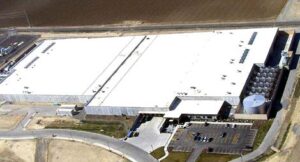
Despite AI pushback, Microsoft data center in Washington state brings “a kind of boom” 

Microsoft data center in Quincy, Washington State

By Megan Cerullo, Emily Pandise, Jo Ling Kent, CBS News, Nov. 11 2026

Opposition to data centers helped propel Democratic candidates who pledged to stall new construction to victory in last week’s midterm elections. More than half of voters said artificial intelligence and data centers were a significant factor in their votes, according to a CBS News exit poll.

But one town says it has benefited from data centers, despite the pushback growing across the nation.

For 20 years, Microsoft has operated its Columbia Data Center in Quincy, Washington, where Mayor Paul Worley told CBS News its presence has created “a kind of boom” for the area.

Additional tax revenue from the project has funded a new high school and hospital, and helped improve other critical services, he said.

Microsoft president Brad Smith told CBS News about the pledge it makes to the communities where it builds and operates data centers.

“Basically, we will put the community first,” he said. “We will not do anything that will increase the electricity rates of our neighbors. We’ll ensure that we replenish more water, we put more water back into the community than we use.”

Read the full article here

Daily energy and environment updates. Free 30-day subscription


Despite AI pushback, Microsoft data center in Washington state brings “a kind of boom”  Read More »

Pa data center opponents tell council: “Do the right thing or resign”

Olyphant resident Halil Berjashi denounces borough officials for considering a settlement and CBA with a data center developer during a council meeting in the Olyphant Borough Building on Tuesday, Nov. 10, 2026. (FRANK WILKES LESNEFSKY / STAFF PHOTO)
Olyphant resident Halil Berjashi denounces borough officials for considering a settlement and CBA with a data center developer during a council meeting in the Olyphant Borough Building on Tuesday, Nov. 10, 2026. 

OLYPHANT — Community members saw no benefit Tuesday to a proposed settlement and $101 million community benefits agreement between the borough and a data center developer.

“We do not want you to willfully neglect your obligation to protect our community, and we are here tonight to hold everyone accountable. We don’t want to insult our sense of community and morality,” Olyphant resident Kathleen Evanina said to borough officials. “For what? A minor discount on a utility bill, some money for the borough? This does not compensate for a ruined landscape, a permanently altered town and an industrial complex demanding its seat and ruling out our table. Data centers are not community assets — they are parasitic drain.”

Olyphant resident Kathleen Evanina calls data centers a "parasitic drain" as she opposes a propoed settlement and CBA during a council meeting in the Olyphant Borough Building on Tuesday, Nov. 10, 2026. (FRANK WILKES LESNEFSKY / STAFF PHOTO)
Olyphant resident Kathleen Evanina calls data centers a “parasitic drain” as she opposes a propoed settlement and CBA during a council meeting in the Olyphant Borough Building on Tuesday, Nov. 10, 2026. 

Borough council held its first meeting since announcing it is considering settling a lawsuit with ERCOR Triboro LLC and entering into a community benefits agreement. The CBA would pay the borough $101 million over 15 years in exchange for allowing Project Triboro to bypass the public hearing process. ERCOR sued Olyphant in June in an effort to circumvent zoning and conditional use hearings to develop more quickly seven data centers and a substation within the footprints of four approved 1-million-plus-square-foot warehouses across 470.61 acres off Marshwood Road and Route 247. Borough officials saw the CBA as a means to significantly reduce residents’ property tax and electricity bills while giving the town more money for its police, parks and schools.

The borough initially scheduled a special meeting Nov. 5 to consider the settlement and CBA but canceled it after learning of potential legal intervention from the neighboring Triboro Commerce Park, which previously applied for and withdrew plans for seven data centers. An attorney for the commerce park later called it a miscommunication.

With the special meeting canceled, about 60 people packed Olyphant’s council chambers Tuesday. Though there was nothing on the agenda regarding the CBA or settlement, a dozen speakers addressed council. Nearly everyone who spoke opposed the agreement.

Do the right thing, or resign’

Residents wearing yellow shirts inscribed with “Stop Olyphant Data Centers” or “Protect Our Queen City” dotted the crowd. Yellow shirts and signs have become synonymous with the local data center opposition movement, particularly in Archbald.

CLICK TO READ FULL STORY

Daily energy and environment updates. Free 30-day subscription


Pa data center opponents tell council: “Do the right thing or resign” Read More »

Senate Advances Sweeping Energy Permitting Bill as Solar Industry Pushes for Passage and Environmental Opposition Grows

Shot of the Capitol Building in Washington, D.C. at twilight 

By Frank Brill, EnviroPolitics editor

More than 300 solar and storage companies are urging Congress to pass a sweeping bipartisan permitting bill that could speed construction of renewable-energy and transmission projects. But environmental organizations warn that the legislation could achieve that speed by weakening protections governing water, wildlife and community participation. [pv-magazine-usa.com], [solarpower…online.com], [pv-tech.org]

The U.S. Senate, on Monday, November 9, 2026,  moved the Bipartisan American Affordability and Jobs Act of 2026 (BAAJA), S. 5653, a major overhaul of federal permitting rules, closer to passage.

Senators voted 73-25 to advance the measure, demonstrating substantial bipartisan support. [solarpower…online.com], [pv-tech.org]

The legislation was introduced September 30 by Sens. Shelley Moore Capito (R-W.V.), Mike Lee (R-Utah), Sheldon Whitehouse (D-R.I.) and Martin Heinrich (D-N.M.). [solarpower…online.com]

At stake is a question that has divided energy and environmental advocates for years:

Can the United States build renewable energy and the electric grid faster without sacrificing environmental review and the ability of communities to challenge potentially harmful projects?

Solar and storage industry rallies behind the bill

The renewable-energy industry is making a major push for passage.

More than 300 solar and energy-storage companies signed a letter organized by the Solar Energy Industries Association (SEIA) calling on congressional leaders to approve the legislation. The signatories collectively employ about 280,000 Americans, according to SEIA. [pv-magazine-usa.com]

They argue that today’s permitting system is preventing badly needed solar, storage and transmission projects from reaching the grid.

According to market research cited by the industry coalition, solar and battery storage represented 70% of new utility-scale generating capacity added to the U.S. grid so far in 2026, while an estimated $120 billion in clean-energy investment is stalled in permitting queues and regulatory reviews. [pv-magazine-usa.com]

SEIA’s analysis also projects that passage of BAAJA could result in 167 GW of additional solar generation between 2028 and 2035. [solarpower…online.com]

The industry sees permitting reform not simply as an environmental or regulatory issue but increasingly as an electricity-cost and grid-reliability issue, as the nation faces growing power demand.

The bill goes far beyond renewable energy

The legislation, however, isn’t limited to clean energy.

BAAJA would speed permitting for a broad range of infrastructure and energy projects. While it specifically includes solar, energy storage and onshore and offshore wind, it also applies to fossil-fuel development including natural gas, oil and coal. [solarpower…online.com]

The measure would alter provisions of several of the nation’s most important environmental laws, including the National Environmental Policy Act, Clean Water Act and Endangered Species Act, with the goal of shortening review periods and changing which projects require certain reviews. [solarpower…online.com], [solarpower…online.com]

It would also give the Federal Energy Regulatory Commission permitting authority over some electric-transmission projects. [solarpower…online.com]

Supporters say those changes could make project approvals more predictable and enable badly needed transmission lines to move electricity from new generating facilities to high-demand areas. [pv-magazine-usa.com]

Environmental groups see a dangerous tradeoff

That broad reach explains why the legislation has produced an unusual split within the environmental and renewable-energy communities.

Environmental advocates agree that transmission and clean-energy projects need to be built faster, but some contend Congress is attaching unacceptable environmental rollbacks to that goal.

Lisa Frank, executive director of Environment America, argued that building more clean energy shouldn’t require weakening rules protecting water and wildlife or limiting the public’s ability to participate in decisions affecting their communities. [solarpower…online.com]

Loren Blackford, executive director of the Sierra Club, similarly said faster permitting for transmission and clean energy is necessary, but criticized provisions she says would undermine clean-water and wildlife safeguards, Tribal sovereignty and community participation. [solarpower…online.com]

PV Tech characterized the political landscape as one in which legislation capable of unlocking substantial new solar development is advancing while facing increasing resistance from environmental campaigners concerned about weakened protections. [pv-tech.org]

The permitting paradox

That leaves Congress confronting what might be called America’s clean-energy permitting paradox.

Solar farms, wind projects, battery-storage facilities and the transmission lines required to connect them to the grid can encounter the same lengthy regulatory processes historically intended to protect communities and the environment from damaging development.

Industry advocates argue those delays now can obstruct environmental progress itself.

Environmental organizations counter that the answer shouldn’t be to dismantle protections that communities rely upon when industrial projects threaten air, water, wildlife or quality of life.

With strong bipartisan Senate support and an unusually aggressive lobbying effort by the renewable-energy industry, BAAJA has substantial momentum. But the growing environmental opposition ensures that the debate is no longer simply about whether America should build energy infrastructure faster.

It’s increasingly about what environmental protections Congress is willing to change to make faster construction possible.

And for environmental advocates, renewable-energy developers and communities confronting major new infrastructure projects, that distinction could prove just as important as how quickly the projects get built.

______________________________________________________________________________________________________________________________________________

Check out our new Data Center Reporter.

Senate Advances Sweeping Energy Permitting Bill as Solar Industry Pushes for Passage and Environmental Opposition Grows Read More »

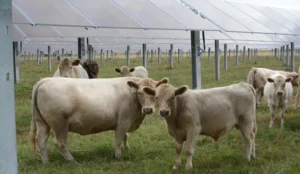
Where’s the beef? Under the solar panels.


Tennessee developer thinks it’s cracked the code for mixing solar panels and cattle. Scaling the model could make it easier to build clean energy in rural America.


Ccattle underneath solar panels. (Julian Spector/Canary Media)

By Julian Spector, Canary Media, 9 November 2026

CHRISTIANA, Tenn. — As sunlight fell between the gaps in flinty November clouds, I found myself impressed by the quietness of the lawn mowers in a Middle Tennessee solar field. Instead of the obnoxious roar of diesel engines, they just produced an occasional moo.

Six months ago, Tennessee’s largest solar developer, Silicon Ranch, channeled its nomenclature and brought cattle to this 3.25-megawatt solar project. The 15-member herd rotates among 15 paddocks marked out by simple electrical wire, munching Bermuda grass that grows in the shade of the panels, which sit on higher-than-usual steel piles. The cows seem amenable to the situation, judging by how plump they’ve become in that short time.

This is the first commercially viable utility-scale project combining solar and cattle farming in the U.S., according to Silicon Ranch (an earlier 2-MW project from AES sought to prove the concept in Massachusetts’ community solar market). If the model takes off, it could boost revenues for farmers while producing more clean, cheap electricity in regions that don’t have a lot of wide-open, unused spaces to develop. And it might remedy a major obstacle to ongoing solar growth.

The U.S. builds more solar installations than any other form of power plant these days. But the industry’s upstart success story is colliding with a bulwark of local opposition from communities that don’t like the idea of this relatively new technology taking over their landscapes. One way around that conflict is to use the same land for solar power and agriculture.

The solar industry already has adopted sheep grazing as a mainstream approach to cutting grass at project sites, while supporting a secondary market for domestic meat. Researchers have also found that grasses and some crops grow better in the shade of photovoltaic panels than in an open field. But the burgeoning ​“agrivoltaics” sector has almost entirely excluded one of the major pillars of American agriculture — cattle ranching — for the simple reason that rambunctious bovines could easily wreck the carefully calibrated solar panels.

 Read the full story here.

____________________________________________________
Daily energy and environment updates. Free 30-day subscription



Where’s the beef? Under the solar panels. Read More »

Why would anyone steal used vegetable oil from restaurants ?

Technological advances have allowed whey, a once-troublesome byproduct of cheesemaking, to turn into whey powder, lactose and protein concentrates, which can be used in baked goods, infant formula, animal feed and protein supplements. BRENDAN SMIALOWSKI/AFP VIA GETTY IMAGES FILE

By Edward D. Melillo, Amherst College

Federal prosecutors recently described an interstate criminal enterprise with all the trappings of organized crime: clandestine warehouses, money laundering and stolen goods transported across state lines. The mid-September announcement stated that 19 defendants faced charges; two had just pleaded guilty, while the remainder are slated for trial in April.

The stolen material was not drugs, guns or jewels. It was leftover cooking oil.

According to prosecutors, members of the group drove trucks to restaurants in 10 states, siphoned used cooking oil from collection tanks and transported it to depots for resale. The alleged motive was simple: Used cooking oil has value. It can be refined into biodiesel. A viscous fluid that the food industry formerly considered garbage has become valuable enough to spur a large-scale criminal operation.

This oil-theft scheme points to a larger lesson. People tend to think of waste as trash, sewage, slag, manure and other seemingly useless or disgusting substances. But historians, anthropologists and geographers increasingly recognize that “waste” is a category defined by humans. Technologies, markets, laws and cultural assumptions all determine what is discarded, what is kept and why. Waste describes a material’s status, not necessarily its substance.

As an environmental historian who studies how societies transform nature into commodities, I am also interested in the other side of the process: how materials classified as waste can be converted back into things of value.

Read the full article here

Why would anyone steal used vegetable oil from restaurants ? Read More »