NJ Agricultural Society joins EPA in curbing food waste, fighting hunger

The EPA announced Thursday, Oct. 29, that the organization has become part of its Feed It Onward program, a growing network of businesses, farmers, nonprofit organizations and communities working to prevent usable food from going to waste.

Through its Farmers Against Hunger program, the New Jersey Agricultural Society works with farmers and wholesalers to recover surplus produce and distribute it to food banks, churches and other organizations serving residents in need. The partnership will allow the organization to share its experience with similar programs across the country while learning about other approaches to reducing food waste.

“As an apple farmer myself, I never want to see my apples go to waste, and I know other farmers feel the same about their crops,” said EPA Region 2 Regional Administrator Michael Martucci. “The New Jersey Agricultural Society helps fill the gap between farmers and hunger relief organizations by harvesting, storing and transporting surplus crops during the busy harvest season. That is exactly what Feed It Onward is about: people coming together and implementing simple ideas to help quality food reach more communities.”

The Farmers Against Hunger program helps address two challenges facing New Jersey communities: food waste and food insecurity. By recovering fruits and vegetables that might otherwise go unused, the program provides fresh produce to organizations that distribute food to individuals and families.

A central part of the program involves a process known as “gleaning,” in which volunteers and food rescue organizations collect surplus crops from farms. The harvested produce is then transported to refrigerated storage facilities, where it is inventoried and stored before being distributed through a network of food banks, churches and other community organizations throughout New Jersey.

Read full story here

NJ Agricultural Society joins EPA in curbing food waste, fighting hunger Read More »

Here’s a way PJM could get some desperately needed grid batteries.


The nation’s biggest grid operator is about to start working on a fix that would make it much easier to add batteries to existing power plants and solar and wind farms.


PJM logo on phone screen in blue and gray with white background
(Photo illustration by Thomas Fuller/SOPA Images/LightRocket via Getty Images)


PJM Interconnection is finally taking steps that could let a lot of new battery capacity connect to its grid without eons of delay.

PJM is the biggest grid operator in the U.S., serving customers across 13 mid-Atlantic, Midwestern, and Southern states. Its grid is notoriously bogged down and congested, especially now that data centers are clamoring for more power, and that’s leading to high electricity prices in its territory.

Among other shortcomings, it’s been falling behind its counterparts elsewhere in the country in pursuing a straightforward solution: allowing power plants to add batteries on-site in order to get more out of grid connections that aren’t always used to full capacity.

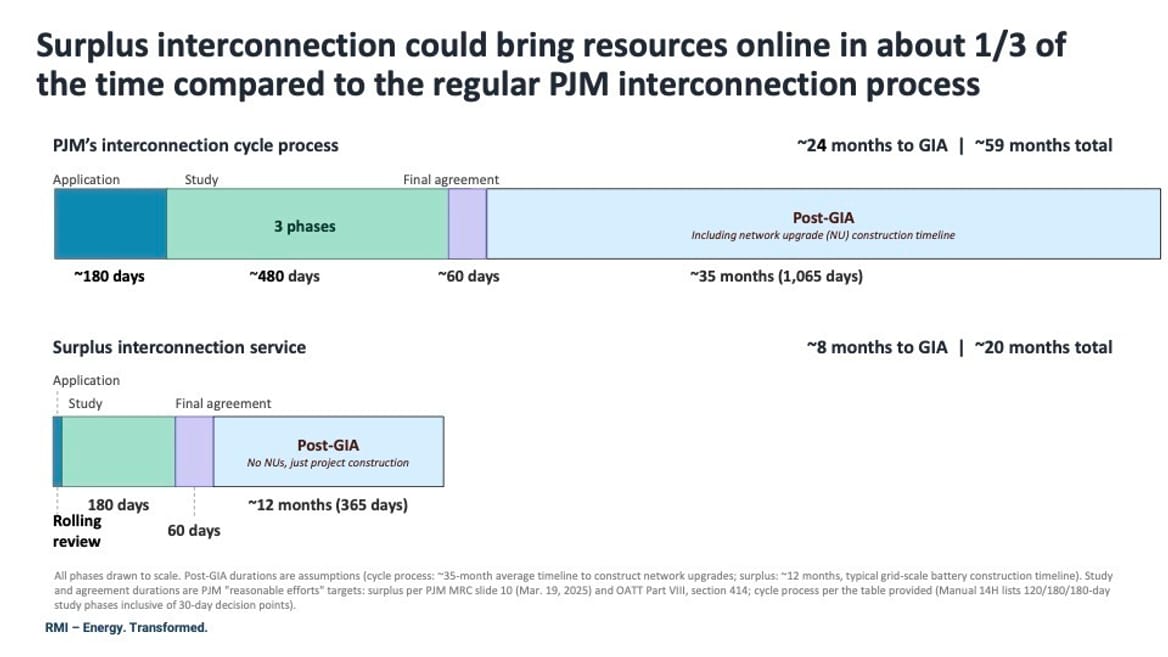
The Federal Energy Regulatory Commission has directed grid operators to pave the way for these kinds of battery additions under Surplus Interconnection Service (SIS) rules. The idea is to let existing power plants — mainly solar and wind farms — add batteries that can soak up excess power when it’s not needed, and then inject it through existing grid connections when power plants aren’t generating at their full potential.

That could be particularly valuable when region-wide demand for electricity spikes, usually on hot summer afternoons or cold winter mornings. PJM has seen the cost of capacity resources to keep the grid running during these times skyrocket over the past few years, largely due to pressures to supply power to proposed data centers.

But PJM has been a laggard in reforming its SIS procedures, according to grid experts and clean energy groups that have been pushing for changes for years. It has approved very few such projects, even as grid operators in other regions have crafted regulations and processes that have opened the door to tens of gigawatts of SIS capacity.

Now — better late than never — PJM has agreed to kick off a stakeholder process to reform its market rules to clear the way for SIS battery additions. Its Market Implementation Committee is set to consider the next steps at its Nov. 4 meeting, according to Jon Gordon, a senior director at clean-energy trade group Advanced Energy United. If a plan wins approval, PJM could complete work on the changes and seek FERC’s permission as early as April 2027 to enact them.

Chart showing surplus interconnection timing, reduced from about 20 months to 8 months

“We have members who are really rip-roaring to go on this,” said Gordon of Advanced Energy United. ​“What I’ve learned is that the devil’s really in some of the wonky details that have become obstacles to solving this problem.”

attery might have different offtakers, different obligations,” she said.

To fix this problem, PJM has proposed a set of changes that, in essence, will allow hybrid projects to separate the contributions of their different resources in both PJM’s energy market and capacity market. ​“You might think of it as an itemized receipt,” Siegner said. ​“It makes it easier to split the bill.”

That simple fix could unlock an enormous amount of pent-up demand for batteries to help meet PJM’s growing hunger for capacity. The new energy storage capacity could be added to existing projects or be integrated into plans for tens of gigawatts of clean power projects that have won permission to connect to PJM’s grid, she said.

This new pathway for bringing batteries more quickly online would be especially welcome in PJM states with energy storage targets, including Illinois, Maryland and New Jersey, Siegner said. Laws passed in Indiana and Virginia that require major utilities to identify and analyze the potential for surplus interconnection could also help boost deployment.

These market rule changes could still be a long way off. Even if PJM moves proposed reforms through swiftly, FERC’s approval of them might take until late next year.

That slow pace is ​“frustrating,” Advanced Energy United’s Gordon said. ​“We’re not talking about physical limitations to the grid. We’re just talking about this quagmire of administrative processes and legal rights.”

If the barriers to surplus interconnection service can be lifted, that could spur a lot of investment in batteries, relatively cheaply and speedily, he said. ​“Given PJM’s desperate situation for capacity, anything that would help PJM manage peaks better — like getting batteries online — would make a massive difference.”

In particular, data center developers might want to bankroll batteries. Data centers are under increasing pressure from state and federal regulators to build their own capacity resources to avoid pushing more costs onto everyday customers — and PJM’s attempts to solve that problem have been stalled.

Earlier this month, FERC rejected PJM’s painstakingly developed plan to require data centers and other ​“large loads” to supply their own capacity or face having their power cut off during grid emergencies.

Given that setback, data center developers and other PJM stakeholders that are trying to curb rising electricity prices are eager for options that can serve their needs as quickly as possible, Siegner said — and surplus interconnection is one of the best ones out there.

“I would like to think that if you threw a battery onto an existing solar project, given how capacity-constrained PJM is today, you could find someone as an offtaker,” she said.


Here’s a way PJM could get some desperately needed grid batteries. Read More »

Jim Morford, longtime Trenton lobbyist, dies at 91

By David Wildstein in In Memoriam

Jim Morford, a longtime Trenton power broker who represented three of New Jersey’s most influential interest groups for more than 35 years, died on October 22. He was 91.

Morford was a familiar figure in State House circles for decades, wielding considerable influence on education, business and food industry issues as a lobbyist and association executive.  Over the course of his career, Morford built relationships across party lines and became part of a generation of Trenton lobbyists who relied on personal relationships, institutional knowledge and a deep understanding of the legislative process.

He began his career as a public school teacher before joining the New Jersey Education Association, where he worked in the union’s field services and government relations divisions.

At the NJEA, Morford trained members in legislative and political activism, helping teachers develop the skills to advocate for public education and their profession.

He later became vice president and chief lobbyist for the New Jersey State Chamber of Commerce, representing the state’s business community’s interests before lawmakers and governors.

Morford subsequently became president and legislative spokesman for the New Jersey Food Council, the trade association representing supermarkets, grocery stores and their suppliers.

His career gave him a rare perspective on Trenton politics, having represented organized labor, the broader business community and a major industry trade association.

After retiring, Morford moved to Williamsburg, Virginia.

Morford also helped launch the career of Michael Drulis, his protégé and longtime associate, with whom he founded MDA Public Affairs, a Trenton lobbying firm.  Drulis is the Hunterdon County Democratic Committee chairman.


Jim Morford, longtime Trenton lobbyist, dies at 91 Read More »

Trump’s out to reverse Biden curbs on oil and gas methane emissions

A flare burns at the top of a natural gas drilling facility.
An oil drilling operation in Carlsbad, N.M.Credit…Susan Montoya Bryan/Associated Press

The move would mark one of the most significant steps by the Trump administration to scale back federal policies designed to tackle climate change.

Methane, the main component of natural gas, traps about 80 times more heat in the atmosphere in the short term than carbon dioxide does. It is responsible for nearly one-third of the rise in global temperatures since the start of the Industrial Revolution, and experts have said that reducing methane leaks is one of the fastest ways to slow global warming.

The Biden administration issued rules in 2023 that would have required oil and gas facilities to monitor their operations and prevent methane from leaking into the atmosphere. The Trump administration has already delayed those rules from taking effect.

Now the Environmental Protection Agency is moving to relax requirements to curb methane emissions from hundreds of thousands of “marginal” oil and gas wells that are nearing the end of their useful lives and have relatively low output. These wells account for around 7 percent of U.S. oil and gas production but produce roughly half of the industry’s methane emissions, the agency has previously said.

Read more here

Daily energy and environment updates. Free 30-day subscription

Trump’s out to reverse Biden curbs on oil and gas methane emissions Read More »

Opinion: NJ Gov. Sherrill Goes All In For AI and Data Centers

We Told You This Was Coming

(Meet NJ’s new “partner”. Gov. Sherrill just announced that NJ now is directly involved in AI development and deployment)

From day one, we told you Gov. Sherrill was a technological utopian, a Neoliberal fan of privatization and deregulation, and a corporate Democrat hiding behind slogans like “innovation”:

The Democrats are pursuing an “abundance” strategy that seeks to promote “affordability” through “innovation”, “modernization”, “streamlining”, and “permit reform”.

They seek to promote “government accountability” (the softer version of right wing corporate attacks on “unelected bureaucrats”), “transparency” and “disclosure”, and pursue “public-privater partnerships” (the softer version of right wing demands for market based policies and privatization).

All that was obvious by her Big Tech donors and her rhetoric, which openly echoes the Trump game plan: A 2025 Blueprint for a Competitive New Jersey:

NJBIA announced on Wednesday the release of its 2025 Blueprint for a Competitive New Jersey, a 28-page policy document that offers elected officials and candidates a guide for how to drive innovation and prosperity in New Jersey and provides a roadmap to get there.

And we warned that she would power that “innovation” with nuclear power and fossil gas turbines – while doing nothing to reduce greenhouse gas emissions or improve environmental quality.

Read more 

Daily energy and environment updates. Free 30-day subscription

Opinion: NJ Gov. Sherrill Goes All In For AI and Data Centers Read More »

Massachusetts sets big battery goals — and the policies to back them up

Energy storage is taking off as the state moves to make development easier and more profitable, but the horizon isn’t all clear for the sector.


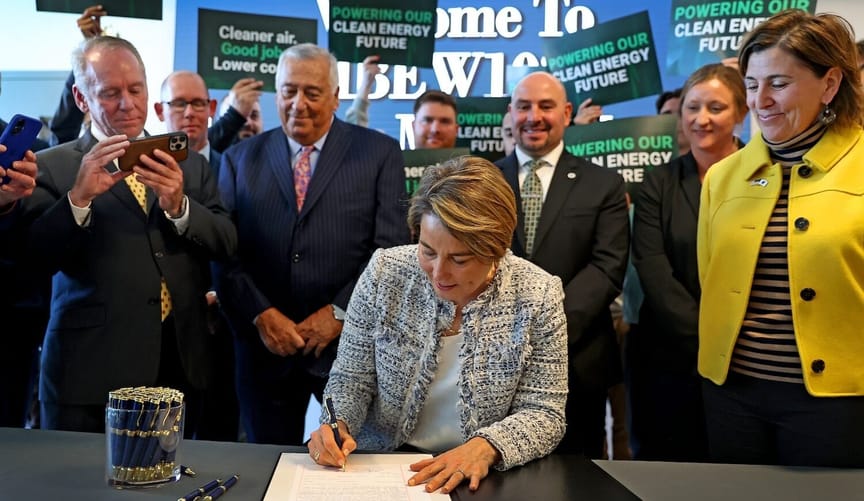
Woman sitting and signing a paper, surrounded by people holding signs reading "Powering our clean energy future"
Massachusetts Gov. Maura Healey holds a ceremonial signing celebration in Boston for climate legislation in late 2024. Expanding energy storage is key to the state’s clean energy strategy. (David L. Ryan/The Boston Globe via Getty Images)

Just outside Boston, a developer is getting set to build a 700-megawatt storage facility that is expected to dwarf every other battery project in New England. One town over, another energy company just closed on $850 million in financing to build a 250-MW battery. Down near the Rhode Island border, ground has been broken on a 200-MW storage facility that is expected to be up and running by the end of the year.

These and roughly a half dozen other projects at various stages are taking advantage of policies Massachusetts has put in place to help reach its goal of getting 5 gigawatts of battery storage capacity online by 2030, with another 5 GW to follow by 2035.

While several larger and generally sunnier states top the list for installed storage capacity — California boasts a whopping 23 GW — Massachusetts’ ambition and policies put it at the forefront of the push to get more batteries on the grid. Thirteen states have set procurement targets for battery storage, but Massachusetts’ total of 10 GW by 2035 is the highest. And its policy landscape is setting the state up for success, observers say.

“Massachusetts is really a leader in this space,” said Erin Smith, energy and grid policy director for the Environmental League of Massachusetts. ​“We’re ahead of the pack as it relates to encouraging battery buildout.”

Read more

Daily energy and environment updates. Free 30-day subscription

Massachusetts sets big battery goals — and the policies to back them up Read More »