Norcross sees his lithium-ion battery bill passing if Democrats take back Congress


Camden residents hold signs reading STOP the BURN and HOLD EMR ACCOUNTABLE

Some Camden residents at the City Council meeting on April 8, 2025

By Sophia Schmidt, WHYY News, September 11, 2026

U.S. Rep. Donald Norcross is pushing a bill he says could help stop the recurring fires at a scrap metal recycling company in Camden.

Norcross, a Democrat who represents the city in Congress, introduced a bill last fall that would incentivize the detection and recycling of highly flammable lithium-ion batteries.

EMR, a multinational scrap metal recycling company with its U.S. headquarters and several industrial sites in Camden, has blamed the batteries as the primary driver of fires at its junkyards.

“It certainly has become something that really doesn’t leave my mind, ever,” EMR USA CEO Joe Balzano said at a press conference promoting Norcross’ bill Thursday at EMR’s metal shredding facility in the Waterfront South neighborhood.

The company’s five facilities in Camden have been the site of 14 major fires since 2020, according to a lawsuit filed by the state against the company earlier this year. Some of these fires have sent dangerous pollution into Waterfront South, where the majority of residents are Black or Hispanic. Residents have evacuated their homes during the fires and been left with lingering psychological distress and concerns about their health.

Lithium-ion batteries are present in consumer products such as smartphones and electric bikes. They are banned at EMR’s junkyards, but the company says they are often delivered anyway and are difficult to detect.

The tax credit would partially reimburse recycling companies for the cost of battery detectors and would tax battery manufacturers. It would also create a lithium battery recycling grant program that would give funds to facilities that collect and recycle the batteries.

Read the full story here

____________________________________________________
Daily energy and environment updates. Free 30-day subscription

Norcross sees his lithium-ion battery bill passing if Democrats take back Congress Read More »

Trump blocks $25 M in funding for national parks

The Interior Department did not approve more than 130 partnership agreements covering activities such as tending to sled dogs and preventing damage to burial mounds.

Joshua Tree National Park in 2019. (Jae C. Hong/AP)


By
The Washington Post,  September 11, 2026

The Trump administration has blocked more than 130 projects in national parks across the country worth at least $25 million, according to internal documents reviewed by The Washington Post — funding that had already been secured for some of the most visited parks for work such as fire preparedness in California, prehistoric mound protection in Iowa and sled dog care in Alaska.

The Interior Department, which oversees the National Park Service, said in a statement it “disapproved” a raft of planned agreements with groups it said work against administration priorities. The agreements were rejected last month and would have allowed the parks, including Yellowstone, Yosemite and Zion, to pay outside partners for various projects in the next fiscal year that begins Oct. 1, the documents show.
Similar to issuing government contracts, the Park Service often partners with outside organizations when specialized expertise or work is needed, allowing it to do work without hiring additional full-time federal employees. The blocked funding instead puts additional pressure on a national park system that has struggled with losing roughly a quarter of its staff since President Donald Trump took office last year and launched efforts to shrink the government.


The changes appear to most affect Joshua Tree National Park, which had at least 10 planned partnership agreements blocked. That park’s partnership agreements would have hired at least 16 people, helped recover areas in the park burned in wildfires, and removed rodents that carry hantavirus from historic buildings, among other activities listed in the documents.

“If this work is not completed, the park will be unable to fight wildfire. Fires will be larger, and fire suppression will be more expensive,” the documents read, describing the impact if a fire preparedness project at Joshua Tree does not gain funding.

Interior spokesperson Aubrie Spady confirmed that the department “disapproved a number of partnership agreements with groups actively working against the best interests of the American people and the priorities of this administration.”

“This decisive action is ensuring that these taxpayer dollars are being used in alignment with the administration’s objectives to make life more affordable for Americans, unleash domestic energy production and expand access to our public lands,” Spady added.

She did not give further details on the agreements or partner organizations affected.

Read the full story here

____________________________________________________
Daily energy and environment updatesFree 30-day subscription

Trump blocks $25 M in funding for national parks Read More »

Trump’s EPA strips away guidance used by companies to measure their carbon footprints

By Zahra Hirji, Bloomberg Green Daily

The Environmental Protection Agency has quietly removed multiple online resources for companies on how to measure the carbon footprint of their supply chains, called Scope 3 emissions.

As the Trump administration aggressively rolls back rules and mandates to reduce pollution, it is also taking down climate change-related datatools, and other information from federal websites that experts say businesses, researchers, and others have long relied on to better understand current and future environmental risks.

“Instead of holding polluters accountable, the EPA under Trump has been focused on reversing and deleting efforts aimed at tackling greenhouse gas emissions,” Senator Adam Schiff, a California Democrat, told Bloomberg News. He said he’s introduced a bill that would require the agency to publish even more guidance than it had previously for companies to track their climate pollution.

When asked about the website removals, EPA spokesperson Carolyn Holran said: “Corporate Climate Leadership is not a statutory obligation.”

Since Trump took office, the agency web page titled “Scope 3 Inventory Guidance” has been taken down, and so have multiple other online references to Scope 3 emissions, according to a Bloomberg News review of the current site and archived versions, including the official government snapshot from January 19, 2025, predating President Donald Trump’s second term. A 2021 EPA webinar titled “Working with Suppliers to Reduce Scope 3 Emissions” was also removed from a landing page for climate risk-related webinars and events.

The Environmental Protection Agency (EPA) headquarters in Washington, DC, US, on Monday, May 18, 2026. PFAS, synthetic compounds designed to resist heat, water, and stains used widely in food packaging, cookware, cosmetics, clothing, carpeting, coatings, and firefighting foam, appeared on the EPA’s draft CCL 5 and returns on CCL 6. Photographer: Al Drago/Bloomberg
The Environmental Protection Agency (EPA) headquarters in Washington. Photographer: Al Drago/Bloomberg


This fits into a government-wide push to abandon the mandatory collection of corporate climate information. Last fall, the EPA proposed ending its Greenhouse Gas Reporting Program, which collects annual emissions from major industrial polluters such as coal plants, oil refiners, and chemical plants. In June, the US Securities and Exchange Commission proposed to rescind a rule requiring public companies to report both greenhouse gas emissions and climate-related business risks.

Read more
____________________________________________________
Daily energy and environment updates. Free 30-day subscription

Trump’s EPA strips away guidance used by companies to measure their carbon footprints Read More »

Korea may invest $120 billion for 8 nuclear reactors in U.S. as part of tariff deal

Seoul is reviewing a proposal by Washington, with Korea looking to build two of the first four and the United States taking the lead on the other two.


Korean President Lee Jae Myung, left, chats with U.S. President Donald Trump after concluding their first bilateral summit at the White House in Washington on Aug. 25, 2025. JOINT PRESS CORPS

The Korean government is considering spending $120 billion of its U.S. investment package on eight nuclear reactors in the United States, with negotiations potentially resulting in a memorandum of understanding as early as Sept. 18.

Of the first four, Korea would build two and the United States would construct the other two.

The Ministry of Trade, Industry and Resources told the ruling Democratic Party during a closed-door government-party meeting Monday that Washington proposed last month using Seoul’s U.S. investment fund to build nuclear power plants under a “comprehensive framework” and that the government is reviewing the proposal, according to multiple attendees.

A comprehensive framework refers to a binding agreement that establishes the overall structure and direction of a deal while leaving detailed rules to be worked out later.

Read the full story here 

____________________________________________________
Daily energy and environment updates. Free 30-day subscription

Korea may invest $120 billion for 8 nuclear reactors in U.S. as part of tariff deal Read More »

Trump killed Climate.gov. A new website is resurrecting it.

Climate.us, spearheaded by three former NOAA staffers (two of whom are sisters), is picking up where the government site left off.


When I was reporting on climate change, one of the most useful websites in my daily rotation was Climate.gov.

The website from the National Oceanic and Atmospheric Administration (NOAA), launched during President Obama’s first term, provided constant updates on the agency’s climate research in plain English, alongside vivid charts and graphics. It lasted 15 years, until the Trump administration gutted the site in 2025; the entire staff was disbanded through layoffs or unrenewed contracts, and the URL now redirects to NOAA’s website instead.

Text on the site, dated June 24, 2025, says the redirect was done to comply with an executive order and White House policies, and that “future research products previously housed under Climate.gov will be available at NOAA.gov/climate and its affiliate websites.”

Anyone paying attention to the Trump administration’s second term will recognize the shuttering of Climate.gov as part of a larger project to obfuscate reality, particularly around science and climate change. Cuts to NOAA and the National Weather Service have created gaps in weather data. Over the summer, the Department of Energy deleted more than 1,600 pages about energy efficiency and utility bill savings amid brutal heatwaves that stressed power grids across the country — around the peak of a Cyclospora outbreak that would have been caught sooner if not for cuts to the federal surveillance programs that usually track food-borne illnesses. If the federal government was once the sun around which most scientific research in this country orbited, it has now become a black hole.

Still, some light remains in the dark. In August 2025, a group of former Climate.gov staffers launched a crowdfunding campaign to restore the Climate.gov archives and continue its work under a new name: Climate.usRebecca Lindsey, the program manager and longtime editorial lead of Climate.gov, spearheaded the effort, which raised $530,000 over six months through individual donors and foundation grants. This year, Lindsey and her colleagues hope to raise an additional $300,000. The team incorporated as a nonprofit and is fiscally sponsored by Multiplier, a California-based nonprofit focused on environmental and social justice issues.

Read the full story here

____________________________________________________
Daily energy and environment updatesFree 30-day subscription

Trump killed Climate.gov. A new website is resurrecting it. Read More »

What is it about shipbuilding that turns young workers off?

Gary Kim, formerly a junior officer with U.S. Navy construction units in Asia, detailed the painful conditions and skilled labor shortages at shipyards around the world


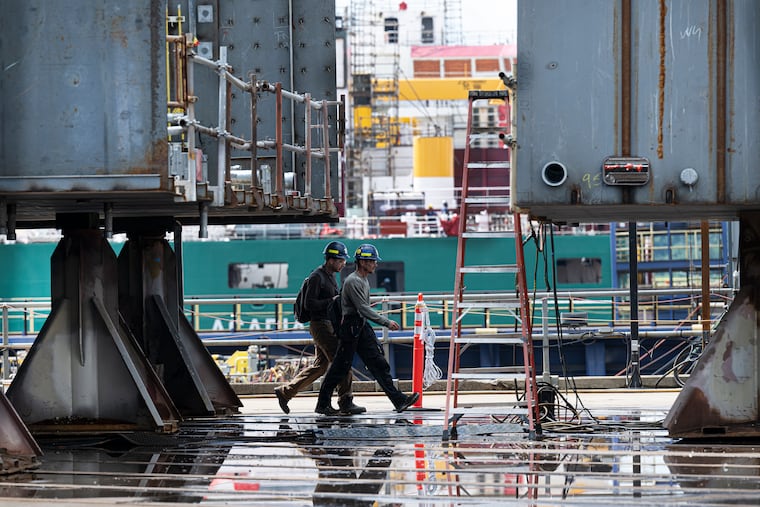
Workers walk near the grand block shop at the Hanwha Philly Shipyard in Philadelphia.
Workers walk near the grand block shop at the Hanwha Philly Shipyard in Philadelphia. Jose F. Moreno / Staff Photographer

The U.S. government is spending over a billion dollars to recruit hundreds of thousands of workers it estimates will be needed in Philadelphia and other shipbuilding centers to expand the Navy and compete with lower-cost Chinese yards, as President Donald Trump proposes. The campaign includes “Build Submarines” ads on social media and SEPTA bus shelters and grants to training programs.

“You have to work the parents,” Michael Cadenazzi, assistant secretary of war for industrial base policy, told contractors assembled by Trump and U.S. Sen. Dave McCormick (R., Pa.) at the U.S. Army War College in Carlisle in July. “Mom and Dad need to understand their kid is succeeding,” even if they skip college for “AI-proof jobs” as “the wizards behind the warriors — shipfitters, welders, pipe fitters.”

BuildSubmarines.com, a U.S. government-funded marketing effort, is trying to recruit workers for shipyards through public-transit and social-media ads. It also sponsors a Nascar team.
BuildSubmarines.com, a U.S. government-funded marketing effort, is trying to recruit workers for shipyards through public-transit and social-media ads. It also sponsors a Nascar team.U.S. Navy

If would-be college students prove a tough sell, there’s an even larger population of American workers who have what it takes to build ships but don’t want to, said Gary Kim, a Wharton School graduate student who has studied U.S., Chinese, Japanese, and Korean shipyards.

In essays for the U.S. Naval Institute and a series of papers titled The Brutal Realities of Building Ships, Kim, formerly a junior officer with U.S. Navy construction units in Asia and a Detroit manufacturing manager, has detailed rough conditions and skilled-labor shortages and suggested what shipyards have to do to realistically fill those jobs.

Read the full story here

____________________________________________________
Daily energy and environment updates. Free 30-day subscription

What is it about shipbuilding that turns young workers off? Read More »