We’re feeling one of the strongest El Nino’s ever recorded

About 1,000 miles south of Hawaii, the first signs of El Niño have come to Kiribati, an island nation in the central Pacific Ocean.

Alyssa Atwood, an associate professor in the Earth, ocean and atmospheric science department at Florida State University, is there now, deploying sensors to monitor ocean heat and salinity, and to track the bleaching of its magnificent coral reefs.

Already, around Christmas Island, one of this nation’s 33 atolls and islands, the ocean surface temperature is 2 degrees Celsius, or 3.6 degrees Fahrenheit, warmer than usual for this time of year, compared with the previous 30 years. As much as 10 percent of the corcore-astterals appeared bleached in a series of dives over the past few days, Atwood said.

Related: El Niño one for the record books

Bleaching occurs when corals become so stressed that they lose the symbiotic algae they need to survive. Bleached corals can recover, but if the surrounding water stays too hot for too long, they die.

“We expect this to get worse and worse and worse until the end of this year,” she said. “This is just the tip of the iceberg.”

That’s because the El Niño event that’s underway is expected to be one of the strongest ever recorded, and it has not yet

Read the full article here

We’re feeling one of the strongest El Nino’s ever recorded Read More »

U. S. energy use has battery storage demand soaring

By Summer Maxwell, Bloomberg Green Daily

Demand for batteries has skyrocketed as electricity use across the US swells, driven by data centers’ booming energy needs and increasing electrification. It’s also getting harder to get them connected to power grids.

Falling prices have made batteries more attractive. But after decades of stagnant investment, grids are racing to make the upgrades needed to plug them in, straining supplies of transformers, circuit breakers and other equipment. As those upgrades get delayed, storage projects are piling up in interconnection queues from coast to coast.

Consolidated Edison Inc., a major utility in New York state, for example, says over the past two years the volume of battery storage projects waiting to be connected has grown by 300%. In California, regulators are expecting that holdups to grid upgrades will stall energy projects up and down the state.

“The whole process of interconnecting these new power plants got really log-jammed and bottlenecked,” said Joseph Rand, an energy policy researcher at the Lawrence Berkeley National Laboratory. “It in some ways broke this historic process of the way transmission grid operators have been operating for almost 20 years.”

Nationwide, some 750 gigawatts of energy storage projects — roughly equivalent to the generating capacity of more than 700 nuclear reactors — are in line to get grid connections, according to the lab’s research. Not all of these projects will get built. Many developers have already abandoned the queue due to delays. Still, the wait is growing; the median was five years in 2025, up from a year and a half in 2015.

The flood of battery projects is expected to continue. Wood Mackenzie, an energy consultancy, projects the US energy storage market will quadruple in the next six years.

Read the full article here


U. S. energy use has battery storage demand soaring Read More »

A first: Solar surpasses wind in global electricity

  • Solar generated 2,811 TWh in 2025, edging past wind’s 2,714 TWh for the first time on record after jumping 30.1% year over year.
  • Renewables reached 33.4% of global electricity generation, but the growth is still adding to total energy supply rather than replacing fossil fuels.
  • China accounted for roughly 42% of both global solar and wind output in 2025, driving most of the world’s renewable expansion.
three people standing in the middle of a solar far on a rooftop


In 2007, nearly two decades ago, I wrote an article called “The Future Is Solar.” At the time, my argument was largely based on efficiency. I had been comparing biofuels with direct solar energy and noted how much more effectively solar panels could capture the sun’s energy than crops could convert it into liquid fuel. Solar was still expensive, storage was a major challenge, and the world’s energy infrastructure was built around fossil fuels. But the direction seemed clear.

It has been a long time coming, but the numbers now make it increasingly difficult to argue that the solar future is still some distant prospect. It is arriving in real time.

The latest Statistical Review of World Energy shows just how dramatically the renewable landscape has changed. Solar generation surged again in 2025 and, for the first time, surpassed wind as a source of global electricity. Hydropower remains the largest renewable source overall, but solar is now the fastest-growing major component of the world’s renewable power supply.

Related: Solar Power Is Gaining Traction With Farmers


Renewables Reach One-Third Of Global Electricity

Worldwide electricity generation reached about 32,202 terawatt-hours (TWh) in 2025. Hydroelectricity, wind, solar, and other renewable sources combined generated approximately 10,749 TWh.

That means renewables supplied about 33.4% of global electricity.

Hydroelectric power remained the largest contributor at 4,479 TWh, accounting for 13.9% of worldwide electricity generation. Solar reached 2,811 TWh, or 8.7% of the global total, while wind generated 2,714 TWh, or 8.4%. Geothermal, biomass, and other renewable sources contributed another 745 TWh, representing 2.3%.

The bigger story is the rate at which those numbers are changing. Total renewable generation increased 9.1% in 2025. But virtually none of the major renewable categories grew at the same pace.

Solar generation jumped 30.1%. Wind increased 8.2%. Other renewables grew 2.8%, while hydroelectric generation edged up just 0.4%.

Perhaps the most striking milestone in the new data is that solar generated more electricity than wind for the first time.

As recently as 2015, global wind generation was more than three times solar generation. Wind produced 832 TWh that year compared with just 257 TWh from solar.

A decade later, wind generation had more than tripled to 2,714 TWh. But solar output increased almost elevenfold, reaching 2,811 TWh.

Solar’s acceleration has been especially dramatic over the past several years. It generated just 1,061 TWh in 2022. Three years later, output was more than 2.6 times that level.

A first: Solar surpasses wind in global electricity Read More »

Veolia sues Delaware manufacturers over PFAS in drinking water

water treatment tankards in an industrial facility
Veolia announced on June 19, 2025, that it opened a PFAS treatment facility at its Delaware drinking water plant capable of treating 30 million gallons of water per day. The company set a goal to eventually build 100 such assets across the U.S. Courtesy of Veolia North America 

Senior Reporter, Waste Dive 

Veolia filed a lawsuit Tuesday against current or former manufacturers at six sites upstream of its drinking water plant in Wilmington, Delaware, alleging they contaminated water with per- and polyfluoroalkyl substances.
The company is seeking to recover the cost
 to build its $35 million granular activated carbon facility last year that filters out PFAS at the Stanton Water Treatment Plant, plus ongoing maintenance costs.

Veolia sues Delaware manufacturers over PFAS in drinking water Read More »

King of Prussia data center complex is rejected

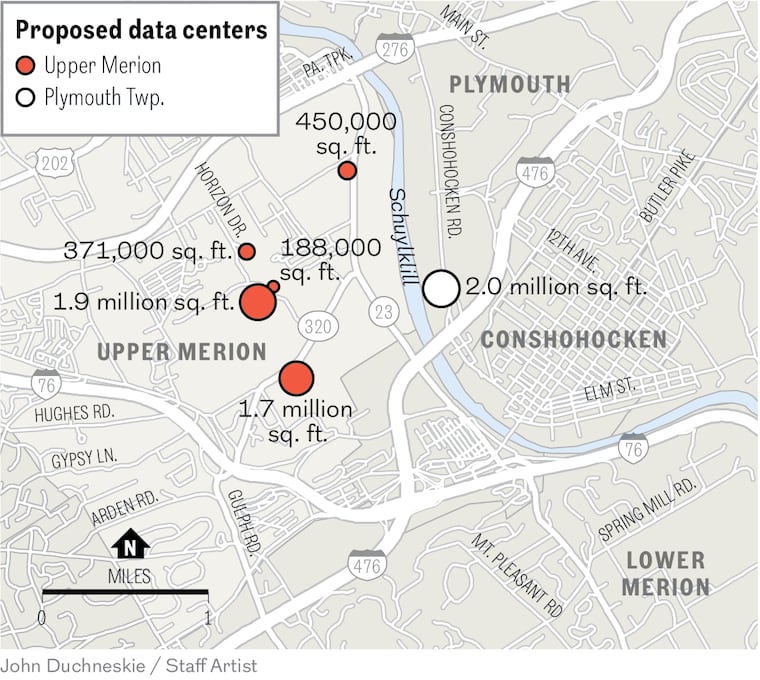
A map of the proposed data centers in Upper Merion and Plymouth
Townships

By Erin McCarthy, Philadelphia Inquirer

7 Williams Lane, Yardley, PA, 19067, USA

Unsubscribe   |   Change Sub

King of Prussia data center complex is rejected Read More »

What caused dozens of dead sharks to wash up at the Jersey shore?


By CBS News Philadelphia

Nearly 30 small sharks found dead along a stretch of beach in Sea Isle City, New Jersey, are raising questions about what caused the animals to wash ashore.

Michelle Greenling said she counted 29 sharks during a Wednesday morning walk along the beach between 29th and 39th streets.

“The first couple weren’t too surprising, but when I saw three and four and five, I knew something was up,” Greenling said.

The sharks were roughly a foot long and appeared to be juvenile dogfish, according to Stephen Nagiewicz, an adjunct professor of marine science at Stockton University. Dogfish are known to travel in large schools.

Greenling said some of the sharks had red markings on their undersides, prompting concerns about what the deaths could mean for the water.

“It was definitely concerning. I was concerned about the water. I was concerned about the sharks,” she said.

Nagiewicz said a toxic substance in the water is unlikely to be the cause.

Instead, Nagiewicz said the sharks may have become trapped by changing tides and subsequently stranded themselves. Another possibility is that fishermen targeting other species accidentally caught the young sharks and discarded them offshore.

“It’s either they got stuck in the tides and beached themselves, or somebody dumped their catch offshore and came this way,” Nagiewicz said.

While finding nearly 30 sharks on the beach is unusual, Nagiewicz said it does not necessarily indicate a larger environmental problem.

What caused dozens of dead sharks to wash up at the Jersey shore? Read More »