Opinion: Trump’s environmental rollbacks getting a Jersey boost

Donald Trump has declared war on environmental protections from Washington, but in New Jersey, the problem isn’t just what Trump is doing. The problem is what New Jersey is doing that allows those attacks to have an impact here at home.

The Trump administration isn’t simply rolling back a few regulations around the edges. It is carrying out the largest dismantling of environmental protections and standards in American history. The cumulative effect isn’t one bad policy. It’s more than 530 administrative actions, a death by a thousand cuts.

For New Jersey, these aren’t abstract policy debates. They translate into dirtier air, more flooding, stalled toxic cleanups, higher utility bills, and greater public health risks.

Gov. Mikie Sherrill can go on cable television and criticize Donald Trump all she wants. She can refuse to hand over voter rolls and denounce attacks on democracy. But if New Jersey weakens its own environmental protections, cuts DEP funding, fast-tracks permits, raids clean energy funds, and delays climate rules, then we aren’t building a wall against Trump. We’re building an on-ramp.

You can’t fight Trump with one hand while handing his agenda a permit with the other.

For decades, New Jersey’s environmental laws acted as a shield against federal rollbacks. We had stronger wetlands protections, stricter flood regulations, and a DEP that wasn’t afraid to tell polluters, “No.” Today, that shield is developing more holes than the Pulaski Skyway.

Trump is swinging a wrecking ball at environmental protections nationally. The question is: Why is New Jersey helping carry it?

Read the full column here

Opinion: Trump’s environmental rollbacks getting a Jersey boost Read More »

Meet New Jersey’s New Consumer Protection Chief

Sherrill taps former federal official to lead New Jersey consumer protection agency

Christopher L. Peterson

By Krystal Knapp, The Jersey Vindicator

Gov. Mikie Sherrill plans to nominate a nationally recognized consumer protection expert and former federal official to lead the New Jersey Division of Consumer Affairs, Attorney General Jennifer Davenport announced Monday.

Christopher L. Peterson will begin serving as acting director Aug. 3 while awaiting formal nomination and confirmation by the state Senate. Peterson ran for Governor of Utah in 2020, losing to Republican Spencer Cox in the general election.

Peterson previously served as a senior official at the U.S. Consumer Financial Protection Bureau, where he helped establish the agency and develop its enforcement policies and strategy. He also worked to strengthen the federal Military Lending Act, which protects service members and their families from predatory loans and other abusive financial practices.

The Division of Consumer Affairs investigates consumer fraud, regulates the securities industry, and oversees 51 professional and occupational licensing boards. Those boards regulate hundreds of thousands of professionals, including doctors, nurses, pharmacists, accountants, electricians, and real estate agents.

“Chris Peterson has spent decades fighting for consumers through public service, congressional advocacy, and in the courtroom,” Sherrill said in a statement announcing the appointment.

Sherrill said Peterson’s selection is part of a broader state effort to fill what her administration sees as a retreat in federal consumer protection. She accused the Trump administration of abandoning the Consumer Financial Protection Bureau’s mission, and said Peterson would help New Jersey protect residents from predatory business practices as families struggle with rising costs.

Davenport said Peterson’s experience developing consumer protection policy and enforcing the law would help the division use New Jersey’s existing laws to address illegal conduct contributing to the state’s affordability problems.

Read the full story here

Meet New Jersey’s New Consumer Protection Chief Read More »

As Seaweed Piles Up, Caribbean Bets On Boats, Barriers And Biofuel

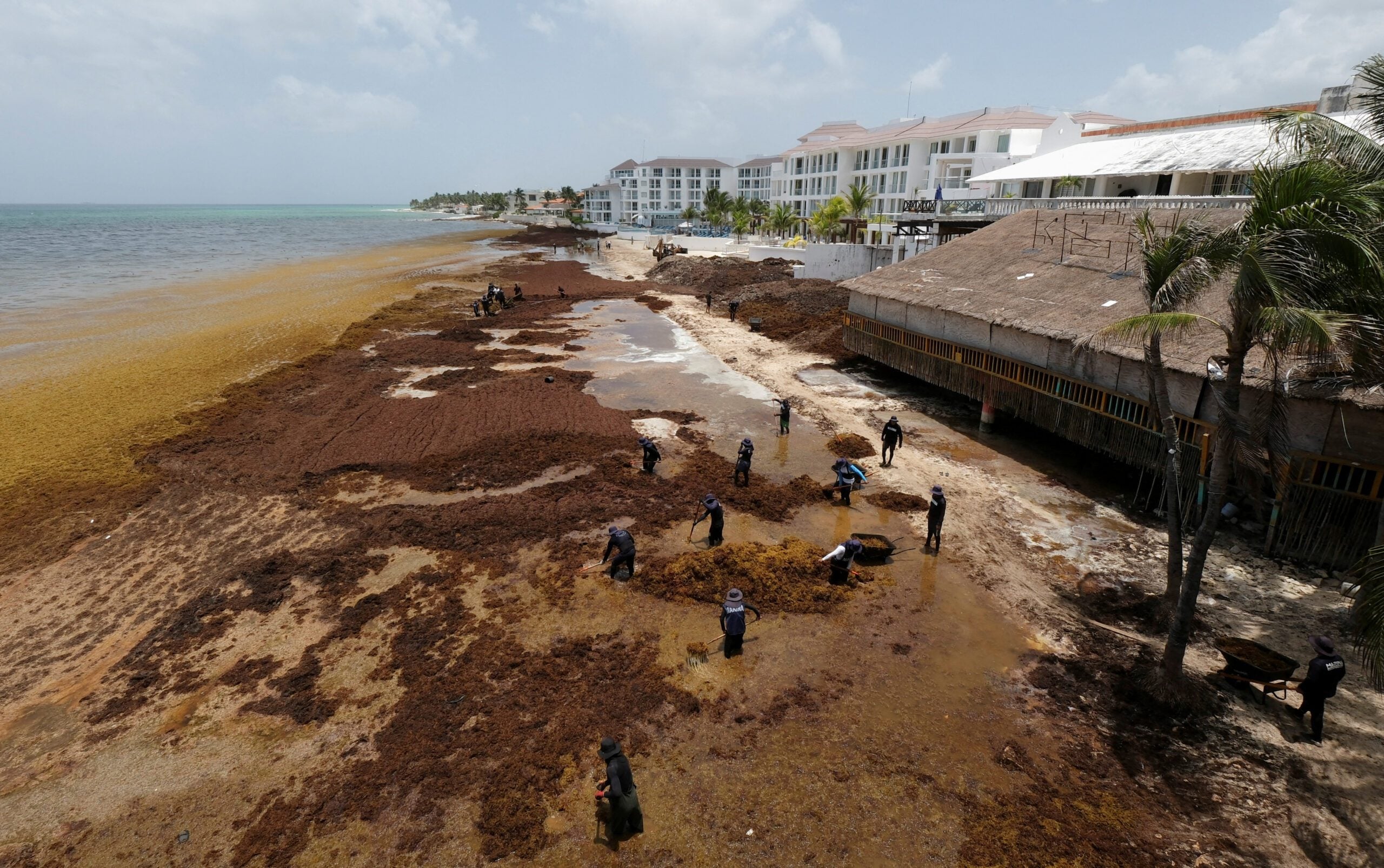
Cleanup to remove sargassum from Playa del Carmen’s beaches

Members of the Mexican Navy remove sargassum seaweed from a beach in Playa del Carmen, Mexico, June 4, 2026. REUTERS/Paola Chiomant


MEXICO CITY, July 31 (Reuters) – Hundreds of Mexican hotel workers, tractor operators and specialized Navy personnel are heading out to the beach each day at dawn to clean record masses of rotting sargassum seaweed off pristine Caribbean coastlines around popular tourist resorts.

The seasonal phenomenon has caused hotels across the Caribbean to cut rates and invest millions of dollars in clearing up piles of the foul-smelling algae from their beaches, while governments and businesses look for solutio

HOW IT STARTED

Sargassum – a brown seaweed that forms floating mats on the ocean surface – was historically confined to the so-called Sargasso Sea in the North Atlantic, but unusually strong winds around 2010 blew sargassum into nutrient-rich tropical waters off West Africa, where it found ideal growing conditions.

The displaced seaweed turned into a self-sustaining belt that rides on ocean currents to northern Brazil and through the Caribbean, bringing masses of algae onto Caribbean island nations, the popular Riviera Maya and into the Gulf of Mexico.

In the tropical Atlantic, sargassum feeds on nutrients running in from major rivers such as the Amazon, Orinoco and Congo rivers, as well as upswells from the deep ocean, Saharan dust and warming sea temperatures.

WHERE IT’S GOING

The University of South Florida’s Optical Oceanography Lab expects 2026 to be at least the second-largest year for sargassum abundance, with more seaweed likely to heap up around the Caribbean and southeastern Florida in coming months.

Brian Barnes, research assistant professor at the university’s College of Marine Science, who works in the lab, told Reuters the novelty of the phenomenon and its seasonality makes predicting its future course challenging.

“Before 2010 there’s nothing, and since then we’ve gone to up to 1 million metric tons over the entire area in 2011 to 40 million last year,” he said, suggesting the seaweed could be doubling in mass every five years.

Read the full story here

As Seaweed Piles Up, Caribbean Bets On Boats, Barriers And Biofuel Read More »

Battery storage, not rooftop solar, becomes the battleground for corporate competitiveness

Berde Renewables handout photo


By Raine Musñgi, ABS-CBN News

MANILA — The next corporate energy race has already begun, and it isn’t about solar panels.

Philippine businesses have spent the past decade installing rooftop solar to rein in some of Southeast Asia’s highest electricity costs. Now, industry leaders say the next competitive advantage is no longer generating electricity.

It’s storing it.

As battery prices continue to fall and technology rapidly improves, Battery Energy Storage Systems (BESS) are emerging as the next frontier in corporate energy strategy.

Instead of serving only as emergency backup power, batteries are increasingly helping companies cut electricity costs, reduce exposure to volatile power prices and maximize the value of renewable energy.


The shift comes as the Philippines works toward raising renewable energy’s share in the power generation mix to 35 percent by 2030 and 50 percent by 2040, targets set by the Department of Energy that will require significantly more energy storage to support the growing use of solar and wind power.

Globally, the International Energy Agency identifies battery storage as one of the fastest-growing clean energy technologies as costs continue to decline and renewable generation expands.

“The biggest challenge for renewables over the past decade has actually been its intermittency,” Berde Renewables Group Chief Executive Officer and Co-founder Morris Zhou said on ANC’s Business Outlook.

“When the sun shines, that’s great. When there’s a cloud, when there’s a typhoon, when it’s cloudy for a few days, you don’t get the power.

“What’s actually been happening over the last five years is that battery energy technology has had a major breakthrough, not only in terms of efficiency but also in cost. The energy storage piece was kind of the last piece for the renewable energy transition.”

Battery storage, not rooftop solar, becomes the battleground for corporate competitiveness Read More »

Rethinking how wind energy turbines are made

Wind turbines in rural America

PHOTO/Shutterstock

By Nate Williams, Slashgear 
For years now, the U.S. Department of Energy has had one major roadblock to the streamlining of wind turbine installation: the sheer amount of work it takes to manufacture blades. Thanks to 3D printing, the DOE has a new approach that could dramatically change how quickly these lightweight blades are designed and built.
Rather than relying exclusively on the traditional process of creating a full-scale plug before manufacturing a blade mold, researchers are finding ways to use large 3D-printed molds to make manufacturing faster, more affordable, and more flexible in designing future blades. The best wind turbine blade design is currently the three-bladed horizontal-axis rotor, but that could change if experimental blades were more accessible.
This 3D printing effort is currently moving in various different directions, including the Department of Energy’s Wind Energy Technologies Office and Advanced Manufacturing Office alongside national laboratories and various private-sector partners. Wind energy already supplies more than 10% of U.S. electricity and generates enough power for tens of millions of American homes. With these advances, the DOE could take the nation’s renewable energy infrastructure to new heights, and the U.S. is also home to many large wind turbine manufacturers.
Read More:

Rethinking how wind energy turbines are made Read More »

Dozens of abandoned box turtles discovered in New Jersey

Dozens of abandoned box turtles discovered in NJ


CRANFORD, N.J. (PIX11) — A summer stroll along the Rahway River became an ongoing wildlife rescue operation after more than 150 box turtles were discovered abandoned along the riverbank in Cranford, NJ.

New Jersey’s Department of Environmental Protection believes someone illegally dumped the turtles along the river on Wednesday. Crews say there are Eastern box turtles, which are native to New Jersey, and Three-toed box turtles, a species not native to the state.

Through the efforts of local residents, animal control officers, firefighters and law enforcement, nearly 100 turtles have already been recovered.

The New Jersey Department of Environmental Protection’s Fish and Wildlife division is leading the investigation, assisted by local animal control officers and the Cranford Fire Department.

One local teenager has been helping rescue the stranded turtles, carefully collecting them and bringing them to the Cranford Fire Department, where officials have established a collection point for recovered animals.

Wildlife experts say box turtles are primarily land animals, not aquatic turtles

“I thought it was really sad,” said Cranford resident Alexandra Augenzucker, who learned about the rescue effort through social media.


“You can’t just dump them in the ponds here. If you get here first thing in the morning, they’ll be out there sunning themselves. It’s one of the cool things about living in the Venice of New Jersey.”

Animal rescue organizations are now caring for the recovered turtles.

Dozens of abandoned box turtles discovered in New Jersey Read More »