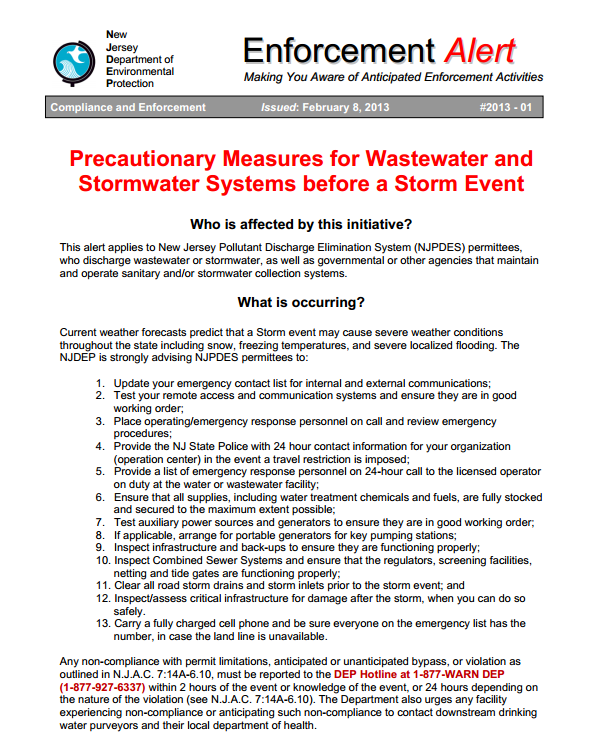
DEPs in PA and NJ fire back at enviros’ river report

Environmental groups in many states love to crank out reports that remind the public that much work remains to be done to return the planet to conditions that prevailed when Adam and Eve were its sole inhabitants.

The reports generally a prepared by a single consulting organization that gathers its statistics from annual disclosures  that industries are required to make to the U.S. Environmental Protection Agency.

Participating environmental groups at the state level slap their names on the report and plug their officers’ names into pre-formatted quotes generated by the consultant.

The impression left is that the local organization is responsible for the study (they are not) and that the local group is disclosing data that otherwise would be unknown (it’s all on the public record available on various agency websites). 

There’s nothing essentially wrong, we guess, with such truth-stretching. The reports provide important information that most folks would not go looking for on their own and it spotlights the existence of local environmental organizations that rely, for the most part, on donations from businesses and individuals who care about the environment. Keeping their brand in the public eye helps keep the donations rolling in.

The problem is that the report writers are skilled at presenting the facts in ways that suggest that Adam and Eve escaped just in time, leaving the rest of us to be slowly poisoned by increasingly toxic levels of pollution. And that regulatory agencies at the federal and state level, that are supposed to be protecting the environment, are sitting by idly as Mother Earth writhes in torture.

The truth is that the environment is steadily improving and has been for decades. This is due, in large part due to those regulatory agencies that the reports impute to be impotent and, yes, also to those environmental activists who believe that the best way to insure additional improvements is to issue alarming reports that keep their donors scared and writing checks.

In Pennsylvania and New Jersey, where Democratic administrations held sway for a long time, the states’ Department of Environmental Protection rarely ever took exception to the reports. Their leaders, or the folks in the governor’s office to whom they reported, were reluctant to challenge environmental organizations regardless of how blatantly they bent the truth.

That is not the case today. Republican governors are in office and their respective DEPs are less inclined to sit back and take their annual bashing with clenched teeth.

Express-Times reporter Douglas B. Brill (no relation) writes today about Pennsylvania DEP Secretary  Mike Krancer’s reaction to the enviro-report Wasting our Waterways 2012.  Brill also includes quotes from New Jersey DEP Spokesman Larry Ragonese.

What’s your take on this? Is spin for a good cause OK? Let us know in the comment box below. If one is not visible, activate it by clicking on the tiny ‘comments’ line.


***********************************************************************************************************

Like this post? You’ll love our daily newsletter, EnviroPolitics
Try it free for 30 days!
  No obligation. Cancel anytime with one click

**********************************************************************************************************
*

DEPs in PA and NJ fire back at enviros’ river report Read More »

Industry not alone in pumping money into fracking fight

In New York, industry and business groups that lobbied against a moratorium on fracking spent $2.9 million
in 2010 alone. The
American Petroleum Institute, an oil and gas industry trade group,
listed $15 million in nationwide lobbying expenses in the same year, while America’s Natural Gas
Alliance, another industry trade group, listed $3.8 million in 2010
lobbying expenses.

Although spending by the hydrofracturing lobby dwarfed the financial efforts of environmental groups and others opposed to the high-pressure, water-and-chemical, horizontal-drilling technique, a sizable amount of funding has been provided to fracking opponents by a single source–the Park Foundation.

Jon Campbell, who covers state government for Gannett’s Democrat and Chronicle, provides background on the foundation, who it has funded, and how the $3 million it has spent since 2009 has drawn fire from some in the oil industry.

You can read Jon’s story at: Park Foundation funds anti-fracking groups.

What do you think? Tell us in the comment box below. If one is not visible, activate it by clicking on the tiny ‘comments’ link. 


***********************************************************************************************************

Like this post? You’ll love our daily newsletter, EnviroPolitics
Try it free for 30 days!
  No obligation. Cancel anytime with one click

***********************************************************************************************************

Industry not alone in pumping money into fracking fight Read More »

New Jersey DEP loses Natural Resources Damage appeal

If you are a company or attorney fighting a Natural Resource Damages claim brought by the New Jersey Department of Environmental Protection (DEP), you may take heart in an appeals court ruling that denied the DEP $8 million it was seeking under the Spill Act.

In a bulletin to clients, Cole Schotz environmental attorney Douglas I. Eilender explains the background to the NJDEP v. Essex Chemical Corp case that the Department was appealing, why the appellate court ruled against the DEP, and what the decision could mean for others subject to similar environmental  damage claims.

You can read Mr. Eilender’s summary here.

Have an insight you’d like to share? Use the comment box below.  If one is not visible, activate it by clicking on the tiny ‘comments’ link 


***********************************************************************************************************

Like this post? You’ll love our daily newsletter, EnviroPolitics
Try it free for 30 days!
  No obligation. Cancel anytime with one click

***********************************************************************************************************


New Jersey DEP loses Natural Resources Damage appeal Read More »

Top 2 environmental news stories for PA & NJ – 4/12/12

Business, government and environmental leaders who subscribe
to EnviroPolitics accessed full versions of the news
stories below
on April 12, 2012
-and dozens more!


In Pennsylvania

Judge puts hold on shale zoning law
A
judge granted a 120-day halt to provisions in a new Marcellus Shale drilling
law that override local zoning laws Inquirer

DEP highlights ‘deficiencies’ in Cabot investigation The
state DEP found “several deficiencies” including “definite
evidence” of a spill or seep in a natural gas driller’s report that the
company had said disproved a whistleblower’s claims of failures at its well
sites Daily
Review


In New Jersey

Fire destroys 100 acres near Meadowlands sports complex
Treacherous ground and fast-moving flames
kept crews from directly fighting a large grass fire near the Izod Center
Wednesday Star-Ledger


Beach smokers get better with their butts Cigarette butts no longer lead the list of debris collected in an
annual sweep of New Jersey’s 127 miles of beaches and bays
Statehouse
Bureau


Top 2 environmental news stories for PA & NJ – 4/12/12 Read More »

Judge grants temporary freeze on Pa’s new fracking law

A judge on Wednesday ordered a temporary halt to a portion of
Pennsylvania’s new Marcellus shale law that limits the power of
municipalities to regulate the booming natural gas industry, the Pittsburgh Tribune-Review reports today.

Commonwealth Court Senior Judge Keith Quigley issued the 120-day
injunction after hearing arguments in Harrisburg. The eight-week-old
law’s local zoning provisions were scheduled to take effect on Saturday.

A group that includes South Fayette in Allegheny County and Peters,
Cecil, Mt. Pleasant and Robinson in Washington County sought the
injunction to give the municipalities time to argue their claims that
the law, known as Act 13, unconstitutionally takes away local powers and
should be overturned.

************************************************************************************************************
Stay on top of fracking-related news stories. Try a free, 30-day subscription to EnviroPolitics
***********************************************************************************************************

“Municipalities must have an adequate opportunity to pass zoning laws
that comply with Act 13 without the fear or risk that development of
oil and gas operations under Act 13 will be inconsistent with later
validly passed local zoning ordinances,” Quigley wrote.

His order halts only any part of the law that might “pre-empt
pre-existing local ordinances” but denies the rest of the
municipalities’ injunction request to stop the entire law from going
into effect.

“What we were seeking was 100 percent what the court granted,” said John Smith, the solicitor for Robinson and Cecil.

The Marcellus Shale Coalition issued a statement saying the natural
gas industry group is “confident that the legal merits of this law —
aimed at ensuring the safe and responsible development of clean-burning
American natural gas in the commonwealth — will be recognized and
upheld accordingly.”

To issue an injunction, a judge must find that the request meets six
standards, including that “there is likely success on the merits.”
Quigley wrote in a footnote to the order that he “is not convinced that
petitioners’ likelihood of success on the merits is high,” but he
ordered the injunction because five other factors were compelling. Read full story here

Related:

What The New Impact Fee Law Means For Pennsylvania
Fracking bill moves forward in California Legislature 
Catskill Mountains town bans natural gas fracking

Corrupt Pennsylvania history holds lessons for fracking


***********************************************************************************************************

Like this post? You’ll love our daily newsletter, EnviroPolitics
Try it free for 30 days!
  No obligation. Cancel anytime with one click

***********************************************************************************************************

Judge grants temporary freeze on Pa’s new fracking law Read More »

EPA grants for hotels, restaurants, markets in NY & NJ

Restaurants, supermarkets and hotels stand to benefit from some $441,000 in pollution-prevention grants awarded this week by the U.S. Environmental Protection Agency’s
Region 2 office.

The EPA provided the New York State Restaurant Association Educational Foundation
an $83,800 grant to expand its
pollution prevention training program for New York City restaurants to
restaurants in Nassau and Westchester County, New York. The restaurant
association will provide group training sessions at restaurants on
pollution prevention techniques such as using water-saving devices,
cleaning products and energy-efficient equipment. It will disseminate
the results through case studies and a green restaurant workbook to
restaurants throughout New York State.


The New Jersey Institute of Technology will use a
$178,060 grant to develop an online toolkit that will provide training
to supermarkets on ways to reduce energy through lighting improvements
and heating, ventilation, and air conditioning controls, and reduce the
release of hazardous materials from cooling system leaks. NJIT will
disseminate the toolkit to supermarket chains throughout New Jersey and
provide training to the supermarket staff through direct outreach and
webinars.


The EPA is providing the New Jersey Department of Environmental Protection with an $180,000 grant that will be used to
promote sustainability in New Jersey’s hotel industry by providing
training on ways to increase energy and water efficiency, reducing the
use of hazardous materials and saving money. NJDEP will train hotel
owners and managers on methods to achieve efficiency in their lighting,
space health/cooling, water heating, refrigeration and appliances. 


This
NJDEP project will target small to medium-sized hotels in Cape May and
Atlantic counties, which have the largest concentration of hotels in the
state. NJDEP will provide outreach through four workshops, hotel job
training at Atlantic Cape Community College, as well as direct mailings to
all hotels in New Jersey.


“Pollution prevention is some of the most important
work being done to protect the environment,” said EPA Regional
Administrator Judith A. Enck. “The EPA Pollution Prevention grants help
businesses, colleges and state agencies identify strategies to reduce
the use of toxic materials, save energy, protect human health and save
money. These grants support programs that reduce or eliminate waste at
the source, preventing the need to treat it after it is generated.”

The grants are part of the approximately $4 million
in grants that the EPA awards each year aimed at preventing pollution
across the nation. For more information on the EPA pollution prevention
program, visit
http://www.epa.gov/region02/p2/.


***********************************************************************************************************

Like this post? You’ll love our daily newsletter, EnviroPolitics
Try it free for 30 days!
  No obligation. Cancel anytime with one click

***********************************************************************************************************

EPA grants for hotels, restaurants, markets in NY & NJ Read More »