Take EnviroPolitics for a two-week vacation
Take EnviroPolitics for a two-week vacation Read More ยป
The Saul Ewing law firm is informing its clients that case law concerning awards of attorneyโs fees and costs under Pennsylvaniaโs Clean Streams Law continues to expand in favor of parties opposing final actions by the state Department of Environmental Protection.
Where proposed projects are facing public opposition (even by a small group of grassroots organizers), the potential exposure for expensive and lengthy litigation before the Pennsylvania Environmental Hearing Board is even greater than it was before, according to Andrew T. Bockis, an associate in the firm’s Environment, Energy and Utilities Department.
Bockis explains a June 15, 2011 Commonwealth Court ruling and how it is likely to affect proposed projects facing public opposition in: Pennsylvania court ruling increases possibility for third-party permit challenges.
Try it free for 30 days! No obligation. Cancel anytime with one click.
More third-party enviro permit challenges ahead in PA? Read More ยป
Solar energy development in New Jersey is second only to California. So far, it has proceeded in a way that is generally consistent with smart growth principles. But that may be changing.
In this guest post, Chris Sturm, senior director of state policy for New Jersey Future, examines the challenges that lie ashed for the state and and for this popular form of alternative energy.
New Jerseyโs Solar Ambitions Raise Difficult Land-Use Issues
By Chris Sturm
Regulatory, Incentive and Policy Framework Needed For Sizing, Siting
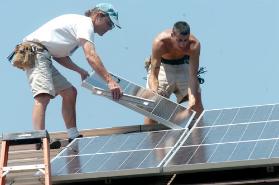
Solar development in New Jersey has so far proceeded in a way that is generally consistent with smart growth principles. Most of the development has been in the form of net-metered installations (supplying electricity predominantly for on-site use) on rooftops in developed areas, rather than sprawling solar arrays on farmland or other sensitive lands in rural areas. The largest rooftop solar installation in the United States, with a capacity of 4 megawatts, was completed in April in Edison.
At industrial facilities and some other sites with extensive electricity needs and large amounts of land available, solar installations have been mounted on the ground. This is the case, for example, at the Rutgers Solar Farm in Piscataway, which generates about 11 percent of the electricity used on the universityโs Livingston Campus. Last month, McGraw-Hill announced plans to install the nationโs largest privately owned, net-metered, ground-mounted solar array at its East Windsor facility, with a potential capacity of 14.1 megawatts.
Even the largest solar facilities in New Jersey to date have primarily supplied electricity for on-site use. There has been much discussion recently, however, about increased development of large, utility-scale solar facilities that function as power providers, much like traditional power plants. Although only a handful of projects of this scale have actually been built or approved for construction in the state, several more are under active consideration, especially in South Jersey.
As New Jersey considers how and where solar energy should be developed in the years to come, some general principles will ensure that solar facilities are sizedโand sitedโin ways that are appropriate to their surroundings. Because of its small size and big ambitions for solar energy, the state will need to be sensitive to the land-use impacts of solar development.
For example, establishing a hierarchy of state incentives that gives priority to rooftop installations over ground-mounted projects would encourage a proven source of solar energy that has minimal impact on land consumption. Discouraging utility-scale solar development on farmland would ensure that agriculture retains its role as a thriving contributor to the Garden Stateโs economy, environment and quality of life. Enacting and enforcing regulations that mitigate any negative impacts from solar development, such as visual impairment or noise from inverters that link solar panels to the electricity grid, would protect residents from unwanted intrusion on their neighborhoods.
Brownfield sites, especially closed landfills, have great potential for solar development, as well as other productive uses. Considerable attention must be paid to the issue of whether a more active use of a given site, especially in a developed area, might be preferable. Other marginal sites, such as underutilized industrial properties, may have significant potential not only for solar energy, but also for commercial, residential or mixed-use redevelopment.
The land-use issues raised by solar development are numerous and complex, and the policy and regulatory options available to state and local government agencies to deal with them are equally diverse and complicated. Although the recently released Energy Master Plan recommends scaling back some of the state incentives for renewable sources, the incentives will likely continue to provide a powerful tool to shape solar siting decisions. If New Jersey is to remain in the forefront of solar energy development, policymakers will have to marshal all of the regulatory and fiscal options to confront these issues directlyโand soon.
———————————————————————————————————————————
Chris Sturm, Senior Director of State Policy, NJ Future
Try it free for 30 days! No obligation. Cancel anytime with one click.
NJ’s solar growth confronts difficult land-use issues Read More ยป
The U.S. Environmental Protection Agency (EPA) today proposed new safeguards for recycling hazardous materials. The proposal modifies EPAโs 2008 Definition of Solid Waste (DSW) rule, which revised hazardous waste regulations to encourage recycling of hazardous materials.
The agency said that the new proposal, now open for public comment, will “improve accountability and oversight of hazardous materials recycling, while allowing for important flexibilities that will promote its economic and environmental benefits.”
EPA also is releasing for public comment its draft expanded environmental justice analysis of the 2008 DSW final rule, which evaluates the ruleโs potential impact on low-income and minority communities. The agency is seeking public comment on the environmental justice analysis as well as on suggested changes received from peer review. The analysis and peer review comments will be available in the docket for this rule-making once the proposal is published.
โSafe recycling of hazardous materials conserves vital resources while protecting the environmental and economic health of our communities,โ said Mathy Stanislaus, assistant administrator for EPAโs Office of Solid Waste and Emergency Response. โTodayโs proposed enhancements show EPAโs commitment to achieving sustainable materials management through increased recycling, while retaining safeguards to protect vulnerable communities and the environment.โ
“EPAโs re-examination of the 2008 DSW final rule identified areas in the regulations that could be improved to better protect public health and the environment with a particular focus on adjacent communities by ensuring better management of hazardous waste,” the agency said in a news release.
“Todayโs proposal includes provisions to address those areas through increased transparency and oversight and accountability for hazardous materials recycling. Facilities that recycle onsite or within the same company under the reduced regulatory requirements retained under the proposal would be subject to enhanced storage and record-keeping requirements as compared to the 2008 rule. Companies that send their hazardous materials offsite for recycling would have tailored storage standards, while being required to send their materials to a permitted hazardous waste recycling facility. The proposed rule also creates a level playing field by requiring all forms of hazardous waste recycling to meet requirements designed to ensure materials are legitimately recycled and not being disposed of illegally.”
EPA will accept comment on this proposal for 60 days after publication in the Federal Register. The docket for the rule-making is EPA-HQ-RCRA-2010-0742 and can be accessed at http://www.regulations.gov once the proposal is published.
More information about this rulemaking: http://www.epa.gov/waste/hazard/dsw/rulemaking.htm
Try it free for 30 days! No obligation. Cancel anytime with one click.
The EPA is updating its hazardous waste recycling rule Read More ยป
Governor Chris Christie may seek to limit to five years the permanent ban on hydrofracturing (fracking) contained in a bill that received final passage in the state legislature last week.
Bob Jordon of Gannett’s Statehouse Bureau wrote today that Christie may call for the change by returning the legislation to the Senate and Assembly in a conditional veto. A CV is a deal-cutting method used by governors to say: Hey, Legislature, if you make changes x, y and z, I’ll sign your bill.
Christie hasn’t publicly commented on the fracking ban contained in S-2576, but his close ally, Senator Joseph Kyrillos, offered an unsuccessful amendment on the Senate floor that called for the ban to serve for five years only.
In arguing for the limit, Kyrillos said:
“โI understand the thrust (of the proposed permanent ban), and from what I can see this practice is not in the form that we would like, and thereโs potential danger, but itโs also possible that over time the practice can be refined,โ Kyrillos said.
โThere is great promise of natural gas finds in the country, in Pennsylvania and perhaps someday in New Jersey, though thatโs not the case today. I think itโs more prudent, as we try to deal with more ways to be energy independent and motivate our economy for the next generation, to preserve the option in case we get to the point of environmental safety.โ
No natural gas drilling is taking place currently in New Jersey. The gas-rich Marcellus Shale bypasses the Garden State in its stretch from Western New York into Pennsylvania.
But environmentalists are concerned that another shale deposit, the Utica formation, eventually will come into play.
For more on how New Jersey, New York and Pennsylvania are dealing with ‘fracking,’ check out our recent posts:
Three years and still no fracking tax in PA…here’s why
NJ bans fracking. NY un-bans it. PA skips a frack tax
Corbett stares down PA lawmakers on gas-drilling fees
Winning hearts and minds of six-year-olds–for fracking
Marcellus Shale sites included in EPA fracking study
PA bill requires disclosure of chemicals in fracking fluid
Try it free for 30 days! No obligation. Cancel anytime with one click.
Will NJ’s governor limit the legislature’s fracking ban? Read More ยป
| PA Gov. Tom Corbett |
Wonder why the Pennsylvania’s legislature and governor last week approved a state budget that slashes funding for education and social welfare but ignores an obvious source of offsetting revenue–a tax on natural drilling industry?
Wonder no more.
The Times-Tribune‘s Harrisburg bureau chief Robert Swift reports today that the natural gas industry spent more than $3.5 million last year to lobby lawmakers and state officials.
Three years and still no fracking tax in PA…here’s why Read More ยป