NJ bans fracking. NY un-bans it. PA skips a frack tax

What a difference a state makes.

Within several days of each other, New Jersey, New York and Pennsylvania reacted, respectively, to the controversial natural gas extraction technique of hydrofracturing (fracking) by:
           1. banning it;
           2. un-banning it, and
           3. letting it proceed unabated and untaxed.

In New Jersey, lawmakers in both houses passed and sent to the governor legislation that would prohibit the use of fracking anywhere in New Jersey.

That’s a bit less courageous than it might sound since God didn’t see fit to locate the gas-rich Marcellus Shale underneath the state.

Bill sponsors argue, however, that other layers of shale do lie below NJ, and it’s just a matter of time before the gas industry comes poking around.
 

In New York, the state DEC announced it would lift its current moratorium on natural gas drilling, as it released recommendations
for state regulations that call for:
  • A fracking ban in the New York City and Syracuse watersheds
  • No fracking within 500 feet of an aquifer
  • A ban on surface drilling on state-owned land; and 
  • Strict regulation of fracturing on privately held lands.
 

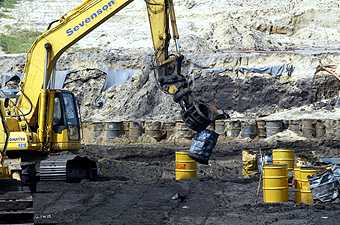
In Pennsylvania, where legislation to ban fracking has never gotten even inches off the ground, and where drilling on private and public land is turning some sections of the state into swiss cheese, the GOP-controlled legislature dropped plans to vote on a bill to impose ‘impact fees’ on shale gas wells.

Lawmakers backed down immediately after Republican Gov. Tom Corbett huffed and puffed that he’d veto any such attempt.

What will be interesting to watch now is whether New Jersey Governor Chris Christie will veto the fracking ban bill that’s been dropped on his desk.

Signing it will only further inflame environmentalists, already enraged by the governor’s decision to pull the state out of RGGI, a regional compact set up to combat climate-altering carbon emissions.

With no drilling taking place, his signature would be an easy way to avoid an unneeded controversy. But controversy is Christie’s middle name.

It’s something to look forward to in July as news-making slides into its summer slumber.

Tell us what you think about hydrofracturing and the divergent approaches to regulation taken by New Jersey, New York and Pennsylvania.  Use the comment box below. If one isn’t visible, click on the tiny ‘comments’ line to open it. 

————————————————————————————————————-
Like this post? You’ll love our daily newsletter, EnviroPolitics

Try it free for 30 days!  No obligation. Cancel anytime with one click. 


NJ bans fracking. NY un-bans it. PA skips a frack tax Read More »

Corbett stares down PA lawmakers on gas-drilling fees

PA Governor Tom Corbett

Pennsylvania’s Republican majority legislators, who have been working to adopt natural gas impact fees in conjunction with the state’s budget legislation, abandoned that plan yesterday after Governor Tom Corbett made it clear that he’d veto any legislation containing the fees.

Corbett, who has been a hardline supporter of the natural gas industry (which helped fund his election campaign last year), said he would not consider any fees on natural gas wells until the Marcellus Shale commission, that he appointed, submits its report next month on the effects of drilling.

The Republican governor was unequivocal in his stance.

“I have sent this message back: If something gets to my desk, it will be vetoed,” he said.

For more, see today’s Morning Call story: Debate on gas drillers’ impact fee put off

————————————————————————————————————-
Like this post? You’ll love our daily newsletter, EnviroPolitics

Try it free for 30 days!  No obligation. Cancel anytime with one click. 

Corbett stares down PA lawmakers on gas-drilling fees Read More »

Winning hearts and minds of six-year-olds–for fracking

Hi boys and girls. Meet Tailsman Terry, the Friendly Fracosaurus.

He’s going to tell you all about the wonderful world of fracking.

It’s healthy. It’s patriotic. And best of all it’s fun.

Have your parent or older brother or sister read the fun story of fracking to you as you use your crayons to color in the pictures of happy drilling sites.

See the happy trees and animals and the smiling sun.

Look at the happy trucks and pipelines that you may get to see when Tailsman Terry and his friends start getting energy from the ground near you.

Hey, look, there’s a mom and dad smiling with a man from the fracking company who just got permission to drill on your property.

And isn’t it great that everything will be put back nice and clean and happy when they’re all done? 

What? You don’t have the Friendly Fracosaurus Coloring Book?  Don’t worry, little friend. You can get one for free at the next community picnic or your mom or dad can use their computer to get one just for you.

So, get those crayons ready and have a happy fracking day.

NOTE TO GROWNUPS: For more information on the gas industry’s educational campaign for kids, check out Color Me Fracked in today’s Pittsburgh Post-Gazette

 
Our most recent blog posts:
Marcellus Shale sites included in EPA fracking study

PA bill requires disclosure of chemicals in fracking fluid
Amended Marcellus gas tax in place for PA Senate vote

NJ bill restricting wind turbines set for June 20 hearing

New group will lobby for more rental units in New Jersey


————————————————————————————————————-
Like this post? You’ll love our daily newsletter, EnviroPolitics

Try it free for 30 days!  No obligation. Cancel anytime with one click. 

Winning hearts and minds of six-year-olds–for fracking Read More »

Marcellus Shale sites included in EPA fracking study

The Environmental Protection Agency announced today that drilling sites in Pennsylvania’s Washington, Bradford and Susquehanna counties are among the locations selected for a nationwide study of hydraulic fracturing (fracking).
EPA says the sites identified were selected following extensive input from stakeholders, including the public, local and state officials, industry, and environmental organizations.

The agency said it will begin field work in some of the selected regions this summer. 

Prospective and Retrospective Studies

The Marcellus Shae in Washington County, PA was one of two sites selected for prospective case studies where EPA will monitor key aspects of the hydraulic fracturing process throughout the life cycle of a well.  The second case study will focus on the Haynesville Shale in DeSoto Parish, La.

Five retrospective case studies were selected and will examine areas where hydraulic fracturing has occurred for any impact on drinking water resources. The Pennsylvania locations chosen for this portion of the study are in Bradford, Susquehanna and Washington counties.  The other locations are in North Dakota, Texas and Colorado. 

EPA says the information gathered will be part of an approach which includes literature review, collection of data and information from states, industry and communities, laboratory work and computer modeling.

“The combination of these materials will allow us to do a more comprehensive assessment of the potential impacts of hydraulic fracturing on drinking water resources, ” the agency said in a news release. “The study will continue to use the best available science, independent sources of information, and will be conducted using a transparent, peer-reviewed process, to better understand any impacts associated with hydraulic fracturing.”  


————————————————————————————————————-
Like this post? You’ll love our daily newsletter, EnviroPolitics

Try it free for 30 days!  No obligation. Cancel anytime with one click.


Marcellus Shale sites included in EPA fracking study Read More »

PA bill requires disclosure of chemicals in fracking fluid

A Philadelphia Democrat has introduced legislation in the Pennsylvania House of Representatives that would require natural gas drilling companies to disclose to state environmental regulators all chemicals used in the hydrofracturing (fracking) process.

The bill, HB 1680 , introduced on June 19 by Rep. Kenyatta Johnson, requires the disclosure to the state Department of Environmental Protection the names of chemicals (but not the proprietary chemical formulas) used in the fracking process. 

The legislation requires the DEP to make the information available to the public on its website.

Disclosure of chemical formulas in cases of health emergencies

The bill also would require the disclosure of “proprietary chemical formula or the specific chemical identity of a trade secret chemical used in hydraulic fracturing: “in the event that the DEP or an appropriate health care provider determines that a medical emergency exists and such disclosure is necessary for emergency or first aid treatment.” 

In a news release, Johnson said that hundreds of chemicals are used during this fracking process, “many of which can be harmful to people if they are absorbed into the ground and eventually into our water supply.”

Our most recent blog posts:
Amended Marcellus gas tax in place for PA Senate vote

NJ bill restricting wind turbines set for June 20 hearing

New group will lobby for more rental units in New Jersey

NJ’s withdrawal from RGGI contested in Assembly


————————————————————————————————————-
Like this post? You’ll love our daily newsletter, EnviroPolitics

Try it free for 30 days!  No obligation. Cancel anytime with one click.

PA bill requires disclosure of chemicals in fracking fluid Read More »

Amended Marcellus gas tax in place for PA Senate vote

Pennsylvania moved a step closer to assessing a fee on shale gas drillers yesterday, but Senate lawmakers supporting the levy say still have changes to make to the legislation before a final floor vote is taken.

The Pittsburgh Post-Gazette reports  that the Senate Environmental Resources and Energy Committee yesterday amended and voted unanimously to release S-1100. The bill would charge drillers an initial $40,000 fee per gas well. Changes approved by the committee raised the fee’s initial cost, and also tweaked how that revenue is doled out. 
[Copy of the amended legislation] 

It’s the first tax or fee on natural gas drilling that has cleared a Senate committee, since former Gov. Ed Rendell first urged creation of a severance tax two years ago.

Senate President Pro Tem Joe Scarnati, who introduced the impact fee bill, said after the committee vote that he supported the changes that have been made thus far and pointed to public pressure on lawmakers as an impetus to approve it with the state budget this month.

A new Quinnipiac University poll shows 69 percent of Pennsylvanians supporting a tax on drillers to help balance the state budget. The support was highest in the drilling-free southeast, where 77 percent of respondents backed the levy. But it was still strong in the southwest, with 72 percent in favor, and in Allegheny County, with 68 percent.

Quinnipiac Poll excerpt:

To help balance the state budget do you support or oppose – a new tax on companies drilling for natural gas in the state’s Marcellus Shale?

Union
                     Tot    Rep    Dem    Ind    Men    Wom    HsHlds


Support              69%    59%    75%    75%    73%    66%    76%
Oppose               24     33     17     21     24     23     20
DK/NA                 7      8      8      4      3     11      3


                     Alghny Philly NthEst SthEst NthWst SthWst Cntrl


Support              68%    61%    67%    77%    62%    72%    70%
Oppose               28     23     26     19     29     24     23
DK/NA                 4     16      8      5      9      5      6


————————————————————————————————————-
Like this post? You’ll love our daily newsletter, EnviroPolitics

Try it free for 30 days!  No obligation. Cancel anytime with one click.


Amended Marcellus gas tax in place for PA Senate vote Read More »