The Supreme Court on Friday curtailed the executive branch’s ability to interpret laws it’s charged with implementing, giving the judiciary more say in what federal agencies can do.
Why it matters: Thelandmark 6-3 ruling along ideological lines overturnsthe court’s 40-year-old “Chevron deference” doctrine. It could make it harder for executive agencies to tacklea wide array of policy areas, including environmental and health regulations and labor and employment laws.
Driving the news: Chief Justice John Roberts, writing the opinion of the court, argued Chevron “defies the command of” the Administrative Procedure Act, which governs federal administrative agencies.
He said it “requires a court to ignore, not follow, ‘the reading the court would have reached had it exercised its independent judgment as required by the APA.'”
Further, he said it “is misguided” because “agencies have no special competence in resolving statutory ambiguities. Courts do.”
Roberts noted the court’s decision did not call into question prior cases that relied on Chevron, including holdings pertaining to the Clean Air Act, because they “are still subject to statutory stare decisis despite our change in interpretive methodology.”
If you liked this post, you’ll love our daily environmental newsletter, EnviroPolitics.It’s packed daily with the latest news, commentary, and legislative updates from New Jersey, Pennsylvania, New York, Delaware…and beyond. Please do not take our word for it, try it free for an entire month. No obligation.
What could court’s decision in Looper mean for regulated communities?
Chevron Overruled: Understanding the Supreme Court’s Decision in Loper Bright/Relentless and What it Could Mean For Regulated Communities
The Supreme Court has now handed down its decisions in Loper Bright v. Raimondo and Relentless, Inc. v. Dep’t of Commerce in which the Court overruled the Chevron doctrine, the longstanding rule requiring courts to defer to agencies’ reasonable interpretations of ambiguous statutes.
The potential ramifications of the Supreme Court’s decision are sweeping and will affect how regulated parties interact with lawmakers, comment on rules, and develop litigation strategies regarding agency action.
If you liked this post, you’ll love our daily environmental newsletter, EnviroPolitics.It’s packed daily with the latest news, commentary, and legislative updates from New Jersey, Pennsylvania, New York, Delaware…and beyond. Please do not take our word for it, try it free for an entire month. No obligation.
The New Jersey Business and Industry Association (NJBIA) has filed an amicus brief in the Appellate Division of Superior Court in support of appeals seeking to invalidate the Department of Environmental Protection’s environmental justice rulemaking, arguing it has caused chaos and creates more problems than it cures.
While not seeking to prevent implementation of the law, the NJBIA is asking the court to “carefully review the deep flaws in this proposal and, having done so, reject the rule not for all time, but as presently written.”
The brief was filed June 17 on behalf of NJBIA by attorneys Angelo Genova and Kenneth Sheehan, of the Genova Burns law firm, in support of businesses and labor groups that are appealing the DEP’s implementation of the law, which allows permits to be denied for facilities located in what the DEP deems to be overburdened communities.
If you liked this post, you’ll love our daily environmental newsletter, EnviroPolitics.It’s packed daily with the latest news, commentary, and legislative updates from New Jersey, Pennsylvania, New York, Delaware…and beyond. Please do not take our word for it, try it free for an entire month. No obligation.
When the state began construction on the New Jersey Wind Port, an offshore wind marshaling and manufacturing hub located in Salem County, in 2021, it was faced with the question of what to do with some 600,000 cubic yards — about 45,000 dump trucks’ worth — of mud, silt, sand and other sediment that needed to be dredged from the bottom of the Delaware Bay.
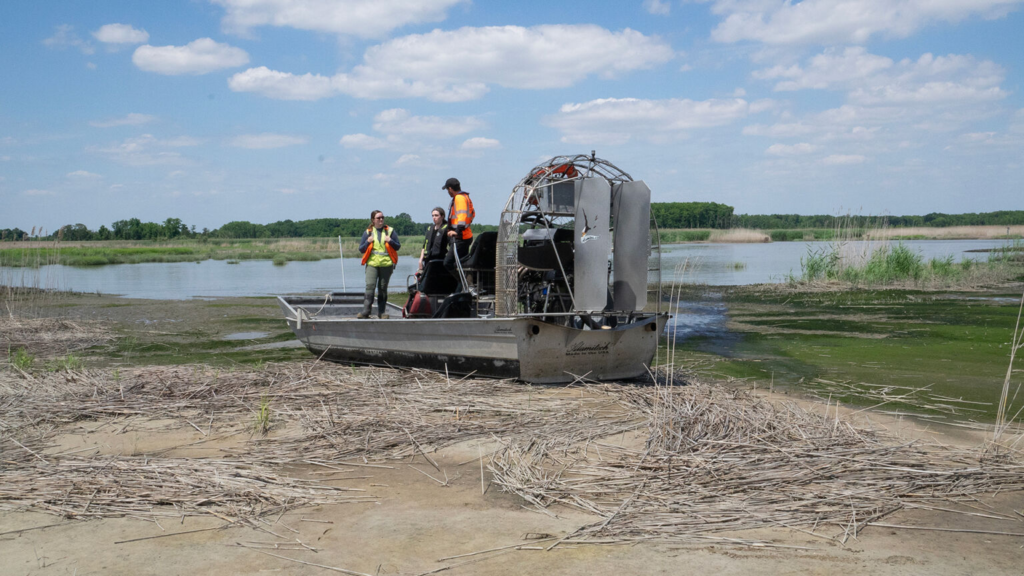
In a previous time, the material would have been jettisoned into a distant confined disposal site or even barged out to sea and dumped overboard. For the Wind Port’s dredged sediment, however, the state’s departments of Transportation and Environmental Protection, along with the Economic Development Authority, looked five miles to the northwest, toward a 365-acre tract of severely sunken marshland within Abbotts Meadow Wildlife Management Area. Embracing a relatively new method of wetlands restoration, the state decided to pump the sediment onto the marsh to build it back up — like a Jersey Shore beach replenishment project, but for the benefit of nature.
Abbotts Meadow project team. Andrew Lewis photo
Rebuilding a sinking wetlands
“The marsh platform had degraded and reverted to open water,” said Scott Douglas, dredging program director for the Transportation Department’s Office of Marine Resources. “We needed a place to put material, and [DEP] was actively looking for a partner to provide them with a large amount of sediment, so we went in, evaluated the hydrology, and figured out how much material we would need to bring the whole site back up to a level that would support healthy marsh.”
By the time the first parcel of Abbotts was sold to the DEP in 1994, centuries of salt hay farming, diking and other ad hoc attempts to hold back tidewater had altered the natural hydrology of the marsh. By 2021, some sections had subsided by as much as 6 feet. The Spartina grasses and other high-marsh habitat had been overwhelmed by saltwater inundation and had died back, taking with them nesting and foraging habitat for fragile species like the northern harrier, black rail and saltmarsh sparrow.
Largest wetlands project of its kind in NJ
The state partnered with WSP, a national environmental consulting and engineering firm, which began designing what is now the largest ever “beneficial use” project to date in New Jersey. Beneficial use takes a page from the “design-with-nature” philosophy, which is based on the idea that the human-built environment should be shaped to complement, rather than resist, the forces of nature, especially water. At Abbotts, that meant redistributing the Delaware Bayshore’s own marshland sediments to those areas that have not been able to keep up with the rate of sea level rise.
“This is the first time the state, with its partners, has been able to do such a large channel project in coordination with a restoration project,” said Katie Axt, WSP’s Abbotts project manager. “It’s great to see the state normalizing sediment as a resource.”
Pumping began last November. According to Douglas, two dredges equipped with 3,000 horsepower pumps steadily moved the slurry of sediment and water through a 24-inch pipeline for the next few months. By January, the project site had been graded into varying elevations to mimic the landscape that had once been there. The hope was that, by summer, the new marsh would begin to show signs of life. The goal, Axt said, was “to create a matrix of habitats.”
If you liked this post, you’ll love our daily environmental newsletter, EnviroPolitics.It’s packed daily with the latest news, commentary, and legislative updates from New Jersey, Pennsylvania, New York, Delaware…and beyond. Please do not take our word for it, try it free for an entire month. No obligation.
Genova Burns LLC Partner Kenneth Sheehan has been appointed co-chair of the Renewable Energy, Cleantech and Climate Change Committee of the New Jersey State Bar Association for the 2024-2025 term.
The appointment reflects Sheehan’s extensive experience and dedication to advancing renewable energy and environmental law.
The NJSBA recognizes the critical role that its committees play in advocating for the legal profession, the interests of the bar association and the public. In his new role, Sheehan will co-lead efforts to promote the development and implementation of policies and practices that support renewable energy, cleantech innovations and climate change mitigation.
Sheehan has built his career in energy law, with a focus on renewable energy and environmental sustainability. With over two decades of experience, he has advised public and private clients on a wide range of issues including regulatory compliance, project development and financing for renewable energy projects. His expertise spans across solar, wind, hydroelectric and other clean energy technologies.
Before joining Genova Burns, Sheehan served in various high-profile positions where he was responsible for shaping energy policies and regulations. His background includes serving as the chief counsel and director, Office of Clean Energy, for the New Jersey Board of Public Utilities. His work has been instrumental in driving New Jersey’s transition to a more sustainable energy landscape.
If you liked this post, you’ll love our daily environmental newsletter, EnviroPolitics.It’s packed daily with the latest news, commentary, and legislative updates from New Jersey, Pennsylvania, New York, Delaware…and beyond. Please do not take our word for it, try it free for an entire month. No obligation.
If you’re both looking for a home and you’re also a fan of “The Sopranos” this is a great day to be you.
The Jersey-centric mob hit had quite a turning point in season 6 episode 1 when Tony Soprano ends up being shot by Uncle Junior who was falling deeper into dementia. That happened right in Junior’s home on Watseeing Avenue in Belleville.
Except in real life the home is in Newark in the Forest Hills section at 380 Highland Avenue.
Fans may remember the clearest view of the home from the outside when Junior’s faulty memory had Tony digging up the yard in vain for $40,000 Junior swore was buried there.
At one point in the scene a neighbor looks suspiciously over and Tony says, “Moles. They chew into your sprinklers, too?”
Later in the cliffhanger episode Junior comes downstairs while Tony was cooking pasta and from near the bottom of the steps sees Tony as a long ago enemy and fires a bullet in his abdomen.
The demented Junior scurries back upstairs to hide in a closet while downstairs Tony fights for his life in an epic battle to get 911 dialed on the kitchen wall phone.
If you liked this post, you’ll love our daily environmental newsletter, EnviroPolitics.It’s packed daily with the latest news, commentary, and legislative updates from New Jersey, Pennsylvania, New York, Delaware…and beyond. Please do not take our word for it, try it free for an entire month. No obligation.