Recycling overhaul is now law in California. Similar legislation in New Jersey awaits action in the fall.

By Marissa Heffernan Plastics Recycling Update

California capitol building in Sacramento.

Legislators have approved EPR for printed paper and packaging in California. | Kit Leong/Shutterstock

This story has been updated.

California’s printed paper and packaging extended producer responsibility bill passed the state Senate unanimously June 30 and was signed into law, just before the deadline to pull a plastic-tax measure from November’s state ballot.

Senate Bill 54 was signed by Gov. Gavin Newsom, and ballot measure backers withdrew their ballot effort.

California compromise

SB 54, which has appeared in different iterations over the past three years, will create a producer responsibility organization (PRO) to run a collection and recycling program with state oversight, establishing a form of extended producer responsibility (EPR) for printed paper and packaging.

Meanwhile, the California Recycling and Plastic Pollution Reduction Act ballot measure, originally submitted in November 2019, aimed to build up both recycling infrastructure and composting infrastructure, along with other areas, all funded by a plastic tax paid by manufacturers. The plastics industry opposed the ballot measure and was grudgingly supportive of SB 54 as an alternative to it.

California legislators, environmentalists, and industry representatives had been working to finalize the language in SB 54, in hopes that a comprehensive bill would persuade ballot measure backers to withdraw their proposal.

To remove the measure from the ballot, the three petitioners behind it needed to agree to do so 130 days before the Nov. 8 election. That deadline meant that, effectively, SB 54 would have needed to pass out of both the Assembly and Senate by the end of June to provide enough time for them to withdraw the measure as part of a compromise.

After days of final-hour work, the amended bill passed the Assembly on June 29 on a vote of 67-2 and the Senate on June 30 on a vote of 29-0.

Gov. Newsom acted quickly to sign the bill on the evening of June 30, and ballot backers subsequently pulled their initiative.

Editor’s Note: In New Jersey, the Senate Environment and Energy Committee on June 13 took testimony on S426, sponsored by committee chairman Bob Smith. The bill would require manufacturers of all packaging products sold in New Jersey, including plastics, to adopt and implement stewardship plans.

The Sierra Club testified: “New Jersey has been a leader when it comes to reducing plastics with our newly implemented plastic bag ban law and recycled content law. Extended Producer Responsibility otherwise known as EPR  is now the next logical step in order to reduce plastic packaging.

Smith said his committee would be back in the fall, following the legislature’s summer recess, to act on the bill with possible amendments that his staff might draft after reviewing all the testimony from environmental and manufacturing groups.

Recent activity on SB 54

SB 54, the Plastic Pollution Producer Responsibility Act, mandates a 25% reduction of single-use plastic packaging and foodservice products by 2032. It also shifts a portion of packaging to reuse or refill systems and calls for a needs assessment, paid for by the PRO but overseen by the California Department of Resources Recycling and Recovery (CalRecycle).

The bill also includes eco-modulated fees charged to producers, which is designed to incentivize them to use sustainable, recyclable or reusable materials.

In the days leading up to the deadline, the bill was amended multiple times to strengthen environmental protection and government oversight and enforcement.

The changes include more clarification that CalRecycle will revoke approval of the PRO if it fails to meet the requirements of the bill.

Read the full story here

If you liked this post you’ll love our daily environmental newsletter, EnviroPolitics. It’s packed with the latest news, commentary, and legislative updates from New Jersey, Pennsylvania, New York, Delaware…and beyond. Don’t take our word for it, try it free for an entire month. No obligation.

Recycling overhaul is now law in California. Similar legislation in New Jersey awaits action in the fall. Read More »

10 Years After Hurricane Sandy: What’s Next for the Jersey Shore?

Sandy walloped the Jersey Shore in October 2012. A decade later, experts say our beaches are more secure—but much of the bayfront remains in peril.

By Ken Schlager New Jersey Monthly

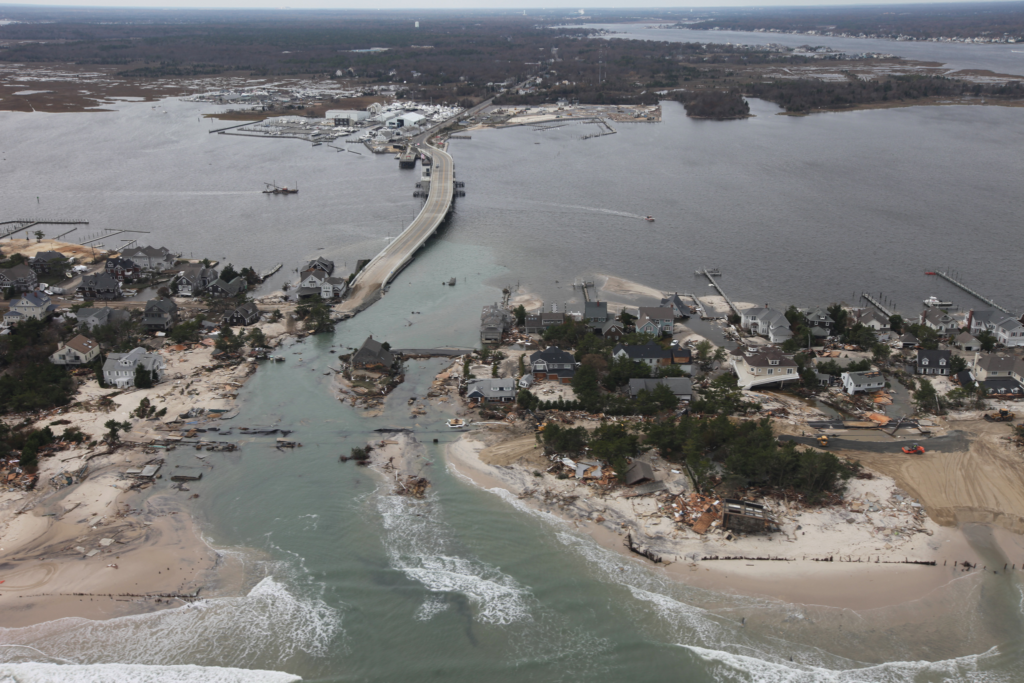
An aerial shot of Ohio Drive in the waterfront community of Mystic Islands

Only a series of short bulkheads and a narrow marsh protect the homes on Ohio Drive in the waterfront community of Mystic Islands. Hurricane Sandy’s storm surge damaged or destroyed many Mystic Islands properties. Photo by Joe Polillio

It happens every spring. Massive mounds of sand rise on the beach in North Wildwood. The mounds loom alongside the boardwalk, gray and menacing, like a rogue wave. 

But the great mounds are nothing to fear. They are evidence of emergency beach replenishment, an annual ritual in this oceanfront resort. North Wildwood trucks sand from Wildwood City (which has too much) and deposits it on its own beaches (which have too little). In the weeks leading up to Memorial Day, the mounds disappear as the sand is spread and North Wildwood’s beaches are restored.

The annual beach fill is a temporary fix; it should cease after fall 2023, when the Army Corps of Engineers is expected to take over the care and feeding of North Wildwood’s beaches. At that point, the Wildwoods will become the last of New Jersey’s beach municipalities to sign on with the Army Corps for what is called coastal storm-risk management. This, experts say, will protect all of New Jersey’s ocean-facing beaches from the wrath of major storms—at least for the 50-year duration of the Army Corps deals.

Trucks dump sand from Wildwood onto the beach in North Wildwood

Trucks dump sand from Wildwood onto the beach in North Wildwood, where it is spread in an annual replenishment effort. Photo by Joe Polillio

“New Jersey’s oceanfront is actually in the best shape of anywhere in the country,” says Stewart Farrell, founder, and director of Stockton University’s Coastal Research Center (CRC).

That’s the good news.

Now the bad: Ten years after Hurricane Sandy, the bayfronts and riverfronts of many of New Jersey’s Shore communities remain vulnerable to the twin terrors of sea-level rise and increasingly intense storms. Addressing this risk is in some ways more complicated than protecting the ocean beaches, but it is no less an issue that affects homeowners, seasonal tourism and natural habitat.

An aerial shot of Wildwood's annual beach restoration

An aerial shot of Wildwood’s annual beach restoration. Photo by Joe Polillio

And the threat will only get worse. In its 2022 update, the National Oceanographic and Atmospheric Administration (NOAA) predicts sea-level rise of 10-12 inches along the East Coast by 2050. In the continental United States, only the Gulf Coast is at greater risk. What’s more, NOAA predicts that thanks to this rise in sea level, even “moderate” flooding will occur “10 times more often than it does today, and can be intensified by local factors.” 

Rising sea level is not just a 21st-century phenomenon. “Sea level was 400 feet lower 25,000 years ago,” says Farrell. As sea level rises, coastlines are pushed inland. Geologists tell us that during the Ice Age—some 20,000 years ago—New Jersey’s shoreline was probably 80 or 90 miles east of where it is today. Even in the 17th century, as early settlers began staking out Shore property, the beaches in Monmouth County were 2,000 feet farther east than the beaches we know. 

Stockton University’s Stewart Farrell surveys a beach in Brigantine

Stockton University’s Stewart Farrell surveys a beach in Brigantine, where sand is abundant. Photo courtesy of Press of Atlantic City

The dominant goal for today’s coastal communities is to keep the shoreline fixed in place. That’s been the case since the late 19th and early 20th centuries, when the development of coastal resorts spurred human intervention. As the natural cycle of erosion ate away at the beaches, coastal towns created rock structures to trap sand and fend off floods. When developers turned to the bayfronts, they filled marshes and built bulkheads.

That was long before anyone could anticipate global warming. NOAA ties modern sea-level rise directly to the warming, and consequent expansion of ocean water, as well as the flow of additional water from melting ice sheets and mountain glaciers. For U.S. coastlines, the 10-12 inch rise in sea level that NOAA predicts over the next 30 years is roughly equivalent to the total increase recorded in the previous 100 years.

Read the full story here

If you liked this post you’ll love our daily environmental newsletter, EnviroPolitics. It’s packed with the latest news, commentary, and legislative updates from New Jersey, Pennsylvania, New York, Delaware…and beyond. Don’t take our word for it, try it free for an entire month. No obligation.

10 Years After Hurricane Sandy: What’s Next for the Jersey Shore? Read More »

Supreme court clips EPA authority over power plant emissions

By Adam Liptak, New York Times

WASHINGTON — The Supreme Court on Thursday limited the Environmental Protection Agency’s ability to regulate carbon emissions from power plants, making it much tougher for President Biden to achieve his goal of cutting greenhouse gas emissions in half by the end of the decade.

The vote was 6 to 3, with the court’s three liberal justices in dissent, saying that the majority had stripped the E.P.A. of “the power to respond to the most pressing environmental challenge of our time.”

In ruling against the E.P.A., the Supreme Court again waded into a politically divisive issue on the final day of a blockbuster term, adding to the conservative supermajority’s decisions to eliminate the constitutional right to abortion, vastly expand gun rights and further erode the wall separating church and state.

The implications of the ruling could extend well beyond environmental policy. It also signals that the court’s newly expanded conservative majority is deeply skeptical of the power of administrative agencies to address major issues facing the nation and the planet.

The decision set off criticism from the left, but voices from the coal industry and conservative states praised the ruling.

Mr. Biden, left with far fewer tools to fight climate change, said the ruling was “another devastating decision that aims to take our country backwards.” He vowed to take action even as the court limited his ability to act, adding: “We cannot and will not ignore the danger to public health and existential threat the climate crisis poses.”

Patrick Morrisey, the attorney general of West Virginia and one of the leaders of the challenge to the E.P.A.’s authority, welcomed the decision.

“E.P.A. can no longer sidestep Congress to exercise broad regulatory power that would radically transform the nation’s energy grid and force states to fundamentally shift their energy portfolios away from coal-fired generation,” he said.

Continue reading the main story

If you liked this post you’ll love our daily environmental newsletter, EnviroPolitics. It’s packed with the latest news, commentary, and legislative updates from New Jersey, Pennsylvania, New York, Delaware…and beyond. Don’t take our word for it, try it free for an entire month. No obligation

Supreme court clips EPA authority over power plant emissions Read More »

NY rejects crypto miner’s bid to renew power plant license permit

The decision was being viewed as an omen for Bitcoin mining in state

By Josh Saul and David Pan, Crypto

New York State rejected the renewal permit for a power plant used by Greenidge Generation Holdings Inc. for Bitcoin mining, a decision that comes after about six months of delays.

The Department of Environmental Conservation said it denied the application because of statewide limits on greenhouse gas emissions.

The ruling comes amid a heated debate between environmental groups and cryptocurrency miners about Bitcoin mining, which uses energy-intensive computers to process records of transactions and earn rewards in the virtual currency. It has become one of the most lucrative businesses and has expanded rapidly in the US. 

Environmentalists want NY Gov. Kathy Hochul to pull the plug on crypto mining

Still, New York is putting forward restrictive measures on crypto mining facilities. The state Senate recently passed a bill that bars miners from using fossil-fuel sources to power their operations.

The bill is set to be delivered to Governor Kathy Hochul, who will decide whether it should become law. Hochul didn’t respond to a request for comment on the legislation.

This is the first time Greenidge’s permits to operate the natural-gas fired facility in upstate Dresden have come up for renewal. The state agency delayed decisions in January and again in March

If you liked this post you’ll love our daily environmental newsletter, EnviroPolitics. It’s packed with the latest news, commentary, and legislative updates from New Jersey, Pennsylvania, New York, Delaware…and beyond. Don’t take our word for it, try it free for an entire month. No obligation.
NY rejects crypto miner’s bid to renew power plant license permit Read More »

Vineland, NJ has a new trash-pickup deal

By the Press of Atlantic City

VINELAND — The city and the Atlantic County Utilities Authority have reached a new 17-month agreement for trash and recycling collection services set to take effect Aug. 1 and run through the end of 2023, the city said Tuesday night.

Under the agreement, residents will see their monthly solid waste fee remain $24 per month. However, trash collection will be reduced from twice to once weekly, the city said in a news release. To compensate for the lost trash collection day, residents will be able to request a second 96-gallon trash cart at no additional cost.

The interim agreement will give city officials time to explore long-term options, the city said. City Council voted to introduce the agreement Tuesday.

Vineland will pay the ACUA $194,671.67 per month for trash and recycling collections, according to the agreement.

Don’t miss environmental news like this Click for free updates

It also will pay for all tipping fees charged by the Cumberland County Improvement Authority and is subject to increase based on the number of residences receiving services, according to the agreement.

Additionally, the city will be given a credit for missed trash and recycling collections and their associated costs.

“Two government agencies worked out what should have been worked out months ago,” ACUA President Rick Dovey said.

The authority has been plagued by staffing shortages amid a tight labor market, something Dovey said is a widespread trend.

The labor issues have caused the ACUA to struggle to provide timely trash, recycling and yard-waste pick-up in the municipalities it serves. Vineland, one of three Cumberland County towns for which the ACUA holds collection contracts, was withholding payment from the ACUA for months, citing inconsistent service.

The ACUA chose to terminate its waste-collection contract with the city in March.

Prior to negotiating the new agreement, the city had issued a request for proposal for trash collection and recycling services. Although other companies expressed interest in working with the city, they would have needed to scale up their operations, which required a longer lead time than was available to purchase new equipment, the city said.

“There is no doubt that the ACUA’s aggressive growth plan, coupled with pandemic-driven labor market shortages, led to their collection issues in Vineland,” Mayor Anthony Fanucci said. “Additionally, inflationary pressures on fuel, along with supply shortages, made it impossible for the ACUA to provide future services to the city at the current contract levels. This interim agreement makes fiscal sense for both parties in the short term.”

If you liked this post you’ll love our daily environmental newsletter, EnviroPolitics. It’s packed with the latest news, commentary, and legislative updates from New Jersey, Pennsylvania, New York, Delaware…and beyond. Don’t take our word for it, try it free for an entire month. No obligation.

Vineland, NJ has a new trash-pickup deal Read More »