
BILLYPENNGRAM 9/18/22

Door flourishes near Philadelphia’s South Street INSTAGRAM / @BOOKCZUK
BILLYPENNGRAM 9/18/22 Read More »
Door flourishes near Philadelphia’s South Street INSTAGRAM / @BOOKCZUK
BILLYPENNGRAM 9/18/22 Read More »
The rise of digital news and the pandemic have decimated a once thriving business. Survivors are pivoting to snacks and lottery.

By Jacob Smollen, Billy Penn
Newsstands are slowly disappearing in Philadelphia. At the ones that remain, owners are either looking to sell, or embracing a business model that doesn’t rely on sales of newspapers and cigarettes.
The increasing dominance of digital news and lower demand for tobacco products have pummeled revenue at newsstands throughout the city, according to operators who spoke with Billy Penn. Much of the business now relies on the state lottery, snacks, and display advertising sold through the Newsstand Association of Philadelphia (NAP).
Philadelphia currently has 96 active newsstand licenses, down 41% since 2012, according to the Dept. of Licenses and Inspections. It’s not just a Philly trend, and the decline has been happening for years. Over 1,500 newsstands operated in 1950s New York; they now number closer to 300.
Atul Amin, 62, is one of the local newsstand owners looking to sell. Working in front of City Hall on a summer Wednesday afternoon, he wore a red and white t-shirt, jeans, and a small blue cloth mask on his face.
“You want to buy?” he asked, with a wink.
Multicolored scratch-off cards fluttered on the back wall of his stand, next to a collection of Cheez-it and Cheetos packs for sale. A few copies of the Philadelphia Daily News, a tabloid version of The Inquirer, lay underneath the metal counter.
When Amin bought his business in 1989 for around $35,000, the Daily News had its own newsroom — and there were many other papers next to it on the stand’s display. He’d moved to the U.S. from India a couple of years prior, seeking opportunities for a better life, he said. NAP’s website calls newsstand owners like Amin “a visible reminder of the hope in the American Dream.”
Nationwide, more than 2,500 newspapers have folded since 2005, and Amin is ready to sell.
If you liked this post you’ll love our daily environmental newsletter, EnviroPolitics. It’s packed with the latest news, commentary, and legislative updates from New Jersey, Pennsylvania, New York, Delaware…and beyond. Don’t take our word for it, try it free for an entire month. No obligation.
Newsstands are disappearing in Philadelphia, and fewer than 100 remain Read More »

A news release from the Clean Air Council
Philadelphia, PA (September 16, 2022) Today, the United States Court of Appeals for the Third Circuit issued a decision affirming that Pennsylvania state legislators and municipalities lacked standing to challenge the Delaware River Basin Commission’s (“DRBC”) regulation banning fracking within the Basin. Additionally, the Court rejected arguments that the trust created by Article I, Section 27 of the Pennsylvania Constitution (the “Environmental Rights Amendment” or “ERA”) was injured by the fracking ban. In rejecting this argument, the Court explicitly relied on a joint amicus brief from Clean Air Council, PennFuture, and Widener University Commonwealth Law School.
Fracking ban challenge by Pa. Republican caucus rejected (Reuters)
In February 2021, the DRBC banned high-volume hydraulic fracturing (commonly known as “fracking”) within the Delaware River Basin. The ban reflected the Commission’s determination that fracking “poses significant, immediate and long-term risks to the development, conservation, utilization, management, and preservation of the [Basin’s] water resources.” The Plaintiffs—two Pennsylvania state senators, the Pennsylvania Senate Republican Caucus, and several Pennsylvania municipalities—then filed a lawsuit in federal district court challenging the ban. After the District Court dismissed the suit for lack of standing, the plaintiffs appealed to the Third Circuit and raised an argument that they had standing under the ERA.
The Third Circuit, citing Clean Air Council and its partners’ amicus brief, held that the legislative plaintiffs’ ERA argument “fundamentally misunderstands the ERA and would turn it ‘upside down’ if accepted.” The Court further held that the plaintiffs’ ERA argument “ignores the explicit purpose of the ERA and mistakes the unique public trust it created for a run-of-the-mill financial trust in which the trustees have a duty to maximize profits.” The Court concluded that the fracking ban “promotes the purposes of the trust and protects its corpus by preventing Pennsylvania’s natural gas reserves, part of the Commonwealth’s ‘public natural resources,’ from being depleted.”
Joseph Otis Minott, Esq., Executive Director and Chief Counsel of Clean Air Council, issued the following statement:
“We are thrilled that the Third Circuit recognized and re-affirmed what the Pennsylvania Supreme Court has already held in no uncertain terms: The state government is constitutionally obligated to protect our public natural resources by conserving and maintaining them for present and future generations, not by extracting and ‘maximizing’ the economic value of those resources. We are hopeful that this will deter future actions by Pennsylvania state and local public officials who would seek to consume, deplete, and monetize our natural resources, rather than uphold their sworn constitutional duty to conserve and maintain them.”
If you liked this post you’ll love our daily environmental newsletter, EnviroPolitics. It’s packed with the latest news, commentary, and legislative updates from New Jersey, Pennsylvania, New York, Delaware…and beyond. Don’t take our word for it, try it free for an entire month. No obligation.
Federal appeals court rejects Pa GOP lawmakers’ challenge to Delaware River fracking ban Read More »
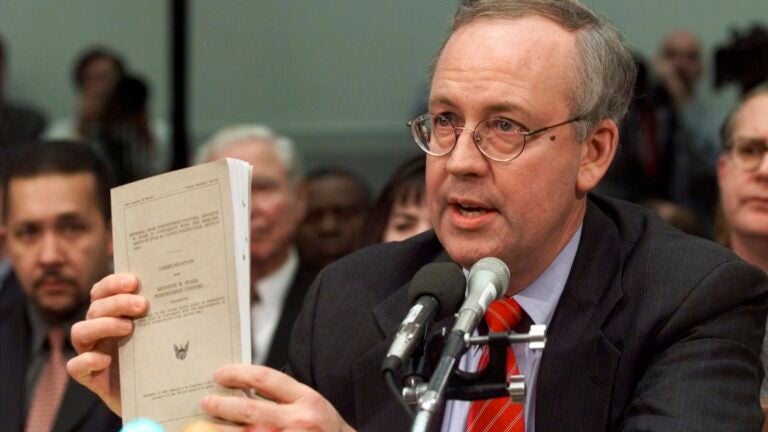
By JAKE BLEIBERG, Associated Press, September 13, 2022
Ken Starr, a former federal appellate judge and a prominent attorney whose criminal investigation of Bill Clinton led to the president’s impeachment and put Starr at the center of one of the country’s most polarizing debates of the 1990s, has died at age 76, his family said Tuesday.
Starr died at a hospital Tuesday of complications from surgery, according to his former colleague, attorney Mark Lanier. He said Starr had been hospitalized in an intensive care unit in Houston for about four months.
Related news stories:
Ken Starr, independent counsel who pursued Clinton, dies (CNN)
Ken Starr, Independent Counsel in Clinton Investigation, Dies at 76 (NY Times)
If you liked this post you’ll love our daily environmental newsletter, EnviroPolitics. It’s packed with the latest news, commentary, and legislative updates from New Jersey, Pennsylvania, New York, Delaware…and beyond. Don’t take our word for it, try it free for an entire month. No obligation.
Ken Starr, whose probe led to Clinton impeachment, dies at 76 Read More »


From an EPA news release
ALBANY, NY (September 13, 2022) – Under a legal agreement with the U.S. Environmental Protection Agency (EPA) General Electric Company (GE) will investigate the Lower River portion of the Hudson River PCBs Superfund site to determine the next steps for addressing contamination.
Under the terms of the legal administrative agreement, GE will immediately develop a plan for extensive water, sediment, and fish sampling between the Troy Dam and the mouth of the New York Harbor.
While polychlorinated biphenyls (PCBs) will be a focus of the data collection in the Lower Hudson River, other contaminants will be evaluated as well. The new data is needed to determine from a scientific standpoint the best path forward, even in advance of a potential formal set of studies that would be required to develop a plan or plans for cleanup. Today’s agreement requires data collection to begin in early 2023. GE will also pay EPA’s costs to oversee the work.
“The sampling that GE is conducting will allow us to better understand and evaluate the conditions and potential contamination in the Lower Hudson River environment,” said EPA Regional Administrator Lisa F. Garcia. “The information will help us determine whether and how to prioritize investigations in each portion of the Lower Hudson and how to best address contamination.”
EPA plans to keep the Community Advisory Group for the Hudson River PCBs Superfund site and the public informed and involved as data is collected and follow-up decisions are made. EPA will also look to engage with communities along the lower Hudson, including communities that have environmental justice concerns.
Don’t miss environmental news like this Click for free updates
Under the terms of the administrative agreement, GE will sample multiple fish species, sediment and water from various locations throughout the Lower Hudson River. There will be three different sediment sampling programs, each from a different range of depths of the river bottom. Collecting sediment at various depths and locations allows EPA to better understand where contamination is present and has deposited over time. GE will implement two of the three sediment programs in 2023. The third program, which includes the collection of deeper sediment samples, will occur in 2024.
Results of the sampling will inform EPA’s investigations moving forward. GE remains legally responsible for its PCBs that migrated to this area. EPA is continuing to evaluate whether other parties may also be liable for PCBs, as well as other contamination in the Lower Hudson.
The new data will supplement information collected during EPA’s investigation of the Lower Hudson River in the 1990s and the periodic monitoring of Lower Hudson River fish and water by GE under EPA oversight since 2004. EPA has also been gathering additional information and data about the Lower River in coordination with New York State and other project stakeholders since 2019 to support these efforts. GE is reimbursing EPA for the costs incurred for planning the work.
New York State Department of Environmental Conservation Commissioner Basil Seggos said, “New York State is committed to a comprehensive cleanup and restoration of the Hudson River. EPA’s agreement directing GE to undertake additional sampling in the lower Hudson is a critical step to address historic PCB contamination. This new data will supplement the extensive sampling efforts previously conducted by DEC, EPA, and GE to evaluate the health of one of New York’s most important water bodies. New York State DEC looks forward to continuing to work with EPA to understand what further actions can be taken to address unacceptable levels of contamination that remain in the river.”
The Hudson River PCBs Superfund site includes the 200-mile stretch from Hudson Falls to the southern tip of Manhattan in New York City. EPA’s 2002 Record of Decision addressed the sediment in the 40-mile stretch of the Upper Hudson River between Fort Edward and Troy, New York. The dredging and capping work in the Upper Hudson River was conducted between 2009 and 2015.
EPA continues to monitor the post-dredging recovery of the Upper Hudson River and is evaluating PCB contamination in the Upper Hudson River floodplain. The investigation of the floodplain is being done under a separate legal agreement with GE under EPA oversight.
Between the 1940s and 1970s, GE discharged PCBs into the Hudson River from its two former capacitor manufacturing plants in Fort Edward and Hudson Falls, New York. These PCBs contaminated the river and its sediment from the Hudson Falls plant to New York Harbor and contaminated certain areas of the floodplain along the banks of the river during high water and flood events.
If you liked this post you’ll love our daily environmental newsletter, EnviroPolitics. It’s packed with the latest news, commentary, and legislative updates from New Jersey, Pennsylvania, New York, Delaware…and beyond. Don’t take our word for it, try it free for an entire month. No obligation.
GE agrees to study PCBs in Lower Hudson River Read More »