Some people might shy away from eating bugs off their plates, but Chef Joseph Yoon is popularizing the age-old practice of entomophagy – with mouthwatering results
By Whitney Bauck, The Guardian
Chef Joseph Yoon is used to people reacting negatively to his creations: he’s watched a child cry when she realized the pumpkin cake in her mouth was made with cricket powder, seen a grown adult spit out his bug-laden bite of food, and endured racist online comments aimed at him for suggesting that scorpions or mealworms are worth eating.
But none of that seems to faze Yoon. If anything, it just reaffirms the importance of his work destigmatizing entomophagy. As the founder of Brooklyn Bugs and a self-described “edible insect ambassador”, Yoon is on a mission to prove that eating bugs is good for the planet – and the palate.
Yoon’s work includes giving presentations everywhere from elementary schools to Harvard, partnering with institutions like the Smithsonian and Nasa on sustainable food initiatives, and occasionally cooking for journalists like me, all in an effort to raise awareness about the planetary benefits and culinary joys of eating bugs.
“I like to share the sense of hope and optimism and to be able to capture people’s imagination through cooking insects,” Yoon said from his kitchen table in Queens over a bite of stir-fried cicadas. “The question is: how do we start changing the perception from insects as pests to something that’s sustainably farmed, nutrient-dense and that can add a tremendous amount of flavor to your food?”
Insect consumption has been highlighted by the UN’s Food and Agriculture Organization as an important tool in addressing food insecurity for a growing global population. And since agriculture is the second-largest greenhouse gas emitter after the energy sector, insect-eating presents a compelling climate solution, too – crickets, for example, can provide the same amount of protein as cows for less than 0.1% of the emissions.
If you liked this post you’ll love our daily environmental newsletter, EnviroPolitics.It’s packed with the latest news, commentary, and legislative updates from New Jersey, Pennsylvania, New York, Delaware…and beyond. Don’t take our word for it, try it free for an entire month. No obligation.
Trenton, N.J.—The New Jersey Board of Public Utilities (NJBPU) has issued an Order requiring the owner or operator of every commercial building over 25,000 square feet in the state to benchmark energy and water use using the U.S. Environmental Protection Agency’s Portfolio Manager tool, as required by the New Jersey Clean Energy Act signed into law by Governor Murphy in 2018.
“This is the next important step in implementing a best-in-class, statewide, energy efficiency program which will help us achieve Governor Murphy’s goal of 100 percent clean energy by 2050,” said NJBPU President Joseph L. Fiordaliso. “Creating a system of benchmarking allows us to measure the use of energy (electricity and gas) and water by the state’s biggest buildings and support building owners in reducing energy and water usage and operating costs.”
This Board initiative is also directed by Goal 3.3.2 of the Energy Master Plan, which calls for transparent benchmarking and energy labeling to spur market-driven energy efficiency improvements. The program helps commercial building owners and operators measure and analyze their respective facilities’ energy and water usage and compare it to other similar buildings. Building owners and operators can use this information to make informed decisions about taking advantage of financial incentives for energy efficiency improvements through State and utility programs.
In particular, the program will enable building owners to obtain aggregated, building-level energy and water data from their utility companies through a data access service. The Board will also establish a “help desk” to assist building owners as they measure and analyze their respective buildings’ energy and water performance. The first benchmarking submissions are due on October 1, 2023 for energy and water consumed in 2022.
This program will also protect individual ratepayers’ energy and water use information by requiring utilities to securely provide aggregated, building-level data. Building owners are required to obtain their tenants’ affirmative, written consent for the utilities from which they receive services to provide building-level energy and water data to the building owner in certain situations to protect individual energy and water use information. Consent will be required only when there are fewer than four tenants in a building or if one tenant exceeds fifty percent of the energy or water consumption.
New Jersey’s Clean Energy Program also offers assistance to building owners to benchmark their buildings. This service is available to building owners who are not required to benchmark under the Clean Energy Act.
The U.S. Department of Energy (DOE) today announced the distribution of $13.5 million in incentive payments to 55 hydroelectric facilities through the Hydroelectric Production Incentive Program.
The Hydroelectric Production Incentive Program supports hydropower development by providing funding for electricity generated and sold from dams and other water infrastructure throughout the United States that add or expand hydroelectric power generating capabilities. The payments announced today mark a record number of recipients, 18 of which were new applicants.
“The Hydroelectric Production Incentive Program encourages the continued growth of a critical clean energy resource to help meet our nation’s climate goals,” said Alejandro Moreno, Deputy Assistant Secretary for Renewable Power. “By supporting a record number of facilities across the country, these payments will help to ensure hydropower will be a reliable source of renewable power for years to come.”
Hydropower accounts for 31.5% of U.S. renewable electricity generation and about 6.3% of U.S. electricity generation. However, less than 3% of the nation’s more than 90,000 dams produce power. Adding generation equipment to these sites could add up to 12% more hydropower capacity to the U.S. electric system and provide reliable, affordable power to communities across the nation.
This is the first year DOE expanded eligibility criteria for this program to include facilities located in communities with inadequate electric service. As a result, five newly eligible hydroelectric facilities received incentive payments.
The Bipartisan Infrastructure Law included $125 million to expand the Hydroelectric Production Incentive Program. With the inclusion of these new funds, future management of the Hydroelectric Production Incentive Program will transfer from DOE’s Water Power Technologies Office to the new Grid Deployment Office, whose mission focuses on maintaining and investing in critical generation facilities and improving and expanding transmission and distribution systems.
The New Jersey Business & Industry Association announced that Chief Government Affairs Officer Chrissy Buteas will leave the role, and current Vice President of Government Affairs Christopher Emigholz has been tapped to fill the position. – NJBIA
Buteas accepted a position as vice president of government affairs for Altice USA, the parent company of News 12 New Jersey. She will remain with NJBIA through the end of this month.
“We are extremely grateful for the leadership, intellect, strategy, and passion that Chrissy has brought to NJBIA over the past four years,” said NJBIA President and CEO Michele Siekerka. “Her tireless efforts have ensured that NJBIA is the strongest voice for business in New Jersey. She will be greatly missed here at NJBIA, but we wish her all the best with her exciting new opportunity, and we very much look forward to working with her in the future.”
Current Vice President of Government Affairs Christopher Emigholz has been tapped to fill the chief government affairs role.
From 2005-2010, Emigholz served as NJBIA’s associate vice president of education & workforce development policy before working as associate executive director/budget director for the Senate Republican Office.
He rejoined NJBIA in 2019 in his current role, and is credited as a driving force behind the effort to reduce the unemployment insurance tax increase, as well as the new teen worker bill that Gov. Phil Murphy signed into law earlier this summer.
“Chris is well known and well respected in Trenton for his knowledge and expertise on economic development and taxation issues in New Jersey,” said Siekerka. “He is a true champion of New Jersey’s business community who will grow into a great leader of our tremendous Government Affairs team.”
Siekerka also announced the promotions of Vice President of Government Affairs Raymond Cantor to deputy chief government affairs officer and Director of Government Affairs Alexis Bailey to vice president.
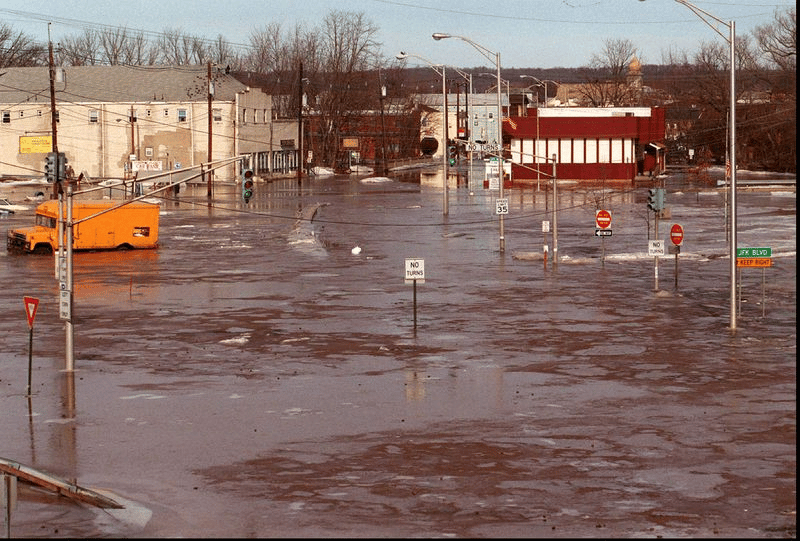
MANVILLE – Mayor Richard Onderko grew up on North Second Avenue and a half-century ago, he had to be rescued by boat from the floodwaters from Tropical Storm Doria.
On Wednesday he stood on the same street a block from the Raritan River before a house ruined by a natural gas explosion during the flooding from the remnants of Hurricane Ida a year ago and implored Gov. Phil Murphy to approve the state Department of Environmental Protection’s proposed rules to upgrade and update the state’s flood hazard and stormwater management regulations.
“We need a sense of urgency to help our residents get out of harm’s way,” he said. “Our residents deserve better.”
“Please help Manville,” Onderko said, adding the borough, bordered by the Raritan and Millstone rivers, is “ground zero” for floods caused not only by excessive rains but runoff from communities as far away as Mercer County.
The mayor, other elected officials and environmentalists gathered Wednesday to deliver the message that the governor should implement the DEP’s proposed rules as soon as possible.
The state has ignored the warnings from the previous floods, said Jim Waltman, executive director of The Watershed Institute.
He likened it to someone hitting the snooze button after the wake-up alarm sounds.
“It’s time to stop hitting the snooze button,” he said.
If you liked this post you’ll love our daily environmental newsletter, EnviroPolitics.It’s packed with the latest news, commentary, and legislative updates from New Jersey, Pennsylvania, New York, Delaware…and beyond. Don’t take our word for it, try it free for an entire month. No obligation.