LG Energy Solution and Honda Motor Co. said they plan to invest $4.4 billion to set up U.S. manufacturing to jointly produce lithium-ion batteries to power Honda and Acura EV models for the North American market.
The partners aim to have an annual production capacity at the plant of around 40 GWh.
The pouch-type batteries will be supplied exclusively to Honda facilities in North America. The location of the plant is not yet final. The companies said they aim to start construction in early 2023 with a goal of starting mass production by the end of 2025.
In April 2021, Honda announced plans for 40% of its North American sales to be battery-electric and fuel cell electric vehicles by 2030, increasing to 80% by 2035, and to 100% by 2040. Honda has been producing cars in the U.S. for 40 years and currently operates 18 manufacturing facilities in North America.
If you liked this post you’ll love our daily environmental newsletter, EnviroPolitics.It’s packed with the latest news, commentary, and legislative updates from New Jersey, Pennsylvania, New York, Delaware…and beyond. Don’t take our word for it, try it free for an entire month. No obligation.
Is there a better way to urge more public investment for cleaning up an urban stretch of the Delaware River than to dress up as a heron and spend a Saturday afternoon drifting down the river with 75 of your closest friends?
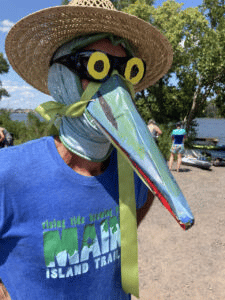
That’s what Stu Lehman had in mind when he donned a long blue costume beak and yellow goggles to participate in “Floatopia,” a ramshackle array of flotation devices, kayaks, and canoes that launches from the north side of Camden once a year in an attempt to show the world that the river is a neglected recreational asset at the heart of a heavily urbanized environment.
“I’m a lesser blue heron,” said Lehman, from behind his mask. “My habitat got so small I had to lease it. I’m interested in seeing the river get cleaner and cleaner because 88 percent of what I eat is fish, as well as frogs and salamanders. I’m not sure the food that I can find is tasty or safe but I’m going to keep eating it as long as I can.”
Lehman, 68, a retired water specialist with the Environmental Protection Agency, said he was participating in his first Floatopia because he wants to support its effort to make the river cleaner and more accessible to communities along its banks such as Camden.
“Things are becoming cleaner, and we’re taking care of a lot of the industrial and municipal waste but we’ve still got a long way to go,” he said before launching his kayak.
Ducks and dinosaurs
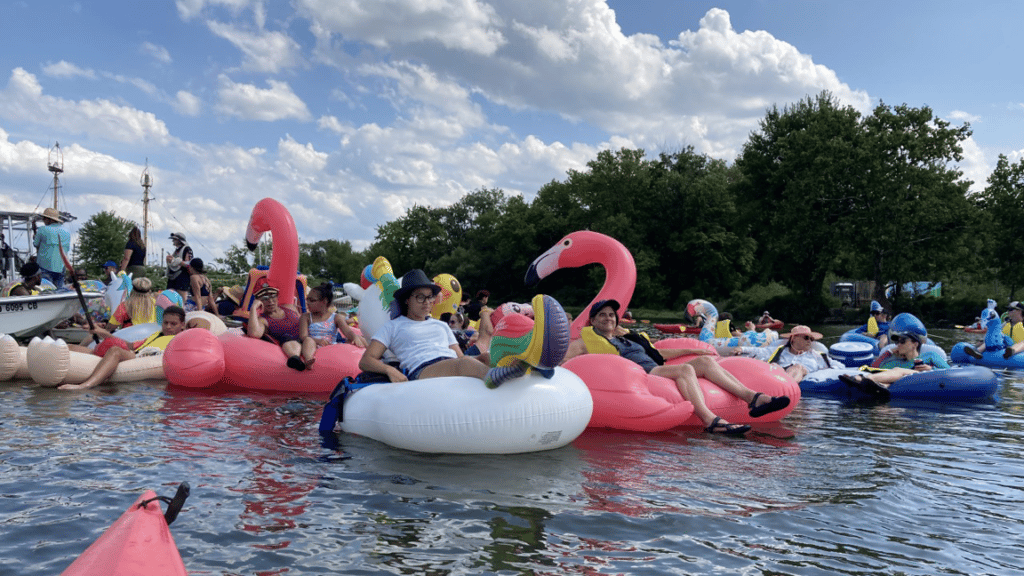
Lehman was among about 75 people who boarded a multicolored flotilla of inflatable unicorns, flamingos, oversized bathtub ducks, pineapples, and at least one dinosaur to drift slowly on the tide down the “back channel” between Camden’s Pyne Poynt Park and Petty’s Island for a couple of hours on Saturday afternoon.
The inflatables were tied to a floating dock where a guitar player entertained those lolling in their devices, and speakers urged participants to support efforts to clean up the water in a 27-mile stretch between Camden and Wilmington, Delaware so that it finally attains a coveted official status of being “swimmable and fishable.”
‘We hope that people will see that it’s a great resource for recreation, that you can swim in it and play on it but that the job is not done yet.’ — Don Baugh, Upstream Alliance
“It’s important for our community to understand what a great resource this is,” said Camden Mayor Victor Carstarphen, in a shoreline interview. “Not a lot of folks know that you can swim here at certain times of the year. One of my jobs is to get more funding for cleaning up our waterways so that all the time, the river can be a resource for our community.”
Floatopia, now in its third year, was attempting this time to create public demand that will result in state and especially federal funding being used to repair or replace combined sewer overflows — old drains that dump stormwater and raw sewage into the river during heavy rains, making it unsafe to swim in for at least 48 hours after storms.
Why not use federal funding?
“For the last 12 months there has been a flood of federal dollars flowing to the states that we think should be available to help solve some of these problems,” said Don Baugh, president of Upstream Alliance, a nonprofit that organizes the event. “There’s never been more federal monies available; we’ve never had an opportunity like this before.”
Baugh said some of the federal money that’s newly available for improvements in infrastructure and pandemic relief should be used to fix or replace the combined sewer overflows, which continue to overflow into waterways and even streets in communities including Camden and Philadelphia.
If you liked this post you’ll love our daily environmental newsletter, EnviroPolitics.It’s packed with the latest news, commentary, and legislative updates from New Jersey, Pennsylvania, New York, Delaware…and beyond. Don’t take our word for it, try it free for an entire month. No obligation.
For years, neighbors of a recycling plant and scrap metal yard in South Camden have complained about repeated fires at the facilities that have pumped noxious black smoke into that part of the city, causing explosions that could be heard downtown and in some cases forced evacuations.
A Camden-based environmental nonprofit is now questioning whether the company is in fact a recycling center as it maintains threats to sue the city and the New Jersey Department of Environmental Protection for not protecting residents’ health. The Center for Environmental Transformation has filed a complaint with the DEP, accusing EMR of being dishonest about what their facilities actually do. EMR maintain they are a recycling center and that they do not accept solid waste, which would subject them to more regulations.
Click the arrow in the center of the photo above to see the video report
If you liked this post you’ll love our daily environmental newsletter, EnviroPolitics.It’s packed with the latest news, commentary, and legislative updates from New Jersey, Pennsylvania, New York, Delaware…and beyond. Don’t take our word for it, try it free for an entire month. No obligation.
In his boyhood, Tom Fote cast his lines off the piers of Brooklyn. Today, he is a treasure chest of information about the species of fish that run off the New Jersey coast and how climate change is directing where you’ll find them.
If you liked this post you’ll love our daily environmental newsletter, EnviroPolitics.It’s packed with the latest news, commentary, and legislative updates from New Jersey, Pennsylvania, New York, Delaware…and beyond. Don’t take our word for it, try it free for an entire month. No obligation.
More than 100 black vultures were found dead on a North Jersey trail due to bird flu, state officials said.
The deaths occurring off the Sussex Branch Trail in Lafayette in Sussex County date back to early August, according to the New Jersey Department of Environmental Protection.
Black vultures are seemingly very susceptible to Avian Influenza, and they tend to scavenge the carcasses of dead vultures, which can prolong the duration of a local outbreak such as the one being seen in Sussex County, officials said.
The birds have been left to decompose on site due to rough terrain causing accessibility issues and a lack of personnel in the State certified to handle infected birds. Improper handling can lead to further spread of disease.
The risk of avian influenza being transmitted to people is extremely low. The New Jersey Department of Agriculture and NJ DEP Fish and Wildlife are monitoring the situation. For questions regarding poultry please contact the NJ Department of Agriculture ((609) 671-6400).
This was the message from acting state Attorney General Matt Platkin and state Commissioner of Environmental Protection Shawn LaTourette this week as they announced environmental justice lawsuits.
The push is aimed especially in the state’s most vulnerable communities, with six of the lawsuits focused on sites in Newark, Linden, Ewing, Rahway, Elmwood Park Borough, and Middlesex Borough.
These areas are now considered “overburdened communities,” which the state defines as at least 35% low-income, at least 40% people of color, or at least 40% residents with limited English proficiency.
The seventh lawsuit is against a Hammonton blueberry farm with allegedly unsafe drinking-water wells where its migrant employees live and work.
“In New Jersey, we are confronting the historic injustices that have burdened low-income and minority communities with a disproportionate amount of pollution,” LaTourette said in a statement.
“Our commitment to furthering the promise of environmental justice sometimes demands that we take legal action to correct the legacy of pollution that underserved communities have endured. Lawsuits like those we are announcing today are an important message to polluters: treat every New Jersey community as though it were your own by leaving your neighbors and their environment better than you found them.”
If you liked this post you’ll love our daily environmental newsletter, EnviroPolitics.It’s packed with the latest news, commentary, and legislative updates from New Jersey, Pennsylvania, New York, Delaware…and beyond. Don’t take our word for it, try it free for an entire month. No obligation.