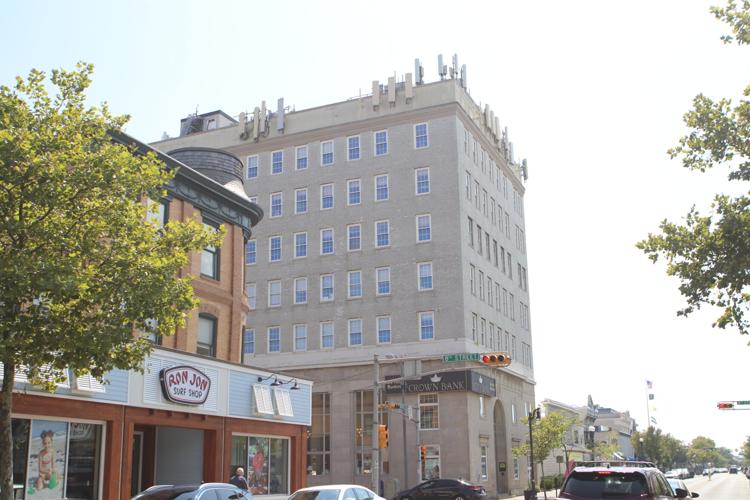
The city wants the building, administrator George Savastano told City Council on Thursday. He said there is no specific use in mind yet but that the city has begun talks with a trustee appointed by a bankruptcy court to begin negotiations.
The next step will be to evaluate the condition of the building, a procedure Savastano described as due diligence.
“The administration considers this property to be extremely worthy of consideration for acquisition given its prime location within our downtown,” Savastano said. “While there are not definitive ideas yet for what the ultimate purpose of the property would be, it clearly presents a number of options if it were to come into the public domain.”
For Alaska salmon fishing, the summer of 2022 is the best of times and the worst of times.
Fresh sockeye salmon, also called red salmon, is on sale on July 19 at Anchorage’s New Sagaya City Market. The Bristol Bay region has the world’s biggest sockeye salmon runs and is enjoying a record return this summer.(Yereth Rosen/Alaska Beacon)
In the Bristol Bay region, the sockeye salmon run and harvest amounts set new records, as was predicted in the preseason forecast. As of Monday, the run had totaled over 73.7 million, with a harvest of over 56.3 million. The previous record was set just last year, with a 67.7 million run of sockeyes and a third-biggest-ever harvest of nearly 42 million of the fish.
But along the Yukon River, a prized salmon run is heading toward a worst-ever season.
The number of Chinook counted by sonar while swimming up the river at Pilot Station, a village near the Bering Sea coast, was the lowest on record for this time of the year, the department said. Things are looking grim for the rest of the summer, Fish and Game said in its most recent update; “the drainage-wide run may be under 50,000 fish, which is so small that escapement goals may not be met in any tributaries,” the update said. Chinook fishing has been closed all along the river and its drainages.
The chum salmon run, which starts in the late summer, is also looking grim and “is anticipated to be critically low,” meaning that even subsistence harvests will be closed for at least the start of the fall season, the department said.
Fisheries activists are pointing to both cases as evidence supporting the protective measures, for which they are campaigning.
Opponents of the controversial Pebble Mine say two consecutive years of record sockeye runs demonstrate the value of protecting the Bristol Bay watershed, site of the world’s biggest sockeye runs, from that proposed development. They are urging the Environmental Protection Agency to invoke a rarely used provision of the Clean Water Act to preclude any wetlands-fill permit for the mine.
Salmon hang to dry on a rack at Lake Clark National Park in 2018. Lake Clark is part of the Bristol Bay region. (National Park Service)
“Salmon have provided for the people of Bristol Bay for thousands of years due to our ancestral stewardship of our pristine lands and waters. We’re grateful our salmon continue to return home in record numbers but our watershed is still facing the grave threat of mines like Pebble. Bristol Bay remains a salmon stronghold and will only continue if it is permanently protected. The EPA must finalize Clean Water Act protections for the headwaters of our fishery this year,” United Tribes of Bristol Bay executive director Alannah Hurley said in a statement.
Advocates for Indigenous communities dependent on Yukon River salmon, meanwhile, say the continued poor returns there and in the Kuskokwim River demonstrate the need for action to reduce cases of ocean bycatch, the accidental harvest of Western Alaska-bound salmon in nets used to harvest other species.
If you liked this post you’ll love our daily environmental newsletter, EnviroPolitics.It’s packed with the latest news, commentary, and legislative updates from New Jersey, Pennsylvania, New York, Delaware…and beyond. Don’t take our word for it, try it free for an entire month. No obligation.
Rutgers says the $450,000 DoorDash helps the ‘economically challenged’
By JEANNE WALL, TapInto
NEW BRUNSWICK, NJ – New Jersey State Senator Declan O’Scanlon is not happy with Rutgers University. Following news that Rutgers University football players racked up more than $450,000 in DoorDash orders paid for with taxpayer funds, O’Scanlon (from the 13th legislative district) has called for a state investigation into the program.
“We saw two stories in two days depicting what amounts to indictments of flagrant incompetence on the part of those charged with overseeing this university,” said O’Scanlon. “It is absolutely mind-blowing that this was allowed to happen without the notice of someone overseeing the accumulating invoices. The person responsible for that lack of oversight needs to be held accountable. Between financial scandals and completely ignoring the newest CDC guidance on outrageous masking mandates, vaccination, and testing policies—and virtually the rest of the science-following-world’s long overdue removal of those mandates—it paints a concerning picture to taxpayers. And to anyone who had faith in those running the institution.”
“We’ve spoken to the university over the last few months on the testing requirements for indoor events, swimming events, and the overall mandates in all departments,” O’Scanlon continued.
“Our state institutions of higher education should be striving to lead the way on covid protocols, but instead they’re lagging behind the rest of the world—including an absurd masking policy which calls for masks in classrooms and libraries…but nowhere else. Those in charge of inflicting these policies should be ashamed.”
Ever wonder what happens to the wood from trees in Philly parks that fall down or need to be removed?
Right now, a lot of it gets sent to the Fairmount Park Organic Recycling Center and ends up as mulch and woodchips. But under a new city initiative, it could find new life as usable — and sellable — lumber.
Set to launch as a pilot next year, the new “Reforestation Hub” at the recycling center will focus on milling salvageable sections of removed trees. The lumber will be sold to orgs that can put it to use, and some of the proceeds will go toward the city’s efforts to grow Philadelphia’s tree canopy.
The Reforestation Hub would also aim to capture wood waste that currently ends up in landfills, said Marc Wilken, director of business development at the Department of Parks and Recreation, which is spearheading the effort.
The recently-funded hub is a joint effort between the city, DC-based climate tech startup Cambium Carbon, and the local AmeriCorps program PowerCorpsPHL.
In Philadelphia, the amount of wood that needs to be disposed of — from dead, dying, or fallen trees on city streets or in city parks — is on the rise, Wilken said.
“Because of the intensity of weather events, … invasive species, and just aging forests, there’s a growing volume of material coming through,” Wilken said. “We need to respond to that, and manage it, and improve the way we manage the material that’s coming in.”
Baltimore has been successfully running a similar program since 2016, and Philly officials have visited. In addition to milling old trees, Baltimore’s program also salvages wood waste from building deconstruction.
For the next six months or so, program partners in Philadelphia are working on setting up the site and designing the training program curriculum, according to Cambium Carbon co-founder Marisa Repka.
The goal is to have Philly’s pilot up and running by spring.
If you liked this post you’ll love our daily environmental newsletter, EnviroPolitics.It’s packed with the latest news, commentary, and legislative updates from New Jersey, Pennsylvania, New York, Delaware…and beyond. Don’t take our word for it, try it free for an entire month. No obligation.
An interesting piece of information from the Department of Energy
Since the early 2000s, wind turbines have grown in size—in both height and blade lengths—and generate more energy. What’s driving this growth? Let’s take a closer look.
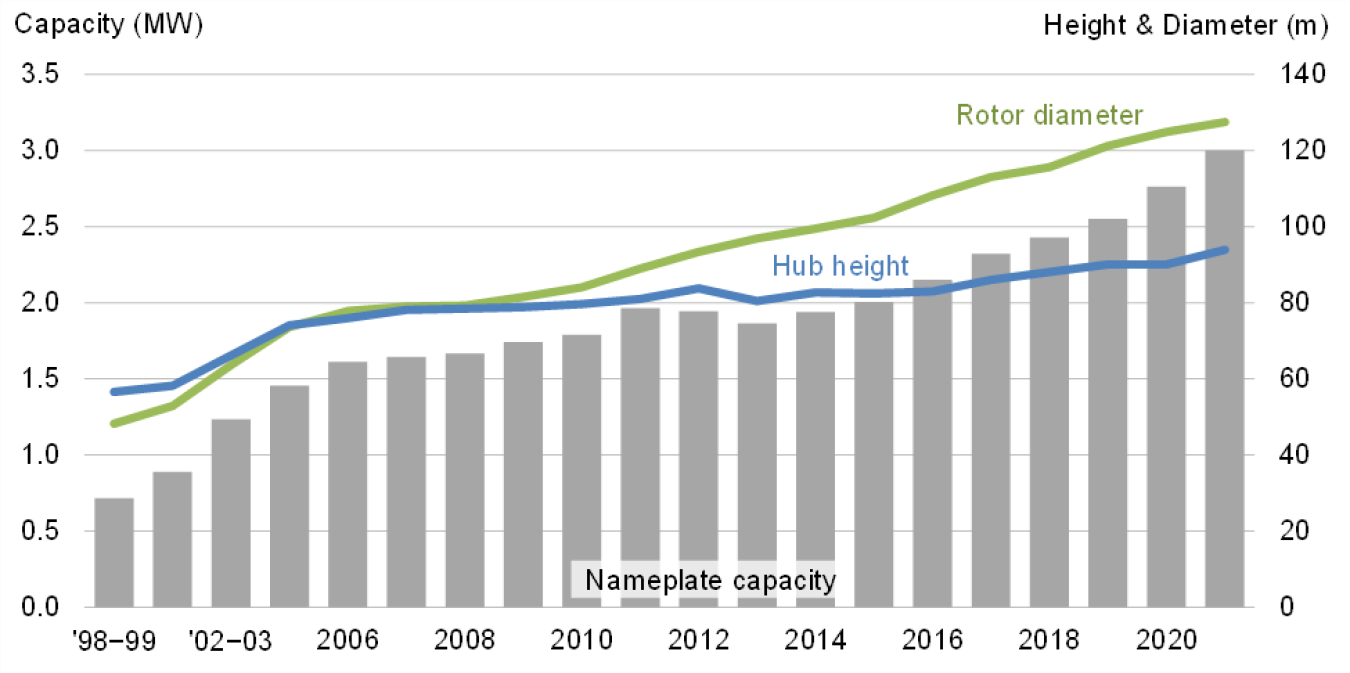
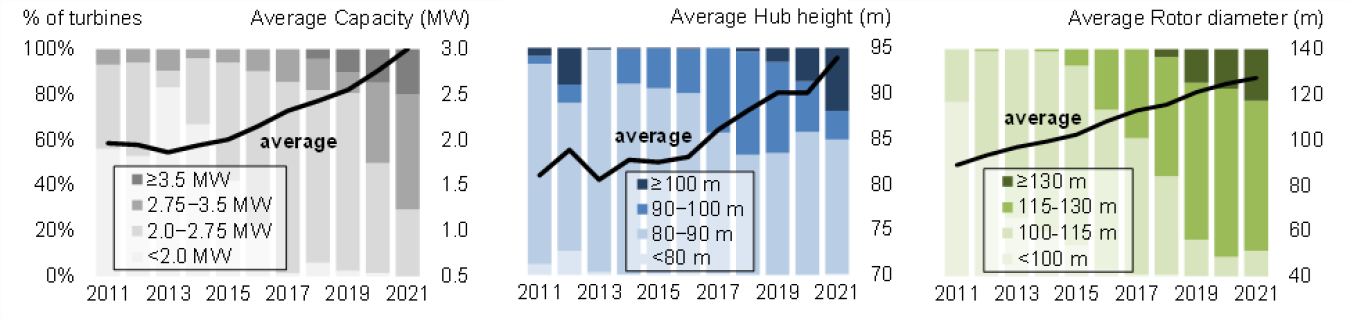
Average turbine hub height, rotor diameter, and nameplate capacity for land-based wind projects from the Land-Based Wind Market Report: 2022 Edition.
Hub Height
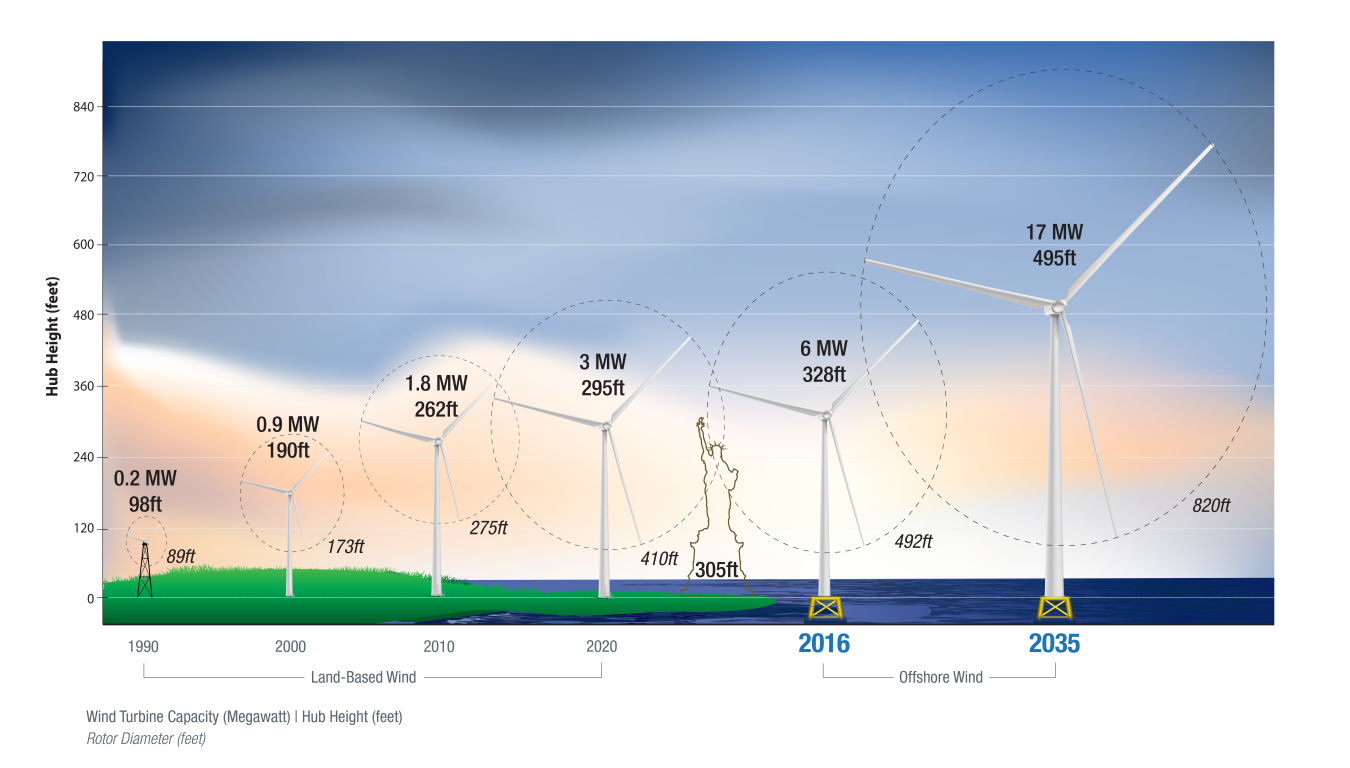
A wind turbine’s hub height is the distance from the ground to the middle of the turbine’s rotor. The hub height for utility-scale land-based wind turbines has increased 66% since 1998–1999, to about 94 meters (308 feet) in 2021. That’s about as tall as the Statue of Liberty! The average hub height for offshore turbines in the United States is projected to grow even taller—from 100 meters (330 feet) in 2016 to about 150 meters (500 feet), or about the height of the Washington Monument, in 2035.
Illustration of increasing turbine heights and blades lengths over time.
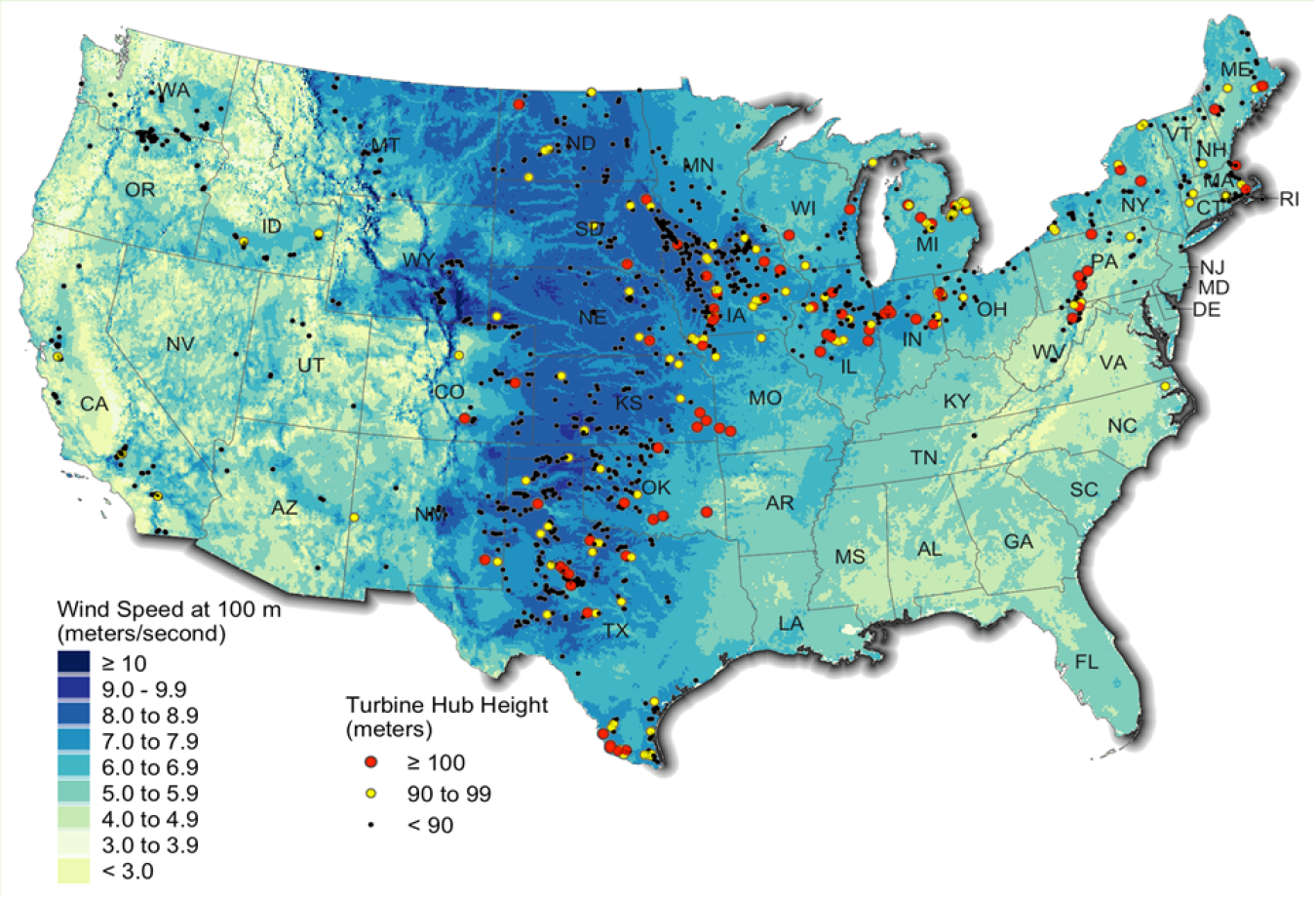
Turbine towers are becoming taller to capture more energy, since winds generally increase as altitudes increase. The change in wind speed with altitude is called wind shear. At higher heights above the ground, wind can flow more freely, with less friction from obstacles on the earth’s surface such as trees and other vegetation, buildings, and mountains. Most wind turbine towers taller than 100 meters tend to be concentrated in the Midwest and Northeast, two regions with higher-than-average wind shear.
Location of tall-tower turbine installations from the Land-Based Wind Market Report: 2022 Edition.
Rotor Diameter
A turbine’s rotor diameter, or the width of the circle swept by the rotating blades (the dotted circles in the second illustration), has also grown over the years. Back in 2010, no turbines in the United States employed rotors that were 115 meters (380 feet) in diameter or larger. The average rotor diameter in 2021 was 127.5 meters (418 feet)—longer than a football field.
Larger rotor diameters allow wind turbines to sweep more area, capture more wind, and produce more electricity. A turbine with longer blades will be able to capture more of the available wind than shorter blades—even in areas with relatively less wind. Being able to harvest more wind at lower wind speeds can increase the number of areas available for wind development nationwide. Due to this trend, rotor swept areas have grown around 600% since 1998–1999.
Nameplate Capacity
In addition to getting taller and bigger, wind turbines have also increased in maximum power rating, or capacity, since the early 2000s. The average capacity of newly installed U.S. wind turbines in 2021 was 3.0 megawatts (MW), up 9% since 2020 and 319% since 1998–1999. In 2021, there was an increase for turbines installed in the 2.75–3.5 MW range, while the proportion of turbines at 3.5 MW or larger also increased. Higher capacity turbines mean that fewer turbines are needed to generate the same amount of energy across a wind plant—ultimately leading to lower costs.
Transportation and Installation Challenges
If bigger is better, why aren’t even larger turbines used currently? Although turbine heights and rotor diameters are increasing, there are a few limitations. Transporting and installing large turbine blades for land-based wind is not easy, since they cannot be folded or bent once constructed. This limits the routes trucks can take and the radius of their turns. Turbine tower diameters are also difficult to transport, since they may not fit under bridges or highway overpasses. DOE is addressing these challenges through its research projects. For instance, DOE is designing turbines with more slender and flexible blades that can navigate through curves in roads and rail lines that conventional blades cannot. DOE is also supporting efforts to develop tall turbine towers that can be produced on site, thus eliminating tower transportation issues. Two companies pioneering these efforts are Keystone Power Systems, which uses spiral-welding in order to minimize the need for costly steel, and GE Renewables, which is experimenting with 3D printing to create customizable tower bases.
Liz Hartman is the Communications Lead for DOE’s Wind Energy Technologies Office.
If you liked this post you’ll love our daily environmental newsletter, EnviroPolitics.It’s packed with the latest news, commentary, and legislative updates from New Jersey, Pennsylvania, New York, Delaware…and beyond. Don’t take our word for it, try it free for an entire month. No obligation.