
#BILLYPENNGRAM
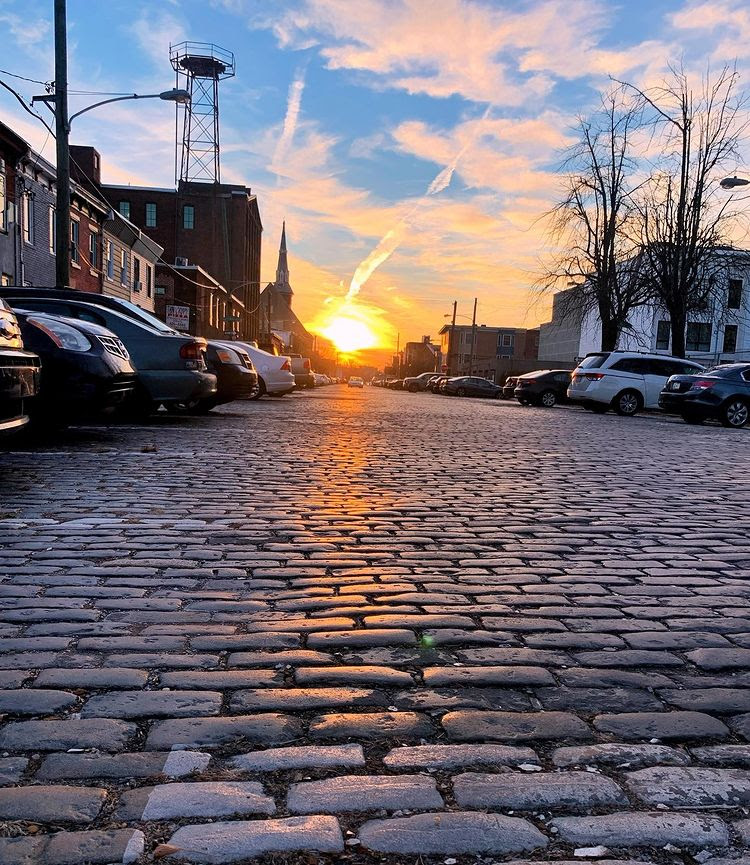
| #BILLYPENNGRAM OF THE DAY – Sunday Fishtown sunset (Photo by @illadelphia) |
| Want to see your photo here? Tag #billypenngram on Instagram |
| #BILLYPENNGRAM OF THE DAY – Sunday Fishtown sunset (Photo by @illadelphia) |
| Want to see your photo here? Tag #billypenngram on Instagram |
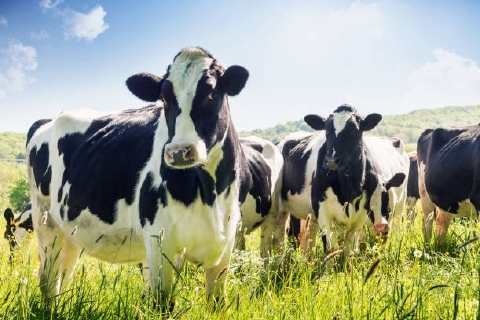
TRENTON, N.J. – Assemblyman Parker Space’s legislation that helps cover dairy farmers’ costs of participating in a federal insurance program for milk producers was signed into law on Tuesday.
“Stepping up the support of our state’s dairy farmers is critical if we want to save this important industry,” Space (R-Sussex) said. “Milk producers, many of whom have been farming in New Jersey for several generations, are hurting from increased costs and supply chain disruptions stemming from government shutdowns during the pandemic. This law helps keep dairy farming alive and well in New Jersey.”
The legislation (2020:A4336 / 2020:S3465) reimburses dairy farmers the annual premiums they pay to participate in the federal dairy margin coverage program, which is voluntary and provides risk protection to dairy farmers when milk prices are low and feed costs are high. A dairy operation that selects coverage above the catastrophic level is required to pay an annual premium based on the coverage level and percentage of production history.
Don’t miss environmental news like this Click for updates
The program delivers effective risk protection for dairies with herd sizes up to 250 cows, and partial risk protection for larger dairies. The average New Jersey dairy herd has 115 cows.
“This federal program has proven to be a successful safety net, especially for small dairy farms like we have in New Jersey. We want to encourage dairy farmers to enroll in the program and ensure that coverage costs are not an impediment,” Space added.
The law directs the N.J. Department of Agriculture to reimburse program participants up to the amount of the premium for coverage for the first 5 million pounds of annual milk production per farm. It also appropriates $125,000 for reimbursements. New Jersey currently has 36 dairy farms eligible for the program.
The Senate companion bill (2020:S3465) was sponsored by Sen. Steve Oroho (R-Sussex). The measure passed both houses unanimously.
Bill supporting New Jersey dairy farmers signed into law Read More »
By Matthew Cappucci Washington Post
On Jan. 15, a powerful eruption of an underwater volcano near the Tonga islands in the Pacific Ocean triggered tsunami waves around the world. (The Washington Post)
The Hunga Tonga volcano in the southwest Pacific erupted explosively on Saturday evening local time, producing a tsunami, sending ash 100,000 feet high and generating an atmospheric shock wave that rippled around the globe. The eruption was heard in Alaska, about 5,000 miles away, while an area the size of New England was blanketed by the ashen smoke plume.
Underwater Pacific volcano sends tsunami waves to Tonga, cutting off contact with outer islands
The volcano is about 40 miles north of Tonga’s main island, Tongatapu, near the international dateline. Tonga, home to 105,000 people, can be found northeast of New Zealand and southeast of Fiji.
Distress signal detected on Tonga islands after the volcanic eruption
“We have a nightmare situation of an isolated community experiencing the effects of a large volcanic ash plume producing significant volcanic lightning, as well as a tsunami,” Janine Krippner, a volcanologist at the Smithsonian Global Volcanism Program, wrote in a Twitter direct message. “Seeing that ash plume, that volcanic lightning, and that tsunami leave me feeling sick thinking about the people being impacted by this large eruption.”
In Volcano’s Aftermath, an Agonizing Wait for Tonga News
If you liked this post you’ll love our daily newsletter, EnviroPolitics. It’s packed with the latest news, commentary, and legislative updates from New Jersey, Pennsylvania, New York, Delaware…and beyond. Don’t take our word for it, try it free for an entire month. No obligation.
Volcano in Tonga rises from the sea, sending a shock wave around the world Read More »
A fire at a New Jersey chemical plant with flames and smoke visible for miles in the night sky Friday spread to multiple buildings, threatening to reach the plant’s chemical storage area, authorities said.

By Megan VerHelst, Patch Staff
PASSAIC, NJ — A massive 11-alarm fire that broke out at a chemical plant in Passaic on Friday night has been contained after firefighters worked through the night, battling flames and frigid temperatures.
The fire broke out at Majestic Industries and the Qualco chemical plant in Passaic just after 8:15 p.m. Friday, ABC New York reported. The flames reached buildings housing plastics, pallets, and chlorine, officials told The Associated Press but did not reach the main chemical plant, which could have endangered the densely populated New York City suburbs of New Jersey.
No serious injuries were reported and no evacuation orders were issued.
Chemical Plant Fire in Passaic, NJ Contained, Evacuations Avoided Read More »

People living in the nation’s capital were treated to a rare sight — a snowy owl perched on statues and monuments far from its breeding grounds in Canada.
A snowy owl is causing a hoot after landing in the District this week. Hobby ornithologists and non-birders alike are celebrating the somewhat-rare bird, which was first spotted around late December near the McMillan Reservoir, according to the Washington Post.
It’s since made several appearances throughout the National Mall and outside Union Station. The bird of prey has been spotted, uh, preying on the local delicacy of pigeons and rats. Lots of them.
In an interview with The Washington Post, Matt Felperin, a naturalist for Nova Parks in Northern Virginia, said the night owl has been using the area as a hunting ground after dark. And according to Felperin, it’s making a killing.
“She’s doing marvelously, and she’s doing us a favor with the rats,” Felperin said.
Meanwhile, some locals have begun to roost around the bird at Union Station. According to one bird enthusiast, they’ve even given her a name: Duchess.
Snowy owl makes rare flight–Canada to D.C. Read More »
Holman’s endorsement of the candidacy of popular sheriff could close door on Gilmore return
By David Wildstein, New Jersey Globe
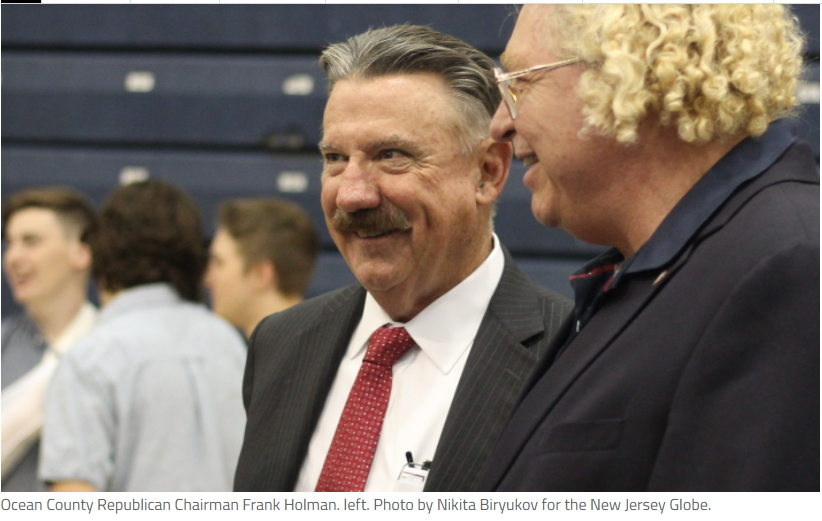
Ocean County Republican Chairman Frank B. Holman III will not seek re-election in June and will support Sheriff Michael Mastronardy as his successor.
“Sheriff Mastronardy is a proven leader, a strong administrator, an uniter, a man of tremendous integrity, a great ambassador to our religious communities, and a dedicated public servant,” Holman said. “All of which has made him a pretty popular guy. I am confident that with your help, he will lead our party to even greater success.”
Ocean is New Jersey’s largest and powerful GOP organization.
Mastronardy, who is seeking a fourth term as sheriff this year, will make a potential comeback by former county chairman George Gilmore more difficult.
Gilmore resigned in April 2019 following his conviction on three federal tax charges. President Donald Trump pardoned Gilmore on his final day in office.
Holman won a special election the following month by 25 votes, defeating Gilmore’s candidate, Frank Sadeghi, 254 to 229.
As county chairman, Holman delivered a 98,274-vote plurality to Trump in 2020 and a margin of 77,141 vote, 68%-32%, for GOP gubernatorial candidate Jack Ciattarelli in 2021. Republicans on Holman’s watch won 92 of 94 local races
If you liked this post you’ll love our daily newsletter, EnviroPolitics. It’s packed with the latest news, commentary, and legislative updates from New Jersey, Pennsylvania, New York, Delaware…and beyond. Don’t take our word for it, try it free for an entire month. No obligation.
Ocean County (NJ) GOP Chairman Frank B. Holman to retire Read More »