HOBOKEN, NJ — Four Hoboken council members raised questions this week about the fact that Hoboken Mayor Ravi Bhalla recently moved from an “of counsel” position at one New Jersey law firm to another. Back in 2018, Bhalla had raised eyebrows when he took a $60,000 slot at a law firm after pledging during his first campaign to focus full-time on the mayor job.
On Dec. 30, 2021, law firm Schenck, Price, Smith, and King — where Assistant City Attorney John Allen also is employed — posted on its website that Bhalla is now “of counsel” there. Bhalla did not announce the change in firms publicly, but it was revealed in the press this week.
In his past slot, Bhalla also held an “of counsel” role and could earn additional funds for delivering clients. Bhalla also earns $116,950 per year as mayor.
Rob Horowitz, who served as Bhalla’s spokesperson for his unopposed re-election bid in November, answered questions this week about the new spot.
Thomas A. Pankok, a humble, community-minded Korean War veteran who served two terms in the New Jersey State Assembly before he was swept out of office in Gov. Thomas Kean’s 1985 landslide re-election, died on January 31. He was 90.
Pankok launched his political career in 1958 as a 27-year-old candidate for Salem City Council. He was re-elected in 1960, winning his West Ward seat with 64% of the vote against Republican David Ayers.
Pankok was elected to the Salem County Board of Freeholders in 1965 with 62% against Republican Joseph Pew. That was at a time when most municipalities had their own freeholder. He won again in 1966, winning a two-year term for a reconstituted, smaller freeholder board.
Pankok ran for re-election in 1968 on a ticket with former Senate Majority Leader John Waddington (D-Salem), who spent 12 years representing Salem County in the State Senate before losing re-election in 1967.
Waddington won, but the decision of Salem County voters to split their tickets led to Pankok finishing fourth in a four-candidate race, about 900 votes behind Waddington. Republican John Pancoast won, and his running mate, David Crockett, lost.
Following the resignation of Salem City Mayor Norris Williams to become undersheriff in 1969, the city council elected Pankok to serve as the new mayor. He did not run in a special election that year.
In 1970, Pankok was again elected to serve as a Salem County freeholder. He and George Ayes, the former mayor of Alloway, ousted Republican incumbent Lester Harris and William Martin by about 1,500 votes.
Despite the Watergate Democratic wave in 1973, Pankok just narrowly won re-election against Republicans Martyna McLean and Martin, who was seeking a comeback. Pankok won by about 300 votes.
Pankok won again in 1976. He ran about 3,000 votes in front of Republicans Stephen Rogers and George Pappas, a former freeholder. He won again in 1979.
When Assemblyman H. Donald Stewart (D-Oldmans) decided not to seek re-election to a fifth term in the 3rd legislative district, Democrats picked Pankok as his replacement on a ticket with four-term Assemblyman Martin Herman (D-Woodbury).
Herman and Pankok defeated Republicans Erwin Sheppard, a Lawrence Township Committeeman, and Harrison Township Deputy Mayor David Liddle. Herman finished 2,825 votes ahead of Pankok, who outpolled Sheppard by 4,025 votes.
The two Democrats were re-elected in 1983 against Republicans Russ Paul and Edmund “Duke” Downer. Pankok won by 3,655 votes.
With Kean, the popular Republican governor, heading the ticket in 1985, the GOP flipped fourteen Assembly seats to take control of the lower house for the first time in twelve years.
Campaigns in Boston and western Massachusetts are taking aim at existing and proposed peakers. Critics say the facilities are bad for the climate and public health, and that cleaner and more economical alternatives now exist.
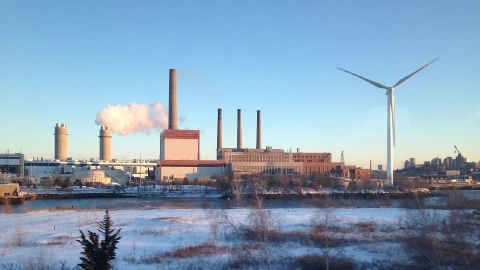
Mystic Generating Station in Everett, Massachusetts, is one of 23 peaking plants in the state. Credit: Fletcher6 / Creative Commons
Activists across Massachusetts are pressuring utilities and regulators to reconsider the need for some of the state’s most rarely used and least efficient fossil fuel power plants.
Campaigns in the Boston suburbs and western Massachusetts are taking aim at existing and proposed peaking power plants. The facilities — often simply called “peakers” — are intended to run only at times when demand for electricity is at its highest.
Utilities and grid managers say peakers are necessary to ensure reliability, especially as more intermittent wind and solar generation is added to the system. Critics, though, say they’re bad for the climate and public health, and that cleaner and more economical alternatives now exist.
“They are low-hanging fruit,” said Logan Malik, clean energy director for the Massachusetts Climate Action Network. “They aren’t in use a whole lot of time, and at the same time, technology is available as we speak, today, to replace these dirty plants with clean, renewable alternatives.”
Massachusetts is home to 23 such plants, according to nonprofit research institute Physicians, Scientists, and Engineers for Healthy Energy. Roughly two-thirds of them burn oil; the remaining plants run on natural gas. More than 90% of the plants are more than 30 years old, and thus more likely to run inefficiently and have higher greenhouse gas emissions, contributing to climate change. Some are so old they are not required to comply with the standards of the 1970 federal Clean Air Act.
Furthermore, they are often located in areas with concentrations of low-income households and residents of color, likely posing additional health risks to populations that are already more vulnerable. When peakers run, it can also raise costs for consumers, as they are generally the most expensive plants to operate.
“There’s just really almost no need for these plants,” said Jane Winn, executive director of the Berkshire Environmental Action Team. “Right now, the ratepayers are paying a hell of a lot of money to keep these plants on standby.”
If you liked this post you’ll love our daily newsletter, EnviroPolitics.It’s packed with the latest news, commentary, and legislative updates from New Jersey, Pennsylvania, New York, Delaware…and beyond. Don’t take our word for it, try it free for an entire month. No obligation.
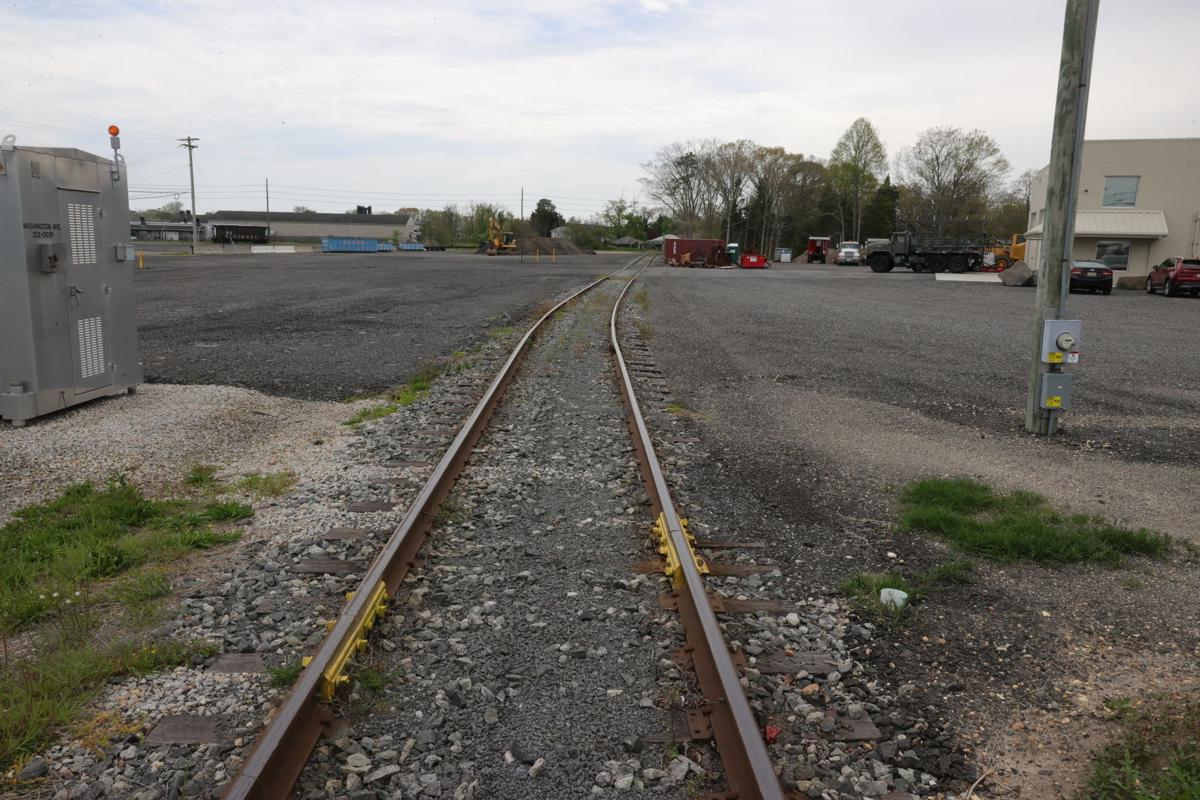
A construction debris waste transfer station is proposed behind 11 Devins Lane in Pleasantville. The Atlantic County Utilities Authority says it would result in increased tipping fees for non-construction waste. Edward Leaf photo
NOTICE: A local residents’ meeting to discuss the project had been scheduled for 6 p.m., Wednesday, April 2. at Mount Zion Baptist Church, 353 South New Road, Pleasantville, NJ. Due to Covid concerns, however, the meeting is being moved to a virtual format (by computer). Check this space tomorrow to learn how to join the meeting.
The debris-waste transfer station planned for a lot in Pleasantville has driven disputes and controversy within the city — but it also has attracted attention from municipalities and stakeholders throughout Atlantic County.
Pleasantville Mayor Judy Ward, an advocate for the station, has said she believed the project would be a valuable ratable for the city while generating an estimated $400,000 in annual revenue via waste-transfer fees. Ward argues this revenue could be invested in other capital improvement projects that would be crucial to the city’s growth. The developer for the project also has pledged to give priority to Pleasantville residents in hiring.
“The city is trying to do what’s best for the residents,” Ward said.
The chief opponent of the station is the Atlantic County Utilities Authority, which has spearheaded a “Stop the Dump” campaign against the project. The ACUA says the planned facility would be too small to handle 100,000 tons of waste per year, as is planned. The authority argued the station would choke the neighborhood with incoming traffic and create noise pollution and offensive smells.
ACUA President Rick Dovey has stressed that the station is still awaiting review from several organizations at different levels of government, including the Atlantic County Solid Waste Advisory Council and the New Jersey Department of Environmental Protection. Dovey said Monday he was skeptical the project would receive DEP approval. He has said he wanted there to be a forum for residents who may be opposed to the project.
James DiNatale, the developer of the project, disputes that the site would be too small to handle 100,000 tons of waste per year. He also stressed that the facility would handle only construction and demolition debris waste. Also, the proximity of the planned station to a nearby rail line would actually reduce the trucks needed to ship waste in and out of the county, lessening the cost and traffic burden, DiNatale said. He argued the area around the facility was already industrial, so the new waste facility would not be out of place in the neighborhood.
Ward has called active opposition by the ACUA to the project offensive and maintained the authority should instead be focused on accelerating trash and recycling pickup.
“I find the whole campaign to be disrespectful to the city of Pleasantville,” Ward said.
The plan is for the trash-transfer station to handle about 100,000 tons of debris per year, shipping it via rail line to an Ohio landfill. The city will be paid a $4 per ton transfer fee, thus amounting to $400,000 in annual revenue for Pleasantville.
In preliminary planning phases, DiNatale had considered the Blue Heron Pines neighborhood of Galloway Township as a location, but he ultimately decided he preferred the Pleasantville site because the city’s rails were better situated to ship waste.
Bob Mueller, president of the Blue Heron Pines Homeowners Association, said he had expressed concerns about the project when he caught wind of it. The Township Council, Mueller said, took residents’ concerns into account and opposed the project.
“There’s got to be a holistic approach, it has to fit within the community, it has to be to the benefit of the people that reside in and around it,” Mueller said. “And that’s up for (Pleasantville residents) to decide.”
If you liked this post you’ll love our daily newsletter, EnviroPolitics.It’s packed with the latest news, commentary, and legislative updates from New Jersey, Pennsylvania, New York, Delaware…and beyond. Don’t take our word for it, try it free for an entire month. No obligation.
Robert F. Kennedy has since offered a qualified apology after making a remark about Anne Frank at an antivaccine rally last week. But it’s only the latest controversy to embroil him. PATRICK SEMANSKY/ASSOCIATED PRESS
A decade ago, when he was first dating actress Cheryl Hines, Robert F. Kennedy Jr. asked her “Curb Your Enthusiasm” co-star, Larry David, if she’d be a good match.
“She’s the most solid person I’ve ever met,” David told him, according to The New York Times’s account of the couple’s 2014 wedding. “Nothing you ever do will rattle her.”
Well, not quite.
Last week, Hines was indeed rattled by Kennedy and added her voice to an avalanche of others, including many in his immediate family and among Jewish advocacy groups, condemning Kennedy’s comments implying that people who oppose the COVID-19 vaccine are being persecuted more severely than Anne Frank, who died in a Nazi concentration camp.
If you liked this post you’ll love our daily newsletter, EnviroPolitics.It’s packed with the latest news, commentary, and legislative updates from New Jersey, Pennsylvania, New York, Delaware…and beyond. Don’t take our word for it, try it free for an entire month. No obligation.