Going into the Thanksgiving Holiday, we want to show our appreciation to you loyal readers of our blog posts by attaching a free copy of today’s (paid subscription) EnviroPolitics newsletter.
File photo: The Delaware River in the West Trenton section of Ewing Township
By Jon Hurdle NJ Spotlight
From stream restorations at Lake Hopatcong to protecting bog turtles in South Jersey, conservation projects across the state will get a boost from the Infrastructure Investment and Jobs Act that President Joe Biden signed into law on Monday.
The new law provides an extra $26 million over five years for conservation projects supported by the federally funded Delaware River Basin Restoration Program, run by the U.S. Fish & Wildlife Service. The money, for projects starting in October 2022, is in addition to federal funds that have already been appropriated.
The program’s goals are to support natural habitat, improve water quality, build stormwater management, and enhance recreational access in the four states that are covered by the Delaware River watershed — New Jersey, New York, Pennsylvania and Delaware. It also prioritizes interconnections between parts of natural systems.
“In the 21st century, conservation work must consider connections at very large scales — such as a 14,000-square-mile Delaware River Basin — to be relevant, to be durable, and to be resilient to large scale stressors like climate change and land use development,” said Christina Ryder, Delaware River Watershed Program Manager for Science Applications at the Fish & Wildlife Service
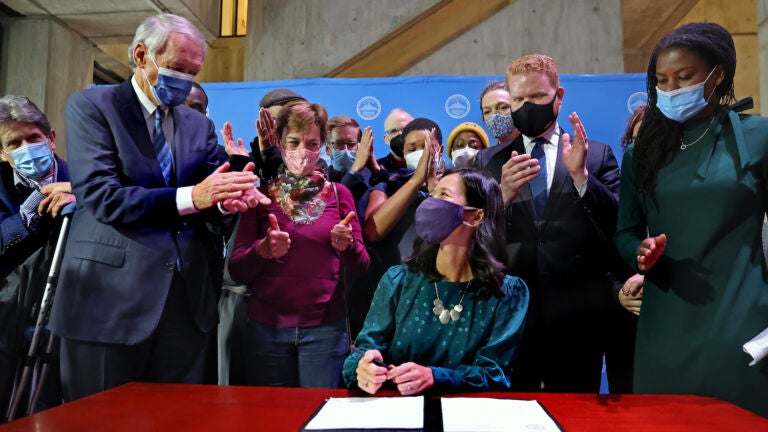
Less than a week after taking office, Mayor Michelle Wu on Monday signed her first law — a landmark regulation that will bar city funds from being invested in fossil fuel industries.
The new rule, passed by the City Council last week, bars the city’s Treasury Department from using public money to invest in companies that earn more than 15 percent of their revenues from selling tobacco products and fossil fuels, or from jail and prison facilities.
In all, that’s $65 million the City of Boston must fully divest by the end of 2025.
Monday marked the end of a legislative push for Wu that spanned nearly her entire career in elected office: She had previously fought for city action on this front since 2014 alongside fellow city councilors Matt O’Malley and Lydia Edwards.
If you liked this post you’ll love our daily newsletter, EnviroPolitics.It’s packed with the latest news, commentary, and legislative updates from New Jersey, Pennsylvania, New York, Delaware…and beyond. Don’t take our word for it, try it free for an entire month. No obligation.
A deathbed statement by a man who claimed to bury the Teamster boss’ body in a steel drum brought agents to the site for an inspection.
By Michael Wilson, New York Times
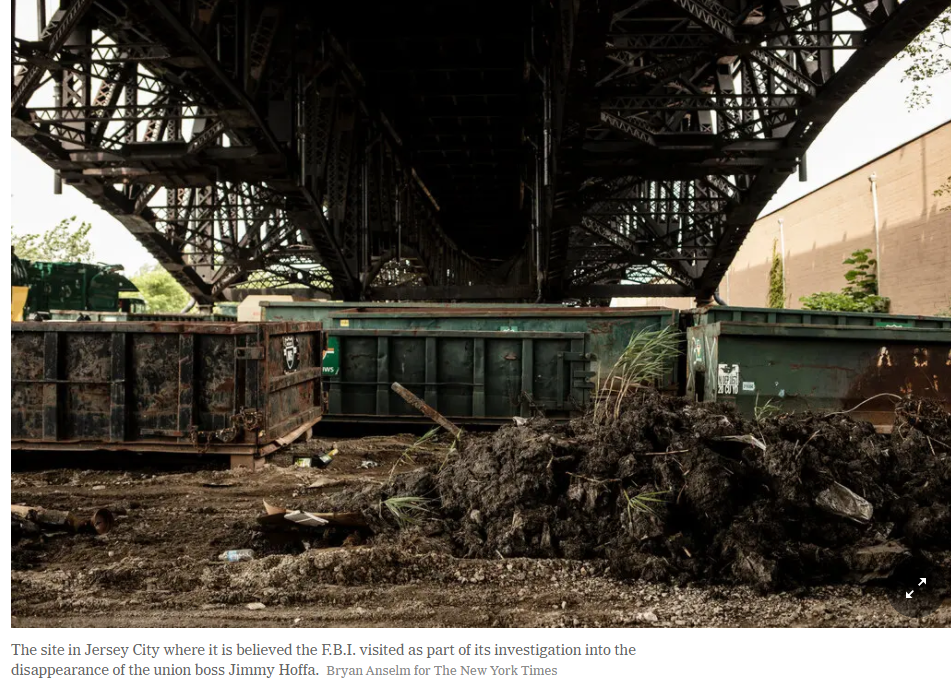
F.B.I. agents armed with a search warrant arrived in Jersey City at a plot of dirt and gravel the size of a Little League diamond below the Pulaski Skyway on Oct. 25 and 26 to conduct a “site survey,” according to the Detroit field office, which has led the investigation into Mr. Hoffa’s disappearance in 1975. The steel drum is said to be buried about 15 feet below ground, in the shadow of countless millions of drivers who have passed it by.
“F.B.I. personnel from the Newark and Detroit field offices completed the survey and that data is currently being analyzed,” Special Agent Mara R. Schneider, a spokeswoman, said on Thursday. The formal statement did not mention Mr. Hoffa by name and did not elaborate on a timeline for any potential excavation
The new investigation, to be sure, has a familiar ring, as it follows several failed searches for Mr. Hoffa’s body over the years. In Michigan, where Mr. Hoffa was last seen outside a restaurant, officers with backhoes have searched various locations, including a farm, a driveway and beneath a swimming pool.
In New Jersey, a popular urban legend had Mr. Hoffa’s remains buried under the old Giants Stadium in the Meadowlands. The 2019 film “The Irishman” raised yet another version of what may have happened, portraying Mr. Hoffa’s character shot and killed by his friend, Frank Sheeran, and his body incinerated. That theory, advanced by Mr. Sheeran in a book before his death, has long been discounted by Hoffa scholars as unlikely.
If you liked this post you’ll love our daily newsletter, EnviroPolitics.It’s packed with the latest news, commentary, and legislative updates from New Jersey, Pennsylvania, New York, Delaware…and beyond. Don’t take our word for it, try it free for an entire month. No obligation.
Porte Liberte, 1 Constellation Place. Rendering by KTGY Architecture and Planning via Toll Brothers 2020 application.
A unique neighborhood along Jersey City’s southern waterfront could be getting some more residents following a property sale and an emerging proposal for a new apartment complex.
Plans have been slowly advancing for the final phase of Port Liberté, a 40-acre neighborhood that currently consists of about 800 townhomes. The area’s southern section has about 14 developable acres left that have been marketed for sale over the last few years by Blue Gate Partners.
Port Liberté, Jersey City. Red outline shows the developable portion. Photo via Bluegate Partners.
Toll Brothers, who built the initial phases of Port Liberté, has officially sold the vacant parcels to New Liberty Residential Urban Renewal Company, a subsidiary of Hoboken-based Ironstate Development. Cleveland-based NRP Group recently submitted an application on behalf of Ironstate to develop four lots at 1 Constellation Place into the first portion of the neighborhood’s fourth phase.
Designed by KTGY Architecture and Planning, the development would consist of a long five-story apartment complex with a seven-story parking garage in the center. The entirety of the project is slated to include 401 units breaking down as 41 studios, 169 one-bedrooms, 166 two-bedrooms, and 25 three-bedroom spaces.
The Department of Environmental Protection says there’s no immediate health risk from drinking water from a South Plainfield treatment plant even though it exceeds a new state standard for the toxic “forever chemical” PFOA.
In a statement, the DEP seemed to side with the plant’s operator, Middlesex Water Co., which has said the exceedance does not represent a threat to public health although the water’s PFOA content will likely remain above the state’s “maximum contaminant limit” until a new treatment plant opens in mid-2023.
“Exceeding the standard (MCL) for PFOA does not create an acute violation, like drinking water contaminated with E. coli (bacteria), that is likely to have immediate health effects,” the DEP said Tuesday in response to a question from NJ Spotlight News. “However, people who drink water containing PFOA above the NJ drinking water standards (MCL) over time have an increased risk of certain adverse health effects from such consumption.”
On Oct. 22, Middlesex told about 29,000 customers in six towns that water from its South Plainfield plant contained PFOA at a level that exceeded the state standard. The company later almost doubled its estimate to about 57,000 affected customers, and said it is looking for ways of complying with the regulation before its new treatment plant opens in mid-2023.
Company won’t give bottled water or filters
The investor-owned utility has said that there’s no immediate risk to public health and that it will not supply bottled water or filters to remove the chemical. It did not respond to a request for comment on the DEP’s statement.
If you liked this post you’ll love our daily newsletter, EnviroPolitics.It’s packed with the latest news, commentary, and legislative updates from New Jersey, Pennsylvania, New York, Delaware…and beyond. Don’t take our word for it, try it free for an entire month. No obligation.