There’s a buyer-beware warning for those in the market to buy a new or used car. With thousands of vehicles destroyed in the floodwaters of Tropical Storm Ida, owners are now heading to dealerships in search of replacements. That’s putting pressure on an already distressed industry because of supply chain problems caused by the pandemic, including a microchip shortage. Inventory is at record lows.
Consumers should watch out for storm-damaged vehicles that have been cleaned up and are being resold to unsuspecting buyers.
Eric Gensinger, the owner of Mike’s Auto Sales in Garfield, warns of people trying to sell cars that were damaged by flooding. “They come in with the cars fully detailed and tell us how they just had it detailed. We’re not stupid. We know they didn’t have insurance, they got flooded, and they’re trying to sell it to us.”
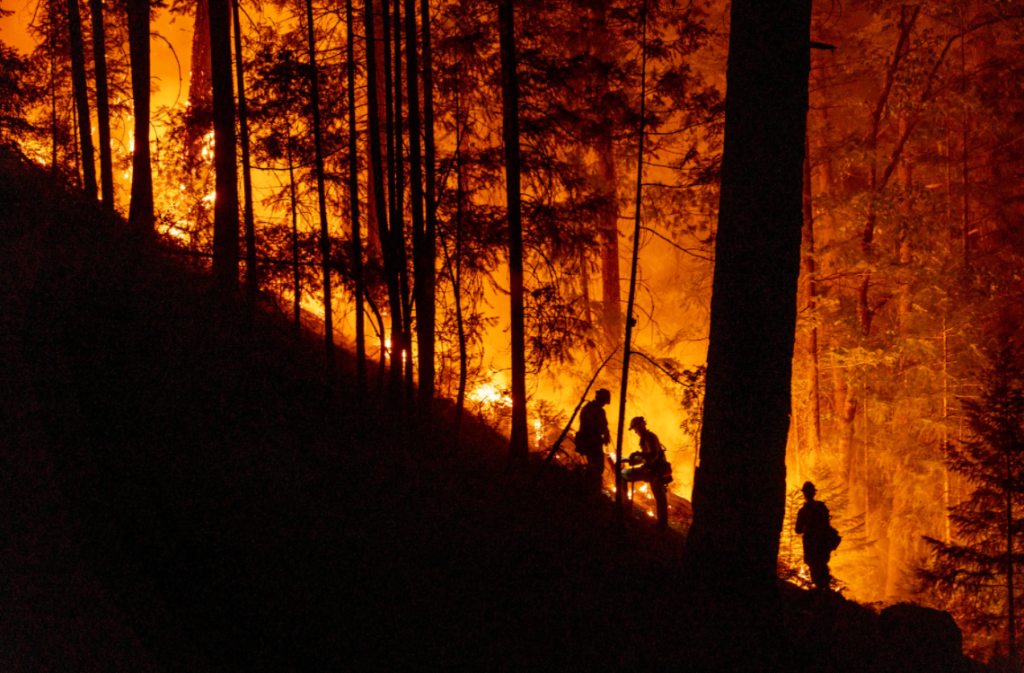
For two months, the Dixie Fire has menaced Northern California — stripping forests, forcing thousands from their homes, and swallowing most of a Gold Rush-era community.
More than 1,300 structures have been leveled. Government agencies have doled out roughly $540 million to battle the blaze. And a federal judge is scrutinizing what role California’s largest utility, the already-embattled Pacific Gas and Electric, may have played in the fire’s origin.
The blaze is the second-largest in California’s history and the biggest to burn in the U.S. this summer, as climate change turbocharged severe storms, floods, and fires. The Dixie Fire has now burned nearly 1 million acres, an area larger than New York City, Chicago, Dallas, and Los Angeles combined.
The fire’s tear through remote, rugged terrain, exceptional drought bringing moisture levels in California’s forests to historic lows, searing heat, as well as a series of unexpected obstacles, combined to fuel a monstrous blaze unlike any firefighters said they had seen before.
This timeline, based on public records and interviews with people affected by the Dixie Fire, shows how a relatively small ring of flames burning 100 miles north of Sacramento morphed into a dangerous harbinger of the devastating wildfire seasons that could be more common as the Earth continues to heat up
July 13: A PG&E employee reports seeing flames and a tree leaning on a power line near the Cresta Dam in Feather River Canyon, a stretch of land known for both its natural beauty and powerful Jarbo winds that in 2018 helped fuel the Camp Fire, California’s deadliest.
The California Department of Forestry and Fire Protection, colloquially known as Cal Fire, arrives at the blaze about 25 minutes after being notified and names it the Dixie Fire after one of the nearest roads. There are few, given the remote location. An unauthorized drone flies near the fire, temporarily forcing firefighting tankers and helicopters to pause their efforts.
PG&E spokesman James Noonan later tells The Washington Post that the company last evaluated the area’s trees on Jan. 14 and found none that needed trimming. PG&E also inspected the poles and wires in the area on May 13 and found nothing awry, he says.
If you liked this post you’ll love our daily newsletter, EnviroPolitics.It’s packed with the latest news, commentary, and legislative updates from New Jersey, Pennsylvania, New York, Delaware…and beyond. Don’t take our word for it, try it free for an entire month. No obligation.
PHILADELPHIA (Sept.. 14, 2021) – The U.S. Environmental Protection Agency announced today that it has deleted the Butler Mine Tunnel in Pittston Township, Luzerne County, Pennsylvania, from the Superfund National Priorities List (NPL). The NPL is a list of the nation’s most contaminated hazardous waste sites.
EPA deletes sites or parts of sites from the NPL when no further cleanup is required to protect human health or the environment. Years, and sometimes decades, of complex investigation and cleanup work have gone into getting these sites to the point where they can be deleted from the NPL.
“Deleting sites from the NPL is a major milestone for Superfund impacted communities,” said EPA Mid-AtlanticActing Regional Administrator Diana Esher. “An NPL deletion signals that cleanup is complete and the site no longer poses a threat to public health and the environment.”
EPA published a Federal Register Notice on May 14, proposing to delete the Butler Mine tunnel site from the NPL and establishing a 30-day public comment period during which the agency did not receive any significant adverse comments.
The Butler Mine Tunnel Site was created by the illegal disposal of oily waste into abandoned underground coal mines during the late 1970s. Waste oil was discharged from the mines in 1979, and again in 1985, following heavy rains associated with Hurricane Gloria. In each case, waste oil is discharged from the mines into the Susquehanna River via the Butler Mine Tunnel.
The EPA response to the discharges included:
Establishing an Administrative Center to monitor the site.
Responding to flush outs with construction and equipment.
Closing boreholes.
Developing an operations and maintenance plan.
Encouraging more responsible disposal of waste through a community education program.
Based on monitoring data collected, further oil flush outs associated with the original disposal activities are not expected. The EPA response at the Butler Mine Tunnel is now complete and as a result, the Site has been deleted from the NPL.
Not only are Rutgers students faced with broken air conditioners in residence halls, inconsistent bus schedules, and, of course, the delta variant of the coronavirus disease (COVID-19), but also my beloved Rutgers peers, we’re currently braving a battle of grave magnitude: the plague of the spotted lanternflies (SLF).
The SLF is an invasive insect species native to China, India, and Vietnam, that feed on the sap from more than 70 different plant species. They secrete a sticky substance called honeydew, which sounds kind of nice, but is actually dangerous to the conditions of the plants they feed on.
Although these scarlet, red, white, and black insects match the Rutgers colors almost perfectly, don’t be fooled: The SLF is nothing short of our collective enemy on campus.
Lycorma delicatula sounds like some sexy secret — the rising and falling of the breath forming the perfect whisper to share between lovers. But friends, it’s anything but that: Lycorma delicatula is the scientific name for the SLF. Honestly, I wouldn’t be surprised to learn that this was somehow another orchestrated propaganda trick from the SLF themselves to win the hearts and minds of the New Jersey populace.
I saw infographics on Instagram warning me of this foe, and I waited for the day that I would encounter one of the life-sucking lanterns. The first time I saw an SLF was on a hot day in the middle of July. One of the sorry members of its wretched kind flew to the side of my apartment building.
Acting with all the bravado I could muster in the span of a few fateful seconds, I destroyed an SLF with a Birkenstock and a hopping motion that I would be far too embarrassed to ever repeat upon request.
My roommate stood beside me, awestruck, as I replaced the shoe on my foot like some vengeful Cinderella. I made no move to clean up the squished mess I created. Instead, I left my fallen foe’s insides on the outside of my building as a warning to all of its friends not to cross me.
Cushman & Wakefield has arranged the sale of the I-78 Solar Farm in Warren County for $3.5 million, the firm said in a statement.
The 10-megawatt solar farm, installed and operated by NJR Clean Energy Ventures III, sits on 49 acres just off Exit 3 of Interstate 78 in Pohatcong.
The property is fully leased to NJR, a subsidiary of New Jersey Resources Corp. and the largest owner-operator of solar farms in the state, Cushman & Wakefield said.
The team of Andy Merin, Kyle Schmidt, Andrew Schwartz, Jordan Sobel, and Andre Balthazard represented the seller, RDG at Pohatcong, and procured the buyer, Turner Group, the firm said.
“Considering the enormous barrier to entry and the fact this site took 10 years of planning, negotiating, and constructing to ultimately come online in January 2020, it’s no surprise that we saw strong interest in the I-78 Solar Farm,” Schwartz said.
The site is part of a 170-acre development that, once finished, will include 244 single-family townhomes and a 120-unit apartment complex, Cushman said.
New Jersey’s budding offshore wind industry got an official endorsement Thursday with a ceremonial groundbreaking for a new state-financed port that will serve as the host of turbines due for construction in the next few years.
Gov. Phil Murphy joined U.S. Labor Secretary Marty Walsh, senior state officials, federal and state lawmakers, trade unionists, and environmental activists to launch the New Jersey Wind Port where operators will marshal and assemble the components that make up the giant turbines.
The facility, on 200 acres adjoining the Salem County nuclear-power complex, will be the nation’s first purpose-built onshore site for servicing an industry that’s key to achieving the Murphy administration’s clean-energy goals, and contributing to a global target of cutting carbon emissions.
Just one week after the remnants of Hurricane Ida ravaged New Jersey with tornadoes and record rainfall, killing more than two dozen people, Murphy said the wind port showed that the state is serious about curbing climate change.
“That sort of reality may be part of our today, but we must do all that we can to prove our unwillingness to deny climate change,” Murphy said. He said the state should attack climate change “head-on” so that future generations can enjoy a habitable world.
‘Epicenter’ of offshore wind industry?
Murphy, a first-term Democrat running for reelection, said the port will establish New Jersey as the “epicenter” of America’s offshore wind industry and the focus of its supply chain.
“This location will provide essential staging, assembly, and manufacturing for the offshore wind industry, not just in Jersey, but up and down the East Coast,” Murphy said, next to a ceremonial sand pile lined with shovels and hard hats.
The project finally refutes a long-held argument that there’s a trade-off between job creation and environmental protection, considering projections that the port will create 1,500 permanent jobs, and hundreds more in the construction phase, Murphy said.
“What we are doing here today is not only creating jobs — overwhelmingly good union jobs — it is going to be perhaps our greatest stand against climate change,” Murphy said. “New Jersey is going to change the narrative: Fighting climate change and creating good jobs do go hand in hand.”
The state’s first commercial-scale wind farm, named Ocean Wind, is sited about 15 miles off Atlantic City, and is due to start delivering power by late 2024. The project will be managed by Denmark’s Ørsted, one of the world’s biggest offshore wind developers, and is 25% owned by the PSEG energy company. It will generate 1,100 megawatts or enough to power around 500,000 homes.
Next up, another wind farm
It is due to be followed by Atlantic Shores, starting in 2024, a wind farm between Atlantic City and Barnegat Light. The project would generate 1,510 MW, or enough to power some 700,000 homes.
If you liked this post you’ll love our daily newsletter, EnviroPolitics.It’s packed with the latest news, commentary, and legislative updates from New Jersey, Pennsylvania, New York, Delaware…and beyond. Don’t take our word for it, try it free for an entire month. No obligation.