Atlantic Shores, one of two offshore wind developers chosen by the state last month to build wind farms off the Jersey coast, is looking to eventually build up to 3,000 megawatts of wind turbines in lease areas it has obtained.
The New Jersey Board of Public Utilities approved the 1,510-MW project in the southern portion of its lease area 10 to 20 miles off the coast between Atlantic City and Barnegat Light on June 30. The Atlantic Shores project is a joint venture of EDF Renewables and New Shell Energies LLC.
Atlantic Shores, however, has purchased leases for 183,000 acres — the largest yet obtained by an offshore wind developer — and hopes to develop the northern portion after obtaining approvals in future solicitations, company officials said during a virtual open house it sponsored Tuesday.
“We are doing everything we can to help New Jersey meet its clean-energy goals,’’ said Jessica Dealy of Atlantic Shores during one of the break-out sessions during the open house. New Jersey is hoping to build 7,500 MW of offshore wind capacity by 2035.
Supplying power, cleaning air, adding jobs
The initial project could supply power to up to 700,000 homes, avoid the equivalent of greenhouse-gas emissions from roughly one-third of all cars in New Jersey, and could create up to 22,290 jobs over its 30-year lifespan. The project is predicted to be operational by 2027, with 111 turbines, according to the company.
A rendering of the streetscape proposed for the exterior of three new residential buildings that would replace an Amazon facility at 930 Monroe Street in Hoboken.
Three residential high-rises with ground-floor retail space may replace an Amazon facility on Hoboken’s western edge, an area that has seen a boost in residential development in recent years.
The trio of buildings at 930 Monroe St. would top out below the Palisade cliffs and host about 675 units, the developer said at a community meeting the city hosted last week. Developer Lou Madigan would also build a 1.5-acre park nearby and bike infrastructure as part of Hoboken’s intended “green circuit” — in exchange for approval of 282 more units than the base maximum.
Many residents who participated in the meeting said they were impressed by the look of the renderings, but raised concerns typical of new projects in Hoboken — parking availability, flooding resilience, and community benefits.
Several city councilmembers, meanwhile, have said that the $15 million the developer plans to provide for the creation of a neighboring park and bike infrastructure doesn’t justify exceptions made that would allow buildings of that scale.
The triangular property at 930 Monroe is sandwiched between the Hudson-Bergen Light Rail tracks and Shoprite. The proposed buildings would be 11 stories tall, with the eastern portion of each sitting lower, creating a tiered look. The maximum height would be 116 feet, which is the same as the Vine Apartment building adjacent to the property.
The park would sit about a block south at 800 Monroe St., currently, an empty property that the city would acquire through a land deal with another developer.
Cardboard boxes and wood pallets saw heightened demand in Q2, according to online platform Thomas, as buyers continue to encounter challenges sourcing shipping equipment.
Packaging ranked fourth among product types by sourcing volume for the quarter, behind adhesives, medical supplies and steel. Corrugated cartons had one of the largest quarter-over-quarter sourcing increases at 358%, according to Thomas’ quarterly report on sourcing activity.
“The challenges that we’re having in the supply chain right now show just how far we’re stretched for certain components,” Thomas Chief Marketing Officer Shawn Fitzgerald said during a presentation on Q2 activity.
Dive Insight:
Supply-demand imbalances have been prevalent in many facets of the supply chain since the COVID-19 pandemic gripped the world. This trend also affects shipping supplies, with prices climbing for corrugated boxes and wood pallets amid tight supply, according to the Institute for Supply Management’s June manufacturing report.
Companies are still clamoring for these pricier materials as they try to keep pace with heightened consumer spending, particularly for e-commerce orders that call for cardboard packaging. International Paper Chief Financial Officer Tim Nicholls said on the company’s Q1 earnings call that containerboard inventories are low across all regions.
“E-commerce, again grew at a strong double-digit pace in the first quarter, and we believe the majority of the accelerated consumer adoption in this channel is permanent,” Nicholls said.
Corrugated packaging manufacturer WestRock raised prices across all paper grades and saw North American box shipments increase 5.5% year-over-year, Ward Dickson, executive vice president and chief financial officer, said on the company’s Q2 earnings call.
Pallet costs, meanwhile, were up 400% in May due in part to strong demand and lumber costs, the United Fresh Produce Association said in an emailed notice.
Thomas didn’t provide data on growth in wood pallet sourcing specifically, but CEO Tony Uphoff said wood pallets ranked No. 4 and No. 10 for items sourced from California and Pennsylvania, respectively.
In his own New Jersey neighborhood, Fitzgerald saw a truck patrolling the streets picking up any wood pallet the driver could find.
“They’re out collecting those up because they can’t find them anywhere else right now,” Fitzgerald said. “There are definitely challenges in finding every manner of components.”
Areas shaded in dark gray are under an air quality alert on Wednesday, July 21, 2021. The alert was issued by the state Department of Environmental Protection . National Weather Service
For the second straight day, state environmental officials have issued an air quality alert for parts of New Jersey as smoke continues to drift over the state from massive wildfires that are burning in the western United States and western Canada.
The “code orange” alert was issued by the state Department of Environmental Protection shortly before 9 a.m. Wednesday in Burlington, Camden, Gloucester, Mercer, Middlesex, Monmouth, Ocean counties. It remains in effect until midnight.
“A code orange air quality alert means that air pollution concentrations within the region may become unhealthy for sensitive groups,” the alert says. “Sensitive groups include children, people suffering from asthma, heart disease or other lung diseases, and the elderly. The effects of air pollution can be minimized by avoiding strenuous activity or exercise outdoors.”
Smoke from wildfires brought a hazy sunset in Bridgewater, N.J. July, 20, 2021Ed Murray | NJ Advance Media for NJ.com
Patrick O’Hara, a meteorologist at the National Weather Service’s regional forecast office in Mount Holly, said smoke and other particles from the western wildfires continue to travel thousands of miles along the jet stream, across the nation to the New Jersey region.
“The smoke is still pretty prevalent over the area,” O’Hara said Wednesday morning. “A lot of stuff that was over Michigan and Ontario a couple of days ago is gone from that area now and over our area.,
This map shows the air quality across New Jersey and other eastern states as of 8 a.m. Wednesday, July 21. Green indicates good air quality, yellow indicates moderate air quality, orange indicates air that is unhealthy for sensitive groups, and red indicates air that is unhealthy for anyone.AirNow | EPA, NOAA, NASA
Smoke from wildfires burning in the western United States and western Canada affects the sunset in Ocean City, Tuesday, July 20, 2021. Tim Hawk | NJ Advance Media for NJ.com
In Big Sur, scientists are rescuing the abalone from landslides caused by the Dolan Fire, and moving them to safety in new neighborhoods where “resident abalone” already thrive.
Wendy Bragg, a marine ecologist and doctoral student at the University of California, Santa Cruz, holds a black abalone just before it’s resettled along the Big Sur coast. Credit: Anne Marshall-Chalmers
BIG SUR, Calif.— It’s four in the morning, damp and dark along the central California coast. Huddled around the back of a minivan, five scientists in waders and boots tenderly move 41 black abalones from large white coolers into reusable Trader Joe’s grocery totes lined with wet, cold washcloths and ice packs.
With abalone slung over their shoulders, they hike towards a field of jagged, slick boulders, beams of light bobbing from their headlamps. The team is working at the mercy of low tides, which meant a 1 a.m. start to their day, but the morning’s early negative tide will help them return rescued abalone into the wild.
In February, Wendy Bragg, a marine ecologist and doctoral student at the University of California, Santa Cruz, along with other scientists from Multi-Agency Rocky Intertidal Network or MARINe, retrieved 200 endangered black abalones from areas along Big Sur’s coast.
Heavy rain had washed over land scarred by California’s worst fire season on record, creating large debris flows that barreled off cliffs and slammed into the rocky intertidal habitat. The landslides buried some black abalone alive and destroyed the rocky shoreline preferred by the marine snail, which is endemic to California and Mexico.
An arsonist is believed to have caused the Dolan Fire that scorched Big Sur, but Bragg, who has a background in fire ecology, believes black abalone, a species already vulnerable to disease, warming ocean waters and ocean acidification, may face increasing threats related to fire.
“As climates are changing, we know fires are increasing,” she said. “We know the intensity is increasing. If you think about just the terrestrial system, it’s obvious fires affect that,” Bragg said. “We now know it impacts the intertidal system.” (California’s current fire season is outpacing the historic summer and fall of 2020.)
Wendy Bragg left, leads a team of scientists resettling black abalone. Credit: Anne Marshall-Chalmers
Big Sur’s majestic, steep cliffs are prone to landslides, fires or not. The contour of the coastline beneath these slopes bends and meanders for more than 100 miles. About 70 percent of the state’s healthy, reproducing black abalone population live along this stretch of coast in the intertidal zone. Black abalone, known for the dark outer shell that boasts a glimmering, pearly underside, is the only abalone species that does not need to live submerged in water.
Last fall, Bragg watched the Dolan Fire burn along Big Sur and knew debris flows would follow if winter brought intense rainstorms. In coordination with the National Marine Fisheries Service and the California Department of Fish and Wildlife, she started planning a rescue operation. MARINe had extensive documentation of where black abalone resided, and Bragg conducted her own surveys. After the landslides struck, she returned to several sites, some of which were unrecognizable.
If you liked this post you’ll love our daily newsletter, EnviroPolitics.It’s packed with the latest news, commentary, and legislative updates from New Jersey, Pennsylvania, New York, Delaware…and beyond. Don’t take our word for it, try it free for an entire month. No obligation.
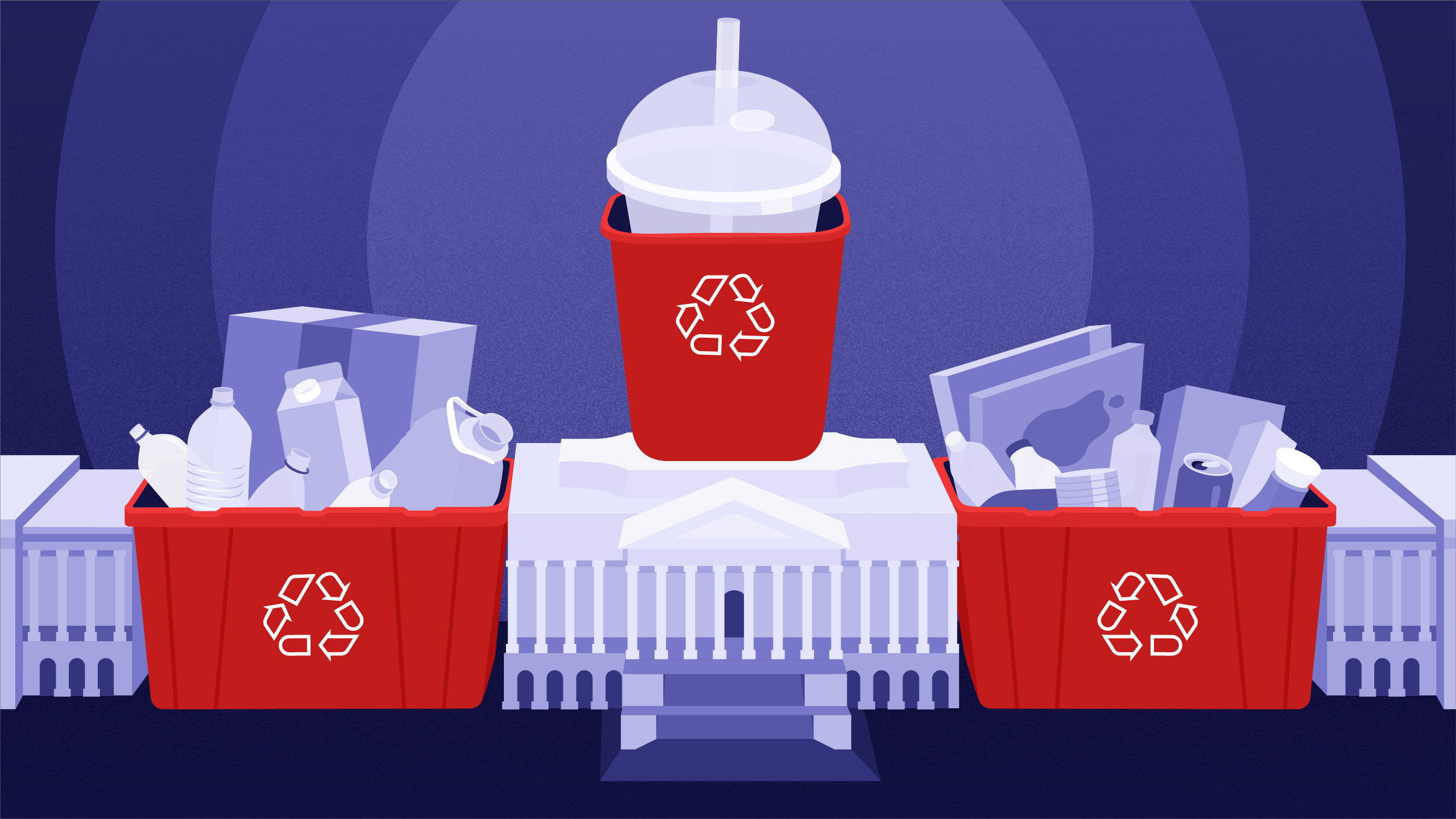
State lawmakers have made significant headway on laws about EPR, recycled content mandates and plastic products. Other bills are still in play, and experts anticipate even more changes in 2022.
State legislatures concerned about climate change and plastic packaging litter have moved the needle in 2021 to pass bills meant to make lasting changes on local waste and recycling systems.
Although many states have wrapped up their legislative sessions, this year has already been notable for the way historically difficult-to-pass bills have finally become law, including two extended producer responsibility (EPR) for packaging bills, one major bottle bill update, several plastic bans, and two mandates that would require certain amounts of recycled content in packaging sold in their states.
Many of these same policies are playing out at the federal level as Congress considers a historic influx of recycling-related bills, but these bills have not progressed at the same pace.
So too have many state recycling and waste bills failed to pass, but 2021 has still been a significant year for the number of climate change-related bills introduced, said Yinka Bode-George, an environmental health manager at the National Caucus of Environmental Legislators.
“This year we saw a lot of states introduce bills such as EPR bills for the first time,” she said. “For a lot of states, this year was a campaign year or an education year for their respective legislatures, so in subsequent years they can add some meat to their strategy.”
Panelists at June’s WasteExpo in Las Vegas took note of how states are setting the tone on recycling, waste and organics policies that could eventually pave the way to success for federal bills with similar aims. Michelle Leonard, senior vice president at SCS Engineers, said industry professionals and lawmakers seem more plugged in now than at any other time in her 30-year career. “We’re finally connecting the dots in terms of climate change, economic development, and protecting public health and safety,” she said.
Covers most types of consumer packaging. Producers will pay into a stewardship organization; local governments could use funds for packaging management costs
Increases recycled content in packaging, bans some types of EPS containers and makes single-use foodservice ware available only on request
It’s just the beginning for state EPR legislation for packaging
2021 has been a breakout year for EPR laws, with Maine becoming the first state to pass one for packaging and Oregon’s governor poised to soon sign a packaging EPR bill. Packaging EPR has been slower to take off in the U.S. compared to other countries, but state lawmakers’ decisions to ultimately enact these laws signals growing momentum and changing attitudes around EPR as a method to manage waste.