Lantana Affordable Redevelopment Rises in Newark

By Chris Fry,  Jersey Digs

Lantana 109 119 Broad Street Newark Groundbreaking
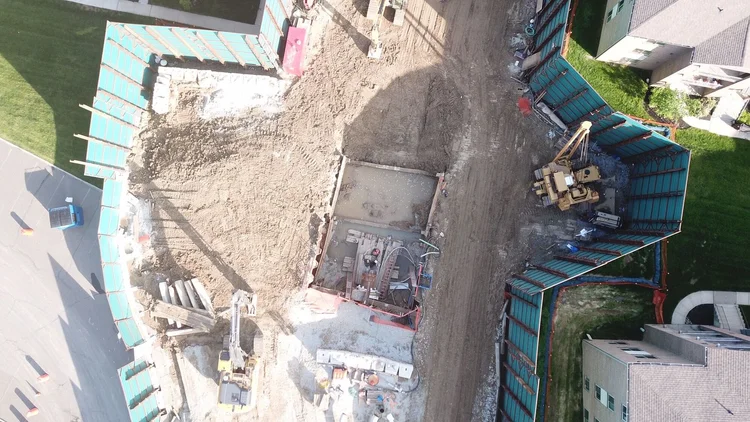
Ground has finally broken on the development Lantana at 109-119 Broad Street in Newark. Photo provided by a Jersey Digs reader.

Montclair-based RPM Development quietly broke ground earlier this year on a project located at 109-119 Broad Street. The property spans over 0.76 acres and is nestled in the city’s Mount Pleasant neighborhood just a short distance from Branch Brook Park.

Lantana 109 119 Broad Street Newark Construction Progress 1
Steel beams are up. Photo via RPM Development Facebook.

RPM was the company behind Jersey City’s Whitlock Cordage revitalization and their latest Newark endeavor is dubbed Lantana. The company purchased the property way back in 2010 and the endeavor has taken years to come together, heating up in 2018 after it was awarded tax credits from the New Jersey Housing and Mortgage Finance Agency.

Patch reported last September that Newark awarded additional federal funds through the HOME Investment Partnerships Program to Lantana and an eagle-eyed reader sent Jersey Digs some images earlier this year that showed the project breaking ground. The five-story complex is set to include 60 affordable units and the development registered for LEED Certification late last year.

Lantana 109 119 Broad Street Newark Construction Progress 2
Decking is down. Photo via RPM Development Facebook.

RPM recently provided an update on the progress of Lantana via its social media accounts. Structural steel and decking at the site have been completed and workers are now preparing for the podium slab installation.

Don’t miss information like this. Sign up for FREE EP Blog updates

Lantana Affordable Redevelopment Rises in Newark Read More »

Bill introduced to stop use of federal funds to buy Chinese solar panels

Solar Power

From Business Standard

A group of Republican senators has introduced legislation to prohibit federal funds from being used to buy solar panels from companies based in China, allegedly using forced labor in Xinjiang.

The Keep China Out of Solar Energy Act’ requires the Director of the Office of Management and Budget to develop standards and guidelines to prohibit federal funds from being used to purchase solar panels manufactured or assembled by entities with ties to the ruling Communist Party of China (CPC).

It also requires the Comptroller of the US to submit to Congress a report on the amount of solar panels procured by federal departments and agencies from covered entities.

The bill requires the Director of the Office of Management and Budget to conduct an independent study of the domestic market of solar panel production and the global supply chain and workforce involved in solar panel production.

Beijing has made it clear that to do business in China, you must leave American values behind, Senator Marco Rubio said.

As the Chinese Communist Party is actively committing genocide against Uyghurs and other ethnic Muslim minorities, it forces American companies to look the other way while profiting from its egregious human rights violations, including forced labour, Rubio said.

Read the full story

Get EnviroPolitics for the top environmental and political news
in New Jersey, Pennsylvania, and New York every business day.
PLUS: Full tracking of environmental legislation
Get EnviroPolitics free, without obligation, for 30 days!

Bill introduced to stop use of federal funds to buy Chinese solar panels Read More »

EPA dismisses dozens of key science advisers picked under Trump

The Biden administration says it needs to restore trust in the agency by “resetting” membership on two key science advisory panels
EPA Administrator Michael Regan is purging two scientific advisory committees of outside experts appointed by President Donald Trump. (Demetrius Freeman/The Washington Post)


By Dino Grandoni Washington Post
March 31, 2021 at 11:33 a.m. EDT

Environmental Protection Agency Administrator Michael Regan will purge more than 40 outside experts appointed by President Donald Trump from two key advisory panels, a move he says will help restore the role of science at the agency and reduce the heavy influence of industry over environmental regulations.

The unusual decision, announced Wednesday, will sweep away outside researchers picked under the previous administration whose expert advice helped the agency craft regulations related to air pollution, fracking and other issues.

Critics say that, under Trump, membership of the two panels — the EPA’s Science Advisory Board (SAB) and Clean Air Scientific Advisory Committee (CASAC) — tilted too heavily toward regulated industries, and their positions sometimes contradicted scientific consensus.

“Science is back,” new EPA administrator says

The Biden administration said the move is one of several to reestablish scientific integrity across the federal government after what it characterizes as a concerted effort under the previous president to sideline or interfere with research on climate change, the novel coronavirus, and other issues.

“Resetting these two scientific advisory committees will ensure the agency receives the best possible scientific insight to support our work to protect human health and the environment,” Regan said in a statement.

Environmental advocates cheered the decision, saying thatremaking the composition of the panels is necessary after the Trump administration illegally barred academics who received EPA grants from serving on them.

Under Trump, the EPA had argued scientists who received research funding from the agency would not be able to offer impartial advice. But environmental and public health advocates, along with some former career officials within the agency, said the policy effectively elevated experts from industry while muzzling independent scientists.

Read the full story

Get EnviroPolitics for the top environmental and political news
in New Jersey, Pennsylvania and New York every business day.
PLUS: Full tracking of environmental legislation
Get EnviroPolitics free, without obligation, for 30 days!

EPA dismisses dozens of key science advisers picked under Trump Read More »

Court fight over Delaware River fracking ban heats up

Lawmakers in the Pennsylvania Senate square off in federal court over the fracking ban approved by the Delaware River Basin Commission.

By John L. Micek, Editor, Pennsylvania Capital-Star

In a local story with national implications, Republicans and Democrats in the state Senate are waging legal war over a regional regulatory agency’s decision to impose a de facto moratorium on natural gas drilling in the Delaware River basin.

On Monday, Senate Democrats announced they’d been granted a motion to intervene in the January lawsuit filed by Sens. Gene Yaw, R-Lycoming, and Lisa Baker, R-Luzerne, along with the Senate Republican Caucus, challenging the Delaware River Basin Commission’s decade-old policy, arguing the agency had usurped the Legislature by imposing its moratorium. 

“My colleagues and I are participating in this lawsuit to preserve the authority of the Delaware River Basin Commission to protect the drinking water of more than 13 million individuals,” Sen. Steve Santarsiero, a Bucks County Democrat whose district runs along the riverfront, said in a statement “Working within its authority, the DRBC has been taking critical steps to protect both the waterways in the Delaware River Basin and our land from the harmful effects of fracking.”

Some background:

After imposing its de facto moratorium in 2010, the commission voted Feb. 25 to formally ban fracking in the basin, StateImpact Pennsylvania, an environmental news outlet, reported at the time. All four of the commission’s member states: Delaware, New Jersey, New York, and Pennsylvania, joined in the action. 

Read the full story

Court fight over Delaware River fracking ban heats up Read More »

Important Updates on EPA’s TSCA New Chemicals Program


EPA News Release

The Environmental Protection Agency (EPA) is conducting an evaluation of its policies, guidance, templates, and regulations under the Toxic Substances Control Act (TSCA) new chemicals program to ensure they adhere to statutory requirements, the Biden-Harris administration’s executive orders, and other directives. The agency has identified several instances where the approach for making determinations and managing risks associated with new chemicals can more closely align with the requirements of TSCA to ensure protections for human health and the environment, including the use of significant new use rules (SNURs) and assumptions related to worker exposures.

EPA remains committed to meeting statutory deadlines for review and determinations on new chemicals submissions under TSCA section 5 and will continue to engage with submitters to ensure the agency is moving as expeditiously as possible to come to a resolution on their submissions. Additionally, EPA will provide timely communication for any changes to stakeholders and the public through the normal distribution lists used to announce TSCA developments.

Use of SNURs

EPA will stop issuing determinations of “not likely to present an unreasonable risk” based on the existence of proposed SNURs. Rather than excluding reasonably foreseen conditions of use from EPA’s review of a new substance by means of a SNUR, Congress anticipated that EPA would review all conditions of use when making determinations on new chemicals and, where appropriate, issue orders to address potential risks. Going forward, when EPA’s review leads to a conclusion that one or more uses may present an unreasonable risk, or when EPA lacks the information needed to make a safety finding, the agency will issue an order to address those potential risks.  

Don’t miss information like this. Sign up for FREE EP Blog updates

As has been the long-standing practice, EPA intends to continue issuing SNURs following TSCA section 5(e) and 5(f) orders for new chemicals to ensure the requirements imposed on the submitter via an order apply to any person who manufacturers or processes the chemical in the future. This ensures that other manufacturers of the same new chemical substance are held to the same conditions as the submitter subject to the TSCA section 5(e) or 5(f) order. A SNUR requires manufacturers to submit a significant new use notification to EPA for assessment before the chemical substance can be manufactured or processed for the new use described in the SNUR.

Worker Exposures

EPA now intends to ensure necessary protections for workers identified in its review of new chemicals through regulatory means. Where EPA identifies a potential unreasonable risk to workers that could be addressed with appropriate personal protective equipment (PPE) and hazard communication, EPA will no longer assume that workers are adequately protected under OSHA’s worker protection standards and updated Safety Data Sheets (SDS). Instead, EPA will identify the absence of worker safeguards as “reasonably foreseen” conditions of use, and mandate necessary protections through a TSCA section 5(e) order, as appropriate. 

Learn more about EPA’s TSCA new chemicals program.

Try our daily newsletter, EnviroPolitics, FREE for a full month!

Important Updates on EPA’s TSCA New Chemicals Program Read More »