As the state tries to electrify its transportation sector, one focus has been on electric school buses. But there hasn’t been much success largely because of the larger upfront costs of purchasing electric vehicles instead of diesel buses.
Clean-energy advocates contend, however, that school districts could offset those costs by having electric vehicles supply power, stored in the vehicles’ batteries, back to the regional electricity grid when they are not transporting students to and from school.
If so, that could speed up the rollout of electric school buses in New Jersey, according to environmental groups who are urging school districts to stop purchasing diesel buses and transition to all-electric buses by 2030 in a new report.
“While electric buses can save and even earn money for schools over the lifespan of the bus, the initial price tag often presents a hurdle for cash-strapped districts,’’ said Hayley Berliner, a clean-energy associate for Environment New Jersey’s Research. & Policy Center.
The report, by Environment New Jersey and the New Jersey Public Interest Research Group’s Law and Policy Center, suggests school districts could recover those upfront costs and more, by using idle school buses to send stored energy back to the grid at times of peak demand, and get paid for that. Those times occur typically when buses are finished delivering students home in late afternoon and early evening.
If you liked this post you’ll love our daily newsletter, EnviroPolitics. It’s packed with the latest news, commentary and legislative updates from NJ, PA, NY, Delaware…and beyond. Try it free for an entire month.
A Gloucester County man forcibly rushed the U.S. Capitol on Jan. 6 and assaulted lines of police officers trying to fend off the attack, the FBI alleges in a criminal complaint.
Ezekiel Stecher, of Sewell in Mantua Township, is charged with five crimes related to the Jan. 6 riot, including assault on a federal officer and violently entering the Capitol. He made his first appearance in federal court on Tuesday, in Camden.
Stecher runs Stecher Farms on Bridgeton Pike (Route 45), according to multiple listings.
The FBI learned of Stecher’s alleged involvement in the Capitol attack from a video that was uploaded to an FBI tip line on Jan. 18, authorities said.
Someone asks a man, “What is your name? Where are you from?” and he replies, “Zeke Stecher from New Jersey,” according to the complaint.
Opposition to New Jersey’s coming surge in offshore wind farms is growing at the Jersey Shore.
The hundreds of wind turbines due to be built up to 20 miles off New Jersey in the next five years or so will spoil ocean views, undermine local economies and hurt wildlife while boosting the profits of overseas developers, critics say.
These opponents reject claims by wind farm builders and their enthusiastic supporters, including Gov. Phil Murphy, that the clusters of turbines are emissions-free. The manufacture and maintenance of the massive steel structures will require huge amounts of fossil fuel-powered energy, they argue.
They also say they fear that the tourism-dependent economies of many Shore towns will be damaged if visitors flee because they don’t want to look at an array of wind turbines on the horizon, or if the new structures disrupt marine life so much that recreational and commercial fishermen stay away.
And if fewer people want to spend time at the Shore, real estate values of coastal properties will drop, the critics predict.
“If people decide they don’t want any part of coming here, they will go elsewhere,” said Suzanne Hornick, administrator of SaveourshorelineNJ, a Facebook page that’s dedicated to opposing the industry, and has about 3,100 members.
Hornick, who lives in Ocean City, said she fears the town will be devastated by wind farms. “If tourism, and recreational and commercial fishing collapses then our restaurants collapse and our schools go to hell and the next thing you know people move off the island, and you have no community at all,” she said.
Critics are focused on Ocean Wind, a planned wind farm that will consist of about 100 turbines about 15 miles off Atlantic City. The project, New Jersey’s first, is due to generate 1,100 megawatts (MW), or enough to power about 500,000 homes, starting in 2024.
The developer, Denmark’s Ørsted, says visibility of the turbines from the shore will depend on atmospheric conditions. But Hornick said Atlantic City’s tallest building, the former Revel casino, is clearly visible from Ocean City, 16 miles away, or about the same distance as the Ocean Wind turbines will be from the Jersey Shore.
Afraid the turbines will be eyesores
At some 850 feet tall, the turbines planned for Ocean Wind will be higher than the 735-foot casino building, and so will be an eyesore on the horizon, she said.
At night, the wind farm will be lit to warn ships and air traffic of their presence, and that will be another visual violation, Hornick said. “These things are going to be so brightly lit, it’s going to look like an industrial park. The days of moonlight beach strolls are gone, and that’s not OK with us.”
But the visual impact could be reduced using lights that only come on when they are activated by radar from nearby ships or airplanes, according to Atlantic Shores, another project planned for an area between Atlantic City and Barnegat Light on Long Beach Island. That project, a 50-50 joint venture between Shell New Energy and EDF Renewables, is being reviewed by the Board of Public Utilities, and could generate up to 2,300 MW starting in 2027.
The two New Jersey projects are among 15 that are currently proposed for the northeastern and mid-Atlantic coasts. On Monday, the federal Bureau of Ocean Energy Management said it has completed its environmental review of Vineyard Wind, an Ørsted project off the coast of Massachusetts that is likely to be the first U.S. commercial-scale wind farm to begin operating. Advocates said the announcement was a sign that the Biden administration is serious about kick-starting the offshore wind industry after years of delay.
Seven East Coast states including New Jersey have committed to buying more than 28,000 MW of offshore wind power in the next 15 years, and some power-purchase agreements such as that for Ocean Wind, have been signed.
Asked how the European offshore wind industry has been able to overcome any environmental or economic problems since becoming established some 20 years ago, Hornick said she believes that Europeans are more likely to accept what their governments tell them than are Americans.
Distance makes a difference
Despite concerns about damage to tourism, research from the University of Rhode Island into the effects on tourism of a small wind farm — the first of its kind on the East Coast — that has been operating off nearby Block Island since 2016 found that occupancy and revenue increased on the island after the wind farm was built because visitors wanted to see it for themselves.
And a University of Delaware study last year found that tourists have fewer problems with offshore wind farms the further away they are. Twenty-nine percent said they wouldn’t visit the beach if turbines were 2.5 miles away but only 5% said they would be put off if the farm was 20 miles away — the outer limit for the Atlantic Shores project.
If you liked this post you’ll love our daily newsletter, EnviroPolitics. It’s packed with the latest news, commentary and legislative updates from NJ, PA, NY, Delaware…and beyond. Try it free for an entire month.
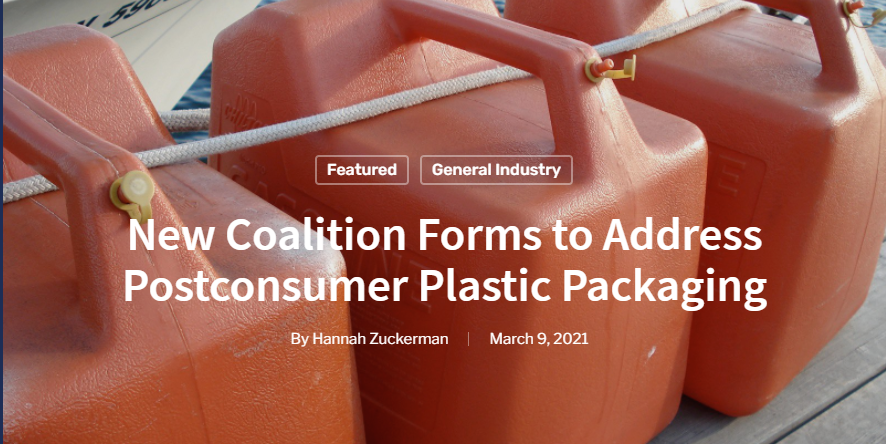
A group of plastic packaging manufacturers and lubricant manufacturers has formed The National Lubricant Container Recycling Coalition (NLCRC). The coalition’s goal is to address the challenges involved in recovering postconsumer plastic lubricant containers for recycling. NLCRC aims to establish a market-sustaining program that drives the recovery and recycling of plastic lubricant containers.
The idea for the coalition came about in early 2020 but its founders delayed its establishment due to the COVID-19 pandemic. NLCRC’s founding companies include Castrol, Valvoline, Pennzoil – Quaker State Company, Graham Packaging, and Plastipak Packaging.
“In the lubricant industry, even an ‘empty’ bottle can contain residual amounts of product,” says Tristan Steichen, director of NLCRC. Consumers often don’t add these containers to the recycling bin. The containers that do make it to the bin are frequently discarded in landfills “due to concerns with secondary-use applications,” says Steichen.
The NLCRC aims to address the challenge these containers present “by building an industry-wide program that involves multiple stakeholders across the value chain,” including manufacturers of the product and packaging, retailers that sell it, consumers, and the recyclers who collect and process it.
Often, when individual companies address the recycling challenge, the solutions are only effective for those particular companies, says Steichen. “We believe in the concept of shared value, and as we engage with each stakeholder, we need to work with them to understand how they connect to the value chain, and how they may extract value from the system,” he adds.
Initially, the coalition will focus on designing and implementing pilot projects to explore the best methods of collection, aggregation, and processing. Right now, the NLCRC is in the design phase of its pilot projects. “Some of these design elements include selection of appropriate ‘test’ markets, engaging with value chain stakeholders, looking at methods for ‘stimulating’ recovery efforts, and so on,” explains Steichen.
NLCRC invites interested organizations to join the coalition. “We are actively seeking participation from retailers, haulers, and recyclers … as well as developing criteria for identifying suitable markets to test our assumptions and build a scalable model,” says Steichen.
On Monday, U.S. Rep. Frank Pallone stood beside the water at Monmouth County’s Belford Seafood Co-Op, flanked by several New Jersey fishermen, and reflected on the tumultuous year that the state’s fishing industry has endured.
When the historic $2 trillion Coronavirus Aid, Relief, and Economic Security Act was making its way through Congress one year ago, Pallone (D-6th) recalled that at the time he “was concerned that we needed to have specific money targeting to the fishing industry.” Those in the state’s fishing industry, he continued, “often get left behind.”
Because seafood is such a dynamic product, typically undergoing six changes of hand as it moves from seafloor to table, it is particularly vulnerable to any tremor in the economy. Add in a legacy in New Jersey of overfishing, pollution and disease and you have an industry toughened with an ability to weather adversity.
But when almost every link in that critical supply chain shut down last March, “Everybody was scared,” said Dave Tauro, manager of the co-op.
New Jersey received $11 million from the first $300 million tranche of aid to the fishing industry nationwide last year — the ninth-largest payout in the country — and, Pallone said, the state will get about the same amount when funds from the follow-up aid package that was passed in December are disbursed later this year. There isn’t a specific earmark for the U.S. fishing industry in the $1.9 trillion American Rescue Plan from the Biden administration, which cleared the Senate and was set for a final vote in the House of Representatives Wednesday. Monday’s news conference was an opportunity for Pallone to tout the $300 million that he, Rep. Andy Kim (D-3rd), and other coastal lawmakers lobbied to have carved out of both the CARES Act and the $900 billion December follow-up package.
“When we protect and properly manage our resources,” said Shawn LaTourette, acting commissioner of the Department of Environmental Protection, which was responsible for administering the grants, “we’re also supporting the people and the businesses who rely upon those resources, businesses like our commercial and recreational fisheries that are so critical to the state’s economy and identity.”
Oyster farmers, charter boats, bait and tackle shops
In all, the emergency grants were paid out to fishing-related businesses from Delaware Bay oyster farmers to Barnegat Bay fluke captains to Ocean County charter boats — and Middlesex County bait and tackle shops, like Fred’s Bait and Tackle in South Amboy, owned by Jung Kim.
“We have faced and overcome many challenges, but nothing could have prepared us for 2020,” said Kim, who along with his wife has owned the bait and tackle shop for more than 35 years. “Our store faced financial loss of sixty to sixty-five percent; one year into the pandemic, our walls and freezers were almost empty, and we were worried about how we were going to replenish our merchandise and supplies for 2021.”