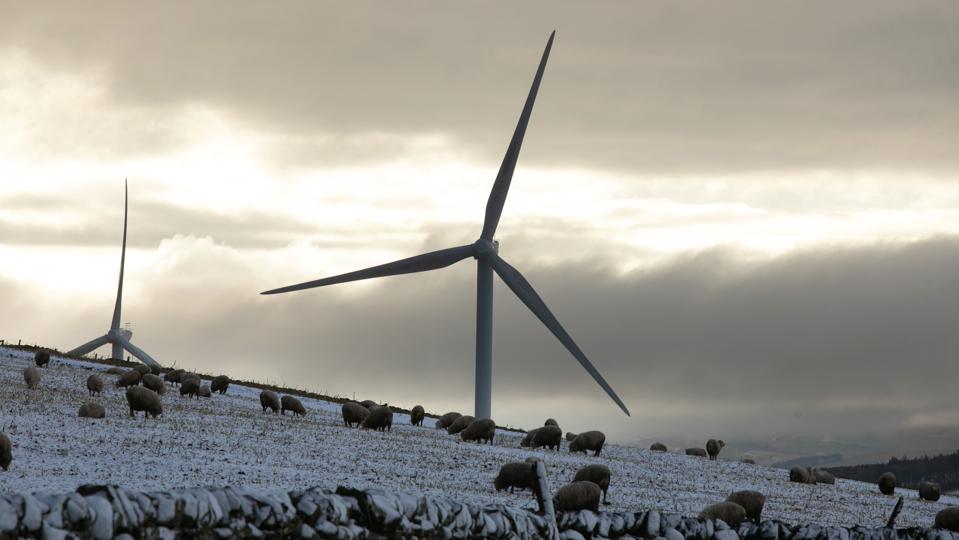
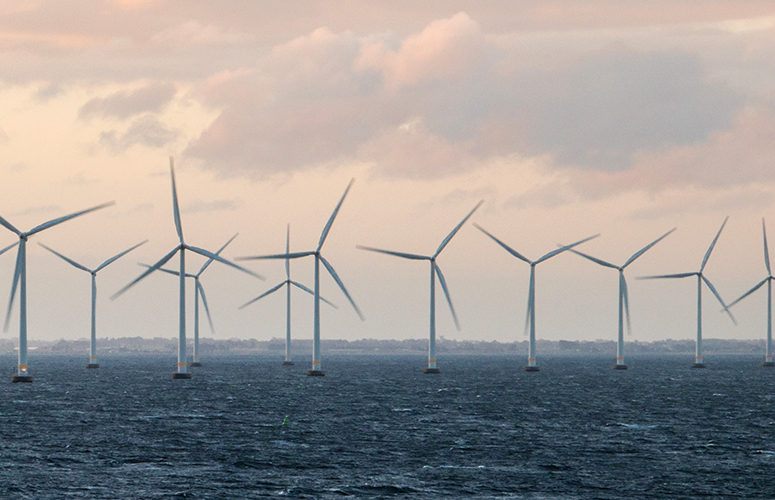
The Danish government has approved a plan to construct what it’s billing as the world’s first artificial island that will serve as a wind energy hub in the North Sea, as the Scandinavian nation seeks to speed up its transition to an all-renewable energy grid.
The island – which will be at least 1.3 million square feet in size, or as big as 18 soccer fields, making it the biggest construction project in Danish history – will be located 50 miles from the west coast of the Jutland peninsula and will be owned by a partnership of the Danish state and private companies.
The energy hub – which will collect electricity from at least 200 offshore wind turbines surrounding the island — will initially distribute enough green energy to supply electricity to 3 million households in Denmark and neighboring countries (including Holland and Germany), eventually expanding to 10 million households as the island’s construction is extended in various stages.
The island hub – slated to be completed by 2030 — will have a potential capacity of 10 gigawatts (or 10 billion watts), as part of the European Commission’s strategy to increase the EU’s total offshore wind capacity to 300 GW by 2050 from the current 12 GW level.
Denmark eventually plans to build a second wind energy hub on the Danish island of Bornholm in the Baltic Sea (with a total capacity of 2 GW) by the year 2030
Last year, Denmark, the largest oil producer in the EU (Norway and U.K. are not in the bloc), has committed to ceasing all oil and gas extraction activities in the North Sea by 2050, the same year the EU has targeted for bloc-wide climate neutrality (i.e., achieving net zero carbon dioxide emissions).
A broad majority of the Danish parliament – across the political spectrum – support the construction of the energy hub. According to Denmark’s Ministry of Climate and Energy, offshore wind energy in the North Sea has immense potential — by 2040, regional nations expect the total capacity of regional windfarms to reach 150 GW, which would be enough meet the electricity demand of 150 million households.
Joy Hollingsworth, of the Hollingsworth Cannabis Company, checks on a young marijuana plant near Shelton, Wash. Hollingsworth family members own a marijuana farm south of Seattle, where they grow about 9,000 plants and employ 30 people at peak harvesting. Ted S. Warren — Associated Press
By Jeff Edelstein, The Trentonian
If you watched “The Good Place” – and if you didn’t, you should, awesome show, just a delight, moving and hilarious and full of deep philosophical questions – you’re familiar with “Jeremy Bearimy.” For those who didn’t watch the show – it’s on Netflix, what are you waiting for? – “Jeremy Bearimy” is the visual representation of how time flows in the afterlife. It’s called “Jeremy Bearimy” because it looks like the cursive signature of someone by that name. The point being time doesn’t exactly flow in a linear fashion post-death. For instance, the “i” in the last name? It’s described as “Tuesdays, July, and occasionally the time moment where nothing never occurs.”
This came to mind recently when I was looking for a way to describe marijuana in the state of New Jersey, because the route it has taken from illegal drug to legalized substance has been very Jeremy Bearimy-like.
This was highlighted last week when 86-year-old state Sen. Gerry Cardinale, a Republican and longtime anti-marijuana politician, introduced a bill that would allow New Jersey residents to grow their own weed
His rationalization for the bill is the most common-sense statement I think I’ve ever heard a New Jersey politician utter.
“We don’t restrict people from growing tomatoes because it’s a legal substance. We don’t restrict you from growing almost anything that is legal to be grown,“ he told Politico.com. “To make marijuana an exception seems to me to only be able to create a private center for the people who are getting the licenses.”
EDITOR’S NOTE: It turns out that NJ Republican Senator Cardinale’s bill is not the ‘latest’ word in self-grown marijuana legislation. Democratic State Senator Troy Singleton has jumped in with his own version allowing for medical marijuana patients or their caregivers to register as home cultivators and grow up to four mature marijuana plants and four immature plants. It is more restrictive than Cardinale’s bill that would legalize growing up to six plants.
What to YOU think about marijuana legalization and/or growing your own? Us the comment link on this post or on our Facebook page.
The New Jersey Economic Development Authority (NJEDA) and the New Jersey Office of the Secretary of Higher Education (OSHE) announced the launch of the New Jersey Offshore Wind Safety Training Challenge, a new $3 million program launched with funding from the New Jersey Board of Public Utilities (BPU) that will help establish an industry-recognized Global Wind Organization safety training program and facility to prepare New Jersey workers for jobs in the State’s growing offshore wind industry.
Offshore wind is a rapidly expanding international industry that Gov. Phil Murphy has prioritized as a target sector for driving long-term, sustainable economic growth. The NJEDA has spearheaded initiatives to grow the industry in New Jersey, including the New Jersey Wind Port, a first-of-its-kind offshore wind manufacturing and marshalling facility located in Salem County, and a state-of-the-art monopile manufacturing facility located at the Paulsboro Marine Terminal.
“Offshore wind is a priority sector for Governor Murphy and the NJEDA that has unparalleled potential to drive long-term, sustainable economic growth. In addition, because the industry is so new, we have a unique chance to ensure equitable access to the economic opportunities it creates,” said NJEDA Chief Executive Officer Tim Sullivan. “Establishing a Global Wind Organization safety training program and facility in New Jersey will make jobs in offshore wind more accessible to New Jersey residents and will help to establish the state as a hub of the growing American offshore wind industry. The NJEDA is proud to partner with BPU and OSHE to launch the Offshore Wind Safety Training Challenge as the first step toward achieving this important goal.”
“Providing equitable access to innovative opportunities is vital to building a stronger, fairer New Jersey economy that works for all residents. Collaboration between the employer community and the higher education sector is essential to further strengthening the workforce and economy that the state needs to sustain a robust pipeline of highly-skilled workers and assure that the postsecondary-to-employment ecosystem is well-positioned for the future,” said Acting Secretary of Higher Education Dr. Brian Bridges. “We are excited to work with the NJEDA to establish the Offshore Wind Safety Training Challenge to build on opportunities for residents to gain access to the critical training, education and skills required to compete for in-demand jobs.”
“Training and certifying New Jersey workers for jobs in offshore wind is a critical aspect of growing this important new industry in New Jersey, and will ensure in-state candidates can benefit from its many exciting, once-in-a-generation opportunities,” said BPU President Joseph L. Fiordaliso. “Marking one year since the release of Governor Murphy’s ambitious Energy Master Plan, the launch of this Offshore Wind Safety Training Challenge will directly strengthen New Jersey’s offshore wind workforce development.”
Governor Murphy’s economic development plan identifies offshore wind as a strategic sector for accelerating economic growth and the NJEDA is currently leading development of the New Jersey Wind Port, a first-in-the-nation, purpose-built port for the offshore wind industry that has the potential to create up to 1,500 jobs and drive economic growth throughout the state. To ensure equitable access to the economic opportunities this project and other offshore wind initiatives create, Governor Murphy established the WIND Council in 2019 to engage industry and local stakeholder groups to evaluate New Jersey’s existing workforce development assets and identify gaps that must be addressed to strengthen the state’s leadership position in offshore wind. On April 22, 2020, the WIND Council released a report summarizing its recommendations.
One of the key workforce development needs the WIND Council identified is the creation of opportunities for workers to receive Global Wind Organization (GWO) Basic Safety and Sea Survival Training. The GWO is a non-profit body founded by leading wind turbine manufacturers and operators that aims to support an injury-free environment in the wind industry. It has set the industry-recognized standard for safety training and many manufacturers and owners of wind turbines require workers to obtain certifications by completing these trainings. To achieve New Jersey’s target of generating 7,500 MW by 2035, at least 1,825 workers will need to complete GWO Basic Safety and Sea Survival Training between 2023 and 2036.
The Offshore Wind Safety Training Challenge announced today will provide New Jersey-based academic institutions and training providers, including labor unions, an opportunity to submit proposals for establishing a GWO accredited Basic Safety and Sea Survival Training program and facility in the state. The winning applicant will receive a grant of up to $3 million to support implementation of the program and construction of the facility. Funding for the grant comes from the NJBPU’s New Jersey’s Clean Energy Program™ (NJCEP).
If you liked this post you’ll love our daily newsletter, EnviroPolitics. It’s packed with the latest news, commentary and legislative updates from NJ, PA, NY, Delaware…and beyond. Try it free for an entire month.
Today, Governor Phil Murphy signed the following bills into law:
S2607 / A2785 (Smith, Greenstein / Benson, McKeon) – Requires land use plan element of municipal master plan to include climate change-related hazard vulnerability assessment
S3230 / A5115(Greenstein, Corrado / Moriarty, Conaway, Calabrese, Chiaravalloti) – Appropriates $30.387 million from constitutionally dedicated CBT revenues to DEP for State acquisition of lands for recreation and conservation purposes, including Blue Acres projects
A5113 / S3235 (Timberlake, Sumter, Caputo / Beach, Pou) – Appropriates $11,777,499 from constitutionally dedicated CBT revenues to NJ Historic Trust for grants for certain historic preservation projects and associated administrative expenses
A5114 / S3229(DeAngelo, Speight, Swain / Codey, Corrado) – Appropriates $37.16 million from constitutionally dedicated CBT revenues for recreation and conservation purposes to DEP for State capital and park development projects
There are many things Pennsylvania state government should do this year to address climate change — but won’t, given the political composition of the state Legislature. But a few significant things are possible.
Pennsylvania emitted about 215 million metric tons of carbon dioxide in 2017 (the most recent data available), making it the fifth largest emitting state in the nation. As such, Pennsylvania should be doing things like increasing its Alternative Energy Portfolio Standard, expanding the energy conservation provisions of Act 129, and joining the Transportation and Climate Initiative Program. But with the state House and Senate firmly in Republican control, it’s unlikely that any of these things will happen this year.
But Pennsylvania can join the Regional Greenhouse Gas Initiative (RGGI), approve methane reduction regulations for the oil and gas industry, enact legislation to expand electric vehicles infrastructure, and enact legislation to authorize community solar development. These measures are possible because they can be done either by Gov. Tom Wolf through executive action or have the support of interest groups beyond the environmental community such as utility companies, labor unions or farmers.
Politics is the art of the possible, and these four things are possible this year.
Joining RGGI is the most important thing Pennsylvania can do this year to address climate change. RGGI is an 11-state cap-and-trade program designed to reduce greenhouse emissions from the electric power sector (mainly from coal- and gas-fired power plants). Joining RGGI could reduce carbon dioxide emissions by about 188 million tons over the next decade, according to the Pennsylvania Department of Environmental Protection. RGGI regulations are expected to be finalized late this year unless blocked by the General Assembly. A bill to block RGGI will be introduced soon.
Methane is the second-most prevalent greenhouse gas after carbon dioxide, and Pennsylvania’s natural gas industry is a major methane emitter. Regulations to reduce methane leakage from unconventional gas well operations are on track to be approved later this year. These regulations would result in methane emissions reductions of about 75,603 tons per year, according to the DEP. This is the equivalent to about 1,890,075 tons of carbon dioxide per year.