By Insider NJ | January 5, 2021, 1:42 pm | in Caucus Room
Andrew Zwicker, a member of the NJ General Assembly representing the 16th Legislative District, has named Petra Gaskins as his chief of staff, effective Monday, January 11, 2021.
“I am thrilled to welcome Petra Gaskins to my staff. She brings a tremendous amount of experience and a unique personal perspective into this role. Her deep desire to help others and to seek changes that improve people’s lives will be invaluable,” said Zwicker.
Gaskins formerly served as the director of Outreach & Programming for Congresswoman Bonnie Watson Coleman, from the 12th Congressional District. In that role, she was responsible for the development and implementation of projects and programs to engage key constituency groups. Previously, she was as an aide to New Jersey Governor Phil Murphy in Intergovernmental Affairs where she served as the liaison to local officials in Mercer and Hunterdon counties. She began her career in government with Congresswoman Bonnie Watson Coleman in constituent relations.
A graduate of Rider University, Gaskins takes great pride in mentoring the next generation of civic leaders by volunteering with New Leaders Council-New Jersey, according to a release from Zwicker’s office. She also is an advisor to the Mercer County Young Democrats.
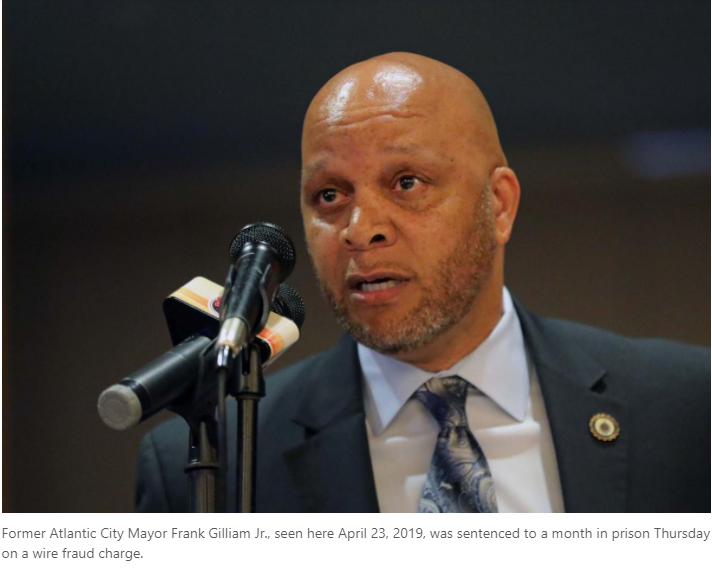
CAMDEN — Former Atlantic City Mayor Frank Gilliam Jr. was sentenced Thursday to 30 days in prison followed by three years’ probation and 200 hours of community service, more than a year after pleading guilty to wire fraud and admitting to taking about $87,000 from a youth sports program.
He also must be on home detention for 11 months following incarceration, when he will be restricted to his residence except for travel for work, education, religious services and medical care. And he must pay $86,790 in restitution to his victims who had donated to the AC Starz basketball program.
He has already started making restitution, said his attorney, Harry H. Rimm.
U.S. District Judge Joseph Rodriguez sentenced Gilliam after a hearing conducted via videoconference. About 20 people spoke as character witnesses, describing how Gilliam has helped, coached and mentored them or their children over the years. They urged the judge not to take Gilliam away from his family and the community by sentencing him to prison time.
More than 200 letters of support for Gilliam were sent to the court, the judge said.
Rodriguez started the hearing saying that, based on offense level and criminal history scores, the recommended sentencing range was 15 to 21 months. After hearing from character witnesses and the U.S. attorney, he said he would lower Gilliam’s scores to a recommended sentence of 8 to 14 months, but then sentenced Gilliam to far less.
Assistant U.S. Attorney Sean Farrell objected to the reduced sentence. The government had been seeking the original recommendation of 15 to 21 months.
Rimm had requested no jail time and a sentence of just probation and 500 hours of community service, with no fine. He said he based his request on Gilliam’s remorse, attempts to repay some of the money even before it was required, history of community service, unique family needs and background of trauma.
Gilliam’s father murdered his mother when Gilliam was 3 years old, and he was raised by his grandmother and aunt in Atlantic City.
From time to time, Gilliam appeared to tear up and lean out of the picture to wipe his eyes, especially when his wife, Shawna, and brother Daniel talked about how he was the rock that kept the family together.
“Your Honor, I stand before this court as a fractured human being,” Gilliam said during his time to speak. He apologized to the court, his family and friends and community, and asked to be allowed to stay at home so he could help his family members.
His wife said Gilliam is the one to wake up their three children and grandchild who live with them, and puts them to bed. He takes them to school and to sports practices, and takes care of his brother who recently had a heart attack.
“Today we are here from results of his trauma,” Shawna said. “I know the person Frank is. I can’t wrap my mind around everything that has happened. At the end of the day, I keep going back to the trauma.”
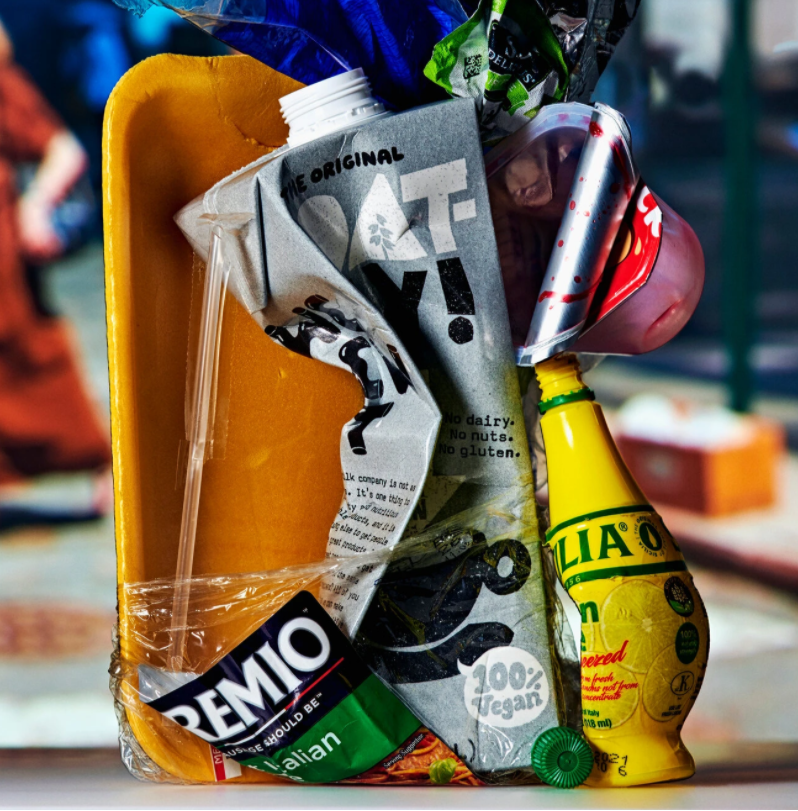
As programs shutter and plastic use rises in the pandemic, a New York bill to get manufacturers to pick up the recycling tab could offer a solution.
By Michael Kimmelman, New York Times
The recycling business in America is in a heap of trouble. The environmental and economic ripple effects on towns and cities are ominous.
China used to take our recyclables but essentially shut its doors in 2018 because the paper and plastics we shipped were too contaminated with garbage. Unsurprisingly, the United States leads the world in per capita municipal solid waste production, and the volume of single-use plastics, rising for decades, has soared since the start of the pandemic.
The closing of the Chinese market has caused America’s recycling business to tank — too much supply, too little demand. In Onondaga County, New York, for example, where collecting, processing and marketing recyclables had long paid for itself, even occasionally earning money, county residents forked over about $2 million in 2020 to cover recycling costs. Dozens of recycling programs have shuttered across the country and Americans are piling more trash than ever into incinerators and landfills, the equivalent of throwing up our collective hands, a trend that disproportionately impacts marginalized neighborhoods and communities of color.
But there’s a way to clean up this mess.
A couple of New York State legislators, Democrats from Long Island, Senator Todd Kaminsky and Assemblyman Steve Englebright, have drafted a recycling bill that, if enacted, would set a conspicuous precedent for other states.
The bill is designed to get money flowing back into New York’s recycling programs, with the prospect of upgrading trash-sorting technology and creating green jobs. It also provides incentives for consumer brand owners to use more recyclable materials and reduce their packaging overall.
For anybody concerned about keeping our communities from opening more sites to burn or bury rubbish and hemorrhaging cash to contend with, say, nonrecyclable plastic food containers, milk jugs and yogurt cups — cash that could go toward building new libraries or hospitals or parks — the legislation is a potential game changer.
And it wouldn’t cost New York taxpayers a dime. The opposite: it would return millions of tax dollars now paying for recycling to municipal coffers.
Instead, the law would get product manufacturers, all but the smallest, to pick up the recycling tab. The prospective legislation, in the works for more than a year, has not only what officials and others I spoke with say are reasonable odds of passing in Albany — it has a good chance of earning support from some of those same companies and their lobbyists.
Why? For certain businesses, it’s the right thing to do and on brand. Nespresso, the upscale coffee maker, recently reached out to Sims Recycling, whose facilities process most of New York City’s recyclables, volunteering to pay for the equipment Sims would need to extract aluminum from its coffee pods, and arranging with the New York City Department of Sanitation for the pods to be included in curbside pickup.
For others in the packaging industry, including some who have opposed such legislation before but now see states like California, Indiana, Massachusetts, Maine and Oregon considering similar bills, getting behind the idea — and therefore a seat at the table to help work out the details — is better than being left out of the process and holding the bag. The lobby group Ameripen, for instance, has lately suggested it is open to the idea.
We’re talking about more than some obscure state recycling bill, in other words. We’re talking about the glimmer of a cultural reset, a shift in how Americans view corporate and individual responsibility.
The New York bill would implement a concept called extended producer responsibility, an incredibly infelicitous recycling term. In essence, E.P.R. compels manufacturers, not consumers, to pay for the end-waste their products produce.
Depending on the environmental impacts of their packaging materials, E.P.R. requires manufacturers to pony up different amounts that municipalities can then use to offset recycling expenses. Right now, companies pretty much do what they wish when it comes to packaging, slapping, say, a metalized plastic label on a recyclable cosmetics bottle and making it nonrecyclable, or swapping plastic foam for pulped-paper egg cartons — with taxpayers having to absorb higher disposal costs.
“We’re reactive,” as Bridget Anderson, deputy commissioner for recycling and sustainability at the New York City Department of Sanitation, put it to me. E.P.R., she said, places the onus on manufacturers rather than consumers and municipalities, rewarding companies that go greener by lowering the fees they would otherwise be required to pay to dispose of their packaging.
If you liked this post you’ll love our daily newsletter, EnviroPolitics. It’s packed with the latest news, commentary and legislative updates from NJ, PA, NY, Delaware…and beyond. Try it free for an entire month.
Make no doubt about it, the COVID-19 pandemic has created plenty of knots for SEPTA to work through.
Behind closed doors, there’s chatter about mitigation strategies and vaccine distribution, talks with its unions about protecting workers and riders, and conversations with lawmakers on its dire financial challenges. As the sixth-largest transit agency in the country faces the future, another big question comes to mind:
What happens to a commuter rail network without any commuters?
With ridership down about 85% from pre-pandemic levels, SEPTA Regional Rail is essentially running empty trains, and it’s clear that many of its suburban riders won’t return to five-day-a-week schedules given the appeal of white-collar telework.
To sustain and grow Regional Rail ridership, transportation experts say, it should try to appeal to those it hasn’t in the past because of pricey fares and less frequent service. That was true before COVID-19 but may be more necessary now than ever, with the identity of Regional Rail turned on its head.
If you liked this post you’ll love our daily newsletter, EnviroPolitics. It’s packed with the latest news, commentary and legislative updates from NJ, PA, NY, Delaware…and beyond. Try it free for an entire month.
The way forward is to blur the line between Regional Rail and SEPTA’s buses, trolleys, and subways, said Megan Smirti Ryerson, associate dean for research at the University of Pennsylvania Stuart Weitzman School of Design. The two groups may be managed by the same authority, but have been seen as separate for decades.
“Now is the time to prioritize the needs of people of color, essential workers, and particularly our communities that have been significantly, economically hurt by the pandemic,” Ryerson said. “Transit is an opportunity to lift people up, to give them access to opportunities that they didn’t have before.”
“There certainly has to be an evolution of Regional Rail and how we use it,” he said. “But again, I can’t stress enough how significant a capital investment that would be.”
But the recommendations aren’t that simple to adopt, said Scott Sauer, assistant general manager of operations.
The authority is losing about $1 million a day as riders avoid public transportation. In response to financial losses from COVID-19, SEPTA has temporarily closed 14 ticket offices across five Regional Rail Lines. Service on the Chestnut Hill West and Cynwyd Lines remain suspended from COVID-19 schedule changes in the spring.
A small solar garden may be on its way to the roof of CubeSmart Self Storage. (Shutterstock)
CHERRY HILL, NJ — Cherry Hill is exploring the possibility of bringing a community solar project to the township under a state pilot program.
The small solar garden would be located on the roof of CubeSmart Self Storage, 1820 Frontage Road, according to Cherry Hill Township Chief of Staff Erin Patterson Gill.
Cherry Hill Council approved a resolution in support of a company applying to bring the program to the township during its meeting Monday night.
“It’s important we act as good stewards for our environment for future generations, and I’m excited to see the potential of this pilot program,” Cherry Hill Mayor Susan Shin Angulo said.
The program allows residents to opt-in to the solar garden and get credits on their energy bills, according to Gill.
Normally, residents would have solar panels on their home that are connected directly to their own panel. Under this program, energy would be generated in the garden and put back into the grid. Residents who opt-in to the program receive credits toward their energy bills.
Sixty homes would be eligible for the program, and 51 percent of those homes would have to meet requirements to be qualified as low- and moderate-income housing.
If you liked this post you’ll love our daily newsletter, EnviroPolitics. It’s packed with the latest news, commentary and legislative updates from New Jersey, Pennsylvania, New York, Delaware…and beyond. Try it free for an entire month.
The United States now has enough installed solar power capacity to power 16.4 million average homes, according to the latest data from the Solar Energy Industries Association.
This year, installations bounced back to 14% higher during the third quarter as compared to the second, when shelter-in-place orders caused a historically low level of solar installations.
On the utility scale, a total of 9.5 GW (dc) came online with the completion of many photovoltaic solar power projects. The utility-scale solar power pipeline stands at 69 GW, according to SEIA’s Solar Market Insight Report.
“Solar accounted for 43% of all new electricity generating capacity added in the U.S. through the third quarter this year, beating out all other generation technologies,” according to the report’s executive summary.
SEIA also ranked the states of the union on how much solar they have build. Click our informative photo gallery to see whether your state made the list.