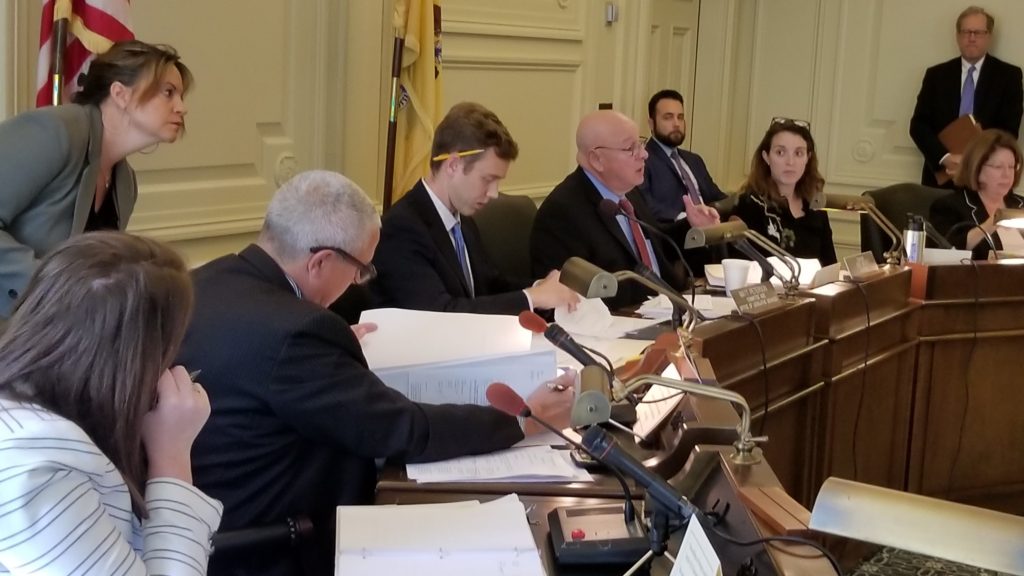
BUCHANAN, N.Y. (AP) — The Nuclear Regulatory Commission’s staff have approved the sale of the Indian Point nuclear power plant north of New York City to a New Jersey company for dismantling, despite petitions from state and local officials to hold public hearings before taking action.
The five-member NRC said Monday that it expects to issue an order next Monday allowing the plant’s owner, Entergy Corp., to transfer its license to Holtec Decommissioning International, which plans to demolish the plant by the end of 2033 at a projected cost of $2.3 billion.
The staff also approved Holtec’s request to use part of a $2.1 billion trust fund set aside for decommissioning to manage spent nuclear fuel stored in dozens of steel-and-concrete canisters that will remain on the site. New York Attorney General Letitia James has called the Holtec deal “very risky,” questioning Holtec’s financing and experience.
Georgia voters recently approved a constitutional amendment directing the state legislature to dedicate tax or fee revenue levied for a specific purpose to only be spent on those given purposes. This could have notable implications by redirecting more funding to hazardous waste clean up, landfill management and recycling and waste reduction programs.
Since 2009, only $56 million of the $154 million collected for the state’s Hazardous Waste Trust Fund has been used for intended purposes. Meanwhile, the Solid Waste Trust Fund collected $73 million and saw $22 million go to intended uses. This is according to Georgia Recycling Economic Development Partners, which backed the amendment.
Some area recycling professionals believe the newly bolstered funding could help prioritize more than $1 million per year for a range of recycling initiatives in a state that was limited by budget cuts years ago. This could include research, a new staff position, educational resources and local program grants.
This is welcome news for regional recycling professionals at a time when funding has been limited, but it still doesn’t mean funding collected will automatically and perpetually be spent only on intended activities. The amendment still requires the state legislature to pass another bill confirming each trust fund will continue. Once passed, the fund (and fees levied to fill it) will expire after 10 years.
If you liked this post you’ll love our daily newsletter, EnviroPolitics.It’s packed with the latest news, commentary and legislative updates from New Jersey, Pennsylvania, New York, Delaware…and beyond. Don’t take our word for it, try it free for an entire month. No obligation.
President-elect Joseph R. Biden Jr’s aggressive approach to climate change includes undoing years of President Trump’s regulatory rollbacks at agencies like the E.P.A.Credit…Christie Hemm Klok for The New York Times
WASHINGTON — President-elect Joseph R. Biden Jr., eager to elevate climate change issues throughout his administration, is already drafting orders to reduce planet-warming pollution and seeking nominees who will embed climate policy not only in environmental agencies but in departments from Defense to Treasury to Transportation.
Top candidates for senior cabinet posts, such as Michèle Flournoy for defense secretary and Lael Brainard for Treasury, have long supported aggressive policies to curb climate change. Mr. Biden’s inner circle routinely asks “is the person climate-ambitious?” of candidates even for lower profile positions like the White House budget and regulatory offices, according to a person advising the transition.
Transition team members have been instructed to identify policies that can improve pollution levels in Black and Latino communities. And one of Mr. Biden’s early executive orders is expected to require that every federal agency, department and program prepare to address climate change.
“We have to re-establish American leadership globally on climate change, and re-establishing global leadership is going to require getting our house in order domestically,” said Ernest Moniz, a former energy secretary and adviser to Mr. Biden’s campaign.
Interviews with more than two dozen advisers and members of Mr. Biden’s transition team reveal an incoming administration acutely aware of the challenges ahead, with a narrowly divided Congress and the outsized expectations that some voters have for action on climate change after four years of regulatory rollbacks and presidential hostility.
“There’s no doubt that Covid is the issue of the moment which has to be addressed right out of the box,” Mr. Moniz said. “But we’re going to see climate addressed right out of the box as well.”
Sen. Charles E. Grassley, the president pro tempore of the Senate, which makes him the third in line of succession to the presidency, revealed Tuesday that he has contracted the coronavirus.
“I’ve tested positive for coronavirus,” he tweeted. “I’ll be following my doctors’ orders/CDC guidelines & continue to quarantine. I’m feeling good + will keep up on my work for the ppl of Iowa from home. I appreciate everyone’s well wishes + prayers &look fwd to resuming my normal schedule soon.”
Grassley (R-Iowa), 87, announced earlier in the day that he would be quarantining after finding out he had been exposed to someone who tested positive for the virus.
The senator was at the Capitol on Monday and spoke on the Senate floor, taking off his mask to do so.
Grassley’s illness follows news late last week that fellow octogenarian Rep. Don Young (R-Alaska,) the dean of the House as the longest-consecutive-serving member, was diagnosed with the coronavirus.
Warning of a predicted increase in hospitalizations and deaths, Philadelphia officials on Monday imposed new rules that ban indoor gatherings, close gyms, museums and other venues, and shut down indoor dining in the city’s first coronavirus clampdown since June.
Without changes, the fall-winter surge could be on track to cause about 1,700 deaths in the city before it ends, as many as occurred in the spring, said Health Commissioner Thomas Farley, citing statistical modeling as he announced the restrictions.
“If we don’t do something to change the trajectory of this epidemic, the hospitals will become full, we’ll have difficulty treating people, and we’ll have between 700 and more than 1,000 deaths just by the end of this year,” Farley said, saying hospitalizations could exceed the first wave.
New Jersey, too, announced tighter restrictions on indoor and outdoor crowds Monday as the number of daily COVID-19 infections continued to soar.
Philadelphia and New Jersey join a handful of cities and states nationwide imposing new restrictions in response to the COVID-19 surge. Pennsylvania’s health secretary, meanwhile, said Monday that commonwealth officials have no plans to go back to “red, yellow, green, or any other type of schema” of coronavirus restrictions.
However, the state Department of Health is evaluating hospital capacity and anticipates “making further announcements this week,” a spokesperson told The Inquirer.
Philadelphia’s new guidance bans private and public indoor gatherings and also prohibits serving food and drink at outdoor gatherings, amounting to a ban on Thanksgiving celebrations in either setting for any group larger than a single household.
New Jersey is limiting all indoor gatherings to 10 people, and officials urged residents to keep Thanksgiving dinners as small as possible. Pennsylvania’s health secretary also asked residents to celebrate within their households.
EnviroPolitics Blog is working to keep you informed about all aspects of the coronavirus — the status of confirmed cases, disease spread, death toll–and also how Americans are coping. Like this story, for instance. If you like what we are doing, Click to receive free EP Blog updates and please tell your friends about us.
Marsha Jackson didn’t go to the mountain. The mountain came to her.
From her home in south Dallas, she watched it grow until it towered at 60 feet tall and spread all the way to her backyard, “a few feet from my bedroom.”
The mountain is human-made — an environmental nightmare of discarded roofing shingles stretching more than a city block. Even though it’s an illegal toxic waste dump on the edge of a neighborhood, it took months of pressure to get city officials to even acknowledge its existence and finally make plans to take it down.
Shingle Mountain didn’t just appear from out of nowhere. It formed just south of a section of Dallas settled by formerly enslaved people, an area that for more than a century has been zoned for everything White citizens didn’t want in their neighborhoods: industrial rail yards, chemical plants, concrete mixing facilities, warehouses that lure up to 100 diesel trucks per day and a massive landfill.
Care to share? Use icons at bottom to share this post on social media
And now, even as Dallas is currently more than 60 percent Latino and African American, with a Black city manager and mayor and a diverse city council, redlining and other historic land-use decisions by White leaders and planners who are long gone continue to have a lasting negative impact.
Jackson spent months fighting against the mountain of shingles in her back yard
When two White business partners looked at the area in 2017, they figured it was an ideal place to start a dump. They redirected truckers hauling shingles to the landfill and charged them a fee to unload their cargo on their vacant land instead. One of the partners set up an illegal recycling operation that ground black shingles into dust, a process that spewed toxins and fine particulate matter into the air around Jackson and about 100 of her neighbors.
With so much industry already in south Dallas, city officials didn’t notice even when it reached the height of a six-story building. Over the course of seven months starting in January 2018, Jackson complained to the city, and no one answered.
Jackson, 62, is certain that particulate matter from the shingles is in the air she and her 12-year-old granddaughter have been breathing for two years. Her voice comes and goes, she says, because “it gets up in my throat.”
Recent studies have shown that minority residents in Dallas breathe more polluted air than White residents and have a significantly shorter life expectancy.
That finding fits with a reality nationwide reflected in other studies. Black and Latino residents in the United States are far more likely than White people to live near landfills, power plants, concrete mixing facilities and other sources of emissions that foul the air.
And they are far more likely than White people to die from exposure to pollution.
“It could not be more crystal clear,” said Chris Dowdy, the vice president for academic affairs at Paul Quinn College, a historically Black university in south Dallas that participated in a study called “Poisoned by Zip Code.” “You can draw a straight line from where Black folks gathered after emancipation to the redlining maps, to where you’re more likely to be poisoned because of zoning, and where people die earlier.”
If you liked this post you’ll love our daily newsletter, EnviroPolitics.It’s packed with the latest news, commentary and legislative updates from New Jersey, Pennsylvania, New York, Delaware…and beyond. Don’t take our word for it, try it free for an entire month. No obligation.