Siemens Gamesa and Siemens Energy have today announced plans to invest €120m ($146m) in a five-year strategy to unlock the potential of harvesting green hydrogen from offshore wind power.
By Smart Energy
The companies are collaborating on a solution to integrate an electrolyzer into an offshore wind turbine as a single synchronized system to directly produce green hydrogen.
Over the next five years, Siemens Gamesa will invest €80m and Siemens Energy €40m in the initiative, with a view to unveiling a full-scale offshore demonstration by 2025/26.
Siemens Gamesa chief executive Andreas Nauen said the joint initiative “brings together brilliant minds and cutting-edge technologies to address the climate crisis”.
“Our wind turbines play a huge role in the decarbonization of the global energy system, and the potential of wind to hydrogen means that we can do this for hard-to-abate industries too.”
Siemens Energy chief executive Christian Bruch said that the two companies “are in a unique position to develop this game-changing solution”.
By Allison Steele, The Philadelphia Inquirer – Atlantic City Press photos
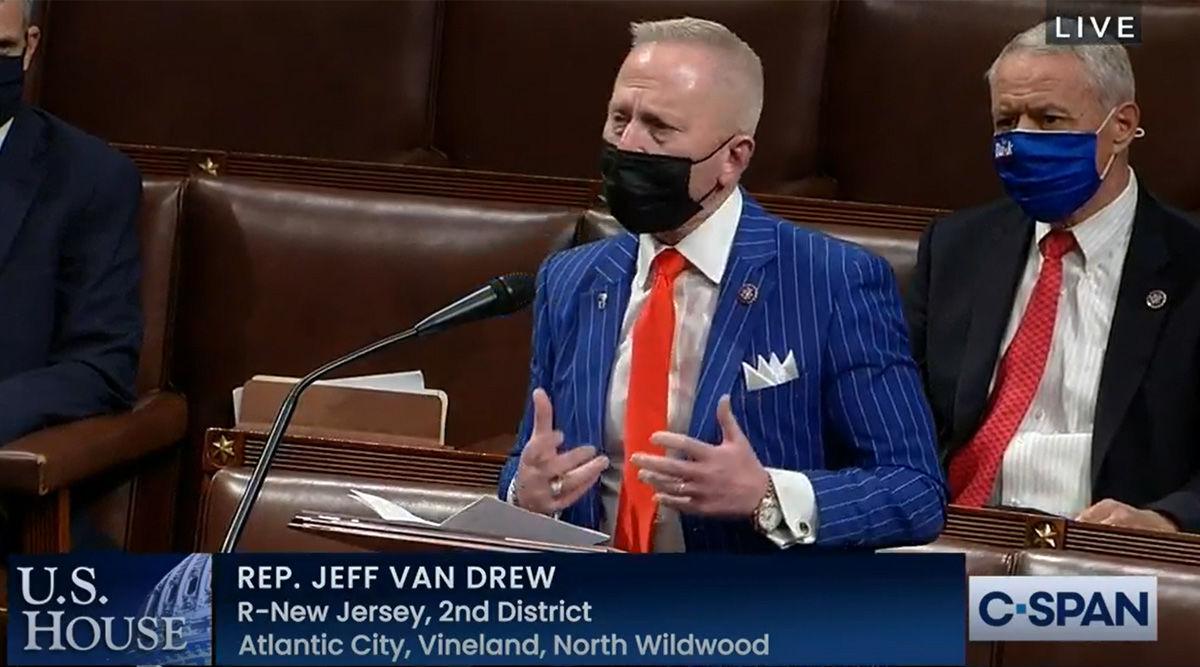
U.S. Rep. Jeff Van Drew, R-2nd, wore a blue suit with white pinstripes, accessorized with a red tie and four-point white pocket square, on Wednesday to deliver a speech against impeaching President Donald Trump. C-Span
Jeff Van Drew dressed for the occasion. As he always does.
The South Jersey Republican congressman knew all eyes would be on him when he took the lectern Wednesday to speak against impeaching President Donald Trump for inciting last week’s deadly Capitol insurrection. But online, Van Drew’s attire might have gotten more attention than his arguments against impeachment.
Van Drew, who won reelection in November, a year after defecting from the Democratic Party and pledging his “undying support” to Trump, donned a blue suit with white pinstripes, accessorized with a red tie and four-point white pocket square.
The look drew savage commentary from Twitter pundits, with some calling it a “zoot suit” and comparing him to an old-timey gangster from a corny movie. One tweet paired an image of Van Drew with a disapproving screenshot of Meryl Streep’s fashion-boss character from The Devil Wears Prada.
“None of the lawsuits against Donald Trump are as bad as this suit,” comedian Samantha Bee wrote.
In an interview Thursday, Van Drew said he began wearing colorful suits years ago as a way to start conversations and bring levity to the sometimes grim work of politics. Wednesday, which saw Trump become the first president ever impeached twice, was no exception.
“So much in politics, especially lately, is negative and sometimes sad,” said Van Drew, R-2nd. “So it’s kind of fun for me to wear suits that are a little bit different. My constituents get a kick out of it, and my colleagues in Congress get a kick out of it.”
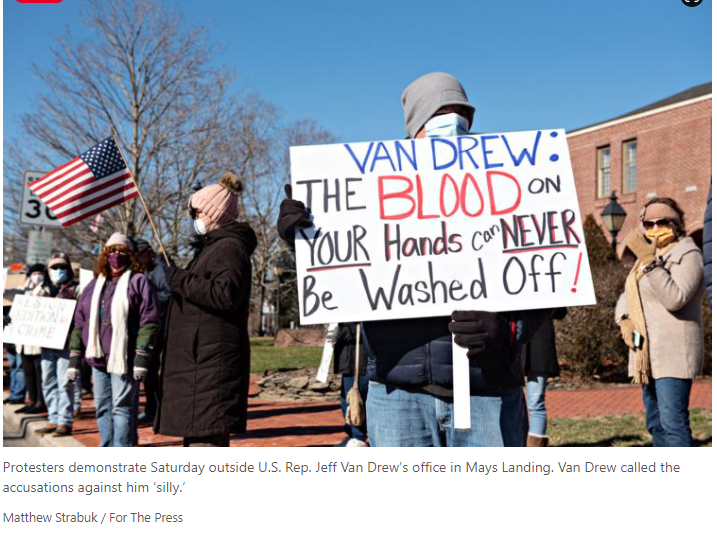
Meanwhile, back in his New Jersey district, some voters are not amused
In an interview Thursday, Van Drew said he began wearing colorful suits years ago as a way to start conversations and bring levity to the sometimes grim work of politics. Wednesday, which saw Trump become the first president ever impeached twice, was no exception.
“So much in politics, especially lately, is negative and sometimes sad,” said Van Drew, R-2nd. “So it’s kind of fun for me to wear suits that are a little bit different. My constituents get a kick out of it, and my colleagues in Congress get a kick out of it.”
The CEO of Clearview AI, a controversial facial recognition app, said the app saw a 26% increase in searches the day after the violence at the Capitol.
The facial recognition app Clearview AI saw an increase in use the day after the Jan. 6 storming of the U.S. Capitol, the New York Times reported. As police departments throughout the United States are helping the FBI identify rioters, some are reportedly using facial recognition technology.
Privacy and ethical technology advocates PublicSource spoke to warned against ramping up surveillance technology following the overwhelmingly white and male insurrection at the Capitol.
Since last summer, Pittsburgh and Allegheny County lawmakers have been grappling with the ‘ifs’ and ‘hows’ of regulating facial recognition. Pittsburgh City Council in September passed a bill regulating the technology. Allegheny County introduced a similar bill in October. It has not yet come up for a vote.
Pittsburgh’s legislation requires city council’s approval of facial recognition and predictive policing technologies but allows, in emergency circumstances, for the public safety director or police chief to temporarily authorize their use without council’s approval.
Councilman Corey O’Connor, who sponsored the city bill, said that the emergency exception was included to account for extreme situations like the Capitol riot. “You’re dealing with, in my opinion, domestic terrorism there,” O’Connor said, as opposed to “robbing a convenience store.”
President Trump called the effort by House Democrats to impeach him for a second time a “witch hunt” and offered no regrets for inciting the mob attack on the Capitol last week as he emerged from seclusion Tuesday to travel to Alamo, Tex., to tour a section of the border wall.
In an unusual move, the Joint Chiefs of Staff, the Pentagon body comprising the military’s top leaders, issued a memo to the entire U.S. military condemning the Capitol riot and confirming Joe Biden will become the 46th commander in chief of the armed forces on Jan. 20.
The House was poised to vote Tuesday on formally calling on Vice President Pence to declare Trump unfit for office and remove him by invoking the 25th Amendment. If Pence doesn’t act, the House was on track to vote on impeachment as soon as Wednesday.
The Joint Chiefs of Staff, the Pentagon body comprising the military’s top leaders, issued a memo to the entire U.S. military on Tuesday condemning the Capitol riot and confirming Biden will become the 46th commander in chief of the armed forces on Jan. 20.
In the memo, the top Pentagon brass characterized the violent riot as “a direct assault on the U.S. Congress, the Capitol building and our Constitutional process,” and said the military remained fully committed to protecting and defending the Constitution “against all enemies foreign and domestic.”
“As service members, we must embody the values and ideals of the nation,” the top brass said. “We support and defend the Constitution. Any act to disrupt the Constitutional process is not only against our traditions, values and oath; it is against the law.”
If you liked this post you’ll love our daily newsletter, EnviroPolitics. It’s packed with the latest news, commentary and legislative updates from NJ, PA, NY, Delaware…and beyond. Try it free for an entire month.
In response to Congressional direction in the National Defense Authorization Act for Fiscal Year 2020, Public Law No: 116-92, on 18 December 2020, the Environmental Protection Agency (EPA) issued “Interim Guidance on the Destruction and Disposal of Perfluoroalkyl and Polyfluoroalkyl Substances and Materials Containing Perfluoroalkyl and Polyfluoroalkyl Substances” (Interim Guidance) as part of its continuing efforts to regulate the large body of perfluoroalkyl and polyfluoroalkyl substances, collectively referred to as “PFAS.” See, Interim Guidance.
EPA issued the Interim Guidance, not as a rulemaking or policy statement, but to provide current scientific information on disposing of or destroying PFAS and PFAS-containing materials.
PFAS are often referred to as the “forever chemicals” because they do not break down easily or quickly in the environment. Thus, they present a unique challenge for disposal/destruction.
The Interim Guidance outlines three methods that may be effective and are currently available for disposal or destruction—landfill disposal, underground injection disposal, and thermal treatment for destruction (incineration)—and discusses the data gaps and challenges for each, along with noting the need for further research into these methods for future guidance. EPA intends for this information to inform the decision making process of those managing the destruction/disposal of this material.
The Interim Guidance identifies six waste streams that commonly contain PFAS:
Aqueous film-forming foam (used in fire suppression);
Soil (directly through land application or spills, or indirectly through particles released from stack emissions, for example) and biosolids (the Interim Guidance refers to the definition in 40 C.F.R. Part 503 for “sewage sludge,” also called “biosolids”);
Textiles, other than consumer goods, treated with PFAS;
Spent filters, membranes, resins, granular carbon, and other waste from water treatment;
Landfill leachate containing PFAS; and
Solid, liquid, or gas waste streams containing PFAS from facilities manufacturing or using PFAS.
Congress specifically identified these six areas in the National Defense Authorization Act for Fiscal Year 2020 as the waste EPA was required to address through issuance of the Interim Guidance. As a result, while EPA recognizes the information could be useful to other PFAS and PFAS-containing materials, the Interim Guidance only covers these six materials.
Controversial papers questioning the seriousness of climate change led by David Legates, a senior official at the National Oceanic and Atmospheric Administration appointed by President Trump, have been published online without White House approval.
The papers, which were published on nongovernment websites, bear the imprint of the Executive Office of the President and state they were copyrighted by the White House Office of Science and Technology Policy (OSTP). But they were disavowed.
“These papers were not created at the direction of The White House Office of Science and Technology Policy nor were they cleared or approved by OSTP leadership,” OSTP spokeswoman Kristina Baum said in an email Monday night.
Reached by phone Tuesday, she added that “OSTP has no intention to formalize these,” and said that they are being dealt with internally.
The papers make controversial and disputed claims about climate science, including that human-caused global warming “involves a large measure of faith” and that computer models are “too small and slow” to produce meaningful climate simulations.
Legates did not reply to requests for comment regarding why the papers were published bearing the seal of the Executive Office of the President when they were not approved.
“These misguided and thoroughly erroneous screeds would not have been issued by any body with a shred of scientific integrity,” wrote John Holdren, who was the OSTP director under President Obama. “It is not enough for an offense of this magnitude to be disavowed by an OSTP spokesperson. It should be forcefully denounced by the OSTP Director, Dr. Kelvin Droegemeier.”