A firefighter stands among the remains of homes burned down in the Rockaway neighborhood of Queens during Hurricane Sandy on October 31, 2012. Credit: Spencer Platt/Getty Images)
Arlene Phipps’ string of bad luck started the night Hurricane Sandy crashed into New York’s coast.
Fierce winds pelted Phipps’ two-story home on New York City’s Rockaway Peninsula that day in 2012, and sea water flooded the first floor, where she ran her daycare center. The damage was so extensive, the city condemned the building, forcing Phipps and her family to live in a hotel for several years.
Then in 2017, Phipps’ husband died unexpectedly, leaving her with a more than $200,000 mortgage that drained her savings as she struggled to reestablish her livelihood.
“I don’t know what I’m going to do—I’m 66 years old, I have a heart condition,” Phipps said. “I’ve had one thing after another.”
Sandy killed 44 people and ultimately cost the city an estimated $19 billion in damages and lost economic activity, officials reported, with over 69,000 residences damaged and thousands of New Yorkers like Phipps forced to find new homes.
By Bill WichertLaw360(August 14, 2020, 9:24 PM EDT)
The dark clouds hovering over the economy have produced an unlikely glimmer of hope for New Jersey’s struggling suburban office market as the health risks posed by the coronavirus encourage businesses to look beyond crowded New York City, experts say.
With workers fearful of taking mass transit and either riding in packed elevators or enduring long waits to reach top floors because of social distancing, companies may explore setting up offices in the Garden State suburbs, potentially boosting a struggling market that has seen tremendous vacancies while employers have gravitated toward urban areas.
“That sort of plain vanilla box in the suburbs, where you can drive to it in your automobile cocoon, get out and then walk up the stairs … sounds a little bit more attractive today than it did just five months ago,” said Rutgers University professor James W. Hughes, former dean of Rutgers’ Edward J. Bloustein School of Planning and Public Policy.
The impact on suburban office complexes amid the pandemic “all depends on how companies are going to be restructured, redefining themselves, how they’re going to set up their work templates and the like going forward,” Hughes said.
Jeffrey L. Heller, New Jersey managing director at commercial real estate services firm Avison Young, cautioned that the idea of the outbreak spurring businesses to head to the state’s suburbs is at this point only a “narrative.” There’s no trend or factual information that “would demonstrate this migration outward,” Heller said.
Yet there are “building blocks out there which would lead into the narrative,” he said.
Among those factors, companies are considering the “hub and spoke” model, which would involve a hub office in New York City, a smaller office in the New Jersey suburbs and similar outposts in other parts of the region, Heller said. Employees would be able to work from home and drop into those small offices on an occasional basis.
“Where there’s smoke, there’s fire. People are talking about the hub and spoke,” Heller said. “That wasn’t discussed previous to COVID. … It’s good to have at least the concept out there and people talking about it.”
Having smaller hubs also could save on time spent commuting between New York City and New Jersey, Hughes said.
“It may be optimal in terms of total productivity if you do have hubs, smaller hubs in New Jersey where people can cluster together once or twice a week on a staggered basis,” Hughes said.
Another positive sign for New Jersey’s suburban office market is the robust amount of residential sales in the suburbs during the pandemic.
Overwhelmed by demand, California’s power grid imposed rotating blackouts, while the coronavirus crisis created a dilemma for those who were unable to stay cool at home.
Heat rising off the pavement created the illusion of puddles near a high-tension power transmission line in the North Hollywood section of Los Angeles. Officials ordered rolling blackouts on Friday night and said continued scorching weather might make more shut-offs necessary. Credit…Richard Vogel/Associated Press
By Nicholas Bogel-Burroughs reports for The New York Times Published Aug. 15, 2020 Updated Aug. 16, 2020, 12:00 p.m.
A heat wave rolling through the Southwest has forced intermittent power shut-offs in California, a state already struggling with wildfires and a recent surge in coronavirus cases, raising fears that the rising temperatures could turn deadly.
Californians used so much electricity to try and stay cool Friday night that the agency that oversees much of the state’s power grid declared an emergency and, for the first time in 19 years, shut off power to hundreds of thousands of customers for several hours to avoid a damaging overload.
There is little relief in sight. High temperatures above 100 degrees Fahrenheit are expected in Los Angeles every day through Friday. In parts of California and Arizona, thermometers are cracking 110. The National Weather Service issued an excessive heat warning for much of the West Coast, including parts of Oregon and Washington State and extending inland to Nevada, Utah and Arizona.
The sweltering heat comes as coronavirus cases are on the rise in California, which reported more than 65,000 new cases and about 950 related deaths over the past week. The health crisis may be deterring residents from gathering at cooling centers or at public places like malls and libraries, making people more susceptible to injury from the heat and driving up electricity demand, as those who have air-conditioners keep them running full blast.
As the coronavirus pandemic devastates the state’s already flailing oil and gas industry, solar energy production is on a trajectory for record growth.
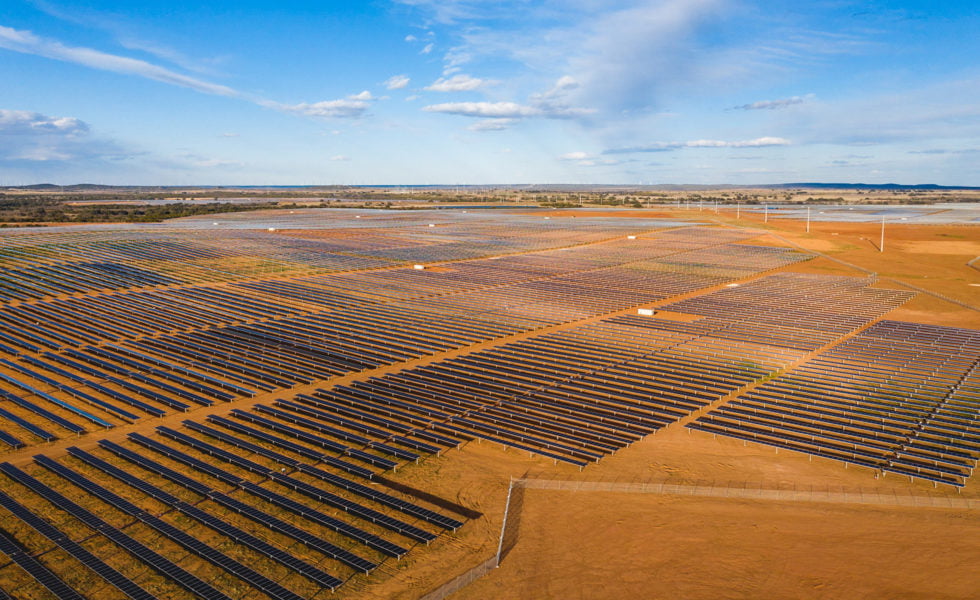
There are now 17 solar facilities in Texas, including 13 that can produce at least 100 megawatts of power, according to the Solar Energy Industries Association. COURTESY DUKE ENERGY
Nancy Nusser reports for The Texas Observer, Aug 13, 2020, 8:00 am CST
On Garland Richards’ ranch in West Central Texas, silicon solar panels spread for two square miles in a shimmering blue expanse that resembles a lake. The Holstein solar farm, which began operating in July in Nolan County, is as long and broad as a small town. The farm has 709,000 solar panels that generate 200 megawatts of electricity, enough to power about 40,000 homes.
Richards leased a tract of his land for the solar farm in hopes that the revenue will pay the taxes on the rest of his property—10,000 acres of cattle country that’s been in his family since the 19th century. “I want to be able to hand the land down to the next generation,” Richards says. “If I can make enough on 1,300 acres to pay the taxes on 10,000 acres, it’s worth it.”
For decades, the 68-year-old former cowboy and his family relied on oil wells that Exxon drilled on the property, which sprawls between San Angelo and Abilene. “But now the oil is depleting, and the market is depleting as well,” he says. In April, oil prices dropped into negative territory for the first time in history as the coronavirus pandemic battered the already beleaguered oil and gas industry. “When oil is negative $47 a barrel, solar looks pretty good,” Richards says.
Garland Richards. COURTESY FORT CHADBOURNE FOUNDATION
With intense sun and vast tracts of empty land that can accommodate the huge scale of major solar farms, West Texas has long been primed for rapid solar development. Texas’ free market approach to electricity production and loose regulation of development encourages big electricity projects of any kind, including solar. With technological innovations, the cost of developing solar farms has dropped about 40 percent in Texas in the last five years, according to the Solar Energy Industries Association (SEIA). And once a solar farm is built, it’s inexpensive to operate compared to gas and coal-fired plants, because its fuel is free.
Federal tax credits have further cut the cost of developing solar farms. Meanwhile, demand for solar electricity has increased as both the public and corporations have embraced it as a means of battling the climate crisis. In response, solar farms have begun to proliferate in West Texas. There are now 17 solar facilities in Texas, including 13 that can produce at least 100 megawatts of power, according to SEIA. “Solar has just started to come on big in the last two to three years,” says Rich Clark, an engineer and board member of Solar Austin, a renewable energy nonprofit in Central Texas. “It’s a huge wave that’s coming.”
The solar surge follows the whirlwind growth of the wind industry in West Texas, where the landscape is dominated by towering propeller-like turbines that stretch for miles. For example, Nolan County, with fewer than 15,000 residents, is home to three of the largest wind farms in the world, and it’s recognized globally as a wind energy powerhouse.
According to the Electric Reliability Council of Texas (ERCOT), the nonprofit that oversees Texas’s electrical grid, the state’s utility-scale solar capacity (the big solar farms that connect to the grid) is expected to increase 150 percent this year to 5,777 megawatts. Next year, installed solar capacity is expected to grow more than 130 percent to 13,449 megawatts, according to ERCOT, which relies on information provided by developers.“They’re looking to purchase solar because it makes economic sense to them. That’s when I feel like you’ve hit that turning point in Texas.”
Momentum has slowed slightly since COVID-19 began spreading across Texas in March, quarantining workers and disrupting supply chains. But unlike the oil and gas industry, the solar industry has not been devastated. “There have been impacts,” says Charlie Hemmeline, executive director of the Texas Solar Power Association. “But big picture, 2020 was slated to be solar’s best year in Texas, and we’re still on track for that to be the case.”
In the last 10 years, Texas had lagged behind other states in terms of solar development, according to SEIA rankings since 2010. But in 2018 and 2019, Texas ranked second in the nation for the amount of solar capacity installed during the year. “It’s really been a sea change for Texas,” says George Hershman, president of California-based Swinerton Renewable Energy, which has eight solar farms in Texas. He says the state “is becoming our biggest solar market.”
Some of Texas’s largest companies, including heavy polluters in the petroleum sector, have begun switching to solar and investing in its development. In 2018, ExxonMobil agreed to use solar and wind power to draw oil from the Permian Basin. Bloomberg reported that it was the biggest renewable deal ever signed by an oil company. In 2019, Facebook agreed to finance construction of the 4,600-acre Prospero solar farm in Andrews County in West Texas. This year, Bank of America announced that it had partnered with the Texas-based Reliant Energy to get electricity from a West Texas solar farm. And Dow Chemical signed an agreement to use a South Texas solar farm to supply its Gulf Coast petrochemical plant, the largest facility of its kind in the western hemisphere.
“When you have these major companies that are not focused on environmental issues deciding to purchase solar, that’s really important,” says Clark, of Solar Austin. “They’re looking to purchase solar because it makes economic sense to them. That’s when I feel like you’ve hit that turning point in Texas.”
If you liked this post you’ll love our daily newsletter, EnviroPolitics.It’s packed with the latest news, commentary and legislative updates from New Jersey, Pennsylvania, New York, Delaware…and beyond. Don’t take our word for it, try it free for an entire month. No obligation.
New Jersey on Saturday reported seven more deaths attributed to the coronavirus and 464 new cases as the rate of transmission ticked up slightly but stayed below a key mark that shows how disease is spreading.
The Garden State’s death toll from COVID-19 now stands at 15,910 — 14,071 confirmed and 1,839 considered probable — in more than five months since the first case was reported March 4.
The state has announced 187,442 positive tests since the outbreak began out of more than 2.4 million tests administered in the state so far.
The governor said Friday that the state’s numbers “look very good,” though there was a bump in new cases this week.
The state on Saturday reported its latest transmission rate was 0.94, a slight increase after holding steady at 0.92 for three consecutive days.
Any number above 1 means each newly infected person is spreading the virus to at least one other person, on average. Anything below 1 means the outbreak is shrinking. The rate had been below 1 for weeks during the strictest parts of New Jersey’s coronavirus lockdowns but had fluctuated above and below 1 in July as the state took more reopening steps.
Saturday marks the 15th straight day New Jersey — an early coronavirus hotspot — has reported fewer than 15 deaths.