AUSTIN, Texas (Legal Newsline) – The Texas Supreme Court has rejected the state Republican Party’s attempt to “commandeer” the George R. Brown Convention Center in Houston this week.
The Texas GOP was supposed to be holding its convention there this week, but Houston Mayor Sylvester Turner announced the cancellation of it, citing coronavirus-related health concerns. The event was supposed to draw about 6,000 people.
The Texas GOP sued Houston, seeking an injunction requiring the center to comply with the contract the sides signed. It sought an order preventing the city from restricting the convention’s events or using COVID-19 as a pretext to cancel the convention.
It said Turner’s reliance on the Force Majeure clause in the contract was a smokescreen to treat the Republicans differently. Turner is a Democrat.
“The Party argues it has constitutional rights to hold a convention and engage in electoral activities, and that is unquestionably true,” the decision says.
“But those rights do not allow it to simply commandeer use of the Center. Houston First’s only duty to allow the Party use of the Center for its convention is under the terms of the parties’ agreement, not a constitution.”
Justice John Devine issued a 10-page dissent, saying he would hold Houston to its word. To invoke the Force Majeure clause, Houston would have had seven days after the “occurrence” to act. It didn’t do so until July 8.
BRICK, NJ — A Brick Township police officer was injured Monday night as a car sped off from a house party that spiraled out of control, drawing more than 400 people to the Baywood section, Brick police said Tuesday.
Darius Edwards, 24, of Brooklyn, has been charged with two counts of assault by auto, eluding, obstruction and possession of marijuana, after he sped off in a white Mercedes and hit Patrolman Joseph Riccio and a detective in the Brick Township Police Department’s Street Crimes Unit, Sgt. Jim Kelly said.
Riccio suffered a knee injury and was treated at the hospital, but the detective was not injured, Kelly said.
Police were called to Atlantic Drive in the Baywood section, at the eastern end of Drum Point Road, about 9:30 p.m. and found more than 400 partygoers, he said. Atlantic Drive and the surrounding streets were blocked with parked vehicles, some of them with people inside, Kelly said.
In addition to loud music, there were reports of littering, public urination and trespassing, and drug use was also evident, he said.
Michelle Cicchillo, the homeowner, told police the party continued to grow until it was beyond her control. She told them she tried to make guests leave “but they were being defiant and refused,” Kelly said.
NORTH BRUNSWICK, NJ — A statewide manhunt is underway for the lone gunman who fired a gun into the foyer of a federal judge’s home Sunday evening in North Brunswick, killing her 20-year-old son and critically injuring her husband, who answered the door.
The judge is U.S. District Judge Esther Salas. Her son, Daniel, 20, was killed and her husband, Mark Anderl, 63, remains in critical condition
The FBI, which is handling the case, said they are looking for one subject “and ask that anyone who thinks they may have relevant information call us at 1-973-792-3001.”
The man was dressed as a FedEx delivery driver, sources told NJ.com, and at 5 p.m. Sunday he arrived at the family’s home on Point of the Woods Drive, which is in the Hidden Lakes development in North Brunswick. Salas’ husband answered the door, was shot multiple times and the couple’s son ran down the stairs to help him; he was shot as well, according to the report.
Salas was in the basement and uninjured in the attack, according to media reports.
“The last thing I heard is that the father ran for the door, Daniel ran down the stairs to get him and I would believe that, that he would run down to help his father,” neighbor Marion Costanza told Patch. She who lives three doors down from the Salas family in Hidden Lakes. “They a very-close knit. That’s the kind of family there were. He wanted to lawyer just like his parents — he was clerking in different law offices.”
Anderl served as an assistant prosecutor in Essex County and now is prominent criminal defense attorney. Salas is the Newark-based federal judge who presided over the convictions of Real Housewives stars Joe and Teresa Giudice. She got her start working as a public defender, said Costanza.
“Daniel was the love of their life, he was their only child, 20 years old,” she said. “Daniel played baseball for St. Joe’s (Catholic high school) in Metuchen and he was a very big baseball fan. Just a good, loving, caring family. I never heard one thing negative about any of them.”
St. Joseph’s released a statement confirming Daniel’s death, saying that he graduated in 2018, writing: “It is with utmost sadness that we inform you that Dan Anderl ’18 was taken from us last night. Dan was a true friend, a proud Falcon, and an overall wonderful human being. He will be truly missed. We pray for Dan’s family and friends during this unbelievably difficult time — please know, we are mourning with you.”
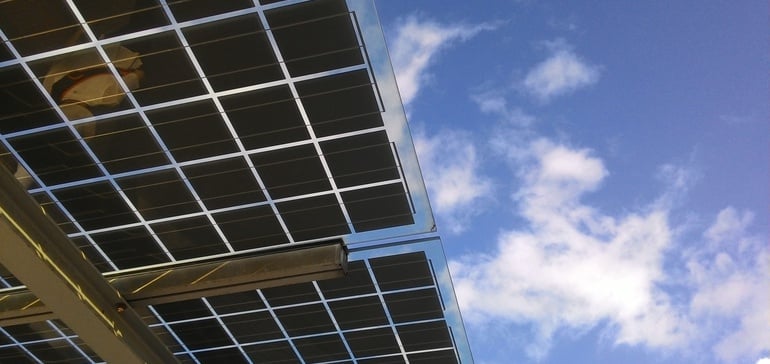
California’s upcoming classification of photovoltaic panels as universal waste is expected to allow for greater efficiencies in handling a material stream that is projected to grow substantially
A long-awaited change to California’s regulations on the handling of solar panel waste is expected to take effect later this year, with implications that could shape the developing U.S. solar panel recycling industry.
A long-awaited change to California’s regulations on the handling of solar panel waste is expected to take effect later this year, with implications that could shape the developing U.S. solar panel recycling industry.In the long run, this move could create a regulatory model that other states can follow, a critical development as the amount of photovoltaic (PV) solar panels that will need to be handled greatly increases in coming decades.
California – which in 2018 produced about two-fifths of all electricity generated by PV solar, according to the U.S. Energy Information Administration (EIA) – attempted to change this regulation seven years ago. But the state’s Office of Administrative Law found the proposed classification was not consistent with federal law, driving the DTSC to seek approval from the U.S. EPA. At the beginning of 2020, the EPA authorized the DTSC’s proposed changes to its hazardous waste program, making it federally enforceable.
“This is the last step in the approval process for regulations to be adopted,” a DTSC spokesperson told Waste Dive. “The PV module universal waste regulation will become effective – earliest expected date of Oct. 1, 2020, – when the regulation package is approved by [the Office of Administrative Law].”
The EPA describes universal waste as subject to a “streamlined” set of standards compared to other types of hazardous waste. The new classification affects how long solar panel waste can be held on site before it is required to be transferred to another facility and reduces requirements for testing for certain hazardous materials.
For example, under the current classification in California, a generator of solar panel waste must move it off-site in under 90 days after generation. But under the universal waste classification, the waste can stay on-site for up to a year, allowing it to be transported to recycling facilities in bulk.
“Some of the advantages of managing PV waste as universal wastes are: reduction of the generator regulatory requirements, accumulation of waste for up to one year, no need for a hazardous manifest, and reduction of the amount of labeling and recordkeeping,” according to a study by researchers from the University of California, Santa Barbara (UCSB).
This new approach comes as the demand for ways to efficiently and economically recycle solar panels is set to jump due to the quickly increasing prominence of solar power in global electricity generation.
Because the boom in solar power is relatively new, the solar panel recycling industry can be considered to be in its “infancy,” according to Andreas Wade, global sustainability director for First Solar, a major solar module manufacturer that also operates several solar panel recycling facilities around the world. “We don’t have that much end-of-life [PV solar] on a global scale because of the long life” of panels, Wade said in an interview with Waste Dive. Panels produced today can last around 30 years.
From 2010 to 2019, net summer solar PV power capacity in the U.S. alone grew from 393 MW to 35,571 MW, according to the EIA. While solar panels currently make up just a small amount of e-scrap, the need for solar panel disposal will rise dramatically over the next few decades as projects being built today reach the end of their useful lives.
“The industry is working with several vendors to establish responsible, comprehensive end-of-life management programs that account for the volume anticipated over the next few decades,” Evelyn Butler, senior director of codes and standards for the Solar Energy Industries Association, said in an email to Waste Dive. “For those modules that are recycled, nearly 100% of the materials used in PV modules are recyclable or reusable.”
About 50 million metric tons of e-scrap are produced annually around the world, according to the United Nations Environment Programme. Amidst the mountains of computer parts, smartphones and various other devices, solar panels may add up to only about 250,000 tons, according to a 2016 scenario projection from a report from the International Renewable Energy Agency.
But based on projections from the UCSB study, looking at the U.S. alone, PV solar waste may rise to 1.3 million metric tons in 2040 and 5.5 million metric tons in 2050. Globally, it could total 80 million metric tons by 2050, according to a recent National Renewable Energy Laboratory report.
In the U.S., solar waste is currently governed by a “patchwork” of state and local regulations that can make recycling “difficult” for solar asset owners, Wade said. For example, solar project owners frequently have to buy a surety bond to guarantee decommissioning costs will be covered, but exactly what disposal measures are required by the bond may differ at the state or even county level. “There is a need to develop a common approach and harmonized methodology for decommissioning cost bonds,” he said.
As the first state to act, California’s regulatory move could be a step toward tying together that patchwork. “Other states may use the California rule as a roadmap for their own regulations,” attorneys from the law firm Baker Botts wrote in a 2019 blog post about the universal waste classification.
In addition, the U.S. EPA looks to the states to see “how their programs have worked in practice and whether their definitions and regulations should be adopted or refined at the federal level,” Baker Botts attorney Martha Thomsen said in an interview with Waste Dive. For example, in 2019, the agency finalized a rule designating aerosol cans as universal waste after several states, including California, took that step. In a statement, the EPA said this final rule “offers a more uniform, nationwide handling system.”
Overall, Europe’s public and private system for handling solar panel waste is “three to four years ahead of the curve” compared to that of the U.S., Wade said. But, he added, “that is beginning to change” due to a number of initiatives
If you liked this post you’ll love our daily newsletter, EnviroPolitics.It’s packed with the latest news, commentary and legislative updates from New Jersey, Pennsylvania, New York, Delaware…and beyond. Don’t take our word for it, try it free for an entire month. No obligation.
[If you thought all the fact-twisters and confrontation-provokers are on the political right, meet Adam Rahuba, a fan of Bernie Sanders, who, in this Washington Post expose, appears quite proud of himself despite the scary potential for increased hatred and violence that his hoaxes can produce — Editor]
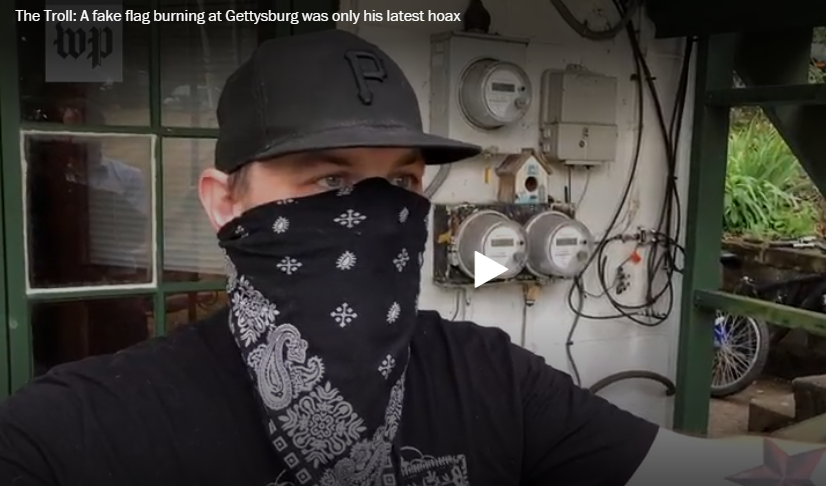
Adam Rahuba, a former concert promoter, works part-time as a food-delivery driver and a DJ. At 38, he spent most of the past year staying on a friend’s couch in a small town north of Pittsburgh.
A Washington Post investigation found that Rahuba is also the anonymous figure behind a number of social media hoaxes — the most recent played out in Gettysburg on Independence Day — that have riled far-right extremists in recent years and repeatedly duped partisan media outlets.
Rahuba once claimed that activists were planning to desecrate a Confederate cemetery in Georgia, The Post found. He seeded rumors of an organized effort to report Trump supporters for supposed child abuse. And he promoted a purported grass-roots campaign to confiscate Americans’ guns.
These false claims circulated widely on social media and on Internet message boards. They were often amplified by right-wing commentators and covered as real news by media outlets such as Breitbart News and the Gateway Pundit.
The hoaxes, outlandish in their details, have spurred fringe groups of conspiracy-minded Americans to action by playing on partisan fears. They have led to highly combustible situations — attracting heavily armed militia members and far-right activists eager to protect values they think are under siege — as well as large mobilizations of police.
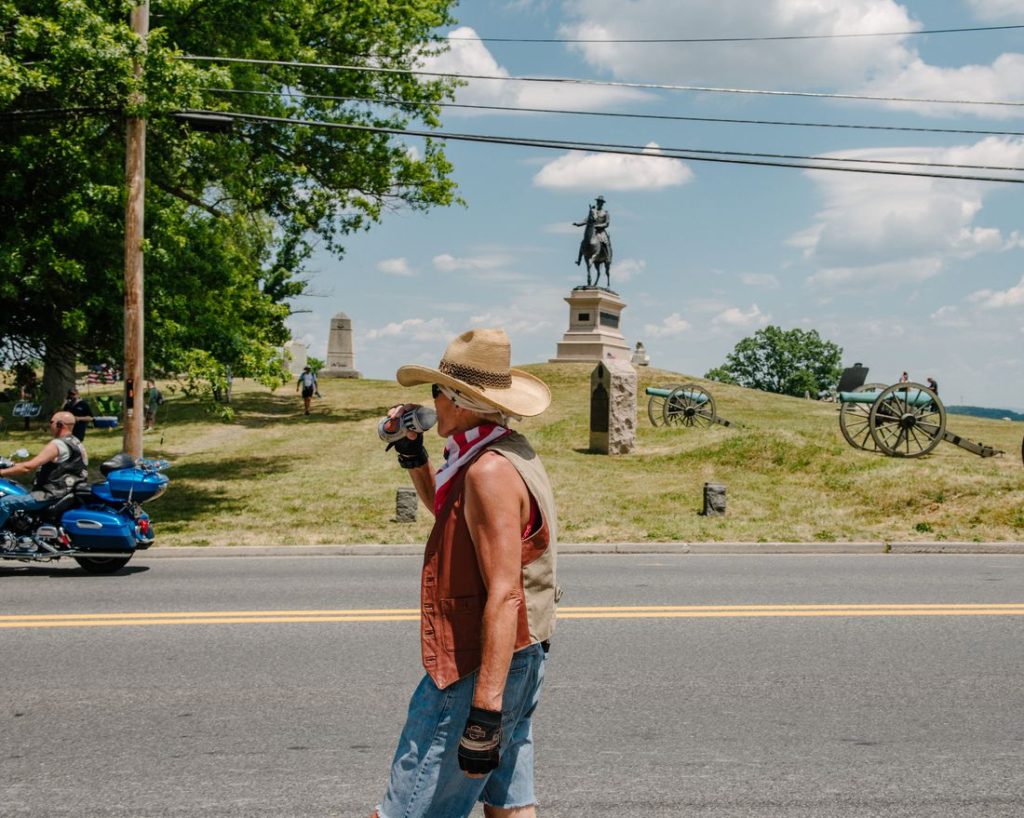
Since the election of President Trump, Rahuba’s hoaxes have focused on leveraging fears of antifa, loosely affiliated activists who oppose fascism and have sometimes embraced property damage and violent protest. His July 4 hoax, a purported burning of the American flag, was billed as an antifa event. Hundreds of counter protesters, including skinheads, flocked to Gettysburg National Military Park to confront the nonexistent flag burners.
A Post examination of Rahuba’s activities provides a rare inside look at the work of a homegrown troll who uses social media to stoke partisan division. It shows that in an era of heightened sensitivity about disinformation campaigns carried out by foreign nations, bad-faith actors with far fewer resources can also manipulate public discourse and affect events in the real world.
A previous Post story raised questions about the identity of the person behind the Gettysburg deception. In response, several of Rahuba’s former acquaintances contacted reporters and said they suspected he operated Left Behind USA, the social media account that promoted the fake event. The Post examined dozens of accounts and websites, some linked to him by name and others used anonymously to promote hoaxes. Similarities in content, design and other details were apparent.
Post reporters located Rahuba last week at a friend’s apartment in Harmony Township, Pa., where he acknowledged in an interview that he was behind 13 aliases and social media accounts that promoted hoaxes as far back as 2013.
“I guess I’m outed,” he said.
Rahuba has a long history of provocative online commentary, including a website he created years ago that made light of 9/11. A self-described democratic socialist and supporter of former presidential candidate Bernie Sanders, Rahuba said he antagonizes far-right extremists mostly for his own amusement.
“I’ve found myself very annoyed with the rise of right-wing populism,” he said. “So I thought I’d do my own thing to push back against them.”



 #BILLYPENNGRAM OF THE DAY