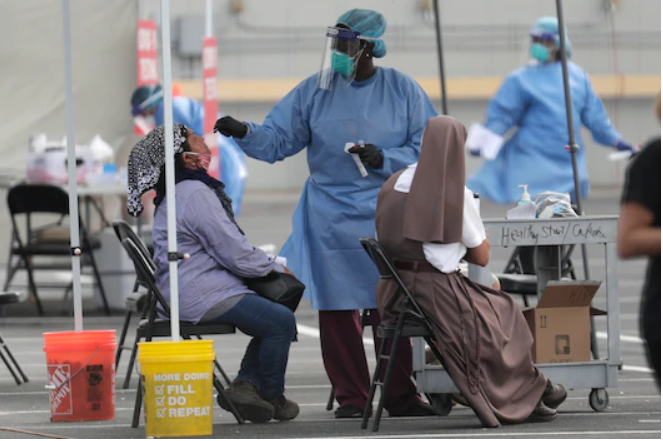
We’ve been in lockdown for a month. Why are so many still testing positive for coronavirus?

By Amanda Hoover and Payton Guion | NJ.com

Stay at home. Slow the spread. Flatten the curve.

These three-word phrases have been thrown at us all for weeks, from electronic traffic message boards, from local leaders and from New Jersey’s governor at his daily briefings on the coronavirus. They’ve become our collective mantras, reminding us we’re not staying cooped up in our houses or apartments just for ourselves, but for our neighbors, for our state.

But now that we’re a month in, what do we have to show for it? Coronavirus cases continue to increase and the death toll climbs higher still. Murphy announced 2,625 more confirmed cases on Wednesday, bringing the total in New Jersey to 71,030. Another 351 people have died from complications related to the virus. In total, 3,156 people in the state have died from it.

“We have asked you to make tremendous sacrifices with us in this fight,” Gov. Phil Murphy said at his daily news conference. “I know some of them seem like nuisances, but every step we have taken has been made out of sheer necessity. I promise you that.”

The news remains grim and could get worse yet. The state’s estimate of reaching peak hospitalization from the coronavirus last weekend didn’t come to pass, and now that estimate has been pushed back another 10 days, to April 25.

On March 15, New Jersey had 98 confirmed coronavirus cases. On April 15, that number stood at 71,030, a scary figure that likely is much lower than reality because New Jersey isn’t conducting widespread testing.

So why, after a month of isolation, are the numbers of confirmed cases and deaths continuing to rise?

Experts say it’s in part because the virus has a lengthy incubation period, but it also comes down to human error. Officials have urged those exposed to a coronavirus case to self-isolate for 14 days, but not everyone, particularly carriers without symptoms, took that advice when the state first instituted measures four weeks ago.

“Adherence to that order has been varied. It continues to be varied,” said Henry Raymond, a biostatistics and epidemiology professor at Rutgers School of Public Health. “We don’t necessarily know how long the incubation period is. Take two weeks off the executive order, and that might be really more of the start date for social distancing.”

Policies have gotten stricter over that time, too, now including the closures of public spaces like parks. And masks in grocery stores only became a mandate in recent days.

Read the full story

EnviroPolitics Blog is working to keep you informed about all aspects of the coronavirus — the status of confirmed cases, disease spread, death toll–and also how Americans are coping. Like this story, for instance. If you like what we are doing, Click to receive free EP Blog updates and please tell your friends.

We’ve been in lockdown for a month. Why are so many still testing positive for coronavirus? Read More »

Covid-19 concerns halt Sherwin-Williams Superfund cleanup in Camden County, NJ

Silent smokestacks from the original factory at the former Lucas Paint Works are a familiar part of the Gibbsboro skyline, but the tranquil scene belies the ground and water contamination that are now being addressed in a federal  Superfund cleanup with Sherwin-Williams, the successor to Lucas.
Silent smokestacks from the original factory at the former Lucas Paint Works are a familiar part of the Gibbsboro skyline, but the tranquil scene belies the ground and water contamination that are now being addressed in a federal Superfund cleanup with Sherwin-Williams, the successor to Lucas. (Photo: Courier-Post File Photo)

By Carol Comegno, Cherry Hill Courier-Post

Silent smokestacks from the original factory at the former Lucas Paint Works are a familiar part of the Gibbsboro skyline, but the tranquil scene belies the ground and water contamination that are now being addressed in a federal Superfund cleanup with Sherwin-Williams, the successor to Lucas. (Photo: Courier-Post File Photo)

GIBBSBORO — Citing the ongoing spread of COVID-19, Sherwin-Williams has halted the cleanup of numerous Superfund sites in Gibbsboro and Voorhees for the safety of project workers and the surrounding communities.

The paint corporation announced a temporary halt to its continuing investigations and remediation of those sites in an announcement Tuesday; the company said is was acting in response to a U.S. Environmental Protection Agency recommendation.

“This pause in activities is for a minimum period of two weeks, during which EPA will monitor the situation and provide further guidance,” Sherwin-Williams said in a news release.

“During this pause in field activities, the Sherwin-Williams technical team will continue to work on remediation designs and other tasks remotely and will work diligently to keep the overall project moving forward despite these changes in the schedule.” 

This content is being provided for free as a public service to our readers during the coronavirus outbreak. Help support local journalism with a Courier-Post subscription.

For decades, arsenic and lead penetrated and contaminated the soil at multiple sites from the manufacturing, dumping and burning of pain and solvents that began under Lucas Paint Works.

Lucas later was purchased by Sherwin-Williams and closed in 1977.

Read the full story

Covid-19 concerns halt Sherwin-Williams Superfund cleanup in Camden County, NJ Read More »

NJ Spotlight provides today’s coronavirus update

  • New Jersey reported an overnight increase of 2,625 positive test results, bringing the state’s total number of positive cases to 71,030.
    • As of 10 p.m. last night, 8,270 residents have been hospitalized, a 3% increase from the day before.
    • Of those, 1,980 residents have been listed in critical/intensive care and 1,705 patients are on ventilators.
       
  • The state reported 709 COVID-19 patients discharged from hospitals in the last 24 hours, and a total of 6,300 COVID patients discharged in New Jersey since the start of the pandemic. It was the state’s first report of a discharge total.
     
  • The state reported another 351 deaths, bringing the total number of COVID-19 related fatalities to 3,156.
    • Race:
      • 52% White
      • 22% African American/Black
      • 16% Hispanic/LatinX
      • 6% Asian
      • 4% other
    • Underlying health condition:
      • 60% Cardiovascular disease
      • 37% Diabetes
      • 30% Chronic disease
      • 20% Chronic lung
      • 15% Neurological condition
      • 11% Cancer
         
  • With nearly all labs in the state reporting, 58,976 tested positive out of 131,967 tests performed, for an overall positivity rate of 44.69%.
     
  • Currently there are 358 long-term care facilities reporting individuals with COVID-19.
    • 6,815 cases have been reported by long-term care facilities.
       
  • At the state’s three veterans facilities, 160 of approximately 800 residents have been tested positive, and there have been 45 deaths, state officials said.
     
  • At the state’s psychiatric facilities, 97 of approximately 1,400 residents have tested positive, and there have been six deaths.

Related coronavirus news from NJ Spotlight
Track Cases of COVID-19 County by County in New Jersey

Don’t miss news stories like these Click for free EP Blog updates

NJ Spotlight provides today’s coronavirus update Read More »

A reminder from the EPA on PFAS rule comments

OPPT Update Header

Comment Period on Proposed PFAS Rule Closes April 17, 2020

This is a reminder that on Friday, April 17, 2020, the 45-day comment period closes for the proposed significant new use rule on certain long-chain PFAS used as surface coatings. Please submit your comments at http://www.regulations.gov/ under docket ID EPA-HQ-OPPT-2013-0225. This proposed rule would ensure that any new uses are reviewed by EPA before any products containing these chemicals could be imported into the United States again.

As part of the agency’s review, EPA has the authority to place restrictions on the import of products containing these chemicals as part of a surface coating.The National Defense Authorization Act of Fiscal Year 2020 requires EPA to finalize this rule by June 22, 2020. To learn more about this rule, visit: https://www.epa.gov/assessing-and-managing-chemicals-under-tsca/risk-management-and-polyfluoroalkyl-substances-pfass For more information on EPA’s actions to address PFAS, visit: https://www.epa.gov/pfas

Background
In February 2020, EPA proposed regulations on imported products that contain certain persistent long-chain PFAS chemicals that are used as surface coatings. This proposal supplements a previously proposed rule on PFAS imports by clarifying the categories of products that would be covered under the significant new use rule. The Toxic Substances Control Act (TSCA) provides EPA the authority to regulate products that are imported as an article, meaning goods that are imported as a component of another product. By clarifying the previously proposed rule, the agency is aligning its regulations with the Lautenberg Act amendments to TSCA.

Try our daily newsletter, EnviroPolitics, free for a full month!

A reminder from the EPA on PFAS rule comments Read More »

Energy storage deals with impacts from COVID-19

Rod Walton, Clarion Energy Content Director
Renewable Energy World

A quarter of energy storage companies expect to reduce their workforces due to the impact of the COVID-19 pandemic, while more than half are anticipating a loss in revenues, according to a new survey from the U.S. Energy Storage Association.

The ESA study queried 101 representatives from the sector. Most of the companies plan and hope to retain their employees while waiting out the virus which has killed more than 22,000 Americans so far this year, but they also confirm that the resulting work stoppage will cut into revenues and projects.

Sixty-three percent of the ESA survey respondents said they expected a decrease in revenues. A third went as far as to predict it would be a 20-percent drop or deeper.

Three-fourths of those energy storage respondents did not expect to reduce employment, but most of the rest admitted that reductions of up to 20 percent were possible.

“The COVID-19 pandemic has impacted the energy storage industry tremendously. While we still anticipate year-over-year growth, it is clear our industry is suffering with immediate and significant risks of workforce reductions and economic damage,” remarked Kelly Speakes-Backman, CEO of ESA.

“These delays upend grid reliability and resilience efforts, just as we enter fire and hurricane season, and as states, towns, and utilities are beginning to incorporate energy storage systems as backup power to prevent power system disruptions for critical healthcare facilities. As such, ESA is actively seeking immediate relief from Congress and the Administration to relieve the financial stresses on our members and the industry, which represents more than 60,000 people, caused by the virus.”  

Read the full story

Don’t miss stories like this Click for free EP updates

Energy storage deals with impacts from COVID-19 Read More »

Coronavirus deaths jump to 2,805 in N.J. with 68,584 total cases.

Gov. Phil Murphy stressed the sharp increase in cases and deaths today may be catching up on reporting cases from Easter weekend.

By Brent Johnson | NJ Advance Media for NJ.com
Updated 3:51 PM; Today

Despite improving projections, the coronavirus outbreak in New Jersey continues to escalate, with state officials Tuesday reporting at least 68,824 total cases and 2,805 total deaths, marking an increase of 4,059 positive tests and 365 new fatalities in the last 24 hours.

The latest death toll marks the largest one-day increase in fatalities in the Garden State since the outbreak started in early March.

Gov. Phil Murphy repeated Tuesday there’s evidence that the rate of increase is slowing and that social distancing efforts including a near-lockdown stay-at-home order have begun to take hold. But the state has yet to hit its plateau.

Murphy stressed the sharp increase in cases and deaths Tuesday may be catching up on reporting cases from Easter weekend.

New Jersey has 128,604 residents who have been tested for coronavirus and 70,950 have tested negative, according to state Department of Health’s website. The positivity rate is about 45%, state Health Commissioner Judith Persichilli said.

Murphy warned again of a possible “boomerang” of the virus if social distancing is lax.

“Let’s only go through this once,” the governor said during his daily coronavirus press briefing in Trenton. “We have to keep our foot on the gas. We have to stay at home.”

As of 10:30 p.m. Monday, 8,185 people in New Jersey were hospitalized with COVID-19 or under investigation for it. Of those, 2,051 were in critical care and 1,626 were in ventilators.

That’s a 4% increase in hospitalizations from the day before, Persichilli said.

Between 10 p.m. Sunday and 10 p.m. Monday, 514 patients who were hospitalized with he virus were discharged.

Of the new deaths reported, 27 were residents at longterm care facilities, officials said. The state’s has confirmed coronavirus cases at 342 of 375 longterm care facilities for a total of 5,945 residents.

The partial county-by-county breakdown of cases includes:

  • Bergen County: 10,426 with 550 deaths
  • Hudson County: 8,242 with 277 deaths
  • Essex County: 8,212 with 535 deaths
  • Union County: 7,265 with 238 deaths
  • Passaic County: 6,438 with 156 deaths
  • Middlesex County: 6,313 with 216 deaths
  • Monmouth County: 4,003 with 145 deaths
  • Ocean County: 3,833 with 149 deaths
  • Morris County: 3,424 with 192 deaths
  • Somerset County: 1,911 with 91 Deaths
  • Mercer County: 1,731 with 71 deaths
  • Camden County: 1,477 with 41 deaths
  • Burlington County: 1,207 with 28 deaths
  • Gloucester County: 587 with 11 deaths
  • Sussex County: 535 with 39 deaths
  • Warren County: 442 with 25 deaths
  • Hunterdon County: 349 with 11 deaths
  • Atlantic County: 284 with 11 deaths
  • Cumberland County: 201 with 3 deaths
  • Cape May County: 169 with 10 deaths
  • Salem County: 73 with 4 deaths

Another 1,702 cases and two deaths are still pending investigation to determine where the person resides.

The breakdown of ethnicity among the new deaths:

  • 51.5% white
  • 22.2% black
  • 15.6% Hispanic
  • 5.5% Asian
  • 3.5% other

New Jersey, a state of 9 million residents, continues to have the second-most number of cases and deaths of COVID-19 among U.S. states. Only New York has more of each.

Try our daily newsletter, EnviroPolitics, free for a full month!

Coronavirus deaths jump to 2,805 in N.J. with 68,584 total cases. Read More »