“As the voice of the recycling industry, having a proactive presence in government affairs at the federal, state and local, and international levels is critical for ISRI,” said ISRI President Robin Wiener. “Since starting at ISRI, Adina has demonstrated extraordinary commitment to the industry, knowledge of government and complex policy issues, and the strategic foresight to get things accomplished on behalf of ISRI’s membership. She is no doubt the right choice to lead our advocacy efforts as we move forward at a key moment for the industry.”
Adler previously served in the role of Assistant Vice President of International Affairs. She joined ISRI in December of 2016 to represent the industry in international negotiations and to advocate trade-expanding opportunities for the scrap recycling industry. Prior to ISRI, Adina was Director of Global Government Affairs for Alcoa and Arconic and International Government Relations Advisor for Shell Oil Company – both positions based in Washington – to advise business leaders on trends in U.S. trade and international policy. Adina also served in the U.S. Government as Director for South Asia in the Office of the United States Trade Representative (USTR) and International Trade Specialist at the U.S. Department of Commerce, both assignments responsible for U.S. commercial and trade policy with the countries of South Asia. Adina has a B.A. from The George Washington University and M.A. from The Johns Hopkins University School of Advanced International Studies (SAIS) and has lived in and traveled to more than 75 countries for business and pleasure.
“I am excited to oversee a department of exceptional advocates for our members in front of policymakers and regulators at the federal, state and local, and international levels providing timely economic data and analysis, and expanding ISRI’s role in the world of sustainability, “ said Adina Renee Adler. “This includes enhancing the integration of paper and plastic recycling within the design and manufacturing supply chain. I look forward to building on the legacy left by Mark Reiter.”
The role of vice president of advocacy replaces the position of vice president of government relations, previously held by the late Mark Reiter, who passed away in January of this year after a career of nearly 30 years at ISRI
Small business owners and representatives hit the New Jersey Senate Fiscal Recovery Strategists Committee with some daunting numbers during a Zoom conference Tuesday, which the lawmakers hosted to speak publicly with businesses affected by COVID-19 shutdowns.
New car sales have dropped 70 to 80 percent for April year over year as a result of New Jersey’s stay at home order, and May 2020 sales are expected to be just slightly north of half of May 2019’s, but New Jersey Coalition of Automotive Retailers Jim Appleton told lawmakers Tuesday that this has been a time of lessons learned.
“If there is a silver lining here, it’s that consumers and retailers are becoming more comfortable with online shopping with cars,” Appleton said during the Zoom hearing hosted by Sen. Paul Sarlo, D-36th District.
Market research shows that older consumers, the most acquisitive and reliable consumers in the car sales world, according to Appleton, “stayed away in droves in the lockdown.” But now, car dealerships are sharpening their online services, and issues have been unearthed within the Motor Vehicle Commission’s online system that can now be addressed.
John Holub, president of the New Jersey Retail Merchants Association, told the committee that retail sales are down across almost the entire board: Health stores are down 10 percent, general merchandise stores are down 13 percent; sporting goods store sales are down 48 percent; electronics, 64 percent; upholstery and appliance, 66 percent; and most dramatically, clothing and accessory store sales are down 89 percent.
“It’s been a very uneven impact,” Holub said. “Obviously certain retail categories have been decimated [while] others have been okay, if you can even say that. It’s critically important that we reopen our main streets.”
Small business owners and association representatives took turns explaining the economic impact on their industries to the lawmakers on the Zoom conference as lawmakers asked them questions.
Obviously certain retail categories have been decimated [while] others have been okay, if you can even say that. It’s critically important that we reopen our main streets. – John Holub, president, New Jersey Retail Merchants Association
The committee, comprised of Sens. Troy Singleton, D-7th District; Steve Oroho, R-24th District; and President Pro Tempore M. Teresa Ruiz, in addition to Sarlo, is tasked with developing a plan to reopen New Jersey’s economy safely as the COVID-19 crisis progresses toward an end.
According to a recent survey by the New Jersey Business & Industry Association, 71 percent of businesses say they can openly safely and follow Centers for Disease Control and Prevention guidelines.
“We need to know if we are within 10 percent of the goal post or are we still 50 percent out?” said NJBIA President Michele Siekerka. “No business can sit and do a business plan when you don’t know when you are opening and how you’re opening.”
For Frank Rizzieri, owner of Rizzieri Spa and Salon, which has three salons and a beauty school in South Jersey and locations in other states, acquiring PPE has meant going to multiple suppliers to get all that’s necessary.
“We started back in March to acquire basic PPE products, and what we’re finding is you can’t go to one supplier. You get some masks from one, some from another, some hand sanitizer,” Rizzieri said. “We’ve been able to acquire a good bit of PPE, but our suppliers aren’t able to keep adequate inventory…”
The cost of PPE per client is $5.40, Rizzieri said. Masks used to be 10 cents apiece, and now they’re $1.25 each.
Singleton noted that while Rizzieri might not have had issues getting PPE, smaller players might. This is where the state can step in, he explained, and be able to source and provide the PPE to the businesses.
He also posed a question to Appleton about the possibility of testing car dealership employees, to which Appleton shared the great expense it could be: “We don’t know what the protocols will be. We don’t know which test, and at what expense …i t could cost an average size dealer as much as $3,000 a day to do this kind of testing, and I’m not sure that’s economically feasible.”
Small businesses need guidance from government and timelines to work with, said Chamber of Commerce Southern New Jersey President Christina Renna.
Using shore restaurants as an example, Renna mentioned how a boardwalk pizza place that can’t have guests inside doesn’t know whether or not it can allow people to sit on the picnic tables in front of the restaurant.
Timelines are crucial too, she said, as small retailers can’t “flip the switch over night” and go back to business as usual. They need to restock their shelves, need time to train people, and need time to prepare.
If you liked this post you’ll love our daily newsletter, EnviroPolitics.It’s packed with the latest news, commentary and legislative updates from New Jersey, Pennsylvania, New York, Delaware…and beyond. Don’t take our word for it, try it free for an entire month. No obligation.
TRENTON – The New Jersey Senate’s Community and Urban Affairs Committee today endorsed a bill sponsored by Senate President Steve Sweeney and Senate Republican Budget Officer Steve Oroho that would establish an electronic construction procurement process for state public works construction projects.
The process would use computer technology and the Internet for the advertising and submission of public bids to determine the lowest responsible bidder.
“Over the past decade, states across the country have taken steps to take advantage of advances in technology and create governmental efficiencies, including electronic bidding,” said Senator Sweeney (D-Gloucester / Salem / Cumberland). “The COVID shutdown underscores the value of electronic bidding but it is a process that should be available at all times. It can result in a more efficient process and produce cost savings.”
“This is part of our ongoing effort to streamline government and make it more efficient and cost effective,” said Senator Oroho. “We’ve all learned during the coronavirus lockdown how much important work can be done remotely through technology. It’s important that our procurement laws not deter these capabilities from being employed wherever feasible by the state, local governments, and our school districts and colleges.”
Under the bill,S2085, state contracting units, including state colleges, would be required to use an electronic construction procurement process for public works contracts whenever the project requires public advertisement.
The State Treasurer would promulgate regulations to effectuate the electronic procurement of public works construction by the state.
This bill would expand current law that authorizes local units of government to use electronic procurement technologies by making it a requirement of state contracting entities.
If you liked this post you’ll love our daily newsletter, EnviroPolitics.It’s packed with the latest news, commentary and legislative updates from New Jersey, Pennsylvania, New York, Delaware…and beyond. Don’t take our word for it, try it free for an entire month. No obligation.
On Tuesday, the state reported a total of 155,764 cases of COVID-19, the disease caused by the novel coronavirus. That represents an increase of less than 1/2% over Monday, although the number of cases and deaths reported are likely lagging due to the long weekend.
Switch between map layers using the check box in the upper left corner. Click on a county for more details. Scroll down to find more county data and to see the change in cases by week. Source: NJ Spotlight analysis of NJ Department of Health data.
Deaths attributed to COVID-19 rose by less than 100 for the fourth day in a row, to 11,191. Again, delays in reporting deaths over the weekend may have lead to temporary undercounts.
The rate of New Jerseyans testing positive for the virus is approaching 18 in 1,000. Hudson County has 18,096 cases, the most of any county. Essex continues to have the greatest number of deaths, 1,605, followed closely by Bergen County. Among large municipalities at last update, the infection rate in Paterson (Passaic County) remains the highest, with more than 46 positive cases per 1,000 people.
If you liked this post you’ll love our daily newsletter, EnviroPolitics.It’s packed with the latest news, commentary and legislative updates from New Jersey, Pennsylvania, New York, Delaware…and beyond. Don’t take our word for it, try it free for an entire month. No obligation.
By Debra Adams Simmons, HISTORY Executive Editor, National Geographic
The art of letter writing, mailing pastel-colored birthday cards with floral stickers, and sending packages that need to be handled with care: Those are traditions still held dear by my mother, mother-in-law, and other seniors in my life. These traditions are directly tied to the belief that the post office will get each special delivery to the intended recipient in short order.
This quaint way of life and the deeply embedded trust that has endured for 250 years of the United States Postal Service, and which we too often take for granted, is in a fight for its life. Decreasing revenue in a dynamic marketplace has some congressional leaders speculating that the service could be out of business by June.
This is not new. The USPS has had a tumultuous and colorful existence, including 100 years ago when people would put stamps on their children and send them through the mail to their destination, Boyce Upholt writes for NatGeo. (Pictured above, a woman who was shipped air mail in an early plane’s cargo.) In forming the Post Office, the founders had wanted a service that connected the scattered populous of the new United States. For two centuries, the agency would drive the expansion of roads and transit, strengthen the nation’s connections with its rural communities, and brave all conditions to bring packages to citizens’ front doors, Uphold writes.
By 1860, these roads linked 28,000 post offices, where people sometimes waited in long lines to pick up their mail in an era before home delivery. In the 1990s the Postal Service was turning a profit. But since 2007, first class mail has dropped 34 percent. It’s greatest source of revenue is delivering packages fueled by an ever-expanding online shopping addiction.
For our family, the Postal Service is like a trusted member. Just last week, I felt guilty when the mail delivery woman had to lug three giant boxes of groceries packaged in cardboard from her truck to my front door. Not that long ago the Postal Service lost a quilt that was mailed to me, made of fabrics from important life moments. Their apology wasn’t particularly emphatic and I was really upset. I vowed to use other services to get packages where they need to go.
Not long thereafter I came around, acknowledging the important role of the Postal Service in keeping us connected. I hope we don’t learn this lesson after it’s too late to do anything about it.
I hope everybody is having a happy (and safe) Memorial Day weekend. The Philly area is still under a stay-at-home order, but there’s finally some movement on the restrictions. Gov. Tom Wolf has announced that counties in Southeastern Pennsylvania can begin to reopen June 5.
And, we talked to Inquirer columnist Helen Ubiñas about the reunion between a Philly police officer and a boy he saved years ago.
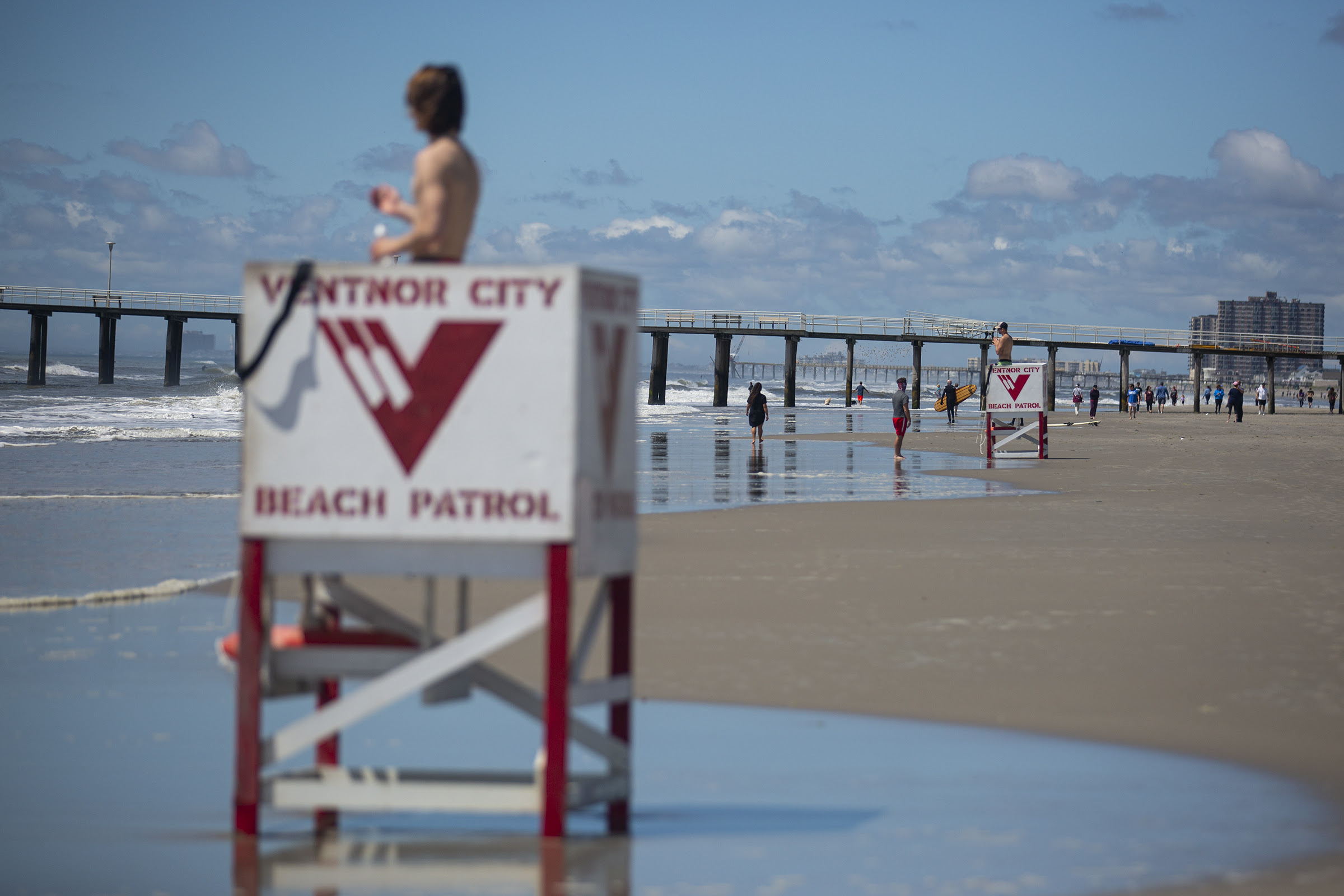
TYGER WILLIAMS / Staff Photographer Lifeguards stand watch at Ventnor City Beach on Saturday, the first day they were back at work since the pandemic started.
As lockdowns continue and protests keep appearing, some medical ethicists, including one from Penn Medicine, are considering the implications. They argued in a provocative essay that protesters should voluntarily sign documents saying that they won’t accept medical care if they get sick.