I hope everybody is having a happy (and safe) Memorial Day weekend. The Philly area is still under a stay-at-home order, but there’s finally some movement on the restrictions. Gov. Tom Wolf has announced that counties in Southeastern Pennsylvania can begin to reopen June 5.
And, we talked to Inquirer columnist Helen Ubiñas about the reunion between a Philly police officer and a boy he saved years ago.
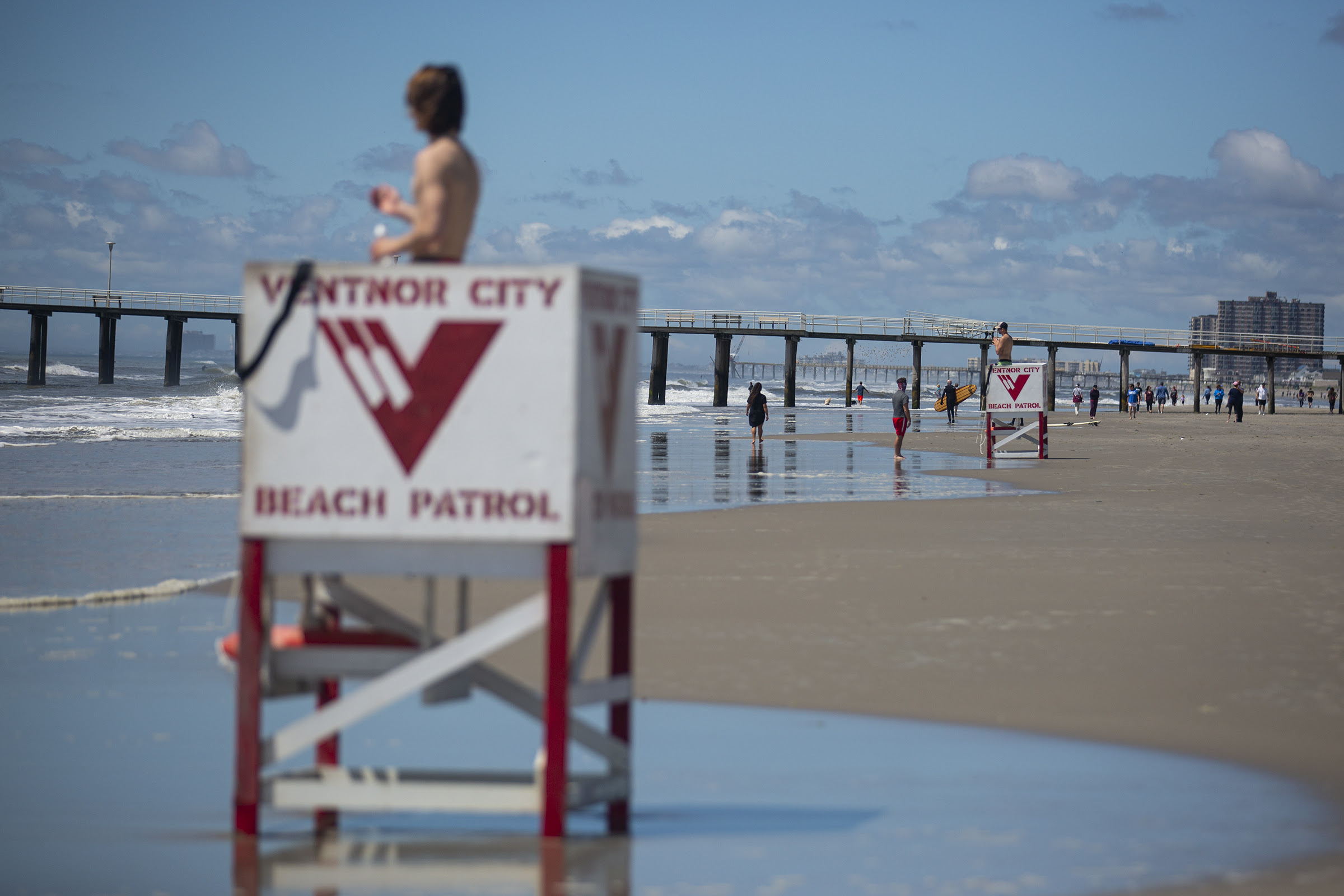
TYGER WILLIAMS / Staff Photographer Lifeguards stand watch at Ventnor City Beach on Saturday, the first day they were back at work since the pandemic started.
As lockdowns continue and protests keep appearing, some medical ethicists, including one from Penn Medicine, are considering the implications. They argued in a provocative essay that protesters should voluntarily sign documents saying that they won’t accept medical care if they get sick.
Kansas National Guard members wait for cars during a lull in people seeking tests at a coronavirus testing site May 20 in Dodge City, Kan. (Charlie Riedel/AP)
The novel coronavirus arrived in an Indiana farm town mid-planting season and took root faster than the fields of seed corn, infecting hundreds and killing dozens. It tore though a pork processing plant and spread outward in a desolate stretch of the Oklahoma Panhandle. And in Colorado’s sparsely populated eastern plains, the virus erupted in a nursing home and a pair of factories, burning through the crowded quarters of immigrant workers and a vulnerable elderly population.
Fourteen counties in New York, Michigan, Louisiana and Washington accounted for about half of the nation’s coronavirus-related deaths through mid-April. Since then, deaths in other parts of the country have increased and are now where most of the fatalities occur.
In these areas, where 60 million Americans live, populations are poorer, older and more prone to health problems such as diabetes and obesity than those of urban areas. They include immigrants and the undocumented — the “essential” workers who have kept the country’s sprawling food industry running, but who rarely have the luxury of taking time off for illness.
The sun rises behind a crude oil storage facility May 5 in Cushing, Okla. (Johannes Eisele/AFP/Getty Images)
Many of these communities are isolated and hard to reach. They were largely spared from the disease shutting down their states — until, suddenly, they weren’t. Rural counties now have some of the highest rates of covid-19 cases and deaths in the country, topping even the hardest-hit New York City boroughs and signaling a new phase of the pandemic — one of halting, scattered outbreaks that could devastate still more of America’s most vulnerable towns as states lift stay-at-home orders.
“It is coming, and it’s going to be more of a checkerboard,” said Tara Smith, a professor of epidemiology at Kent State University in Ohio. “It’s not going to be a wave that spreads out uniformly over all of rural America; it’s going to be hot spots that come and go. And I don’t know how well they’re going to be managed.”
America’s largest and most densely populated cities and suburbs still suffer more infections and deaths per capita, but those overall rates are increasing faster in smaller, rural counties where the virus has spread rapidly in the past month, the Post analysis found.
In many of those places, where the health-care system is already stretched thin, even a minor surge in patients is enough to overwhelm.
There are still more than 180 counties across 25 states that have yet to report a positive case, according to The Post’s analysis. Nearly all of them are among the least populous places in the country. Experts say it’s possible such locales have avoided the virus, but a lack of testing can also allow an outbreak to fester silently.
A University of Texas study found last month that in counties with no reported cases, there’s about a 10 percent chance the virus is spreading undetected. Elsewhere, it may only be a matter of time.
Where and when hot spots arise in America’s most isolated counties is, in part, a matter of chance. But crowded spaces, and populations with poor access to health care, quickly facilitate the spread.
Of the 25 rural counties with the highest per capita case rates, 20 have a meatpacking plant or prison where the virus took hold and spread with abandon, then leaped into the community when workers took it home.
Infection has raced through immigrant worker communities, where poverty or immigration status prevent some of the sick from seeking care and language barriers hinder access to information. It has taken hold in counties where residents flout social distancing guidelines or believe the pandemic to be exaggerated, the virus’s lethality a myth spread by President Trump’s political foes and a liberal media.
Patricia Flood, who has COPD and other health issues, peeks out of her front door in Bristow, Okla., March 24. (Nick Oxford for The Washington Post)
“We’ve got a little bit of everything: folks who feel their rights have been taken away because they’ve been asked to stay home and they lost jobs and they’re really hurting, and we have folks who are very concerned and frightened and won’t leave their house,” said Rebecca Burns, a health officer for the agency that covers Hillsdale County, Mich., which last month topped the state for the highest death toll among rural counties, after a nursing home outbreak.
“We can’t let our guard down. We have to continue to watch,” Burns added, during a week when members of a conservative militia stood outside a Hillsdale County barbershop, brandishing guns to “protect” its reopening, in defiance of the governor’s orders. “Anyone who thinks this is one and done is probably wrong,” she said.
Close confines, chilled temperatures and sometimes spotty sanitation standards make meatpacking plants “the perfect storm as far as transmission events go,” Smith said. A Centers for Disease Control and Prevention report this month found nearly 5,000 covid-19 cases in workers at 115 meat and poultry processing plants across 19 states.
That tally is likely an undercount, as testing varies widely among facilities and some companies and state officials have refused to release detailed data. The United Food and Commercial Workers Union, which represents those who handle about 75 percent of the beef and pork processed in the United States, says that at least 10,000 workers have so far contracted the virus — and at least 35 have died.
The news surrounding coronavirus is moving fast. With so much information, it’s easy to miss some of the developments, even major ones. To help keep you up-to-speed, The Morning Call staff takes a step back and look at 5 takeaways surrounding the most significant developments from the past week.
The end is in sight for the most severe coronavirus restrictions
Eight counties will go yellow next Friday: Monroe, Luzerne, Pike, Dauphin, Franklin, Huntingdon, Lebanon and Schuylkill. That will leave just Philadelphia and its suburbs, the Lehigh Valley and Lackawanna County left to make the transition the following week.
In the yellow phase, the most severe restrictions such as the stay-at-home orders and some business closures are lifted. Others businesses remain closed, including bars and restaurants for dine-in service, gyms, spas, salons and casinos.
To support his decision to lift some restrictions statewide, Wolf cited many statistics, including decreased hospitalization rates, rapidly falling new-case rates and declines in hospital patients on ventilators.
The first group of counties has also been cleared to go to the green phase, when most mitigation efforts are lifted but some basic restrictions remain in place such as limits on building capacity. Those 17 counties are: Bradford, Cameron, Clarion, Clearfield, Crawford, Elk, Forest, Jefferson, Lawrence, McKean, Montour, Potter, Snyder, Sullivan, Tioga, Venango and Warren.
State releases data on nursing home cases and deaths
The Pennsylvania Department of Health on Tuesday released data on the number of coronavirus cases and deaths at individual long-term care facilities in Pennsylvania. The information included the number of resident cases, number of employee cases and number of deaths at each facility.
The data was released weeks after advocates, including the state’s chief fiscal watchdog, Auditor General Eugene DePasquale, urged greater transparency. Health Department officials had said they were weighing the public’s right to know against patient privacy and the dictates of state law.
A spokesman said DePasquale welcomes efforts by the Wolf administration to be more transparent. DePasquale believes families of long-term care residents and the public deserve a clearer picture of how this crisis is being managed by facilities, spokesman Gary Miller said.
Confusion continues over Pa. Department of Health data
The release of the nursing home data did not go off without a hitch.
Shortly after it was released, facilities around the state began flagging inaccurate numbers, Spotlight PA reported. In some cases, the data showed a higher number of cases than residents at a facility.
A review by Spotlight PA found the department quietly made changes to the data after its initial release. On Thursday, Secretary of Health Dr. Rachel Levine admitted “there were a small number of errors.”
“We’re correcting those,” she said.
Provider associations said publishing erroneous data has sown panic and anger among family members, distrust among nursing home staff, and frustration for providers. After its initial request for the data to be taken down was denied, the Pennsylvania Health Care Association is now threatening legal action, according to Spotlight PA.
With 205 resident cases, Gracedale is second only to Brighton Rehabilitation and Wellness Center in Beaver County, and its 44 coronavirus deaths places it behind Brighton and Parkhouse in Montgomery County, and tied with ManorCare in Sinking Springs.
EnviroPolitics Blog is working to keep you informed about all aspects of the coronavirus — the status of confirmed cases, disease spread, death toll–and also how Americans are coping. Like this story, for instance. If you like what we are doing, Click to receive free EP Blog updates and please tell your friends about us.
Editor’s Note: You might have heard that you’re now free to escape Covid-9 self-imprisonment and begin enjoying the great outdoors at New Jersey campsites. Technically, that’s true. Gov. Phil Murphy on Friday did flip the stay-at-home switch to off for the summer camping season. But not, so far, at state parks, which are still gearing up for the season, and maybe not at your favorite private campsite either. It appears that going from stop to go on one-day notice isn’t as easy as signing a proclamation. There is a considerable amount of prep work to be taken care of, like hiring lifeguards for those ponds and pools. Caroline Fassett of NJ Advance Mediagets to deliver the lukewarm news below. — Frank Brill
In alignment with the governor’s executive order issued Friday, the state Department of Environmental Protection will create and publish a plan within the next 15 days for a phased reopening of its campsites at state parks and forests, according to a post shared on the State Parks Service’s Facebook page on Friday evening.
This plan allows for seasonal staffing preparations to be made at all campgrounds in state parks and forests to support their reopening, a spokesperson for the state confirmed.
Campgrounds operated by counties and municipalities are permitted to reopen this weekend, according to the executive order.
The park service says camping at state sites is off limits, and so is swimming. “While we are currently recruiting and training lifeguards, our beaches and lakes are not yet ready for swimmers,” the park service says in its Facebook post.
Campers and other park visitors are advised to check the Facebook page for upcoming announcements on the camp sites’ reopening.
Private campgrounds in New Jersey have widely reopened, but residents should contact the camp sites in advance to verify whether or not they are kicking off their camping season this Memorial Day weekend.
As New Jersey kicks off Memorial Day weekend with open — but socially distanced — parks and beaches, officials on Friday announced 146 new deaths attributed to the coronavirus and 1,394 new positive test results in the state, though Gov. Phil Murphy says the outbreak here continues to slow 11 weeks after it started.
The Garden State has now reported 10,985 known deaths attributed to COVID-19, with at least 152,719 cases confirmed since the first positive test was announced March 4.
New York is the only American state with more coronavirus deaths and cases than New Jersey, a state of 9 million residents.
When the numbers are combined, New York and New Jersey account for almost 42 percent of all the COVID-19 deaths reported across the United States, according to public data.
Still, officials note the number of daily deaths, cases and hospitalizations continues to drop. This is the 16th straight day the Garden State has reported fewer than 2,000 new cases and the fifth straight day the state has reported fewer than 200 new deaths.
”Every trend we need to see to move along our road back we are seeing,” Murphy said Friday morning during his daily press briefing in Trenton. “Every key indicator is down from the peak, and the bad days are just as often followed by and equal, if not better, good days.”
As the numbers have fallen, Murphy has begun to gradually pull back the near-lockdown restrictions he installed over the last two months. He has allowed parks to reopen, non-essential businesses to offer curbside services, and says beaches, boardwalks and lakes can be open with social-distancing guidelines starting Friday — the unofficial kickoff to summer.
On Thursday, Murphy said more businesses — including gyms, hair salons and barber shops — may be allowed to reopen with guidelines “in a matter of weeks.”
And during Friday’s briefing, Murphy announced he’s allowing more people to gather outdoors, up to a maximum of 25, just in time for Memorial Day weekend. Indoor gatherings remain limited to 10 people.
This does not include outdoor dining or graduation ceremonies, he said. But it does include outdoor church gatherings and fitness classes, his office said.
EnviroPolitics Blog is working to keep you informed about all aspects of the coronavirus — the status of confirmed cases, disease spread, death toll–and also how Americans are coping. Like this story, for instance. If you like what we are doing, Click to receive free EP Blog updatesand please tell your friends about us.
A PennDOT worker’s Facebook post saying she would ‘gladly smash into a school bus’ got her fired, until Commonwealth Court reinstated her. This week, the state Supreme Court said her speech was not protected by the First Amendment, clearing the way for her termination.
A PennDOT worker’s Facebook rant about smashing into careless school bus drivers is not protected by the First Amendment, the Pennsylvania Supreme Court ruled.
The rant cost Rachel L. Carr her job in 2016 after other members of the Facebook group where she made the posts sent screenshots to PennDOT. Carr appealed to the State Civil Service Commission, which upheld her termination.
A Commonwealth Court decision reinstated Carr after finding that her comments were protected speech, but the Supreme Court on Tuesday disagreed and upheld Carr’s firing.
The justices found Carr’s rant held little public importance and interfered with PennDOT’s mission of public safety, two of the factors courts must consider in determining whether a public employee’s speech is protected.
Under a 1968 U.S. Supreme Court decision, public employees can be fired for comments on issues of public interest only when their employer can show a negative result is likely.
The Pennsylvania Supreme Court established additional factors to determine whether speech is protected, including whether the remarks prevent the agency from carrying out its responsibilities; prevent the employee from carrying out his or her own responsibilities; interfere with working relationships; and how, when and where the remarks are made.
“While there is no present dispute whether Carr’s comments touched on a matter of public concern, they were essentially a rant based on her personal observation of a particular bus driver rather than an explanation of safety concerns that she became aware of as a department employee,” Justice Sallie Updyke Mundy wrote.
According to the opinion, Carr posted in the “Creeps and Peeps” Facebook group May 24, 2016, that she was frustrated with school bus drivers in the Erie area, calling them “horrible” and “hella scary.” She said school buses ran her off the road daily and one asked her “to t-bone it.”
“I don’t give a s— about those little babies and I will gladly smash into a school bus,” Carr wrote. When other members of the group suggested she should care more about the safety of children, Carr doubled down, saying she would put her safety before that of schoolchildren, the opinion says.