More than half of U.S. states with container redemption programs have temporarily suspended enforcement of requirements for retailers, and in some cases other facility operators, due to multiple factors around the new coronavirus. Connecticut, Iowa, Maine, Massachusetts, Michigan, New York, Oregon and Vermont recently announced respective suspensions.
California and Hawaii – the other two states with bottle bills – have not announced enforcement changes. Recology, which operates redemption facilities in California, notified customers that some of its redemption services are suspended because of COVID-19. The Hawaii Department of Health noted online that hours of operation for redemption centers could change due to the virus.The enforcement suspensions in Connecticut, Maine and Oregon run through the end of March, while Iowa’s continues through April 7 and Vermont’s goes through the end of April.
Those suspensions are subject to extension, and several state agencies have noted that the situation is changing quickly. The suspension in Massachusetts is in effect until further notice, or until a state of emergency ceases. New York will continue its policy “during the ongoing COVID-19 response efforts.”
We’re always looking for information that might benefit our readers. If you come across something that cries out to be shared, please send it to editor@enviropolitics.com If we agree, you’ll see it here soon.
The textile mills and dye houses that gave Paterson the nickname Silk City are almost all gone, but one that has survived the endless trade wars is now stepping up in America’snewly declared “war” on the coronavirus.
Until two weeks ago, LBU Inc. was cranking out tote bags with corporate logos at a 130-year-old factory in Paterson’s Bunker Hill section. Then the virus invaded America and shut down much of the economy, and suddenly there wasn’t much demand for the company’s products.
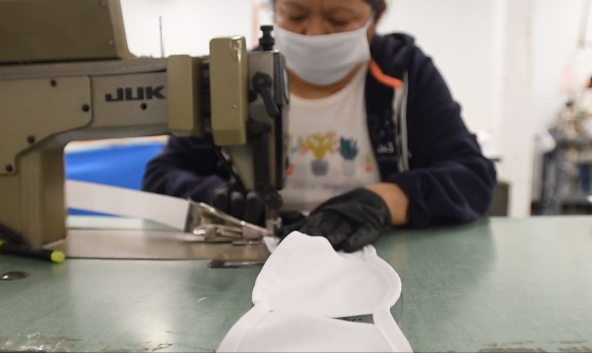
So heeding the calls of state and federal officials, LBU has hastily switched to more precious merchandise. Repurposed in a matter of days, the factory is now churning out 100,000 cloth face masks and gowns a week, items in desperately short supply for health care workers fighting the outbreak.
“We were very busy before this, but once the coronavirus hit here, everything just stopped,” owner Jeffrey Mayer said during a tour on Wednesday. “But we were able to repurpose quickly. I didn’t have to lay off my workers, and we’re proud to be making protective gear that hospitals, nursing homes and other medical workers will need.”
Nationwide, hospitals dealing with the outbreak face a severe shortage of masks, gloves and other “personal protective equipment” needed to keep medical staff safe. “We are in desperate need of more PPE,” Gov. Phil Murphy said Sunday, as he repeated a plea for more equipment from a federal stockpile.
LBU’s white, woven masks won’t replace the most in-demand N95 masks, the type that filter out 95% of airborne particles. But they’re still useful for local nursing homes, doctor’s offices and support staff in hospitals and can help relieve the demand those workers have put on the N95 stock, Mayer said.
The quick switch at LBU caught the attention of Paterson Mayor Andre Sayegh, who on Wednesday paid a visit to Mayer and his 100 workers with the factory in full throttle. Each mask is made by hand, so there was little time for celebration, and the workers spent most of the time hunched over sewing machines or cutting fabric.
Sayegh echoed President Donald Trump’s recent assertion that America is “at war” with the coronavirus. Paterson manufacturing once played a big role in World War II, cranking out military hardware for planes, tanks and artillery, he noted.
“We helped to win one war, and we’ll do it again,” Sayegh said.
A worker holds up a line of masks at LBU Inc., in Paterson, NJ on Wednesday March 25, 2020. Until a week ago, LBU Inc., was manufacturing backpacks and cosmetic supply cases. Now it’s churning out 100,000 protective masks a week, with plans to double that capacity by next week. (Photo: Mitsu Yasukawa/ Northjersey.com)
EnviroPolitics Blog is working to keep you informed about all aspects of the coronavirus — the status of confirmed cases, disease spread, death toll–and also how Americans are coping. Like this story, for instance. If you like what we are doing, Click to receive free EP Blog updates and please tell your friends.
State officials Friday announced nearly 2,000 new cases of the coronavirus and 27 new deaths in New Jersey, boosting the statewide total to at least 8,825 known cases — including at least 108 deaths — as the state continues its efforts to slow the spread of the fast-moving virus.
“We mourn with these families and indeed with our entire state every precious life that has been lost,” Gov. Phil Murphy said at the Trenton War Memorial during his daily coronavirus media briefing. “We can’t bring them back. That is as stark a reality as we have to face.”
New Jersey, which has about 9 million residents, ranks second in the United States in total coronavirus cases, after the neighboring state of New York.
Officials say they expect the number of positive cases to keep rising as testing expands in New Jersey. They say the peak of infections may be three weeks away, but the actual number of cases is likely even higher than the numbers announced Friday, because there’s been a testing lag as long as seven days.
That’s before Murphy issued his most dramatic social-distancing restrictions on residents, including ordering them to stay at home and ordering non-essential businesses closed.
At Friday’s coronavirus briefing, the governor lashed out at people who are getting tested without showing symptoms.
Murphy said it is “useless” and “unnecessary” to test people who are asymptomatic, saying it would “not provide us with the critical data we need to get out in front and stay out in front. We need to know we’re testing the right people and not wasting tests.”
New Jersey’s state laboratory has run 28,043 coronavirus tests since the outbreak started, with 8,296 positive tests — a positive rate of 33.4%, said state Health Commissioner Judith Persichilli.
Persichilli said she may have numbers by Monday on how many New Jerseyans with the virus have recovered.
“You have to make an assumption that absent the deaths, everyone else is recovering or on the road to recovery,” she said. She noted that 1,080 residents who have tested positive were hospitalized as of late this week, though many more cases are under investigation.
Officials also announced Friday that the state-run testing sites at Bergen Community College in Paramus and PNC Bank Arts Center in Holmdel will go to a new schedule starting Saturday.
On Saturday, both sites will only test health-care workers and first-responders. After that, the sites will run on alternating days for people across the state showing symptoms.
On Sunday, only the Paramus center will be open. On Monday, only the Holmdel center will be open. They each will administer 500 tests a day.
Murphy pumping $140M to health care industry to ramp up COVID-19 efforts
By Daniel J. Munoz, NJBIZ March 27, 2020 2:39 pm
Gov. Phil Murphy said he’ll pump $140 million into the state’s health care industry in a bid to help ramp up its ability to conduct COVID-19 testing and help treat a potential surge of patients.
“We must ensure their viability to meet the challenge,” Murphy said at daily press conference on the outbreak in Trenton on Friday.
This comes as the total count of positive diagnosis for COVID-19 in New Jersey reaches 8,825, with a death toll of 108 people.
Hospitals and health care providers have become dangerously low on N95 masks, beds, facemasks and most importantly, ventilators.
Businesses and all non-hospital health care facilities are being ordered by Murphy to hand over a list of any such equipment they possess.
The COVID-19 testing centers at Bergen Community College in Paramus and at PNC Bank Arts Center in Holmdel – run by the state government and Federal Emergency Management Agency – have frequently reached capacity less than an hour after opening.
Murphy said Thursday he would expand BCC’s daily test capacity from 350 a day to 500 a day.
In response to a widely anticipated patient surge, the Murphy administration and U.S. Army Corps of Engineers are bringing two decommissioned hospitals back online, one in Woodbury and another in Plainfield.By: Daniel J. Munoz
March 27, 2020 2:39 pm
Gov. Phil Murphy said he’ll pump $140 million into the state’s health care industry in a bid to help ramp up its ability to conduct COVID-19 testing and help treat a potential surge of patients.
“We must ensure their viability to meet the challenge,” Murphy said at daily press conference on the outbreak in Trenton on Friday.
This comes as the total count of positive diagnosis for COVID-19 in New Jersey reaches 8,825, with a death toll of 108 people.
Hospitals and health care providers have become dangerously low on N95 masks, beds, facemasks and most importantly, ventilators.
Businesses and all non-hospital health care facilities are being ordered by Murphy to hand over a list of any such equipment they possess.
The COVID-19 testing centers at Bergen Community College in Paramus and at PNC Bank Arts Center in Holmdel – run by the state government and Federal Emergency Management Agency – have frequently reached capacity less than an hour after opening.
Murphy said Thursday he would expand BCC’s daily test capacity from 350 a day to 500 a day.
In response to a widely anticipated patient surge, the Murphy administration and U.S. Army Corps of Engineers are bringing two decommissioned hospitals back online, one in Woodbury and another in Plainfield.
EnviroPolitics Blog is working to keep you informed about all aspects of the coronavirus — the status of confirmed cases, disease spread, death toll–and also how Americans are coping. Like this story, for instance. If you like what we are doing, Click to receive free EP Blog updates and please tell your friends.
Former State Sen. Francis J. McManimon, an enormously affable, cigar-chomping Mercer County Democrat who served in the New Jersey Legislature for 20 years, passed away today. He was 93.
McManimon served as superintendent of the Hamilton Township Department of Parks and Recreation from 1959 to 1989.
He made his first bid for public office in 1967, seeking a State Assembly seat in a newly-drawn Mercer County district.
In what turned out to be a Republican year – it was the sixth year of Democrat Richard J. Hughes’ governorship – McManimon lost to Republican John Selecky, the mayor of West Windsor, by 2,118 votes.
The top vote-getter in that race was Republican William Schluter, a Pennington township committeeman. McManimon’s running mate, Lloyd Carver, a Lawrence Councilman and the dean of admissions at Trenton Junior College, ran 622 votes behind him.
Lines were redrawn again in 1971 to create a Hamilton-Trenton legislative district.
Francis J. McManimon (D-Hamilton) as a State Assemblyman from Mercer County in 1976. Photo from the David Wildstein Collection.
The retirement of five-term State Sen. Sido Ridolfi, a former Senate President, opened a State Senate seat for Assemblyman Joseph Merlino (D-Trenton). McManimon, a close political ally of former State Sen. and Mercer Democratic chairman Dick Coffee, ran for Merlino’s Assembly seat.
McManimon was the top vote-getter, running 4,629 votes ahead of his running mate, four-term Assemblyman S. Howard Woodson (D-Trenton). One of the Republicans was Jack Rafferty, a 33-year-old Hamilton Township councilman who would go on to serve 24 years as mayor.
Woodson defeated Rafferty by 2,838 votes, with Republican Peter Rossi finishing 2,732 votes behind Rafferty. McManimon’s plurality over Rafferty was 7,467 and 10,199 over Rossi.
His niece, Jane, married the son of Gov. William T. Cahill in 1972.
In the 1973 Watergate landslide that propelled Democrats into a 66-14 majority in the New Jersey Assembly, McManimon won re-election by 19,528 votes over Republican Harry Dearden. He finished 5,122 votes ahead of Woodson, who became the first African American Assembly Speaker in state history.
Former Hamilton mayor Albert DeMartin decided to run off the line for Assembly in the 1975 Democratic primary, giving Woodson, the sitting Speaker, and McManimon a real primary challenge.
DeMartin made an issue of Woodson’s interest in leaving the legislature to join Gov. Brendan Byrne’s cabinet as president of the New Jersey Civil Service Commission.
McManimon was again the top vote-getter with 17,546 votes. Woodson defeated DeMartin by 2,185 votes, 14,021 to 11,836. In a primary that attracted a relatively heavy 35% turnout, DeMartin won Hamilton by over 2,000 votes, but Woodson doubled that plurality in Trenton.
The general election that year was a breeze. McManimon ran 4,277 votes ahead of Woodson, and 16,189 ahead of Republican Jay Destribats. The other Republican, Richard Harrison, ran 16,321 votes behind McManimon.
Woodson wound up resigning in 1976 to take the Civil Service Commission post. A special election that year for his Assembly seat was won by Helen Chiarello Szabo, the vice chair of the Mercer County Democratic Committee. She defeated Republican Carmen Armenti, the former mayor of Trenton, by nearly 7,000 votes.
McManimon went on to massive re-election victories for his State Assembly seat in the next two elections, exceeding 2-1 victories both times.
He outpolled Republican David Wriggins by 22,682 votes in 1977, and by 12,173 votes against Republican Michael Angarone in 1979. His 1979 win was with a new running mate, Gerald Stockman, who won a 1978 special election when Szabo stepped down to become Mercer County Superintendent of Elections.
Redistricting in 1981 separated Hamilton and Trenton into separate legislative districts.
McManimon ran in the new 14th district, which included parts of Middlesex and Somerset counties. Stockman won the 15th district Senate seat that was vacated when Merlino, the Senate President, ran for governor.
He defeated Republican Thomas Colitsas, an accountant from West Windsor, by 8,446 votes, 58%-42%.
The Assembly race in the new 14th was much closer: four-term incumbent Joseph Patero (D-Manville) ran with Joseph Bocchini, Jr., a 37-year-old attorney from Hamilton. Patero ran 336 votes ahead of Bocchini, who defeated Republican Paul Kramer, the Hamilton Township Improvement Authority chairman, by just 660 votes.
When 29-year-old freshman Republican Rep. Christopher Smith (R-Hamilton) sought re-election to a second term in 1982, the Democrat that frightened him the most was McManimon. Merlino ran instead and lost.
With two popular GOP incumbents up for re-election – Rafferty as mayor and Mercer County Executive Bill Mathesius, Republicans believed they could make a play for the 14th in 1983.
They recruited former Franklin mayor Charles B.W. Durand to take on McManimon, with Hamilton councilman Donald Tamutsas and Colitsas running for Assembly.
McManimon crushed Durand by 27 percentage points, a 12,928-vote margin (64%-37%).
Spared having to run in 1985, when Republican Gov. Thomas Kean won a landslide re-election, McManimon watched Rafferty beat Patero by 1,253 votes. Bocchini ran 516 votes ahead of Rafferty, and 4,287 ahead of Colitsas.
Rafferty’s unimpressive win meant that he couldn’t frighten McManimon out of the 1987 Senate race. Indeed, internal Republican polling that year showed that if Rafferty attempted to run for re-election as mayor and jeep his Assembly seat, he could lose both.
Instead, Rafferty left the legislature after one term and refocused on his local post.
A sign designating the New Jersey State Senator Francis J. McManimon Highway on I-195 in Mercer County. Photo courtesy of Facebook.
McManimon faced former South Brunswick GOP municipal chairman Michael Richmond and beat him by 13,651 votes, 64%-36%.
Democrats won both Assembly seats: with Bocchini giving up his post to run for county executive, Democrats nominated Patero and Mercer County Freeholder Anthony “Skip” Cimino in a primary against Janice Mironov, the East Windsor Democratic municipal chair. Patero and Cimino easily won the general election against Hamilton’s Dave Kenny and WCTC radio personality Walt Sodie.
McManimon’s political career ended abruptly in 1991 when his support for Democratic Gov. Jim Florio’s $2.8 billion tax increase cost him his Senate seat.
His district had been redrawn to become more favorable to Republicans. McManimon lost Franklin Township and now had Hamilton, East Windsor, Hightstown and Washington (now Robbinsville) in Mercer County and Cranbury, Helmetta, Jamesburg, Monroe, Plainsboro and South Brunswick in Middlesex.
This is the most current video for New CDC (Center for Disease Control) data, safe takeout food practices, and an updated practice for safe grocery shopping/handling.
You may already be practicing many of these safety tips to protect yourself from the coronavirus, but you may find a few that will surprise you. Stay healthy.