New Jersey’s total coronavirus cases rose to at least 4,402 with 62 deaths as officials announced another 736 new cases on Wednesday during an afternoon briefing on the expanding outbreak.
“These numbers are sobering, but not surprising to us,” Gov. Phil Murphy said. “We’ve been one of the most aggressive testing states in America.”
Details on the 18 new deaths were not immediately available. Murphy said more cases are expected and the state continues to work to expand hospital capacity. New Jersey has the second highest number of coronavirus cases after New York.
“We must be ready for the time when the surge comes,” Murphy said. “We have known that we will need to increase hospital capacity. We are in this fight to save lives.”
A county-by-county breakdown on the new cases was not immediately provided.
In an effort to slow the spread of the virus, Murphy has closed all schools in the state, ordered people to stay at home except for necessary travel, banned social gatherings, and ordered non-essential retail businesses to close until further notice. Officials have promised to prosecute those who violate the orders.
There are now government-run drive-thru coronavirus testing centers in Paramus and Holmdel, as well as a number of sites run by county agencies, hospitals and private companies. Both state-run testing sites closed early Tuesday after hitting testing capacity.
Meanwhile, officials announced Tuesday that four new pop-pop field hospitals are on their way from the federal government to help deal with the surging cases. They will be located in Secaucus, Edison, and Atlantic City, with a fourth location to be determined.
By ANDREW WAGAMAN THE MORNING CALL |MAR 23, 2020 | 8:55 PM
Nat Hyman appears before Allentown City Council in October 2018.(APRIL GAMIZ / THE MORNING CALL)
Allentown (Pa) developer Nat Hyman apologized Monday for a letter his property management company sent to tenants amid the COVID-19 pandemic threatening to evict those who didn’t pay rent on time.
The Hyman Properties letter, which provoked a furor on social media, began by acknowledging that “these are difficult times,” and that many tenants in the last few weeks “may have lost your jobs and/or be on unemployment.”
“Despite these circumstances, you are required to pay your rent on time,” the letter continued. “While this may sound like we are being uncaring, please keep in mind that all of our expenses, including bank mortgages, taxes, insurance, etc. continue to be due and payable on time. Our policies to enforce the payment of rent remain exactly as they were before.”
Tenants who pay rent April 2-5 would be charged a $50 late fee, the letter stated. The company threatened to file evictions and disconnect cable for tenants who did not pay rent in full by April 6.
“If you are not able to pay your rent in full, please contact the office and we will arrange a date for you to move out of your apartment,” the letter stated.
The Pennsylvania Supreme Court ruled last week that no one can be evicted, ejected or otherwise displaced from a home because of failure to make rent or mortgage payments during a court shutdown, which will extend through at least April 3.
Reached Monday evening, Hyman apologized for the letter, which he said was written by one of his managers and was “not worded as well as it could have been.”
Hyman assured that no tenant will be evicted during the pandemic, and that the intent was to “remind people that rent isn’t a negotiable bill.” All too often, he lamented, tenants stop paying rent before they stop paying cable and utility bills.
Later Monday, Hyman issued a written apology via text, calling the letter “totally insensitive.”
“I’ve spent all week trying to negotiate with the banks, but they have shown very little movement,” he wrote. “I asked one of my managers to make sure that we get in as much rent as possible to pay the banks. In writing this letter, the manager should have been more sensitive, but I have to own this because I am the boss.”
Hyman reiterated that he will not try to evict any tenants during this crisis, and that he was wrong for allowing the letter to go out.
Ortega shared emails in which he asked Hyman directly if they could wait to pay rent until they get their first unemployment checks. Hyman didn’t budge.
“Go file tomorrow and you should have no problem having your money in time to pay the rent,” he wrote.
Ortega said he was hopeful the backlash on social media would persuade Hyman to work with tenants.
“People don’t deserve to be bullied, especially not right now,” he said.
Hyman has 15 properties in Allentown, many of which are older industrial buildings he’s redeveloped into middle-income and affordable lofts. He’s also the CEO of Landau Jewelers, a costume jewelry company.
Hyman ran for mayor in 2017 and has said he’s giving a 2021 run “serious consideration.”
Morning Call reporter Andrew Wagaman can be reached at 610-820-6764 or awagaman@mcall.com.
EnviroPolitics Blog is working to keep you informed about all aspects of the coronavirus — the status of confirmed cases, disease spread, death toll–and also how Americans are coping. Like this story, for instance. If you like what we are doing, Click to receive free EP Blog updates. Please tell your friends.
Stocks posted one of their best days ever on Tuesday, a sign of investor belief that Congress has no alternative than to pass a $2 trillion rescue of a U.S. economy that is on life support.
The massive stimulus is designed to be a lifeline to Americans and their employers until the coronavirus is brought under control and the country returns to some semblance of normalcy. The Federal Reserve signaled the gravity of the situation Monday when, in an unprecedented move, the central bank said it would spend whatever it takes to preserve the U.S. financial system.
Markets starved for good news shot upward Tuesday on faith that the stimulus was almost a given. The Dow Jones industrial average surged more than 2,000 points, or 11 percent, and pulled itself back above the 20,000 mark. The Dow finished the day at 20,704, its best day since 1933 and fourth best ever. The Standard & Poor’s 500 Index jumped 9 percent to 2,446. That is the broad market’s best day since 2008. The tech-heavy Nasdaq composite jumped more than 8.1 percent.
“It’s too early to be blindly optimistic, but the size and pace of the policy responses to this crisis are very encouraging,” said Lauren Goodwin, economist and portfolio strategist at New York Life Investments. “This is not a time to be heroes calling a market bottom, but we are keeping a close eyes on indications of light at the end of the tunnel.”
All 11 S&P sectors were positive, led by a beaten-down energy sector that had lost half of its value this year due to a collapse in oil prices. Energy posted a nearly16 percent gain, led by oil giants such as Chevron. Several oil companies, including BP, saw shares spike after companies said they would tighten their belts in the wake of the rock-bottom oil prices.
Boeing, Home Depot, American Express, JP Morgan and Walt Disney — most of whom have been savaged by the coronavirus restrictions — had big days on the Dow as optimism over the stimulus took hold. American Airlines led the airlines sector with a 35 percent jump. The airline industry is anticipating a massive aid package from the stimulus.
Some of the buying came on the heels of slim-but-positive news that parts of the world were making strides against the coronavirus.
“The decline in the growth of virus cases in Italy is very encouraging because it gives the U.S. a line of sight into what the other side of this crisis might look like,” Goodwin said.
The eventual exit from the various lockdowns in the U.S. and across the world is starting to enter the national discussion. Most health experts have said it is going to take several weeks or even months of people staying home to significantly contain the spread of the disease.
Dr. Anthony S. Fauci, director of the National Institute of Allergy and Infectious Diseases, said in an NBC interview last week that “I cannot see that all of a sudden, next week or two weeks from now, it is going to be over. I don’t think there is a chance of that.”
Analysts, economists and corporate leaders are saying that even the beginnings of a plan would help. President Trump said Tuesday that he would like to see the economy reopened by Easter.
“Beijing announced that its lockdown on Hubei province will be lifted on April 8,” said David Rosenberg of Rosenberg Research. “The case count there has plunged significantly. Korea is in such good shape it is now exporting masks. There seems to be a light at the end of the dark tunnel in Italy too. And here at home, President Trump is talking openly about establishing a balance between health and wealth.”
The turnaround follows a volatile session Monday that sent markets plunging after the Senate twice failed to advance the coronavirus stimulus bill. Now, striking positive and optimistic tones, legislators are hashing out remaining discussions so that a vote may come to pass by Tuesday night.
If you liked this post you’ll love our daily newsletter, EnviroPolitics.It’s packed with the latest news, commentary and legislative updates from New Jersey, Pennsylvania, New York, Delaware…and beyond. Don’t take our word for it, try it free for an entire month. No obligation.
Gibbons attorneys’ guidance to clients and friends
David J. Freeman and Jordan M. Asch 3/24/2020
The pandemic caused by the novel coronavirus, or COVID-19, has slowed business—and activity in general in many areas of the United States—to a crawl. New York State is one of the places hit hardest by this pandemic. Indeed, at the time of this writing, New York has the highest number of confirmed COVID-19 cases in the country. Unfortunately, the spread of the virus shows no signs of relenting.
Nonetheless, manufacturing, the real estate industry, and other regulated businesses continue to face environmental reporting obligations, regulatory deadlines, and potential penalties for non-compliance. Businesses and other property owners are dealing with remediation deadlines, as well as operation and maintenance obligations of environmental controls.
Businesses are also rightly concerned about reporting requirements under various permits, including under such federal permitting programs as the Resource Conservation and Recovery Act and others. Meeting these obligations has become significantly complicated by the pandemic and the ancillary issues it has brought on, such as the illness of key personnel, inaccessible facilities, and other impediments.
On March 20, 2020, Governor Andrew Cuomo signed Executive Order 202.8, which directs that all “non-essential” businesses implement remote work policies for 100 percent of their respective workforces, effective March 22 through April 19, 2020. The Executive Order further states that businesses that provide “essential services or functions whether to an essential business or a non-essential business … may operate at the level necessary to… Click Here to View Full Blog Post
New Jersey now has at least 3,675 coronavirus cases with 44 deaths throughout the state as officials announced Tuesday an increase of 846 positive tests. It marks the largest single-day increase in deaths since the outbreak began.
“This is a sobering report,” Gov. Phil Murphy said during an afternoon update, noting New Jersey ranks second in the nation for cases. “This is by far our largest single-day report of new deaths.”
The new deaths include cases in Bergen (5), Morris (3), Essex (3), Hudson (2) and one each in Monmouth, Camden, Passaic and Union counties, said Judy Persichilli, commissioner of the state Department of Health.
Persichilli revealed for the first time the testing rate for negatives from seven labs reporting to the state. Of the 12,000 tests, 3,600 have been positive, for 27%.
“That’s a really important rate,” Persichilli said. “That will help us in our predictive modeling.”
If you liked this post you’ll love our daily newsletter, EnviroPolitics.It’s packed with the latest news, commentary and legislative updates from New Jersey, Pennsylvania, New York, Delaware…and beyond. Don’t take our word for it, try it free for an entire month. No obligation.
It’s happened at schools, stores and offices, warehouses and city halls: Someone who might be infected with the coronavirus passes through.
The building often closes. Then come the calming words: deep cleaning.
The idea is that a thorough cleaning and disinfecting could help prevent people from getting sick. The virus is spread mainly through person-to-person contact, though people can also catch it from droplets exhaled when an infected person coughs or sneezes. Those droplets can stick to surfaces, and the virus can survive for hours or days, according to health officials.
A deep clean is supposed to kill it.
The term sounds official, but it isn’t. It has no standardized definition.
One company says the right approach is using a mechanical sprayer or thermal fogger that mists disinfectant into the air, then wiping all surfaces. Another swears by taking everything out of each room, disinfecting it all and then putting it back.
Some have warned against trusting competitors who, they say, only wipe down places that get touched a lot, like doorknobs or handles, or don’t require workers to wear heavy-duty protective gear.
“Deep cleaning is really just a term they use to make the public feel warm and fuzzy,” said Erick McCallum, founder of Texas-based the Cleaning Guys, which handled ebola cleanup during a 2014 outbreak in Dallas.
Health experts say it’s enough to clean frequently with soap, alcohol or bleach-based products. “You don’t need any unusual procedures or cleaning agents,” says Dr. Timothy Brewer, professor of medicine and epidemiology at UCLA.
That hasn’t stopped the onslaught of calls for deep cleaning.
The Servpro Extreme Response Team typically handles calls related to water or fire damage repairs in California, Nevada and Arizona. Now it gets about 100 inquiries a week on coronavirus cleanings and goes on four related calls a day.
Aftermath Services, based in Illinois, generally cleans up crime scenes and biohazards. The flood of calls about coronavirus-related cleanings threatened to overwhelm it, so the company pulled people from its finance department to help answer the phones.
“It’s all hands on deck,” said Casey Decker, Aftermath’s vice president of field services.
The calls haven’t slowed even as more companies require employees to work from home.
As restaurants, bars, gyms and other businesses close their doors, some professional cleaning firms expect demand will ramp up. Buildings can be thoroughly disinfected when there are no customers or employees inside.
“It’s very possible that almost everything will end up shutting down,” said Vanessa Cabrera, director of client services at All Clean Inc. MD, which cleans commercial and industrial properties on the East Coast. “When that’s the case, then we’ll have a lot more people calling and more jobs to do…. They’re going to want a deep clean of their facility.”
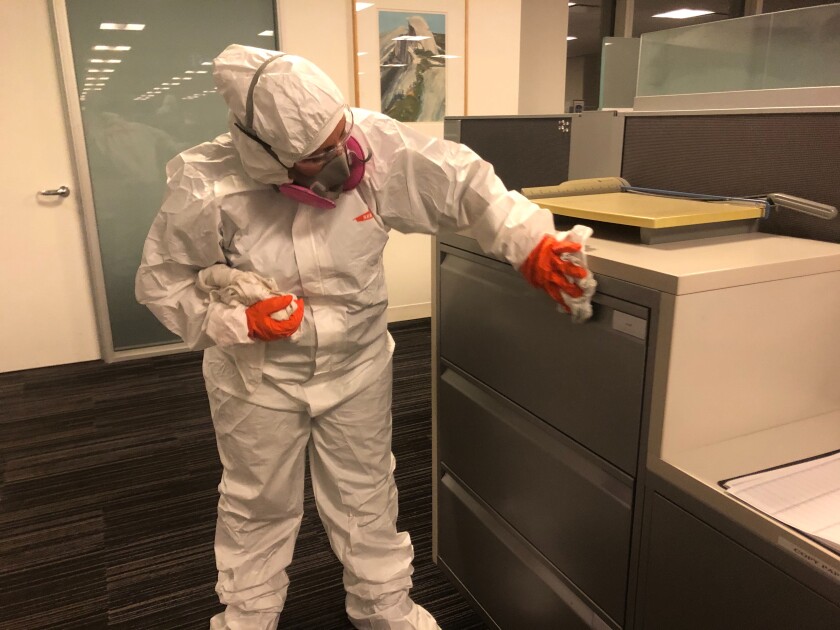
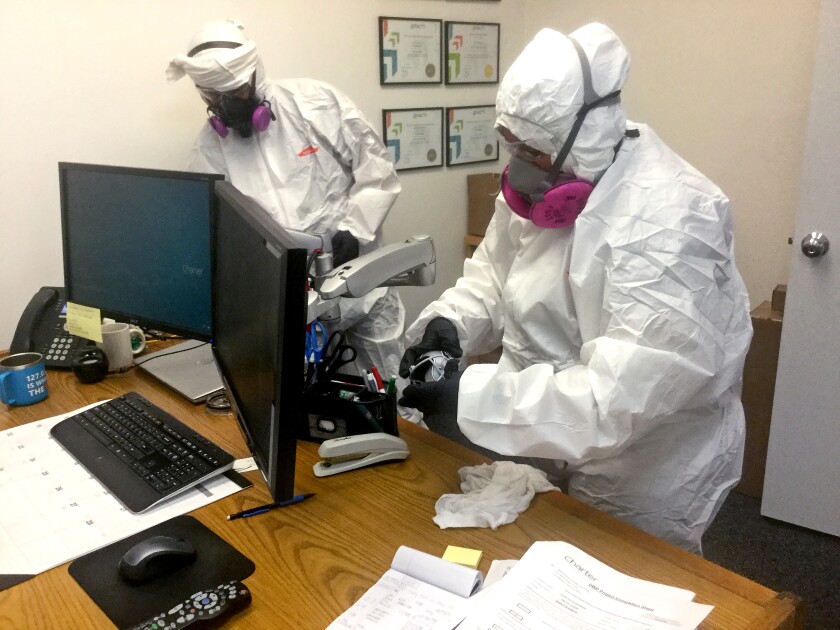
Workers, at times, might wear full-face respirators, one-piece protective suits, two pairs of gloves and booties, particularly if they’re at a place that had confirmed cases of the coronavirus. Brewer, the UCLA professor, said booties and respirators aren’t necessary. A face shield or surgical mask will do.
“When you’re going in and you’re 100% encapsulated, you feel like you can go up against anything,” Decker said of wearing a protective suit.
Cabrera’s mother, Adriana Corona, a manager at All Clean Inc. MD, is often in the field with workers and said they now wear more protective gear than they would during their normal course of work. She’s also done online training on how to do deep cleanings.
She said she hasn’t been afraid of becoming infected while on jobs. “We just clean and disinfect everything,” Corona said.
Clean Harbors, a Massachusetts company that specializes in hazardous waste removal, designates three different zones for its employees when they arrive at a decontamination job.
Workers suit up in the “warm zone” before entering the “hot zone,” where decontamination occurs. After the job is done, one person who did not enter the building helps the others take off their suits back in the warm zone before they can enter the “cold zone,” or clean area.
The protective gear is put into a drum and incinerated. The respirators are rinsed with bleach, soap and water before they’re used again.
In some ways, there’s precedent for the kind of thorough disinfection that cleaning companies are now doing. Some have compared the work to sewage and mold removal or to cleanups of crime scenes and meth labs. Some even have experience with other viruses, such as MRSA or norovirus.
“We’re used to this,” said Chuck Geer, senior vice president of field services at Clean Harbors. “It’s not uncommon at any point in time for our teams to respond to something like this.”
His company, he said, helped clean up ground zero in New York after the Sept. 11, 2001, attacks; decontaminated oily boats after the Deepwater Horizon oil rig explosion in the Gulf of Mexico; and also has experience with anthrax.
In each of these cases, “you normally know exactly what you’re cleaning up,” Geer said. But with the coronavirus, “you can’t see it,” he said. “When you go into a room or a building, you have to disinfect everything.”
Art Dickerson, president of restoration firm Paul Davis Commercial, compared coronavirus cleanings to sewage or mold cleanups. Workers use the same types of disinfectants.
But these recent jobs are on “a wider scale,” he said. “We only get so many mold jobs or sewage jobs a year.”
The demand for coronavirus cleanings has shifted Aftermath’s primary business from crime-scene cleanups to “virucidal disinfection,” a term a company official acknowledged does not roll off the tongue.
Aftermath now gets about 500 to 600 calls per day nationwide, up from its usual 50 to 75 calls. Calls have been coming in from all parts of the country, though California is a hot spot, said Vikas Chopra, director of marketing.
Prices vary depending on the size of the place to be cleaned and the types of services desired. For a 800- to 1,000-square-foot building, All Clean Inc. MD charges between $800 and $1,200. Servpro charges 50 cents to $2.50 per square foot.
But it’s important not to go overboard with the cleaning.
Using antimicrobial solutions could inadvertently lead to antimicrobial resistance that can lead to super bugs, said Erica Hartmann, assistant professor of civil and environmental engineering at Northwestern University, who specializes in environmental microbiology.
“Yes, wash your hands. Yes, you can disinfect high-touch surfaces, but within reason,” she said. “We’re not aiming to sterilize everything around us.”
Times staff writer Molly Hennessy-Fiske contributed to this report.
If you liked this post you’ll love our daily newsletter, EnviroPolitics.It’s packed with the latest news, commentary and legislative updates from New Jersey, Pennsylvania, New York, Delaware…and beyond. Don’t take our word for it, try it free for an entire month. No obligation.